

Amazon affiliate links - we earn a commission.Affiliate disclosure

Buying guide · 13 min read · Updated 2026-11-07

Best 240V Solar Generators (2026)

Five solar generators that can supply 120V and 240V split-phase power, compared on inverter size, storage, solar input and expansion for home and RV backup.

James MillerBy James MillerLead Machine Editor5 machines comparedSpec-sheet verified
Best 240V Solar Generators

At a glance

Our top picks

Side by side

Spec comparison

A 240 volt solar generator is a different kind of machine from the camping power bank. Its inverter can supply the split-phase power that well pumps, electric dryers, welders and some air conditioners need, and it can be wired into a home through a transfer switch.

That capability comes with real cost, weight and setup rules. The questions that matter are how the 240 volt side is actually produced, how much energy sits behind it and whether a licensed electrician needs to be involved. Treat the figures below as listing claims and read the manual before you wire anything to a house panel.

Before you buy

6 Criteria to Look For Before Buying a 240V Solar Generator

  1. 01

    How 240V is produced

    Some stations make 240V natively from one split-phase inverter, such as the PECRON F5000LFP and OSCAL PowerMax 6000. Others, like the BLUETTI Apex 300, switch modes through an app, and the Jackery reaches 7200W by pairing two units. Ask whether you get both legs from one box, because pairing two units doubles weight and cost. Ask the seller for the exact outlet types, because a 240V plug on a station may be a 14-50 or an L14-30 receptacle, and your appliance cord must match.

  2. 02

    Inverter size versus storage

    The PECRON offers 7200W and 5120Wh while the OUKITEL pairs 5120Wh with 3600W. A well pump and a dryer each pull around 3000 to 5000 watts at start. Big storage with a small inverter will last long but cannot start heavy loads, so buy the inverter for your biggest load and the battery for your longest night. For example, the OSCAL at 3600Wh and 6000W would drain in about half an hour at full output, which tells you what the inverter number really means.

  3. 03

    Solar input capacity

    The PECRON accepts up to 6400W of solar over two ports and the OSCAL 2400W. A 5120Wh pack needs 1500 to 2000 watts of panels to refill in one day. Smaller solar input stretches refill over several days, which is a risk during storm weather. Cloudy weather can cut panel output to a fraction, so allow for a charging plan that also accepts wall or generator power.

  4. 04

    Expansion and modularity

    The BLUETTI Apex 300 takes B300K and B500K batteries, and the Jackery reaches 21kWh. Expansion lets you start with one battery and add before storm season. Confirm expansion batteries are on sale now, and price the full system, not only the base box.

  5. 05

    Electrical safety and installation

    Connecting a power station to household wiring requires a transfer switch and often a licensed electrician. Backfeeding a panel through a dryer outlet is dangerous and illegal in many places. The Jackery lists plug-and-play with a manual transfer switch, which is the clean route.

  6. 06

    Weight and portability

    A 5 kWh LiFePO4 pack is heavy even when marketed as lightweight. OUKITEL claims 25 kg less than a conventional 5 kWh unit, yet it is still a two-person job. If you will move it, budget for wheels or place it permanently. Moving a 5 kWh unit up steps is a hazard, so plan its resting place before the delivery date.

Detailed reviews

The 5 best 240v solar generators, explained

01
PECRON F5000LFP 5120Wh 7200W Dual Voltage Station
7200W AC5120Wh LiFePO4120V/240V6400W solar in
Check price on Amazon
Best for: Home backup buyers who want one box with big storage and 240V.

The F5000LFP combines a 7200 watt inverter with 5120 watt-hours of LiFePO4 storage, and it lists dual-voltage 120V and 240V output. That inverter size is about double the next class down, which is what lets it run a well pump and a few household loads together.

It lists two 20 amp outlets and one 30 amp outlet with 0 millisecond online UPS behavior, and two solar ports at 25 amps each for a stated 6400 watts of total solar input. That solar ceiling is the highest in this group, so with enough panels it refills a 5 kWh pack in a day.

The tradeoff is weight and price, as with any 5 kWh station, and the brand's long-term support is a question. Compared with the BLUETTI Apex 300 at 2765Wh, it holds nearly double the energy. It is the right choice for a home backup where the 240V circuits matter more than portability.

What works

  • 7200W output with 120V and 240V dual voltage
  • 5120Wh LiFePO4 battery for long runtime
  • Up to 6400W of solar input across two ports
  • 0 ms online UPS outlets listed

Watch out for

  • Heavy and not a portable camping tool
  • Newer brand with an unproven support record

Spec sheet

AC output
7200W, 120V/240V dual voltage
Capacity
5120Wh LiFePO4
Solar input
6400W over 2 ports
UPS outlets
Two 20A and one 30A, 0 ms
Solar port current
25A per port
02
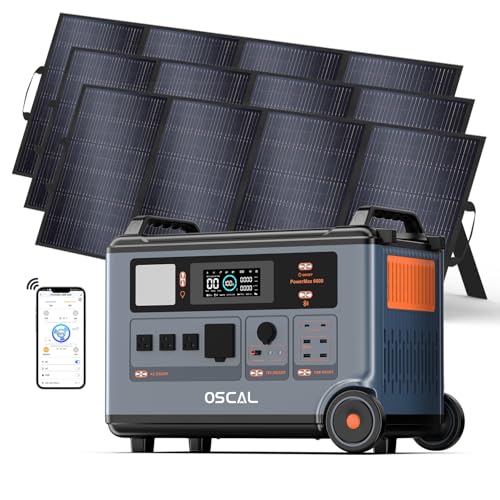
OSCAL PowerMax 6000 with 3x400W Solar Panels
6000W AC9000W surge3600Wh120V/240V split phase
Check price on Amazon
Best for: Buyers who want 240V power, fast recharging and a big panel kit.

The PowerMax 6000 is built around a 3600 watt-hour LiFePO4 pack and a 6000 watt inverter with a 9000 watt surge, and it lists split-phase 120V and 240V output. It uses a 2200 watt bi-directional inverter for charging, and a full refill in 1.44 hours is the fastest recharge claim in the group.

That speed uses 2200 watts from the wall and 2400 watts from solar together, so it only works with enough panels and a strong circuit. This kit includes three 400W panels, which makes it the only bundle here with a panel array large enough to use that input.

Compared with the PECRON, it stores 3600Wh against 5120Wh and runs 6000W against 7200W, a meaningful step down, but it asks less. It suits a homeowner who wants 240V power for a few hours at a time, with fast recovery between outages. Owners should also plan the panel mounting, since three 400W panels need roughly 20 square metres of open ground or roof.

What works

  • 6000W output with 9000W surge
  • Fast 1.44 hour full recharge claim
  • Includes three 400W panels in this kit
  • Split-phase 120V/240V output listed

Watch out for

  • 3600Wh is less storage than the PECRON
  • Fast charging needs a strong circuit and many panels

Spec sheet

AC output
6000W, 9000W surge
Capacity
3600Wh LiFePO4
Voltage
120V/240V split phase
AC charge
0 to 100% in 1.44 hours at 2200W
Solar input
2400W
03
BLUETTI Apex 300 2764.8Wh Modular Station
3840W AC7680W surge2765Wh LFPApp-switched 240V
Check price on Amazon
Best for: Buyers who want to start small and expand with a known brand.

The Apex 300 is the modular option. It starts at 2765 watt-hours with a 3840 watt inverter, and lets you add B300K or B500K batteries, an RV 12V DC hub and alternator chargers as needs grow. You switch between 120V and 240V through the app or the onboard controls.

That design matters for a staged build. You buy the energy you need now, such as one pack for an outage, and add batteries before storm season. Against the PECRON, you give up about 3400 watts of output and half the storage in the base box.

BLUETTI has a longer record than most rivals here and a clear accessory ecosystem, which reduces the risk of buying into a dead end. It suits a household that expects its needs to grow and wants established support behind the platform.

What works

  • Expandable with B300K or B500K batteries
  • 3840W output with 7680W surge
  • Switch between 120V and 240V by app or controls
  • Accessory range includes RV hub and alternator chargers

Watch out for

  • Lower base capacity at 2765Wh
  • Expansion batteries add significant cost

Spec sheet

AC output
3840W, 7680W surge
Capacity
2764.8Wh LFP
Voltage
120V and 240V, switch via app or controls
Expansion
B300K or B500K batteries
Accessories
Hub D1, Charger 1 and 2
04
OUKITEL P5000 Plus 5120Wh 120V/240V Kit
5120Wh3600W AC6000 cycles2x400W panels
Check price on Amazon
Best for: Buyers who want 5 kWh of storage and a panel kit with modest power needs.

OUKITEL pairs a 5120 watt-hour pack with a 3600 watt inverter and lists 120V and 240V output. It lists a wall charge in 2.8 hours at 1800 watts and a claim of 6000 cycles, with about 10 years of use, and it is described as 25 kg lighter and 39 percent smaller than a conventional 5 kWh unit.

The big capacity with a modest inverter makes it a runtime-first design, with 3600 watts being half the PECRON's 7200. It covers a fridge, a pump and lights for a full day, but it cannot start a heavy air conditioner and a dryer together. The kit includes two 400W panels, so solar refill is workable.

The cycle claim is a vendor figure, so treat it as marketing until warranty terms are confirmed. It suits someone who wants a lot of stored energy and 240V capability without the biggest inverter.

What works

  • 5120Wh battery gives long runtime
  • 120V and 240V output listed
  • Includes two 400W panels
  • Claims 6000 cycles of battery life

Watch out for

  • 3600W inverter is half the PECRON's
  • Cycle life is a vendor claim

Spec sheet

Capacity
5120Wh LiFePO4
AC output
3600W, 120V/240V
Wall charge
2.8 hours at 1800W
Cycle life
6000 cycles claimed
Kit
Includes two 400W panels
05
Jackery HomePower 3600 Plus 3584Wh Station
3600W AC7200W parallel3584Wh LFPExpands to 21kWh
Check price on Amazon
Best for: Homeowners who want a trusted brand and a home transfer switch path.

Jackery's HomePower 3600 Plus holds 3584 watt-hours in an LFP pack and outputs 3600 watts, with a stated 7200 watts when two units are paired. That parallel pairing is how the maker reaches higher-voltage loads, so confirm the 240V wiring accessory before you rely on it for a dryer or a well pump.

Its selling points are safety and integration. The cells use a ceramic membrane that the maker rates for 302 degrees Fahrenheit, and it plugs into a manual transfer switch for a home connection. Expansion to 21 kWh gives a growth path comparable to the BLUETTI.

Against the PECRON, it has half the inverter and 70 percent of the storage, but it comes with a brand that is easy to buy and easy to claim warranty on. It suits a homeowner who values clear support and a tidy, listed home integration.

What works

  • Expands to 21kWh for large backup
  • High-temperature ceramic membrane cell design
  • Plug-and-play with a manual transfer switch
  • 7200W when two units are paired

Watch out for

  • 240V output depends on pairing and accessories
  • 3600W single-unit inverter is below the larger rivals

Spec sheet

AC output
3600W, 7200W in parallel
Capacity
3584Wh LFP
Expansion
Up to 21kWh
Cell design
Ceramic membrane cells rated for 302 F
Home link
Plug-and-play with MTS

Spec sheet decoder

What the numbers on the box really mean

The specs manufacturers lead with, translated into what they tell you about real-world performance.

Split phase 120/240V

Two 120V legs that give 240V across them, as US homes use. It runs dryers, pumps and some air conditioners. Both legs share the inverter's total output, so a 7200W unit cannot give 7200W on each leg.

Watch forThe PECRON and OSCAL list dual or split-phase output natively, while others rely on app switching or pairing.

Rated and surge watts

Rated is continuous, surge is a brief startup allowance for motors.

Watch forThe OSCAL lists 6000W with 9000W surge, the BLUETTI 3840W with 7680W surge.

0 ms UPS

A listed instant switchover that keeps loads running when grid power fails.

Watch forOnly the PECRON lists 0 ms online UPS outlets in this lineup.

Solar input watts

The peak panel power the station can accept. It sets the fastest solar refill.

Watch forThe PECRON lists 6400W, the OSCAL 2400W.

Cycle life

The number of full charge cycles before capacity falls to a set fraction.

Watch forThe OUKITEL claims 6000 cycles, which is a vendor figure and should be checked against warranty terms.

Methodology

How We Evaluated These 240V Solar Generators

240V capability

We read whether 240V is produced natively, switched or paired. The PECRON and OSCAL scored highest for native dual voltage. Units that need pairing or accessories scored lower.

Inverter and surge

We compared continuous and surge ratings. The PECRON at 7200W and the OSCAL at 6000W with 9000W surge led. The OUKITEL at 3600W is the smallest in this group.

Storage and expansion

We scored base capacity and growth. The PECRON and OUKITEL at 5120Wh led base storage, and the BLUETTI and Jackery led expansion. Fixed units lost points for lack of growth. Expandable systems were not given credit unless the batteries are listed for sale.

Solar and charging speed

We read stated solar and AC input. The PECRON at 6400W and the OSCAL at 1.44 hours to full stand out. Slow solar input was scored lower.

Support and installation

We looked at brand history and listed home integration. Jackery and BLUETTI score highest, while newer labels score lower. Anything touching household wiring should involve an electrician.

Decision guide

How to Choose the Right 240V Solar Generators

By Primary Use

SituationPickWhy
Whole-home backup with heavy loadsPECRON F5000LFP7200W and 5120Wh in one box
Fast recovery between outagesOSCAL PowerMax 60001.44 hour full recharge claim
Build in stagesBLUETTI Apex 300Expands with B300K and B500K batteries
Long runtime, moderate loadsOUKITEL P5000 Plus5120Wh with a 3600W inverter
Brand support and transfer switchJackery HomePower 3600 PlusPlug-and-play with a manual transfer switch
Well pump and fridgePECRON F5000LFPHighest surge headroom here
RV with a 30 amp needBLUETTI Apex 300RV hub and alternator chargers available

By Budget

TierPickWhy
LowerOUKITEL P5000 PlusLarge battery with panels
Lower to middleOSCAL PowerMax 6000Big inverter and panel kit
MiddleJackery HomePower 3600 PlusBrand support
Middle to upperBLUETTI Apex 300Modular platform
UpperPECRON F5000LFPLargest inverter and battery
HighestAny unit plus expansion batteriesScaled system cost

Native 240V vs Paired Units

Native dual voltage

The PECRON and OSCAL list 120V and 240V split-phase output from a single box. You avoid a second unit and the wiring accessory, which simplifies installation.

Paired or switched

The Jackery reaches 7200W by pairing two units, and the BLUETTI switches voltage by app. These add flexibility and brand support, but they add cost or setup.

Simple installs favour the PECRON or OSCAL, and cautious buyers favour the Jackery or BLUETTI.

Storage Needs

PreferencePickWhy
Over 5 kWh in one boxPECRON F5000LFP5120Wh base
Over 5 kWh with a panel kitOUKITEL P5000 Plus5120Wh and two 400W panels
About 3.6 kWhOSCAL PowerMax 60003600Wh
About 3.5 kWhJackery HomePower 3600 Plus3584Wh
About 2.8 kWhBLUETTI Apex 3002765Wh, expandable
Up to 21 kWhJackery HomePower 3600 PlusMaximum listed expansion

For Well Pumps and Dryers Specifically

Look for

Check the locked-rotor or starting watts on the appliance label, not only running watts. A well pump can need 3 to 5 times running watts for a moment. Also confirm the unit is a true 240V source, not 120V with a step-up.

In this comparison

The PECRON F5000LFP at 7200W and the OSCAL PowerMax 6000 at 6000W with 9000W surge have the headroom. The OUKITEL at 3600W may trip.

When to Spend More

Spend more if

You want one unit to handle a whole circuit panel. The PECRON F5000LFP gives the largest inverter and storage, and the Jackery gives the clearest brand support.

Save if

You only need 240V for a pump and a few loads over a day or two. The OUKITEL P5000 Plus or OSCAL PowerMax 6000 cover that for less.

Ownership

Maintenance schedule

The upkeep that decides whether this machine lasts two seasons or ten.

TaskIntervalWhy it matters
Store at partial chargeWhen idle over a monthHalf charge lowers cell stress. LFP packs tolerate storage better than most but still prefer partial charge. Also avoid leaving it in a hot garage, since heat is the main enemy of battery life.
Cycle testEvery 3 monthsA discharge and recharge confirms capacity and resets the management system. It also reveals faults before an outage.
Inspect cables and connectorsEach seasonHigh-current connectors on solar and expansion ports can loosen or corrode. Reseat and clean them. Check the torque on any bolted terminals if the unit has them, because heat cycles loosen them.
Test the transfer switchTwice a yearA manual transfer switch should be exercised under supervision. A stuck switch is worse than none during an outage.
Keep vents and fans clearEvery useA 6000W inverter runs warm under load. Blocked airflow cuts output and wears fans.

FAQ

Frequently Asked Questions

Do I need an electrician to use 240V?

For plug-in appliances that match the outlet, no. To feed household circuits through a panel, yes, because a transfer switch or interlock is required for safety and code. Even a plug-in setup should use the correct 240V cord and a properly rated receptacle, and a permanent installation is worth the small cost of a professional hookup.

How long will 5120Wh run a house?

A modest essentials load of about 500 watts lasts roughly 8 to 9 hours after losses. Heavy loads like a dryer drain it in well under an hour. Add the losses from a hot inverter and a cold battery and the real number shrinks, so plan with a margin of at least 20 percent for any critical load.

Is split phase the same as 240V?

In US homes, yes. Two 120V legs 180 degrees apart give 240V across them, and 120V from each leg to neutral.

Can solar panels alone recharge it?

Yes, with enough panels. The PECRON accepts up to 6400W and the OSCAL 2400W, so a 1500W array can refill a 5kWh pack in a long sunny day. Panel voltage matters too, since high-voltage strings need a station whose input window accepts them, so match the panel string to the station before you buy.

Is LiFePO4 worth it here?

Definitely. These packs cycle often and LFP cells tolerate more cycles and heat. The OUKITEL claims 6000 cycles, though vendor claims should be checked.

Should I buy expansion batteries now?

Not unless you need the energy. Buy the base unit first and confirm that expansion batteries stay on sale, since proprietary connectors lock you into one brand. Price the complete system including the cables, the transfer switch and any wheels, because the box itself is only part of the bill.

Bottom line

The short version

Browse more 240v solar generatorson Amazon →
James Miller, Lead Machine Editor

About the author

James Miller

Lead Machine Editor, MachineFanatic

James Miller leads MachineFanatic's buying guides, turning spec sheets, manuals and owner feedback into clear verdicts on power tools, outdoor power equipment, shop machines and kitchen machines.

More from James →

Keep reading

Related guides