
Amazon affiliate links - we earn a commission.Affiliate disclosure

Buying guide · 13 min read · Updated 2026-11-09

Best Belt Sanders Under $100 (2026)

Five belt sanders at or under $100: handheld 3x21 models, a 2-in-1, a benchtop belt and disc sander and a detail file sander, compared on power and control.

James MillerBy James MillerLead Machine Editor5 machines comparedSpec-sheet verified
Best Belt Sanders Under $100

At a glance

Our top picks

Side by side

Spec comparison

A belt sander runs a loop of abrasive around two rollers, which removes wood far faster than any orbital sander and also makes it easy to gouge a surface if you pause for a second. The right machine depends on whether you flatten boards, shape edges or sharpen tools, and the shape of the tool matters as much as its power.

This guide explains what a modest budget buys in a belt sander, how belt size, speed and tracking decide the results, and why handheld, benchtop and detail machines are really different tools. The picks are listed above, with the reviews below. Listing prices move, and the cap reflects prices when this guide was updated.

Before you buy

6 Criteria to Look For Before Buying a Belt Sander Under $100

  1. 01

    Handheld, benchtop or detail

    These are three different tools. A handheld 3 by 21 sander flattens boards, a benchtop belt and disc sander shapes small parts, and a detail file sander reaches tight spots. The Triton, CRAFTSMAN and VEVOR are handheld, the WEN 6515T is benchtop and the WEN 6307 is detail. Buying the wrong type is the most common mistake. A good rule is to match the sander to the board: a 3 by 21 inch machine for a tabletop, a benchtop for a drawer front, and the file sander for a chair spindle.

  2. 02

    Amps and stock removal

    Amps decide how well the belt holds speed under pressure. The Triton has 10, and the CRAFTSMAN and VEVOR have 7. A sander that bogs under load slows work and glazes belts. For hardwood flattening, choose 8 amps or more. Weigh the amps against the weight, because a 10 amp sander is heavier and a tired arm pushes harder, which is how gouges happen.

  3. 03

    Belt speed and control

    Belt speed is measured in feet per minute. The VEVOR offers 630 to 1,200 FPM, and the CRAFTSMAN peaks at 800. Slow speeds suit finishing, and fast speeds suit stripping. A variable dial prevents gouging. A belt sander at its slowest setting still removes wood faster than a random orbital sander, so start slow on a visible surface.

  4. 04

    Belt tracking

    A belt that drifts into the housing eats the sander. The Triton has a tracking adjustment, and the WEN 6307 tracks automatically. Check tracking with the sander running and not touching wood. Tracking drifts as a belt warms, so recheck it after the first minute of sanding.

  5. 05

    Dust collection

    Belt sanders make a lot of dust. The Triton and others use a bag, and a vacuum port is better. Dust left in the air is a health risk. Wear a respirator rated for fine wood dust, because a belt sander launches more fine dust than any other sander.

  6. 06

    Weight and control

    A heavier sander removes wood by its own weight, and a lighter sander needs you to push. Never push hard on a belt sander. A lock-on button helps for long passes. Never rest the sander on its belt while it is running, since it will walk off the work.

Detailed reviews

The 5 best belt sanders under $100, explained

01
Triton TA1200BS 3 by 21 Inch Variable Speed Belt Sander, 10 Amp
10 amp motor3 by 21 inch beltVariable speedLock-on button
Check price on Amazon
Best for: Woodworkers who flatten boards and remove stock quickly and want the strongest handheld here.

A belt sander's job is to remove material, and a 10 amp motor is the largest in this roundup, so it keeps belt speed up when you lean into hardwood. Variable speed lets you slow the belt for finer work, which matters because a fast belt on soft wood digs in quickly. An adjustable auxiliary handle and a lock-on button support two-handed control and long passes without holding the trigger.

A belt tracking adjustment keeps the belt centered on the rollers. If the belt drifts toward the frame, the sander chews up the housing, so the tracking knob is a basic need. Compared with the CRAFTSMAN CMEW213 at 7 amps, the Triton has more power, but also more weight. Versus the VEVOR 2-in-1, it is a pure handheld machine with no bench mode.

Ownership: set tracking with the sander running, using a few light taps on the knob. Always sand with the grain, and keep the sander moving. Replace the belt when it clogs or glazes, and use the dust bag or a vacuum. Lift the sander off the work before turning it off.

What works

  • 10 amp motor keeps belt speed up in hardwood
  • Variable speed controls aggressiveness on soft wood
  • Lock-on button and auxiliary handle support long passes
  • Belt tracking adjustment keeps the belt centered

Watch out for

  • Heavier than the 7 amp handheld models
  • Aggressive power gouges wood if you pause
  • No bench-mounting mode

Spec sheet

Motor
10 amp corded
Belt
3 by 21 inches
Speed control
Variable
Controls
Lock-on button, auxiliary handle
Tracking
Belt tracking adjustment
02
CRAFTSMAN CMEW213 7 Amp 3 by 21 Inch Corded Belt Sander
7 amp motor3 by 21 inch belt800 FPMTool-free belt release
Check price on Amazon
Best for: Homeowners who sand decks, doors and tables and need to reach close to walls.

An angled belt design brings the belt edge closer to the side of the tool, which lets you sand tight against a wall or a vertical surface. A maximum of 800 feet per minute is a measured, controllable speed, and a tool-free belt release swaps belts in seconds. A 7 amp motor is enough for pine, oak and plywood.

The tradeoff is power and speed control. At 800 FPM it removes material slower than the Triton, and it has no variable dial. Against the VEVOR's 630 to 1,200 FPM range, the CRAFTSMAN gives up speed range. For a homeowner sanding a deck, a door edge or a small table, the close-sanding design and easy belt changes are the helpful features.

Ownership: set belt tracking before each session, and replace the belt when it glazes. Keep your hands clear of the belt path. Use the dust port with a vacuum, and wipe the rollers clean. Store the sander on its heel, not its belt.

What works

  • Angled belt design reaches close to adjoining surfaces
  • Tool-free belt release speeds changes
  • 800 FPM is controllable for beginners
  • 7 amp motor is enough for pine and oak

Watch out for

  • No variable speed control
  • Slower stock removal than the Triton
  • Lower power for hardwood flattening

Spec sheet

Motor
7 amp corded
Belt
3 by 21 inches
Belt speed
Up to 800 FPM
Design
Angled belt for close sanding
Belt change
Tool-free release
03
VEVOR 7A 3 by 21 Inch Belt Sander, 6 Speeds, Handheld and Benchtop
7 amp motor6 speeds to 1,200 FPM2-in-1 use2 clamps included
Check price on Amazon
Best for: Hobbyists who want one machine for handheld sanding and small-part shaping on a bench.

Six speed settings between 630 and 1,200 feet per minute give more control than a fixed-speed sander, and the lower end suits delicate work while the top end strips paint and rough wood. A 2-in-1 design lets you clamp the sander to a bench, belt facing up, and sand small parts against it, which is the setup used to shape and polish small pieces. Two clamps come with the machine.

The tradeoff is the middle-class construction. A 7 amp motor is below the Triton's 10, and the flexible 2-in-1 design compromises weight. Compared with the CRAFTSMAN, it offers more speed settings but no angled belt. For a hobbyist who sharpens knives, shapes small parts and sands boards, flipping it to bench mode is a real convenience.

Ownership: clamp the sander securely before using it in bench mode, and keep fingers away from the belt. Check that the clamps hold, and set tracking on each belt. Use a vacuum, and replace belts when they clog.

What works

  • Six speeds from 630 to 1,200 FPM give control
  • Handheld and benchtop modes in one machine
  • Two clamps included for bench mounting
  • 7 amp motor handles stock removal on boards

Watch out for

  • 7 amps is below the Triton's 10
  • Less proven brand support
  • Flexible design adds weight versus a pure handheld

Spec sheet

Motor
7 amp corded
Belt
3 by 21 inches
Speeds
6 settings, 630 to 1,200 FPM
Use
Handheld or benchtop
Included
2 clamps for benchtop mounting
04
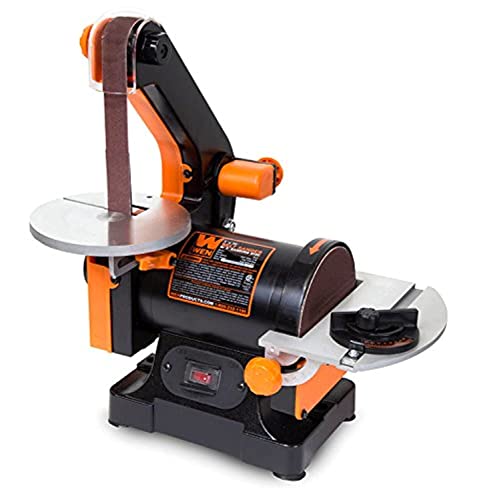
WEN 6515T Benchtop Belt and Disc Sander, 1 by 30 Inch Belt and 5 Inch Disc
2.3 amp motor1 by 30 inch belt5 inch disc3,160 FPM belt
Check price on Amazon
Best for: Hobbyists who shape small parts, sharpen tools and trim edges on a bench.

A benchtop belt and disc sander is a stationary machine: you hold the work against the belt or disc, which is the opposite of a handheld sander. The belt runs at up to 3,160 feet per minute, much faster than the handheld models, and a 5 inch disc spins at 3,450 RPM. A heavy base prevents the machine from walking, which is a common fault of cheap benchtop units.

The tradeoff is scale. A 1 by 30 inch belt is narrow and small, so it shapes small parts, sharpens tools and trims edges rather than flattening boards. Compared with the Triton, it has less power but more precision for small work. It is a different tool from the handheld sanders, so choose based on whether you move the sander or the work.

Ownership: keep the work rest close to the belt, within a sixteenth of an inch, to prevent jamming. Use the disc table at a right angle with a square. Replace belts and discs when they clog, and keep the machine clean of dust. Wear eye and dust protection.

What works

  • Belt runs up to 3,160 FPM for fast shaping
  • 5 inch disc adds a second sanding surface
  • Heavy base prevents walking and wobbling
  • Precise control for small parts

Watch out for

  • Narrow 1 by 30 inch belt cannot flatten boards
  • 2.3 amp motor is modest for heavy stock removal
  • Stationary design needs bench space

Spec sheet

Motor
2.3 amp
Belt
1 by 30 inches
Disc
5 inch
Belt speed
Up to 3,160 FPM
Disc speed
3,450 RPM
05
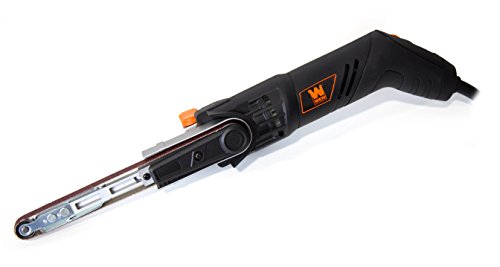
WEN 6307 Variable Speed Detailing File Sander, 1/2 by 18 Inch Belt
1/2 by 18 inch belt1,080 to 1,800 FPMPivots 55 degreesAuto-tracking
Check price on Amazon
Best for: Furniture repairers and crafters who sand curves, corners and tight spaces.

A file sander uses a narrow belt on an extended arm to reach where a standard sander cannot, such as the inside of a curve, between spindles or in a corner. This WEN has a 1/2 by 18 inch belt on an arm that pivots up to 55 degrees, so you can angle it to the work. An auto-tracking system keeps the belt centered without tensioning, which removes the most fiddly adjustment of a belt sander.

The variable speed dial runs the belt from 1,080 to 1,800 feet per minute, and that range lets you slow down for delicate work. It is a precision tool for detail, not a stock-removal machine. Compared with the Triton, it removes far less material, and it complements a bigger sander rather than replacing one. For a woodworker doing furniture repair and shaping, it fills a gap that no other tool here does.

Ownership: belts are narrow and specific to the size, so buy a pack. Keep the arm clean of dust, and use a light touch. Replace worn belts early, and wear a mask for fine dust.

What works

  • Narrow belt reaches curves, corners and tight spaces
  • Arm pivots up to 55 degrees for angled access
  • Auto-tracking removes belt adjustment
  • Variable speed from 1,080 to 1,800 FPM

Watch out for

  • Removes far less material than a full-size sander
  • 1/2 by 18 inch belts are less common
  • Not suitable for flattening boards

Spec sheet

Belt
1/2 by 18 inches
Speed
1,080 to 1,800 FPM variable
Pivot
Arm pivots up to 55 degrees
Tracking
Auto-tracking, no tensioning
Use
Detail work and tight spaces

Spec sheet decoder

What the numbers on the box really mean

The specs manufacturers lead with, translated into what they tell you about real-world performance.

Belt size

Belt size is width by length, such as 3 by 21 inches. It sets the area sanded and the sander's class.

Watch forBelts are not interchangeable between sizes, so check before buying. A 3 by 21 inch belt is the most common handheld size and the easiest to find.

FPM (feet per minute)

FPM is belt surface speed. Higher speeds remove stock faster.

Watch forThe WEN 6515T's 3,160 FPM is far faster than handheld models, and it is a different class. Do not compare a benchtop sander's belt speed with a handheld's, because the loads are different.

Amps

Amps measure motor draw. A higher amp motor holds speed under load.

Watch forThe Triton's 10 amps leads the roundup. A 10 amp sander can still stall on thick paint if you press hard.

Auto-tracking

Auto-tracking keeps the belt centered without manual adjustment.

Watch forThe WEN 6307 lists it, but it may still need cleaning. Check tracking again after changing grits.

Grit

Grit is the abrasive size. Lower numbers cut faster, and higher numbers finish smoother.

Watch forStart at 80 grit on rough wood and go finer. For paint stripping, start at 40 to 60 grit and move up.

Methodology

How We Evaluated These Belt Sanders Under $100

Tool class

We separated handheld, benchtop and detail sanders, since they do different jobs. Only the handheld models compete directly. We treated a benchtop sander as a complement rather than a rival to a handheld.

Power

We compared amps, from the Triton's 10 to the benchtop WEN's 2.3. We noted that more amps also means more weight and more risk of gouging.

Speed control

We looked at variable speeds, favoring the VEVOR and Triton. Variable speed earned credit because it reduces mistakes on soft wood.

Belt handling

We checked tracking and belt change design. Belt tracking is the adjustment that most often goes wrong, so auto-tracking earned credit.

Relative value

We used price tier to compare what extra spending buys. We used relative price tiers and never listed amounts.

Decision guide

How to Choose the Right Belt Sanders Under $100

By Job

Pick the tool class before the brand: a belt sander that is the wrong shape for the job will frustrate you whatever its amp rating.

JobPickWhy
Flattening boardsTriton TA1200BS10 amps
Sanding near wallsCRAFTSMAN CMEW213Angled belt
Handheld and bench useVEVOR 7A2-in-1
Shaping small partsWEN 6515TBenchtop
Curves and cornersWEN 6307Detail file sander

By Budget

Relative tiers only: spending more here mostly buys motor power, speed control and sturdier housings, not a different kind of result.

TierPickWhy
LowestWEN 6307Detail sander
LowVEVOR 7A2-in-1
Low-middleCRAFTSMAN CMEW213Basic handheld
MiddleWEN 6515TBenchtop
UpperTriton TA1200BS10 amp power

Handheld vs Benchtop

Handheld

You move the sander over the work. The Triton, CRAFTSMAN and VEVOR fall here. They flatten boards and strip surfaces.

Benchtop

You move the work against the belt. The WEN 6515T falls here, and the VEVOR can convert. They shape small parts.

Choose handheld for large surfaces and benchtop for small parts.

By Speed Control

NeedPickWhy
Six speedsVEVOR 7A630 to 1,200 FPM
Variable dialTriton TA1200BSVariable speed
Fixed controllable speedCRAFTSMAN CMEW213800 FPM
Very fast beltWEN 6515T3,160 FPM
Detail speed rangeWEN 63071,080 to 1,800 FPM

For Stripping Paint or Flattening a Tabletop Specifically

Look for

These jobs need power, dust collection and a coarse belt. Sand with the grain and keep the sander moving.

In this comparison

The Triton TA1200BS leads at 10 amps. The VEVOR 7A offers speed options for tabletops.

After the belt sander, switch to a random orbital sander at 120 grit to remove the belt's scratch pattern.

When to Spend More

Spend more if

You sand daily or need a heavier, steadier machine. The Triton TA1200BS shows where power rises.

Save if

You sand a few projects a year. The CRAFTSMAN or VEVOR covers that.

Ownership

Maintenance schedule

The upkeep that decides whether this machine lasts two seasons or ten.

TaskIntervalWhy it matters
Replace the beltWhen it clogs or glazesA clogged belt burns wood. Fresh belts cut faster. Use a stiff brush or a belt cleaning stick.
Set trackingAt each belt changeA drifting belt eats the housing. Adjust with the sander running. Do not oversteer the knob.
Empty the dust bagEvery sessionA full bag blocks airflow. Empty it often. Use a vacuum with a hose where possible.
Clean the rollersMonthlyDust on rollers makes belts slip. Wipe them clean. Use a dry cloth, not solvent.
Inspect the cordBefore each jobDamaged cords overheat. Replace them. Wrap it loosely.

FAQ

Frequently Asked Questions

Belt sander or random orbital?

A belt sander removes stock fast. A random orbital finishes smoothly. Many shops own both. Start with the belt sander and finish with the orbital sander.

What does the cap buy?

It buys a decent corded sander, a benchtop machine or a detail tool. Listing prices move, so check the live cost. Belts are cheap, so budget for a variety of grits. Check that the belt size matches the sander before ordering replacements.

How long do belt sanders last?

With care, many years. Belts and brushes wear first. Keeping the belt clean extends life more than anything.

Why does my sander gouge the wood?

Pausing or tilting the sander causes gouges. Keep it flat and moving. Let the belt reach full speed before it touches the wood.

Which grit should I use?

Start at 60 to 80 for rough wood, then finer. Finish with an orbital sander. Always sand with the grain.

Is it safe to bench-mount a handheld?

Only with secure clamps and a guard. Keep fingers away from the belt. Use a push stick and a dust mask. Never bench-mount a sander that was not designed for it.

Bottom line

The short version

Browse more belt sanders under $100on Amazon →
James Miller, Lead Machine Editor

About the author

James Miller

Lead Machine Editor, MachineFanatic

James Miller leads MachineFanatic's buying guides, turning spec sheets, manuals and owner feedback into clear verdicts on power tools, outdoor power equipment, shop machines and kitchen machines.

More from James →

Keep reading

Related guides