
Amazon affiliate links - we earn a commission.Affiliate disclosure

Buying guide · 13 min read · Updated 2026-11-09

Best Sheet Sanders (2026)

Quarter and third sheet palm sanders compared by OPM, paper clamp, dust collection, vibration and pad size for cabinets, trim and paint prep.

James MillerBy James MillerLead Machine Editor6 machines comparedSpec-sheet verified
Best Sheet Sanders

At a glance

Our top picks

Side by side

Spec comparison

MachineMotorSpeedPaper sizeDust
DEWALT DWE6411K 1/4 Sheet Palm Sander KitBest OverallDEWALT DWE6411K 1/4 Sheet Palm Sander Kit2.3 amp14,000 OPM1/4 sheetn/a
Makita BO4556K 1/4 Sheet Finishing Sander with CaseBest Low VibrationMakita BO4556K 1/4 Sheet Finishing Sander with Casen/a14,000 OPM1/4 sheetn/a
BOSCH GSS20-40 1/4 Sheet 2 Amp Orbital Finishing SanderBest Orbital PrecisionBOSCH GSS20-40 1/4 Sheet 2 Amp Orbital Finishing Sander2 amp12,000 OPM1/4 sheetMicro-filter canister
Milwaukee M18 1/4 Sheet SanderBest CordlessMilwaukee M18 1/4 Sheet Sandern/a11,000 to 13,000 OPM dial1/4 sheetUp to 95% collected (maker claim)
SKIL 7292-02 2 Amp 1/4 Sheet Palm Sander with Pressure ControlBest Pressure ControlSKIL 7292-02 2 Amp 1/4 Sheet Palm Sander with Pressure Control2 ampn/a1/4 sheetMicro-filtration canister
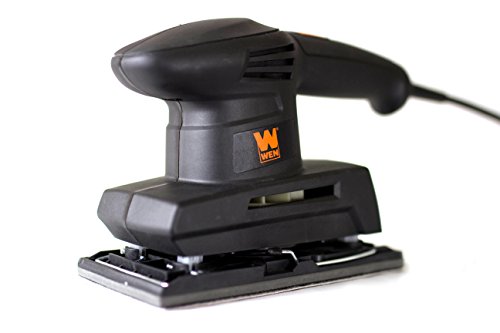
WEN 6313 1/3 Sheet Electric SanderBest Third-Sheet ValueWEN 6313 1/3 Sheet Electric Sander1.2 amp12,000 OPM1/3 sheetn/a

A sheet sander, also called a finishing or palm sander, moves a rectangular pad in tiny orbits and holds a standard quarter or third sheet of sandpaper with clamps. Its square corners reach into cabinet corners and flat edges that a round random orbital pad cannot, which is why it is the tool for paint prep and the last pass before finish.

The trade is aggression: a sheet sander cuts slowly and can leave straight-line scratches if you sand across the grain. This guide explains the specs that decide control and finish quality, then points you to the top picks above and the reviews below.

Before you buy

6 Criteria to Look For Before Buying a Sheet Sander

  1. 01

    Pad size

    Quarter sheet pads suit corners and trim, as on the DeWalt DWE6411K and Makita BO4556K, while the WEN 6313 uses a one-third sheet pad of 3-5/8 by 7-3/8 inches. A bigger pad covers more area but is harder to control. A common mistake is buying a large pad for cabinet work and gouging edges. Match pad size to the work you do most, because a pad that is too large is hard to control.

  2. 02

    Orbit speed

    Finish sanders run 11,000 to 14,000 OPM. The Milwaukee covers 11,000 to 13,000 with a dial, while the Makita and DeWalt are fixed at 14,000. Variable speed helps on delicate finishes and fixed speed is simpler. Faster does not mean smoother, as tight orbits at lower speeds can leave a finer finish. Test the dial and grip for a minute, since you will hold this tool for long stretches.

  3. 03

    Paper clamp design

    A weak clamp lets the sheet slip and tear. The DeWalt advertises an improved clamp, and cheap sanders often use small fiddly clamps. Hook-and-loop options exist, but sheet sanders cut punched paper to size. Check clamp tension when you buy. Replace a weak clamp at the first sign of slipping paper.

  4. 04

    Dust collection

    Palm sanders put dust in your face. The Bosch GSS20-40 and SKIL 7292-02 use micro-filter canisters, and the Milwaukee claims up to 95 percent capture. A vacuum port is better. Match punched holes in the paper to the pad. A canister you can see through tells you when suction is dropping.

  5. 05

    Weight and grip

    A finishing sander is held in one hand, often overhead. The WEN 6313 weighs about 3 pounds, and the Makita BO4556K has a contoured rubber grip. Pick a sander that fits your palm, since fatigue ruins control. Hold the tool for a few minutes to see whether your hand tires.

  6. 06

    Corded or cordless

    Corded sanders like the DeWalt give steady power and no weight penalty. Cordless sanders like the Milwaukee M18 avoid cords across wet finishes. If you sand once a month, corded is cheaper. If you finish trim on a ladder, cordless is easier. If you sand only occasionally, a corded tool is the cheaper way to go.

Detailed reviews

The 6 best sheet sanders, explained

01
DEWALT DWE6411K 1/4 Sheet Palm Sander Kit
2.3 amp motor14,000 OPMQuarter sheetRubber overmold
Check price on Amazon
Best for: Cabinet and trim finishing where you want a solid, comfortable tool.

The DWE6411K is a quarter sheet palm sander with a 2.3 amp motor that runs at a fixed 14,000 orbits per minute. A rubber overmold covers the body for a grip that stays comfortable and secure through a long session, and the paper clamps are improved over earlier versions.

The fixed speed is the compromise: the Milwaukee and WEN 6313 vary theirs, while the DeWalt trades a speed dial for simplicity and a strong, consistent cut. At 2.3 amps it has more motor than the Bosch GSS20-40 at 2 amps, which shows up on cabinet doors and hardwood. The kit adds a carry case that keeps sheets and the sander together.

Paper changes are where cheap sanders annoy you, and a good clamp holds the sheet taut without tearing it. Use pre-cut quarter sheets or tear full sheets in four. Empty the dust bag often, since a full bag cuts suction and returns dust to the pad. Keep a spare quarter-sheet pad handy, since the hooks and foam wear before the motor does.

What works

  • 2.3 amp motor with 14,000 OPM
  • Overmolded rubber grip for comfort
  • Improved paper clamps hold sheets taut
  • Carry case included

Watch out for

  • Single speed, no dial for delicate work
  • Onboard bag captures only part of the dust

Spec sheet

Motor
2.3 amp
Speed
14,000 OPM
Paper size
1/4 sheet
Grip
Rubber overmold
Paper clamp
Improved design
Kit
Case included
02
Makita BO4556K 1/4 Sheet Finishing Sander with Case
14,000 OPMBall bearing buildQuarter sheetRubber palm grip
Check price on Amazon
Best for: Fine finish sanding where vibration and noise matter.

The BO4556K runs at 14,000 OPM and uses precision ball bearing construction to reduce vibration and noise, which Makita highlights as a core feature. A contoured, rubberized palm grip completes a design built for comfort during repeat passes.

Vibration is what separates good finishing sanders from tiresome ones, because the tool rides on top of the work and every shake telegraphs into your hand. Compared with the DeWalt DWE6411K, the Makita is a quieter, smoother feel with a similar speed, though the DeWalt has a stronger motor rating. It comes with a case.

Check that the paper clamp holds the sheet evenly, and keep the pad flat. A pad with a warp or a curled edge leaves lines on the work. Because it is a finishing tool, resist the urge to lean on it, since the weight of the tool alone is enough pressure.

What works

  • Ball bearings reduce vibration and noise
  • Contoured rubber palm grip
  • 14,000 OPM finish speed
  • Case included

Watch out for

  • Motor rating is not published in the listing
  • Single speed only

Spec sheet

Speed
14,000 OPM
Paper size
1/4 sheet
Bearings
Precision ball bearings
Grip
Contoured rubberized palm
Kit
With tool case
03
BOSCH GSS20-40 1/4 Sheet 2 Amp Orbital Finishing Sander
2 amp motor12,000 OPMAluminum plateMicro-filter box
Check price on Amazon
Best for: Final sanding before stain or clear coat.

The GSS20-40 is a quarter sheet sander engineered for very tight orbital motion, with a 2 amp motor and 12,000 OPM. A precision-machined aluminum sanding plate keeps the pad flat, and a micro-filter dust canister with a screw-off cap captures fine particles.

A tight orbit leaves a finer scratch pattern than a wide one, which is why this style suits final sanding before stain or clear coat. It has less raw power than the DeWalt, which is not a problem for finish sanding but slows it on bare boards. The flat aluminum plate is an advantage over cheaper plastic pads that warp.

Empty the canister regularly and clean the filter, since a clogged filter reduces suction and lets dust settle on the work. The aluminum plate is easy to wipe clean, and the filter canister can be rinsed and dried between jobs.

What works

  • Tight orbit leaves a fine scratch pattern
  • Aluminum plate stays flat
  • Micro-filter canister traps fine dust
  • Compact quarter sheet size

Watch out for

  • Lower power than the 2.3 amp DeWalt
  • 12,000 OPM is slower on rough stock

Spec sheet

Motor
2 amp
Speed
12,000 OPM
Paper size
1/4 sheet
Plate
Precision-machined aluminum
Dust
Micro-filter canister
04
Milwaukee M18 1/4 Sheet Sander
M18 cordless11,000-13,000 OPMLow vibration95% dust claim
Check price on Amazon
Best for: M18 owners who want cordless finishing without a cord.

The Milwaukee M18 quarter sheet sander runs on M18 batteries with a variable speed dial between 11,000 and 13,000 OPM. Milwaukee claims up to 95 percent of dust is collected, a manufacturer figure under its own conditions, and designs the tool for low vibration.

Cordless means you can sand a door or railing without dragging a cord across the finish. The variable dial lets you drop speed for delicate work, a feature the DeWalt DWE6411K lacks. The cost is battery weight and the need for an M18 pack, since this is a bare tool listing.

If you own M18 batteries it is a convenient finishing tool. A 2.0Ah pack is enough for a cabinet door or two, and a larger pack for a full kitchen. Keep the battery charged but not left on the tool, and let it cool before storing.

What works

  • Cordless with variable 11,000 to 13,000 OPM
  • Low vibration design
  • Strong dust collection claim
  • Fits all M18 batteries

Watch out for

  • Battery and charger sold separately
  • Heavier than corded sheet sanders

Spec sheet

Platform
M18, 18V
Speed
11,000 to 13,000 OPM dial
Paper size
1/4 sheet
Dust
Up to 95% collected (maker claim)
Vibration
Low vibration design
05
SKIL 7292-02 2 Amp 1/4 Sheet Palm Sander with Pressure Control
2 amp motorPressure controlMicro-filterClear dust canister
Check price on Amazon
Best for: Beginners who want feedback on sanding pressure.

The SKIL 7292-02 adds pressure control technology, which warns you when you press too hard. Pressing hard is the main cause of uneven sanding and swirl marks, so a warning teaches the right touch, and it suits beginners well.

It also has a micro-filter canister with a clear window so you can see when it needs emptying. The 2 amp motor is the same class as the Bosch GSS20-40, and it is among the more affordable picks here. It is not as refined as the Makita or DeWalt for long sessions.

Empty the canister regularly and avoid leaning on the tool. The feedback light is a tool for learning, and once you have the feel you can sand without it. Use the clear canister as a prompt to tap out the filter every time the dust reaches the line.

What works

  • Pressure control warns of heavy pressing
  • Clear canister shows when to empty
  • Micro-filtration for fine dust
  • Affordable entry

Watch out for

  • Less refined than DeWalt or Makita
  • Moderate motor power

Spec sheet

Motor
2 amp
Paper size
1/4 sheet
Feature
Pressure control alert
Dust
Micro-filtration canister
Canister
Clear view
06
WEN 6313 1/3 Sheet Electric Sander
1.2 amp motor12,000 OPM1/3 sheet pad3 lb weight
Check price on Amazon
Best for: Occasional sanding of flat panels at low cost.

The WEN 6313 is a one-third sheet sander with a 3-5/8 by 7-3/8 inch pad, a 1.2 amp motor and 12,000 OPM. The larger pad covers more area per pass than a quarter sheet, so it speeds up work on doors and panels.

At about 3 pounds it is light, which suits overhead work. The 1.2 amp motor is the lowest rating here, and the WEN does not have the comfort or dust performance of the premium picks. It is the least expensive way to get a larger pad.

Use one third of a sheet and be careful of the larger pad's corners, which can dig into edges. Replace the paper as soon as it clogs. Store it flat so the pad does not curl, and keep paper in a dry drawer, since damp paper clogs instantly.

What works

  • Larger third-sheet pad covers more area
  • Light at about 3 pounds
  • 12,000 OPM finishing speed
  • Low cost

Watch out for

  • Lowest motor rating in the lineup
  • Less refined dust collection

Spec sheet

Motor
1.2 amp
Speed
12,000 OPM
Pad
3-5/8 x 7-3/8 in
Weight
About 3 lb
Paper size
1/3 sheet

Spec sheet decoder

What the numbers on the box really mean

The specs manufacturers lead with, translated into what they tell you about real-world performance.

OPM

Orbits per minute is how often the pad completes its tiny orbit. Higher OPM gives a finer cut at the same pressure but not necessarily a better finish.

Watch forSome budget listings quote 26,000 OPM, which describes a vibrating head, not a better cut.

Sheet size

Quarter sheet is a quarter of a 9 by 11 inch sheet, and a third sheet is a third. Using the sander's own size avoids wasted paper.

Watch forPad size differs from sheet size in some listings, so check the actual dimensions.

Amp rating

Amps measure current draw. At 1.2 amps the WEN 6313 draws about half what a random orbital does, and has less torque under load.

Watch forPower matters less than vibration and dust on a finish sander.

Orbit size

The orbit is the diameter of the pad's circle. A small orbit leaves fine scratches and a large one removes faster.

Watch forThe spec is often missing. Look for tight orbit in the Bosch description.

Dust capture claim

A capture percentage such as 95 percent refers to a controlled test with a vacuum or bag. Real results depend on the paper and the work.

Watch forThe Milwaukee 95 percent figure is a manufacturer claim.

Methodology

How We Evaluated These Sheet Sanders

Finish quality

We looked at orbit speed, pad flatness and plate material. The Bosch aluminum plate and the Makita ball bearing build led this category.

Vibration and comfort

We compared grip design and balance. The DeWalt overmold and Makita palm grip stand out.

Dust handling

We compared canister, bag and vacuum designs. The Bosch and SKIL micro-filters rank well, and the Milwaukee makes a high capture claim.

Paper handling

We looked at clamp design and sheet size. The DeWalt clamp is improved, and the WEN uses a third sheet.

Power and platform

We compared motor ratings from 1.2 amps on the WEN 6313 to 2.3 amps on the DeWalt, and the Milwaukee's M18 platform.

Decision guide

How to Choose the Right Sheet Sanders

By Type of Work

ScenarioPickWhy
Cabinet doors and trimDEWALT DWE6411KStrong motor and comfortable grip
Final pass before stainBOSCH GSS20-40Tight orbit
Smooth finishMakita BO4556KLow vibration
Door and panel facesWEN 6313Third-sheet pad
Ladder workMilwaukee M18Cordless

By Budget

TierPickWhy
EntryWEN 6313Least expensive
ValueSKIL 7292-02Pressure feedback
Mid-rangeBOSCH GSS20-40Aluminum plate
UpperDEWALT DWE6411KPower and kit
CordlessMilwaukee M18Needs batteries

Quarter Sheet vs Third Sheet

Quarter sheet

Reaches corners and tight areas, and the standard for trim and cabinets. The DeWalt, Makita, Bosch, Milwaukee and SKIL use it.

Third sheet

Covers more area on flat panels but is harder to control. The WEN 6313 is the third sheet pick.

Pick quarter sheet for detail and third sheet for flat surfaces.

Dust System

PreferencePick
Micro-filter canisterBOSCH GSS20-40
Clear canisterSKIL 7292-02
High capture claimMilwaukee M18
Dust bagDEWALT DWE6411K

For Paint Prep Specifically

Look for

Look for a tight orbit, a flat plate and good dust control so you do not wreck a fresh surface.

In this comparison

The Bosch GSS20-40 and Makita BO4556K suit paint prep, and the DeWalt works for heavier scuffing.

When to Spend More

Spend more if

Spend more on the DEWALT DWE6411K or Makita if you sand weekly.

Save if

Save with the WEN 6313 or SKIL if you sand occasionally.

Ownership

Maintenance schedule

The upkeep that decides whether this machine lasts two seasons or ten.

TaskIntervalWhy it matters
Replace the sanding padWhen worn or warpedA warped pad leaves lines. A new pad restores a flat surface.
Empty the dust bag or canisterEvery 10 minutesA full container reduces suction. It also lets dust fall on the work.
Clean the filterAfter each sessionA clogged filter reduces airflow. Tap it out.
Check the paper clampMonthlyA weak clamp lets paper slip. Replace worn clamps.
Inspect the cordBefore useA damaged cord is a hazard. Replace it.

FAQ

Frequently Asked Questions

What is the difference between a sheet sander and a random orbital?

A sheet sander has a square pad and orbits in a small fixed circle, so it reaches corners. A random orbital has a round pad and also spins, which avoids patterns. Many woodworkers own one of each, using the square pad for corners and the round pad for open areas.

Can I sand across the grain?

Avoid it with a sheet sander, because the fixed orbit leaves straight scratches. Sand with the grain. Sanding across the grain on a bare board shows up as scratches once stain goes on, so mark the grain direction first.

What grit should I use?

Use 120 for prep, 180 for final and 220 before finish. Do not skip more than one grit. Skipping from 80 to 220 leaves deep scratches that the fine paper cannot remove, so step through each grit.

Do I need a vacuum?

A vacuum improves capture. Onboard canisters work for light jobs. A shop vacuum on a port also keeps dust off the finish, which matters more than speed.

Quarter or third sheet?

Quarter sheet for trim and corners. Third sheet for flat panels. If you are unsure, quarter sheet is the more versatile size, because paper is cheap and easy to find.

Why does my sander leave marks?

Marks come from too much pressure, a dirty pad or grit contamination. Lighten up and change paper often. Dust trapped between pad and paper also scratches, so blow off the pad when you change sheets.

Bottom line

The short version

Browse more sheet sanderson Amazon →
James Miller, Lead Machine Editor

About the author

James Miller

Lead Machine Editor, MachineFanatic

James Miller leads MachineFanatic's buying guides, turning spec sheets, manuals and owner feedback into clear verdicts on power tools, outdoor power equipment, shop machines and kitchen machines.

More from James →

Keep reading

Related guides