
Amazon affiliate links - we earn a commission.Affiliate disclosure

Buying guide · 13 min read · Updated 2026-11-09

Best Detail Sanders (2026)

Corded and cordless detail sanders compared by OPM, pad shape, attachments and dust collection, for tight corners, louvers, trim and furniture refinishing.

James MillerBy James MillerLead Machine Editor5 machines comparedSpec-sheet verified
Best Detail Sanders

At a glance

Our top picks

A detail sander uses a small triangular or pointed pad that vibrates in tiny orbits, so it can reach into the 90 degree corners of cabinets, window sashes and chair legs where a round or square pad cannot. It does fine work rather than fast stock removal, and it is usually a second sander that complements a larger one.

Pad shape, attachments and dust control matter more than motor size on these small tools. This guide explains what to look for, then points you to the top picks above and the reviews below.

Before you buy

6 Criteria to Look For Before Buying a Detail Sander

  1. 01

    Pad shape and attachments

    A triangular pad reaches 90 degree corners, and the SKIL adds three attachments for louvers and grooves. The WEN 6307 swaps the pad for a belt. Match the shape to the job: corners need a point, spindles need a belt, and flat faces need a square pad. On a dresser with louvered drawers the extra tips save an hour of hand sanding.

  2. 02

    Orbit speed

    Detail sanders run 9,000 to 16,000 OPM, with the BLACK+DECKER at 16,000 and the CRAFTSMAN cordless at 9,000 to 12,000. A higher number sounds better, but a small motor stalls under pressure. A variable dial gives you control for paint and delicate work. If you only own a random orbital sander, this is the tool that fills the gaps it cannot reach.

  3. 03

    Dust collection

    A tiny sander still produces fine dust. The SKIL has a micro-filter box and a 1-1/4 inch vacuum port, and the CRAFTSMAN cordless takes a vacuum hose too. A vacuum port gives much better capture than a small bag. A cheap vacuum adapter turns a messy job into a clean one for a few dollars of parts.

  4. 04

    Weight and grip

    A detail sander is held for long periods in awkward positions. The BLACK+DECKER offers a 3-position grip, and the CRAFTSMAN has a rubber grip. A light, balanced tool matters more than motor size. Hold a tool before buying if you can, because a pointy sander that feels awkward will sit in the drawer.

  5. 05

    Corded versus cordless

    A corded tool gives constant power. A cordless tool, such as the CRAFTSMAN 20V MAX, frees you from the cord but adds battery weight. Pick cordless only if you own the batteries. Cordless is handy on a ladder, but it adds ounces to a tool you hold at arm length.

  6. 06

    Sandpaper availability

    Detail sanders use shaped sheets. Triangular hook-and-loop paper is common, but belts for the WEN 6307 are less common. Check supply before buying, as paper costs more over time than the tool. Detail paper wears fast, so the paper cost over three years often exceeds the tool cost.

Detailed reviews

The 5 best detail sanders, explained

01
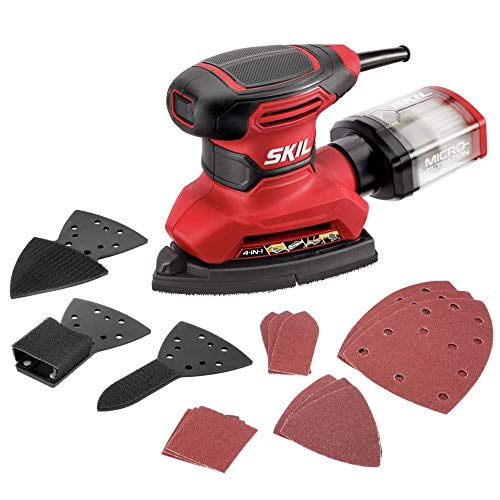
SKIL Multi-Function Detail Sander with Micro-Filter Dust Box
1.2 amp motor13,500 OPM4-in-1 attachmentsMicro-filter box
Check price on Amazon
Best for: Furniture refinishers who want one tool for corners, louvers and contours.

The SKIL is a 4-in-1 detail sander with a 1.2 amp motor and 13,500 orbits per minute. It ships with three extra attachments for fine finishing, plus a micro-filter dust box and a 1-1/4 inch port for a vacuum hose.

The attachments make it the most versatile tool in this guide, because a single motor can reach louvers, grooves and contours that a plain triangular pad cannot. Compared with the SKIL SR250801 at 1 amp and 12,000 OPM, it has a bigger motor and a faster orbit. It is a corded tool, which keeps weight low and runtime unlimited.

Punched sandpaper is cheap and widely available, but check that the hole pattern matches the dust port. Keep the dust box emptied, and switch attachments with the tool unplugged. It suits furniture refinishing and window trim. The attachments live in a small bin, so keep them with the tool, because losing the louver tip turns a versatile sander into a basic one. Switch attachments only with the plug pulled, and brush resin out of the finger tip with a toothbrush before it hardens. Over a few years the foam under the pad compresses, which is the cue to replace the whole pad rather than just the paper.

What works

  • Three detail attachments cover odd shapes
  • 13,500 OPM from a 1.2 amp motor
  • Micro-filter dust box and vacuum port
  • Sanding sheets included

Watch out for

  • Small motor stalls under heavy pressure
  • Attachments add parts to lose

Spec sheet

Motor
1.2 amp
Speed
13,500 OPM
Attachments
Three detail attachments included
Dust
Micro-filter box and 1-1/4 in port
Paper
12 sheets included
02
BLACK+DECKER 1.2 Amp Corded Detail Sander, 16,000 OPM
1.2 amp motor16,000 OPM3-position gripDust collector
Check price on Amazon
Best for: Light paint prep and trim work in tight corners.

The BLACK+DECKER detail sander has a 1.2 amp motor at 16,000 OPM, the highest orbit rate in this guide, along with a compact body and a 3-position grip. The grip adjusts so you can hold it like a mouse, by the nose or with a pinch, which helps in tight spaces.

The high OPM suits light sanding on paint, and the compact shape fits in cramped corners. It lacks the attachment range of the SKIL, and 16,000 OPM does not mean faster cutting if the motor is small. Compared with the CRAFTSMAN at 14,000 OPM, the B+D is faster on paper but both are in the same tier.

It is a corded tool, which gives continuous power for the biggest jobs, as the maker notes. Replace pads as they wear and use fresh paper for clean edges. Because the pad is small, work in short strokes and let the point do the corner while the flat side handles the rest. The extra grip positions matter more than the motor spec once you spend twenty minutes on a window sash. Expect to replace the pad after a few dozen sheets, which is normal wear for any detail sander.

What works

  • 16,000 OPM orbit rate
  • 3-position grip for tight spots
  • Compact body
  • Corded for unlimited runtime

Watch out for

  • Fewer attachments than the SKIL
  • Small motor for heavy sanding

Spec sheet

Motor
1.2 amp
Speed
16,000 OPM
Grip
3-position
Design
Compact
Power
Corded
03
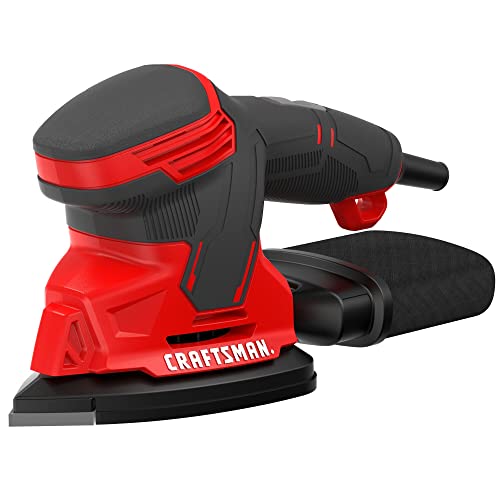
CRAFTSMAN Corded Mouse Detail Sander with 2 Attachments
14,000 OPMDust-sealed switch2 attachmentsRubber grip
Check price on Amazon
Best for: Homeowners who want a durable corded detail sander.

The CRAFTSMAN corded mouse sander runs at 14,000 OPM, includes two attachments and sandpaper, and has a dust-sealed switch. The dust seal is a durability feature that protects the contacts from the fine dust that kills cheap switches.

The rubber grip adds control, and the mouse shape fits a palm. It has fewer attachments than the SKIL and a lower OPM than the B+D, but a durable switch is a real ownership benefit. It is a sensible tool for homeowners.

Check the pad condition and replace it before hooks wear out. Use fine paper on the mouse tip and move slowly, since a hard point can burn through paint or veneer at an edge. Vacuum the dust port every few sessions, and wipe the rubber grip because sanding dust turns slick. A dust-sealed switch is the one failure point that ends most cheap sanders, so this feature is worth having.

What works

  • Dust-sealed switch extends life
  • 14,000 OPM orbit rate
  • Includes attachments and sheets
  • Rubber grip for control

Watch out for

  • Fewer attachments than the SKIL
  • No published motor rating

Spec sheet

Speed
14,000 OPM
Switch
Dust-sealed
Attachments
Two included
Grip
Rubber
Power
Corded
04
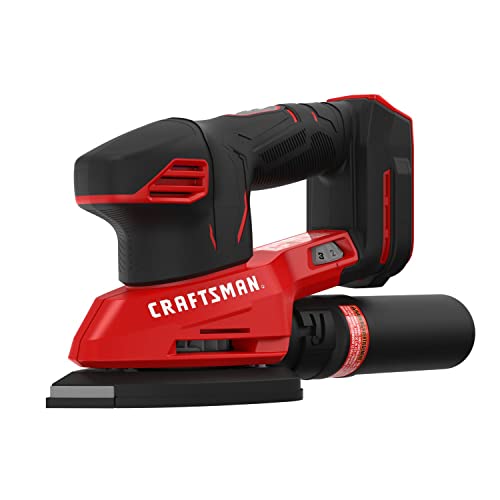
CRAFTSMAN 20V MAX CMCW221B Cordless Detail Sander (Bare)
20V MAX9,000-12,000 OPMDust bagTool only
Check price on Amazon
Best for: CRAFTSMAN battery owners who want a cordless detail tool.

The CMCW221B is a cordless detail sander with a variable speed range of 9,000 to 12,000 OPM. It has a dust-sealed switch and collects dust in a bag or through a 1-1/4 inch vacuum connection.

Cordless operation removes the cord from finished surfaces and tight corners, which is useful on ladders. The variable speed range gives you control that the corded tools lack, and the lower OPM ceiling is a trade for control. The cost is the battery, as this is a bare tool.

If you already own CRAFTSMAN 20V MAX batteries it is a good addition. Charge a pack before starting. Battery life on a small detail tool is generous, because the motor draws far less than a random orbital, so even a compact pack covers a few hours of corner work. The trade is that a pack on the back changes the balance, so test it by holding the tool upright. Charge packs away from heat and do not store them on the tool.

What works

  • Cordless with 9,000 to 12,000 OPM dial
  • Dust-sealed switch
  • Bag and vacuum port
  • No cord on finished surfaces

Watch out for

  • Battery and charger sold separately
  • Lower top speed than the corded sanders

Spec sheet

Platform
20V MAX
Speed
9,000 to 12,000 OPM
Switch
Dust-sealed
Dust
Bag and 1-1/4 in vacuum port
Kit
Tool only
05
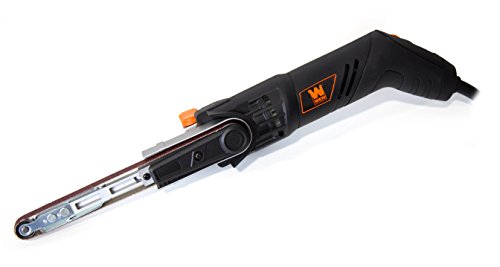
WEN 6307 Variable Speed Detailing File Sander, 1/2 x 18 in Belt
Variable speed1,080-1,800 FPM1/2 x 18 in beltPivot head
Check price on Amazon
Best for: Shaping and sanding in narrow gaps, spindles and curves.

The WEN 6307 is a belt-type file sander, not a vibrating detail sander. A 1/2 by 18 inch belt runs at 1,080 to 1,800 feet per minute, and the head pivots up to 55 degrees to reach into gaps and around curves.

A narrow belt fits spindles, tight radii, rails and interior cuts that a triangular pad cannot reach. Auto-tracking means you do not tension or adjust the belt, which removes the most annoying part of a belt tool. It removes material faster than an orbital detail sander, so treat it as a shaping tool.

Expect to buy 1/2 by 18 inch belts, a less common size than hook-and-loop sheets. Use light pressure. Belts wear at the edges first, so flip your attention to the belt tracking if it starts to wander. Keep the contact surface clear of resin, since pitch makes the belt glaze, and clamp small workpieces rather than holding them by hand. Treat it as a shaping tool for spindles, rails and curves, not a finishing sander.

What works

  • Narrow belt reaches tight gaps
  • Auto-tracking needs no adjustment
  • Pivot head to 55 degrees
  • Variable belt speed

Watch out for

  • Removes material fast, so it can gouge
  • 1/2 x 18 in belts are less common

Spec sheet

Belt
1/2 x 18 in
Speed
1,080 to 1,800 feet per minute
Tracking
Auto-tracking, no tension
Pivot
Up to 55 degrees
Type
Detailing file sander

Spec sheet decoder

What the numbers on the box really mean

The specs manufacturers lead with, translated into what they tell you about real-world performance.

OPM

Orbits per minute is how many tiny circles the pad makes each minute. A higher OPM gives a smoother cut but not more material removal.

Watch forTreat 16,000 OPM as light-duty speed, not power. Manufacturers stretch this number with marketing, so judge by how the tool feels in the cut.

Amp rating

Amps show current draw, which hints at torque. A 1.2 amp motor is about half what a random orbital draws.

Watch forMost detail sanders stall if you press hard, regardless of amps. A small motor and a light touch pair better than a large motor and a heavy hand.

Feet per minute

Belt tools use feet per minute for belt speed. The WEN 6307 ranges from 1,080 to 1,800.

Watch forHigher belt speed removes material faster and heats the work. Belt speed is more relevant for shaping than for finishing.

Hook and loop

Hook-and-loop paper sticks to the pad with a fabric surface. It swaps quickly and works with punched holes for dust.

Watch forWorn hooks cause paper to slip, so replace the pad. Replace the pad at the first sign of slipping, not after the paper flies off.

Dust-sealed switch

A sealed switch keeps fine dust out of the electrical contacts. Dust is the main killer of cheap switches.

Watch forThe CRAFTSMAN tools advertise this feature. Check the listing for the phrase, since many budget tools omit the seal.

Methodology

How We Evaluated These Detail Sanders

Reach and shape

We looked at pad shape, attachments and reach into tight corners. The SKIL attachments and WEN 6307 belt led. This gives a clearer picture of what each tool does well in a corner, where detail sanders actually earn their place.

Speed control

We compared fixed speeds of 13,500 to 16,000 OPM with the CRAFTSMAN cordless dial and the WEN belt speed range. This gives a clearer picture of what each tool does well in a corner, where detail sanders actually earn their place.

Dust management

We compared micro-filters, bags and vacuum ports. The SKIL and CRAFTSMAN cordless offer a vacuum connection. This gives a clearer picture of what each tool does well in a corner, where detail sanders actually earn their place.

Ownership

We considered switch protection, paper cost and battery needs. This gives a clearer picture of what each tool does well in a corner, where detail sanders actually earn their place.

Value

We sorted corded value picks from cordless bare tools, noting what each buyer pays beyond the tool. This gives a clearer picture of what each tool does well in a corner, where detail sanders actually earn their place.

Decision guide

How to Choose the Right Detail Sanders

By Type of Work

ScenarioPickWhy
Furniture with louvers and groovesSKIL multi-functionExtra attachments
Window trim and cornersBLACK+DECKERCompact with 3-position grip
Homeowner paint prepCRAFTSMAN cordedDurable switch
Ladder workCRAFTSMAN 20V cordlessNo cord
Spindles and curvesWEN 6307Narrow belt

By Budget

TierPickWhy
EntryBLACK+DECKERLeast expensive
ValueCRAFTSMAN cordedDurable switch
Mid-rangeSKILAttachments
SpecialtyWEN 6307Belt design
CordlessCRAFTSMAN 20VNeeds battery

Orbital Pad vs Belt

Orbital pad

Vibrates in tiny orbits and leaves a fine finish. The SKIL, BLACK+DECKER and both CRAFTSMAN sanders use this design.

Belt

A narrow belt removes material faster and reaches gaps. The WEN 6307 is the belt choice.

Pick an orbital pad for finish work and a belt for shaping.

Power Source

PreferencePick
Corded with attachmentsSKIL
Corded compactBLACK+DECKER
CordlessCRAFTSMAN 20V MAX
Corded durable switchCRAFTSMAN corded

For Furniture Refinishing Specifically

Look for

Look for attachments that fit curves and a vacuum port, because stripped finishes make dust.

In this comparison

The SKIL multi-function and WEN 6307 handle the widest range of shapes.

When to Spend More

Spend more if

Spend more on the SKIL if you refinish furniture often.

Save if

Save with the BLACK+DECKER if you sand a few corners a year.

Ownership

Maintenance schedule

The upkeep that decides whether this machine lasts two seasons or ten.

TaskIntervalWhy it matters
Replace the padWhen hooks wearWorn hooks cause paper to slip. A new pad restores grip.
Empty the dust boxEvery 10 minutesA full box blocks airflow. Tap out the filter.
Clean the ventsMonthlyDust clogs the vents and heats the motor.
Check the beltBefore each use on belt toolsA frayed belt breaks. Replace worn belts.
Inspect the cord or batteryRegularlyA damaged cord is dangerous. Batteries age with heat.

FAQ

Frequently Asked Questions

What is a detail sander used for?

It sands corners, louvers and trim where larger sanders cannot reach. It is not for large flat surfaces. Work in light passes and check progress often, since a detail sander can burn through thin finishes quickly.

Is a mouse sander the same as a detail sander?

Yes, a mouse sander has a triangular pad shaped like a computer mouse. Both names describe the same kind of tool. Work in light passes and check progress often, since a detail sander can burn through thin finishes quickly.

Can it remove paint?

It can scuff and remove thin paint with coarse paper. Thick paint is faster with a scraper. Work in light passes and check progress often, since a detail sander can burn through thin finishes quickly.

Do I need a vacuum?

A vacuum improves capture. Bags are enough for small jobs. Work in light passes and check progress often, since a detail sander can burn through thin finishes quickly.

What grit should I use?

Use 80 to 120 for prep and 180 to 220 for finish. Change paper often. Work in light passes and check progress often, since a detail sander can burn through thin finishes quickly.

Why does the paper wear out so fast?

A small pad concentrates wear. Replace the sheet when it clogs. Work in light passes and check progress often, since a detail sander can burn through thin finishes quickly.

Bottom line

The short version

Browse more detail sanderson Amazon →
James Miller, Lead Machine Editor

About the author

James Miller

Lead Machine Editor, MachineFanatic

James Miller leads MachineFanatic's buying guides, turning spec sheets, manuals and owner feedback into clear verdicts on power tools, outdoor power equipment, shop machines and kitchen machines.

More from James →

Keep reading

Related guides