

Amazon affiliate links - we earn a commission.Affiliate disclosure

Buying guide · 13 min read · Updated 2026-11-13

Best Camping Inverters (2026)

Five camping inverters compared, from a Milwaukee 18V and DeWALT 20V battery-powered pair to 12V plug-in units and a 2000W pure sine box, for any campsite.

James MillerBy James MillerLead Machine Editor5 machines comparedSpec-sheet verified
Best Camping Inverters

At a glance

Our top picks

Camping inverters fall into three very different families. Some plug into a car socket, some clamp to a battery bank, and a growing group runs from the same cordless-tool battery you already own, so the first decision is where the power will come from.

Once the source is settled, the rest is about honest sizing. A tent needs a few dozen watts for phones and lights, a camper van needs enough for a kettle or a blender, and bigger is not better when every extra watt of idle draw comes out of a battery that has to last the weekend.

Before you buy

6 Criteria to Look For Before Buying a Camping Inverter

  1. 01

    Power source first

    Decide whether the inverter will draw from a car socket, a battery bank or a cordless-tool battery. The Bestek 300W and Pro Chaser 400W use the lighter plug, the BELTTT 2000W needs battery clamps, and the Azocek 220W and Ecarke 200W take Milwaukee 18V and DeWALT 20V packs. The source sets the ceiling on what you can run, so buying a big inverter for a small source only wastes money.

  2. 02

    Size to the loads

    Add up the continuous watts you will run and add 20 percent. A phone and laptop total about 100W, which fits the Bestek 300W. A microwave near 1000W needs the BELTTT 2000W. Oversizing wastes battery on idle draw, since bigger units burn more power doing nothing. Many people buy 2000W for a weekend of phone charging and regret it.

  3. 03

    The lighter socket limit

    A lighter socket is fused at 10 to 15A, about 120 to 180W at 12V. That means the Bestek 300W and Pro Chaser 400W are limited to roughly that in practice. Anything above 150 to 200W belongs on battery clamps, which is the BELTTT's territory.

  4. 04

    Battery runtime math

    Current is watts divided by 12 plus losses, so 100W draws about 9A and 2000W about 190A. A 100Ah lithium battery holds about 1200Wh, which is roughly ten hours at 100W. A tool battery of a few amp-hours holds far less, so the Azocek and Ecarke are for short charges.

  5. 05

    Waveform

    Pure sine suits appliances with motors and electronics. Only the BELTTT 2000W states it here. The rest are treated as modified sine, fine for phones, lights and basic chargers but a poor match for a CPAP unless the manual says otherwise.

  6. 06

    Remote and extras

    A wired remote on the BELTTT lets you switch off a hidden box, and the Ecarke's 200 lumen LED doubles as a work light. These are not power features, but they decide whether you actually use the thing correctly at night.

Detailed reviews

The 5 best camping inverters, explained

01
BELTTT 2000W pure sine inverter, 4000W surge, 23ft remote
2000W continuous4000W surgePure sine wave23ft remote
Check price on Amazon
Best for: Van and camper owners who run a blender, microwave or tool chargers.

BELTTT is the pick for campers who bring appliances. It delivers 2000W of continuous pure sine power, with a 4000W surge, a real-time screen for input and output and a 23ft wired remote. A pure sine wave means a blender, a coffee maker with electronics or a power-tool charger behaves exactly as it does at home, which is the whole point of paying for it.

The real value at a campsite is the remote. A box of this size lives in a battery compartment or under a bench, and a wired remote lets you switch it from the sleeping area without opening anything. That cuts idle draw, which is the quiet killer of weekend battery budgets. The unit also offers a 20A outlet beside the standard ones, for larger plugs.

It is also the heaviest commitment in the guide. At full load it draws roughly 190A from a 12V bank, so it needs heavy cable, a hardwire connection and a large lithium or AGM battery. A car battery will not last. Fit a fuse near the battery, keep the fan intake clear and allow airflow, because a fan that cycles under load is normal.

What works

  • Pure sine output at 2000W suits appliances
  • 23ft wired remote avoids opening the battery bay
  • Real-time screen shows input and output
  • 20A outlet accepts larger plugs

Watch out for

  • Needs a large battery bank and heavy cable
  • Too much inverter for tent and car camping
  • Fan cycles audibly under load

Spec sheet

Continuous output
2000W
Surge rating
4000W
Waveform
Pure sine
Outlets
Dual AC and 20A
Remote
23ft wired
02
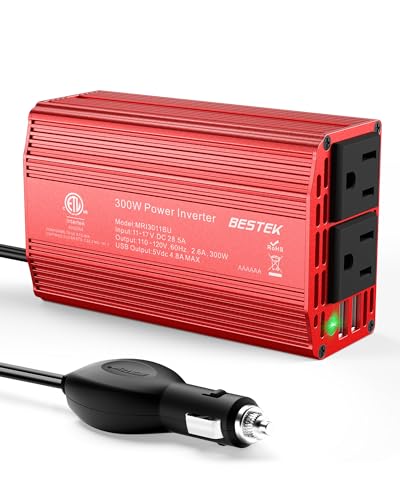
Bestek 300W inverter, 11-17V input, 2 AC and 2x4.8A USB
300W11-17V input2 AC outlets4.8A dual USB
Check price on Amazon
Best for: Car campers who charge phones, cameras and a laptop from the vehicle.

Think of this Bestek as the tent-and-car answer. At about the size of an iPhone it slides into a lighter socket, gives two AC outlets and two high-current USB ports, and comes with a cord of about 32 inches so the body can sit on a seat. The wider input range helps with newer cars whose sockets run higher than the old 12 to 14V.

The listing positions it for vacations, work trips and camping, and that is the right fit. It will charge a phone, run a camera battery charger and power a laptop brick. The lighter socket fuse limits it to roughly 120 to 180W of real power, which means a 300W label is headroom and not a promise.

The hidden cost of the lighter plug is battery draw. A car socket that stays live with the engine off will let the inverter slowly drain the starter battery, so unplug it when you leave the car. It sits at a low tier in the price ordering. If you need clean power for a CPAP, look at the 400W or 2000W units instead.

What works

  • iPhone-sized body plugs into the lighter socket
  • Two 4.8A USB ports charge phones quickly
  • Cord lets the body rest on a seat
  • Low tier in the price ordering

Watch out for

  • Real output is capped by the socket fuse
  • Waveform is not stated
  • Cannot run a kettle or tool

Spec sheet

Rating
300W
Input range
12V to 17V
AC outlets
2
USB
Two 4.8A ports
Cord
About 32 inches
03
Pro Chaser 400W inverter, 800W peak, dual AC, 30in cord
400W continuous800W peakDual AC sockets30in cord
Check price on Amazon
Best for: Campers who want a stated peak rating and a long cord for a camp-table charging hub.

Pro Chaser gives you 400W continuous and 800W peak in a body the size of a cell phone, with a 30-inch cord for maximum flexibility. That cord matters at a campsite, where the lighter socket is rarely where you want the inverter. The unit has dual 110V AC sockets and dual USB charging ports for phones, tablets and cameras.

Compared with the Bestek 300W, it adds about a third more nominal power and a stated peak rating, which is useful for estimating a small motor load. Both share the same lighter-socket limit, so the extra rating shows up only if you also have a battery clamp option, which this unit does not emphasise.

In practice it is a good camp-table charging hub. Plug a laptop, a phone and a camera battery charger into it and it will run quietly. Keep it out of direct sun on the dash, and let the vents breathe. If you want a unit that can clamp to a battery for a CPAP or a fridge, step up to the BELTTT. For small, steady loads, this is simple, sensible and inexpensive.

What works

  • Lists 400W continuous and 800W peak
  • 30-inch cord reaches a table or seat
  • Dual 110V AC sockets and dual USB ports
  • Cell-phone sized and easy to pack

Watch out for

  • Lighter-socket limit applies to real output
  • Waveform is not stated
  • USB ports are older generation, not PD

Spec sheet

Continuous output
400W
Peak output
800W
AC sockets
Dual 110V
USB
4.8A dual
Cord
30 inches
04
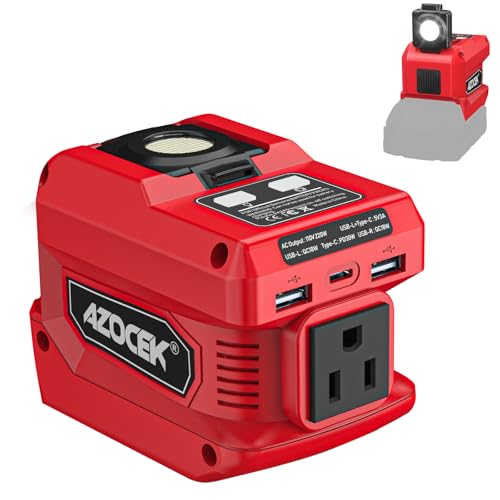
Azocek 220W inverter for Milwaukee 18V batteries
220W18V tool battery30W USB-CTwo 18W USB-A
Check price on Amazon
Best for: Campers who already own Milwaukee 18V batteries and want power without a vehicle.

This one turns a cordless-tool battery into an AC outlet. It is built to accept Milwaukee 18V batteries and converts 18V DC into 110V to 120V AC, with one AC outlet, two 18W QC USB-A ports and a 30W USB-C port. The battery is not included, so the value depends on whether you already own the pack.

The appeal at a campsite is independence from the vehicle. A tool battery can power a laptop, a phone or a light for a while with no engine running, no clamps and no cable to a car. The tradeoff is capacity: an 18V pack of a few amp-hours stores a few dozen watt-hours, so it suits short charges and not all-night loads.

Ownership is simple. Charge your battery before the trip, carry a spare, and keep the inverter dry. The single AC outlet limits you to one device at a time. It sits at a low tier in the price ordering, and if you already own the battery platform it is cheap insurance. Anyone who does not own a compatible battery should look at the 12V units above.

What works

  • Runs from a Milwaukee 18V battery you may already own
  • 30W USB-C and two 18W USB-A ports
  • No vehicle or clamps needed
  • Small and light for a backpack

Watch out for

  • Battery is not included
  • Single AC outlet limits simultaneous use
  • Battery capacity limits runtime to short charges

Spec sheet

Rating
220W
Power source
Milwaukee 18V battery
AC outlet
One
USB-A
Two 18W QC
USB-C
30W
05
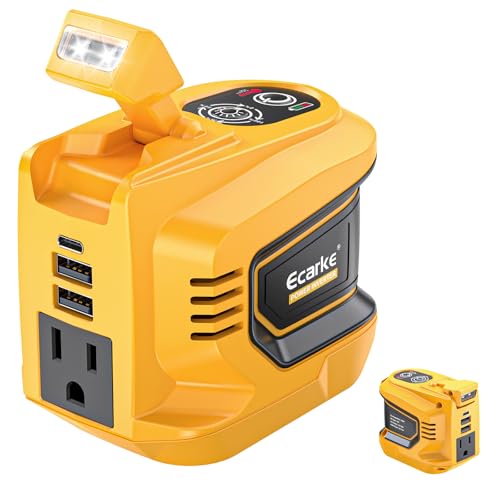
Ecarke 200W inverter for DeWALT 20V batteries, LED light
200W continuous250W peak20V tool batteryBuilt-in LED
Check price on Amazon
Best for: Campers who already use DeWALT 20V batteries and want a lightweight AC outlet with a light.

Ecarke weighs 0.68 pounds, less than a water bottle, and runs from a DeWALT 20V battery pack. It delivers 200W continuous and 250W peak at 110 to 120V AC, enough for laptops, tablets, phones, LED lights, mini projectors and camera chargers. The peak figure is modest at 250W, so a motor load of any size is out.

The built-in 200 lumen LED with low, medium and high settings and an 85 degree tilt is a surprise bonus. At a campsite it doubles as a work light, a handy extra when you are fixing a flat tire or finding a tent peg at night. That makes it more than a gadget and keeps the pack in the bag instead of two separate items.

As with the Milwaukee version, battery capacity is the limit, so bring a spare and keep the inverter dry. If you do not own DeWALT 20V batteries, it makes little sense. If you do, it is the lightest way to get AC power at a remote site, and it beats any 12V unit on weight and simplicity.

What works

  • Weighs 0.68 lb and fits a tool bag
  • 200W continuous and 250W peak from a DeWALT 20V battery
  • Built-in 200 lumen LED with three settings
  • No vehicle needed

Watch out for

  • Battery is not included
  • 250W peak rules out most motors
  • Runtime depends on a small battery pack

Spec sheet

Continuous output
200W
Peak output
250W
Power source
DeWALT 20V battery
Weight
0.68 lb
Light
200 lumen LED

Spec sheet decoder

What the numbers on the box really mean

The specs manufacturers lead with, translated into what they tell you about real-world performance.

Continuous watts

The load an inverter can carry for hours. It decides what you can plug in.

Watch forThe Azocek 220W and Ecarke 200W run only small loads.

Peak watts

A brief startup allowance of a second or two. It is not a running limit.

Watch forThe Ecarke's 250W peak and the Pro Chaser's 800W peak are startup figures.

Input voltage

The DC supply the inverter expects: 12V, 18V or 20V depending on the model.

Watch forThe Azocek wants an 18V battery and the Ecarke a 20V battery, never a 12V source.

Pure sine

A smooth AC waveform matching grid power.

Watch forThe BELTTT 2000W states it.

Remote

A switch on a cable or wireless link that turns the inverter on and off.

Watch forThe BELTTT includes a 23ft wired remote.

Methodology

How We Evaluated These Camping Inverters

Fit to the campsite

We matched each unit to realistic camp loads: phones, a laptop, a CPAP, a blender. The Bestek 300W and Pro Chaser 400W suit devices, while the BELTTT 2000W suits appliances. A tool-battery unit is a niche pick.

Power source flexibility

We counted how many ways each unit can be powered. The tool-battery models need no vehicle at all, which adds independence. The 12V units need a car or a bank.

Waveform and compatibility

The BELTTT 2000W was credited for stating pure sine. Others were scored as modified sine. Sleep and computing gear raise the stakes.

Battery friendliness

We looked at idle draw, remote switching and cable options. The BELTTT's remote saves capacity. Tool-battery units are limited by pack size, so we penalised them for runtime.

Portability

Weight and size matter on a hike-in site. The Ecarke at 0.68 lb is the lightest, and the BELTTT is the heaviest. We scored accordingly.

Decision guide

How to Choose the Right Camping Inverters

By Power Source

SituationPickWhy
Car socket, phones and laptopBestek 300WiPhone-sized with cord
Car socket, more headroomPro Chaser 400W800W peak and long cord
Large battery bank in a vanBELTTT 2000WPure sine with remote
Milwaukee 18V batteryAzocek 220WRuns from the pack
DeWALT 20V batteryEcarke 200WRuns from the pack, with a light

By Budget

SituationPickWhy
Lowest outlayBestek 300WLow tier, simple
Low tier with tool batteryAzocek 220WCheap if you own the pack
Low tier with a lightEcarke 200WLED included
Lower-middle with more headroomPro Chaser 400W400W and 800W peak
Upper tier for appliancesBELTTT 2000WPure sine at 2000W

Vehicle-Powered vs Tool-Battery-Powered

Vehicle-powered

The Bestek 300W, Pro Chaser 400W and BELTTT 2000W draw from a car or bank. They offer more power and longer runtime, but they tie you to the vehicle and risk draining the starter battery.

Tool-battery-powered

The Azocek 220W and Ecarke 200W run from a pack you carry. They are light and independent, but runtime is short and the battery is not included.

Choose vehicle power for longer use, tool batteries for short charges away from the car.

Trip Style

SituationPickWhy
Drive-up weekendPro Chaser 400WSimple plug-in hub
Backpacking from a trailheadEcarke 200W0.68 lb and a light
Long van tripBELTTT 2000WRemote and clean power
Hunting camp with tool batteriesAzocek 220WUses Milwaukee packs
Road trip with a laptopBestek 300WCord and USB ports

For a Laptop Specifically

Look for

A continuous rating above the laptop brick's draw, which is usually 45 to 100W, and a USB-C PD port if your laptop supports it. A USB-C port at 30W trickles a laptop, while a 65W port charges it directly.

In this comparison

The Bestek 300W and Pro Chaser 400W both run a laptop brick from a car. The Azocek 220W has a 30W USB-C port and runs a laptop from a tool battery for a short while.

When to Spend More

Spend more if

You travel in a van with real appliances or sleep on a CPAP. The BELTTT 2000W gives clean power and a remote that saves battery.

Save if

You only charge phones and a laptop. The Bestek 300W covers it at the lowest tier, and the tool-battery units are cheap if you already own the packs.

Ownership

Maintenance schedule

The upkeep that decides whether this machine lasts two seasons or ten.

TaskIntervalWhy it matters
Clean vents and socketsEvery tripDust and pine needles block airflow. A quick brush keeps fans working, and a clogged fan is the most common reason a small inverter cuts out in warm weather.
Check cables and clampsEvery 3 monthsLoose clamps cause heat at high current. Re-tighten and check insulation.
Charge tool batteriesBefore each tripLithium packs self-discharge. A pack stored empty can be damaged, and a pack left fully charged in a hot car ages faster than one kept cool.
Store dryOff seasonMoisture corrodes terminals. Store indoors with vents covered and cables coiled loosely, so the insulation does not crack over the winter.
Switch off or unplugEvery stopIdle draw empties a battery. Make it a habit at the end of use, especially with a lighter socket that stays live after the key is out.

FAQ

Frequently Asked Questions

What size camping inverter do I need?

Most campers need 300 to 400W for phones and a laptop. A 2000W unit is for appliances like a blender. Add your loads and add 20 percent. Bigger units idle higher, so oversizing costs battery even when nothing is plugged in.

Can I run an inverter from a tool battery?

Yes, with a model built for it, like the Azocek for Milwaukee 18V or the Ecarke for DeWALT 20V. Runtime is short because the packs are small. A 5Ah pack holds about 90Wh, so a 45W laptop brick gets roughly one to one and a half hours after conversion losses.

Will a car inverter drain my starter battery?

Yes if it is on with the engine off. A lighter socket often stays live, so unplug the unit when you leave the car.

Is pure sine necessary for camping?

For a CPAP or sensitive electronics, yes. For phones, lights and basic chargers, no. The BELTTT 2000W states pure sine.

Can I use the lighter socket for a kettle?

No. A kettle draws around 1000W, while a socket supports 120 to 180W. Use clamps on a large battery or a stove. A camp stove is also cheaper to run than any battery system for cooking.

How long will a battery last?

A 100Ah lithium battery holds about 1200Wh. A 100W load lasts roughly ten hours after losses, and a 1000W load about an hour. These are best-case figures, since idle draw and cable losses trim them further.

Bottom line

The short version

Browse more camping inverterson Amazon →
James Miller, Lead Machine Editor

About the author

James Miller

Lead Machine Editor, MachineFanatic

James Miller leads MachineFanatic's buying guides, turning spec sheets, manuals and owner feedback into clear verdicts on power tools, outdoor power equipment, shop machines and kitchen machines.

More from James →

Keep reading

Related guides