
Amazon affiliate links - we earn a commission.Affiliate disclosure

Buying guide · 12 min read · Updated 2026-11-07

Best Power Inverters Under $75 (2026)

Four 12V power inverters under $75, from 75W lighter-socket units to a 750W battery-clip model, with honest limits on what each can run.

James MillerBy James MillerLead Machine Editor4 machines comparedSpec-sheet verified
Best Power Inverters Under $75

At a glance

Our top picks

Side by side

Spec comparison

A cheap inverter is a simple device: a switching circuit that turns battery direct current into household-style alternating current. At the low end the circuit is a stepped approximation of a sine wave, which is fine for chargers and lights but unkind to motors and audio equipment.

The real decision is not features but connection. A lighter socket limits you to charger-sized loads no matter what the label says, while clamps on the battery open up tools and small appliances. Listing prices move, and the $75 cap reflects prices when this guide was updated on 2026-11-07.

Before you buy

6 Criteria to Look For Before Buying a Power Inverter Under $75

  1. 01

    Continuous watts, not peak

    Continuous output is what the inverter can hold for hours, while peak covers a surge lasting a second or two. A laptop charger needs about 65W steady, so a 75W unit like the BESTEK or Amazon Basics covers it with little headroom. The common mistake is reading the 1500W peak on the Ampeak or the 1000W peak on the MOVFFGGRM as usable power. Size to the continuous number and add 20 percent margin.

  2. 02

    Lighter socket versus battery clamps

    A vehicle lighter socket is fused at roughly 10 to 15A, which is 120 to 180W at 12V. That means the 75W units fit comfortably, while the 500W MOVFFGGRM and 750W Ampeak cannot reach full output through the socket. Anything above about 150W should be connected directly to the battery with fused leads. Buyers who plug a 500W unit into the socket usually find the fuse blowing as soon as a real load starts.

  3. 03

    Waveform and what it runs

    Every unit here is modified sine class, a stepped approximation of the grid waveform. It runs chargers, lights and simple tools, but can make motors run hot, cause audio hum and confuse some battery chargers. If your load has a motor, a dimmer or a medical function, move up to a pure sine unit in a higher budget band. Check the device label before plugging it in.

  4. 04

    USB ports are not free power

    USB outputs are a separate small converter inside the case, and their rating is shared. The BESTEK splits 3.1A across two ports, the Amazon Basics gives one port 2.1A, and the Ampeak lists 2.4A per port. A tablet that wants 2.4A will charge slowly on a shared port. If fast phone charging matters, count the amps, not the number of ports.

  5. 05

    Fuses and protection

    A fuse protects the wiring, not the inverter, and a blown fuse is a normal event, not a failure. The Ampeak lists two replaceable 50A external fuses, which makes field repair simple. The smaller units usually hide the fuse in the plug. Whatever you buy, carry spares of the exact rating and never substitute a larger one.

  6. 06

    Battery draw and engine state

    DC current is AC watts divided by 12, plus losses, so a 500W load pulls roughly 45 to 50A from the battery. A starting battery cannot sustain that for long with the engine off. Run the engine for anything above a phone charger, or use a deep-cycle battery. A low-voltage shutdown protects the battery, but it is a last resort, not a plan.

Detailed reviews

The 4 best power inverters under $75, explained

01
Ampeak 750W inverter, 1500W peak, clip cable, 2 AC, 2 USB
750W continuous1500W peak2 AC outlets2 USB ports
Check price on Amazon
Best for: Small tools, laptops and chargers off a battery with clip leads.

This is the only unit in the lineup built to be wired straight to a battery as well as plugged into a lighter socket, and that is what separates a real 750W continuous rating from a phone-charger class device. It ships with a battery clip cable for heavy loads and a plug cable for light ones, and the listing calls out two replaceable 50A external fuses. The listing never claims pure sine wave, so treat the AC side as modified sine, which suits chargers, lights and simple tools better than audio gear.

At 750W continuous and 1500W peak it has ten times the capacity of the two 75W units here and 250W more than the MOVFFGGRM 500W. That capacity is only usable on the clip cable, because a lighter socket tops out near 120 to 180W. If your loads stay under 150W the BESTEK 75W is the more convenient choice, but if you want a drill charger and a laptop running together this one wins.

Ownership is straightforward: keep the clip leads short, keep the terminals tight, and carry a spare fuse of the same 50A rating. Inverters of this size shed heat through a fan or heatsink, so keep the vents clear and do not idle it for hours with the engine off.

What works

  • Battery clip cable makes the full 750W reachable
  • Two replaceable 50A fuses are easy to service
  • Two AC outlets plus two USB ports at 2.4A each
  • Ten times the capacity of the 75W units here

Watch out for

  • Modified sine output is rough on motors and audio gear
  • Full power needs clamps on the battery, not the lighter socket
  • Heaviest and bulkiest pick in this lineup

Spec sheet

Continuous output
750W
Peak output
1500W
AC outlets
2
USB ports
2 at 2.4A each
Input options
Battery clips or 12V socket
02
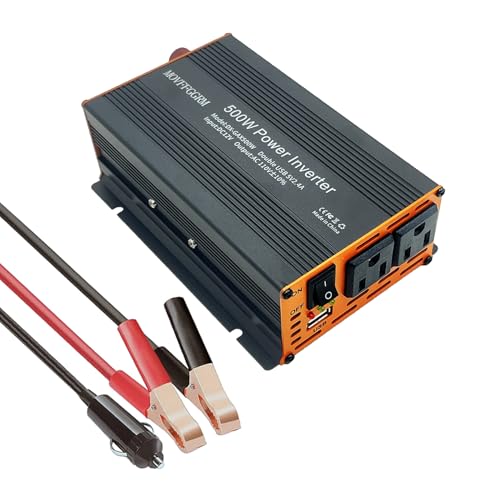
MOVFFGGRM 500W modified sine inverter, 1000W peak, 2 AC
500W continuous1000W peak2 AC outlets1 USB port
Check price on Amazon
Best for: Two small loads at once when you want mid capacity for less.

This unit lists 500W continuous and 1000W peak, with two AC outlets and one USB output, fed from a 12V socket or by wire. The waveform is modified sine, which the listing states plainly and which is the right expectation at this class. Protection is listed against overheating, over and under voltage, short circuit and overload.

That is more than six times the capacity of the 75W units and 250W below the Ampeak 750W, so it sits in the middle of the lineup. The wiring route matters, because anything above about 150W should not run through a lighter socket. Pick it when you want two outlets for small tools or a cooler without moving up to the highest price tier here.

It comes from a lesser-known brand, so inspect the leads and any fuse before the first real load. Replace a blown fuse only with the same rating, and check what support the seller offers before you need it.

What works

  • 500W continuous is six times the 75W units
  • Two AC outlets handle a charger and a small tool
  • Listed protections cover heat, voltage and shorts
  • Mid price tier undercuts the 750W Ampeak

Watch out for

  • Modified sine output limits what it can run well
  • Lesser-known brand means thin support history
  • Only one USB port for phones and tablets

Spec sheet

Continuous output
500W
Peak output
1000W
Waveform
Modified sine
AC outlets
2
USB ports
1
03
BESTEK 75W inverter, pivoting head, 1 AC, 3.1A dual USB
75W continuous200W peak1 AC outlet3.1A dual USB
Check price on Amazon
Best for: Charging one laptop and a phone in the car.

BESTEK builds this around a lighter-socket plug with a pivoting head, so the body can be angled away from the console and seat. It delivers 75W continuous with a peak figure around 200W, one AC outlet and two USB ports sharing 3.1A. At 75W it is sized for one laptop brick or a camera charger, not a power tool.

The pivoting head is the practical difference from the Amazon Basics 75W, which has one AC outlet and a single USB port at 2.1A. USB capacity is where this one pulls ahead, with 3.1A combined against 2.1A. Neither can run anything that heats, since a 75W ceiling is far below a hair dryer or kettle.

Because it draws from the lighter socket, the socket fuse is the real limit and this unit stays well inside it, so pull the plug when parked since an idle inverter still draws standby current. Heat is a non-issue at this wattage, so the case stays cool on short trips.

What works

  • Pivoting head keeps the body out of the way
  • Two USB ports share 3.1A for phone and tablet
  • Stays inside the lighter socket fuse limit
  • Compact enough to live in a glovebox

Watch out for

  • 75W ceiling rules out any tool or heating load
  • Only one AC outlet
  • Costs more than the Amazon Basics 75W for small gains

Spec sheet

Continuous output
75W
Peak output
About 200W
AC outlets
1
USB ports
2, 3.1A combined
Input
12V lighter socket
04
Amazon Basics 75W car inverter, 1 AC outlet, 1 USB port
75W continuous1 AC outlet1 USB at 2.1A12V socket
Check price on Amazon
Best for: A single charger on the lowest budget.

This is the plainest design in the lineup: a 75W continuous inverter with one AC outlet and one USB port rated to 2.1A, plugged into a 12V socket. There is no pivot, no second USB port and no surge figure worth chasing. Its job is to run a single laptop charger or phone charger on a road trip or during an outage.

It is the cheapest pick in the lineup, and the trade is capability. The BESTEK 75W adds a pivoting head and 3.1A combined USB output for a modest step up, and against the MOVFFGGRM 500W it gives up 425W of capacity. Pick it when your loads are one charger at a time and budget matters most.

Ownership is nearly zero upkeep, with no clamp leads and no external fuse to replace. Keep the cord slack so a tug does not pull the plug partly out of the socket, since a loose contact heats the plug first.

What works

  • Lowest price tier in this lineup
  • Nothing to wire and nothing to service
  • One AC outlet runs a laptop or phone charger
  • Simple plug-in design with no setup

Watch out for

  • Only 75W, so no tools and no heating loads
  • One USB port at 2.1A is slow for tablets
  • No pivoting head, so the body can crowd the console

Spec sheet

Continuous output
75W
AC outlets
1
USB ports
1 at 2.1A max
Input
12V lighter socket
Best use
One charger at a time

Spec sheet decoder

What the numbers on the box really mean

The specs manufacturers lead with, translated into what they tell you about real-world performance.

Continuous watts

The steady power the inverter can supply without overheating. This is the only wattage that determines what you can run.

Watch forThe Ampeak at 750W and the Amazon Basics at 75W differ tenfold, so make sure the number matches the job.

Peak or surge watts

A brief overload allowance for the startup of motors and some chargers. It often lasts well under a second.

Watch forThe MOVFFGGRM lists 1000W peak against 500W continuous, which only helps a short spike.

Modified sine wave

A stepped waveform that approximates the grid sine curve. It is cheaper to build and fine for resistive and charger loads.

Watch forAll four picks here are in this class, so avoid motor and audio loads.

USB amperage

The maximum current a USB port can deliver at 5V. Higher amps mean faster charging for tablets and phones.

Watch forThe Amazon Basics caps at 2.1A while the BESTEK shares 3.1A across two ports.

Input connection

How the unit gets its DC power, either a lighter plug or clamp cables. The connection sets the real power ceiling.

Watch forOnly the Ampeak ships with both a clip cable and a plug cable.

Methodology

How We Evaluated These Power Inverters Under $75

Real capacity

We evaluated continuous output first and treated peak figures as secondary. The lineup spans 75W to 750W, so capacity decides what each unit can plausibly run. A unit whose headline number is mostly surge scored lower than one with honest continuous output.

Connection quality

We evaluated how each unit connects, because the connection sets the true limit. A lighter plug caps useful output around 150W, while clip cables allow the full rating. The Ampeak's dual-cable design scored well for that reason.

Outlet and USB layout

We evaluated whether the ports match typical loads, based on the spec sheet and owner feedback patterns. Two AC outlets on the MOVFFGGRM and Ampeak suit multiple devices, while one outlet suits a single charger. USB amperage counted more than port count.

Protection and serviceability

We looked at listed protections and whether the fuse is accessible. External replaceable fuses make a blown fuse a two-minute fix, while hidden fuses can end a unit's life. Overheat, overload and voltage cutouts were treated as the baseline.

Value inside the cap

We evaluated how much usable capacity each unit offers relative to its price tier. The 75W units are cheapest but offer the least, while the Ampeak 750W offers ten times that at the top tier. Value meant useful watts, not the lowest sticker.

Decision guide

How to Choose the Right Power Inverters Under $75

By What You Plug In

SituationPickWhy
One laptop charger on a tripBESTEK 75WPivoting head and 3.1A of USB for a phone as well
Phone charging onlyAmazon Basics 75WEnough output at the lowest price tier
A cordless drill charger plus a laptopMOVFFGGRM 500WTwo outlets with 500W continuous
Small tools or a cooler from a batteryAmpeak 750WClip cable reaches the full 750W

By Budget

Budget tierPickWhy
Lowest in the lineupAmazon Basics 75WCheapest, no extras, no wiring
Low to middleBESTEK 75WA small step up for the pivoting head and USB
MiddleMOVFFGGRM 500WSix times the capacity of the 75W pair
Top of the capAmpeak 750WHighest real capacity and serviceable fuses

Lighter Plug vs Battery Clamps

Lighter plug

The Amazon Basics 75W and BESTEK 75W are built for the socket. They stay inside the 10 to 15A socket fuse, need no wiring, and fit charger-sized loads. The limit is hard: nothing above about 150W belongs there.

Battery clamps

The Ampeak 750W and MOVFFGGRM 500W can use heavier leads for real capacity. You get tool-sized power, but you must route and fuse the cables and keep them short. Voltage drop in thin cable can trigger early shutdown.

Choose the plug units if every load is under 100W. Choose the Ampeak or MOVFFGGRM if you ever need more.

By Number of Outlets

PreferencePickWhy
One AC outlet is enoughAmazon Basics 75WSingle outlet and single USB
One outlet plus strong USBBESTEK 75W3.1A shared across two ports
Two outlets, light useMOVFFGGRM 500WTwo outlets at mid capacity
Two outlets plus two USB portsAmpeak 750WMost ports and the most capacity

For Road Trips and Camping Specifically

Look for

Look for a continuous rating that matches your largest single load, and check how the unit connects. Camp setups often add a cooler or a fan, which are small motor loads that dislike modified sine. Keep loads modest and the engine running when drawing more than a charger.

In this comparison

The Ampeak 750W is the most flexible because the clip cable lets it run a small cooler and a laptop together. The BESTEK 75W covers pure charging needs with the fewest cables. Neither suits a coffee maker, which draws far more than either can supply.

When to Spend More

Spend more if

You need to run a motor, a medical device or a laptop for hours daily. Move out of this band into a pure sine unit; the BESTEK and Amazon Basics at 75W will not carry a motor, and the modified sine Ampeak will run it hot.

Save if

Your loads are chargers under 75W. The Amazon Basics 75W does exactly that at the lowest tier, and the extra capacity of the MOVFFGGRM 500W would go unused.

Ownership

Maintenance schedule

The upkeep that decides whether this machine lasts two seasons or ten.

TaskIntervalWhy it matters
Inspect plug and cable endsMonthlyA loose plug or frayed lead causes heat and voltage drop. Wiggle the plug in the socket and replace anything that looks scorched.
Check clip terminalsEvery few usesClip leads loosen with vibration. A loose clamp arcs and heats, so tighten and clean the contact.
Replace blown fusesAs neededA blown fuse is a normal event. Replace it with the exact rating, never a larger one.
Clear vents and fanEvery seasonDust blocks airflow and raises temperature. Blow it out gently with compressed air.
Unplug when parkedEvery timeAn idle inverter still draws standby current. Over days it can drain a weak starting battery.

FAQ

Frequently Asked Questions

Can a lighter socket run a 500W inverter?

Not at full power. A socket is fused around 10 to 15A, which caps real output near 120 to 180W. For a 500W or 750W unit use clamps on the battery.

What can I run on the 75W inverters?

Phone chargers, laptop chargers, camera chargers and small LED lights. Anything with a heating element or a motor is outside their range.

Is a cheap inverter safe for a laptop?

Usually yes, since laptop chargers tolerate modified sine output. Keep the load within the rated continuous watts and give the unit airflow.

Does peak wattage matter?

Only for a short startup spike. The 1500W peak on the Ampeak does not mean it can run a 1500W load, and continuous output decides what you can run.

Will an inverter drain my car battery?

Yes, if used with the engine off. Even small loads draw steady current, so run the engine for anything bigger than a phone charger.

Which of these is best for emergencies at home?

The Ampeak 750W with clip leads on a charged battery is the most capable here. Keep expectations modest: it runs chargers and a light, not a refrigerator.

Bottom line

The short version

Browse more power inverters under $75on Amazon →
James Miller, Lead Machine Editor

About the author

James Miller

Lead Machine Editor, MachineFanatic

James Miller leads MachineFanatic's buying guides, turning spec sheets, manuals and owner feedback into clear verdicts on power tools, outdoor power equipment, shop machines and kitchen machines.

More from James →

Keep reading

Related guides