
Amazon affiliate links - we earn a commission.Affiliate disclosure

Buying guide · 13 min read · Updated 2026-11-13

Best Car Inverters for Camping (2026)

Five car inverters for camping, from a 150W credit-card unit to a 1000W battery-clamp box, compared on real output, USB-C power and engine-off battery drain.

James MillerBy James MillerLead Machine Editor5 machines comparedSpec-sheet verified
Best Car Inverters for Camping

At a glance

Our top picks

Side by side

Spec comparison

Car camping turns the vehicle into the power station, and that creates a trade that most buyers underestimate. The inverter is only as good as the battery behind it, and a starter battery is built for a short burst, not for powering a campsite overnight.

The sensible approach is to match the inverter to the loads and to the way you will use the engine. Small devices belong on a plug-in unit, anything heavier needs a battery connection, and the choice of ports can matter more than the headline wattage.

Before you buy

6 Criteria to Look For Before Buying a Car Inverter for Camping

  1. 01

    Engine on or engine off

    A starter battery is built for a short, heavy burst, not a long draw. A 100W load for a few hours is fine, but a 1000W load flattens it in minutes. With the engine off, keep loads small. With the engine running, the alternator can support a heavy load, which is when the 1000W LCD unit makes sense. A good habit is to run the engine for fifteen minutes before and after any heavy use, so the battery stays topped up.

  2. 02

    Lighter socket versus clamps

    A lighter socket is fused at 10 to 15A, so real output is about 120 to 180W. The FOVAL 150W is honest about that, while the 500W YSOLX and 400W Pro Chaser carry larger labels. Only the 1000W LCD unit connects to the battery for real power. Anything above about 150 to 200W belongs on clamps and a fuse.

  3. 03

    USB-C power for laptops

    A laptop that charges over USB-C at 45 to 65W saves the inverter loss. The Pro Chaser 400W's 65W port is the only one in the lineup that reaches that range. The 1000W unit's 36W port trickles a laptop and the YSOLX has no PD port. Check your laptop's charger label for the wattage before you decide.

  4. 04

    Honest ratings

    Many plug-in listings advertise watts the socket cannot deliver. Look at how each states it: the FOVAL says 150W, the Pro Chaser gives 400W with 800W peak, and the YSOLX says only 500W. A listing that names realistic loads, like lights, routers and fans, is more trustworthy, because the seller has at least thought about the real use case.

  5. 05

    Cord versus fixed body

    A cord lets the inverter rest on a seat or a cooler. The Pro Chaser has a 30-inch cord and the Bestek 300W has a 32-inch cord. A fixed body hanging off the socket levers against it on every bump, and over a season that wears the plug and the socket spring.

  6. 06

    Display and diagnostics

    At 1000W, a mystery shutdown is hard to diagnose. The 1000W LCD unit shows fault codes and voltage, which helps tell a weak battery from a thin cable. Smaller units have no display, which is acceptable at 150 to 400W because the loads are small and the failure modes are simple.

Detailed reviews

The 5 best car inverters for camping, explained

01
Pro Chaser 400W inverter, 800W peak, PD 65W USB-C, 30in cord
400W continuous800W peak65W USB-C PD30in cord
Check price on Amazon
Best for: Car campers who work or stream from a laptop and charge phones and cameras.

Laptop charging is where the Pro Chaser stands apart, because its 65W USB-C port changes what a car inverter is for. Most modern laptops charge at 45 to 65W over USB-C, so this Pro Chaser feeds a laptop directly with no AC conversion at all, saving the 10 to 15 percent that an inverter normally burns as heat. The dual 110V AC sockets stay free for a camera charger or a lamp.

The unit is rated 400W continuous with 800W peak and connects through the cigarette lighter. That is the honest limit: the lighter socket's 10 to 15A fuse allows about 120 to 180W in real use, so the 400W label is thermal headroom. The 30-inch cord lets the body rest on a seat or a cooler instead of hanging from the dash.

The body is cellphone-sized, which keeps it easy to pack. Because a lighter socket often stays live with the engine off, always unplug it when leaving the car. If your camp loads are a laptop, a phone and a headlamp charger, this is the most useful box here. For anything with a motor, use a battery-connected unit instead.

What works

  • 65W USB-C PD charges many laptops directly
  • Dual 110V AC sockets stay free for other gear
  • 800W peak with 400W continuous is stated plainly
  • 30-inch cord lets the body rest on a seat

Watch out for

  • Real output limited by the lighter socket fuse
  • Waveform is not stated
  • Fixed plug can wear a loose socket

Spec sheet

Continuous output
400W
Peak output
800W
USB-C
PD 65W
AC sockets
Dual 110V
Cord
30 inches
02
YSOLX 500W inverter, dual 24W USB, 2 AC outlets
500W2 AC outletsDual 24W USBLighter plug
Check price on Amazon
Best for: Campers running lights, a router and a fan from the car.

YSOLX pitches this unit at road trips, camping and outdoor work, with two AC outlets and dual 24W USB ports. The listing says the AC sockets suit appliances below a rated power, and it names lights, routers and fans as typical loads. That is a sensible and honest list for a plug-in unit.

It carries a 500W label, which on a lighter socket cannot be reached, so read it as headroom for a cooler-running circuit. A fan and a router together draw well under 100W, which sits comfortably inside the socket limit. A laptop brick adds another 60 to 90W, which is about the ceiling.

The dual 24W USB ports charge phones quickly. No PD port is listed, so a laptop must use the AC side. It sits in the middle of the price tiers. If you are choosing between this and the Pro Chaser, the Pro Chaser wins for laptops and the YSOLX is a fine choice if your loads are lights and a router. Check the plug fit each trip, and unplug when parked.

What works

  • Dual 24W USB ports charge phones fast
  • Two AC outlets for lights and a fan
  • Listing names realistic loads
  • Middle price tier

Watch out for

  • No PD USB-C port
  • 500W label cannot be reached from the lighter socket
  • Waveform is not stated

Spec sheet

Rating
500W
AC outlets
2
USB
Dual 24W fast charge
Connection
Lighter plug
Loads named
Lights, routers, fans
03
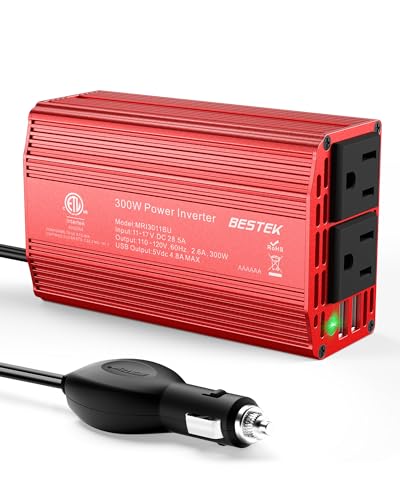
Bestek 300W inverter, 12-17V input, 32in cord, dual USB
300W12-17V input32in cord2x4.8A USB
Check price on Amazon
Best for: Campers who want a low-cost spare inverter for the glove box.

iPhone-sized is how the listing describes this Bestek, and that is accurate. It slides into the lighter socket, offers two AC outlets and two 4.8A USB ports, and comes with a cord of about 32 inches. The widened 12 to 17V input range helps with vehicles whose sockets run higher than a traditional 12V system.

The listing aims it at vacations, work trips and camping, which is exactly where it fits. It charges phones, tablets and a laptop brick in a car. The limit is the same as everywhere in the plug-in class: the socket fuse caps real output near 120 to 180W.

The tier is low, and the price is the draw. In ownership terms, keep it out of the sun, clean the socket contacts and pull it when you park. If you need USB-C power for a laptop, the Pro Chaser is better. If you need clean power for a CPAP, this is not the unit. For a spare charger kept in a glove box year-round, it is a quiet, dependable choice.

What works

  • 12 to 17V input suits newer vehicles
  • Two 4.8A USB ports charge devices quickly
  • 32-inch cord rests the body on a seat
  • Low tier in the price ordering

Watch out for

  • Real output capped by the socket fuse
  • No PD USB-C port
  • Not suited to a CPAP

Spec sheet

Rating
300W
Input range
12V to 17V
AC outlets
2
USB
Two 4.8A ports
Cord
About 32 inches
04
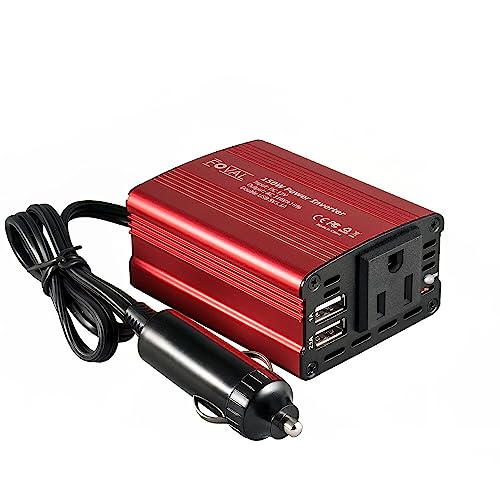
FOVAL 150W inverter, credit-card size, 3.1A dual USB
150W continuous3.1A dual USBCredit-card sizeAluminum case
Check price on Amazon
Best for: Tent campers who need a tiny AC outlet for a laptop or camera charger.

Credit-card size sums up the FOVAL: 3.2 by 2.5 by 1.5 inches, with an aluminum body that doubles as a heat sink. It offers 150W of continuous AC and dual USB ports that share a maximum of 3.1A. That 150W figure is honest in a way many listings are not, since it matches what a lighter socket can really deliver.

The cost is low, at the cheapest tier in this group, and so is the capability. A laptop brick or a camera charger works; a drill charger or a heater does not. Because the unit is so small, it tucks into a door pocket or a tent bag without notice.

For a tent camper whose real needs are a phone, a camera battery and a headlamp, it is the right size. Pull it out when parked, keep it dry and clean the socket occasionally. If the AC side ever trips, check the socket fuse. For bigger loads, none of the smaller ones in this guide will do and you should look at the 1000W unit.

What works

  • Honest 150W rating matches the lighter socket limit
  • Credit-card size fits a door pocket
  • Aluminum body sheds heat
  • Cheapest tier of the five

Watch out for

  • Cannot run any heavier load
  • USB shares 3.1A across both ports
  • No PD USB-C port

Spec sheet

Continuous output
150W
USB
Dual, 3.1A total
Size
3.2 x 2.5 x 1.5 inches
Body
Aluminum
Connection
Lighter plug
05
1000W LCD car inverter, 2 AC, 36W USB-C
1000W continuous2000W peakLCD fault codes36W USB-C
Check price on Amazon
Best for: Campers running a blender or tool chargers from the car with the engine on.

Moving up to 1000W means leaving the lighter socket behind. This unit connects to the battery and offers 1000W continuous with 2000W of surge, two AC outlets, a 36W USB-C port and a 5V/3A USB port. Its LCD reports input and output voltage, battery status and fault codes: OL for overload, HI for high voltage and LO for low voltage.

The LCD is what makes it good for camping. When the engine is off and the battery sags, the screen shows it, and the LO code tells you to start the car before the unit shuts down. At full load it draws roughly 90 to 100A from a 12V source, so it needs heavy cable and a fuse near the battery.

The tier is upper-middle. It does not state a waveform, so treat it as modified sine and keep sensitive electronics away. If you want to power a blender or a tool charger at a campsite with the engine running, it fits. If your needs stop at a laptop, the Pro Chaser is simpler and cheaper.

What works

  • 1000W continuous with 2000W surge
  • LCD shows voltage and fault codes
  • 36W USB-C port plus a 5V/3A port
  • Battery-clamp connection delivers real power

Watch out for

  • Waveform not stated
  • Needs heavy cable and a fuse
  • Drains a starter battery quickly

Spec sheet

Continuous output
1000W
Peak surge
2000W
Display
LCD with OL, HI, LO
USB-C
36W
AC outlets
2

Spec sheet decoder

What the numbers on the box really mean

The specs manufacturers lead with, translated into what they tell you about real-world performance.

Continuous watts

The load an inverter can carry for hours. In a plug-in unit the socket fuse sets the real limit.

Watch forThe 500W YSOLX is limited to roughly 120 to 180W in the socket.

Peak watts

A startup allowance of a second or two. It is not a running rating.

Watch forThe Pro Chaser lists 800W and the 1000W LCD unit lists 2000W.

USB PD wattage

The power delivered over USB-C. Higher numbers charge laptops faster.

Watch forThe Pro Chaser leads at 65W.

Input range

The DC voltage the inverter accepts. A wider range suits newer vehicles.

Watch forThe Bestek 300W lists 12 to 17V.

Fault codes

Display messages for overload, high voltage and low voltage.

Watch forThe 1000W LCD unit shows OL, HI and LO.

Methodology

How We Evaluated These Car Inverters for Camping

Realistic output

We scored each unit on whether its connection method can deliver its label. The FOVAL 150W is honest, and the 1000W LCD unit uses battery clamps. Plug-in units labeled above 200W lost points.

Camping fit

We matched each unit to car-camping loads: phones, a laptop, a router, a fan and a blender. The Pro Chaser and YSOLX suit small gear, and the 1000W unit suits a blender with the engine on.

Charging ports

We compared USB output across the lineup, from 3.1A shared on the FOVAL to 65W PD on the Pro Chaser. A fast USB-C port keeps the AC side free.

Battery friendliness

We considered engine-off behavior and idle draw. A small unit like the FOVAL barely taxes a battery, while the 1000W unit can flatten one. Unplugging is the real fix, and a unit with a power switch is a plus.

Portability

We weighed size and cord design. The FOVAL is credit-card sized and the Pro Chaser has a 30-inch cord. The 1000W unit needs a mounting spot with airflow, and a cable run to the battery that does not cross a hot exhaust or a moving part.

Decision guide

How to Choose the Right Car Inverters for Camping

By Load

SituationPickWhy
Laptop and phonePro Chaser 400W65W USB-C charges the laptop directly
Lights, router and a fanYSOLX 500WTwo AC outlets
Phones and a camera onlyFOVAL 150WCredit-card size
Spare for the glove boxBestek 300WLow tier
Blender or tool charger1000W LCD unitBattery-clamp power

By Budget

SituationPickWhy
Cheapest tierFOVAL 150WHonest and tiny
Low tierBestek 300WCord and USB ports
Lower-middle with laptop USB-CPro Chaser 400WPD 65W
MiddleYSOLX 500WTwo outlets and fast USB
Upper-middle for clamp power1000W LCD unitLCD and 1000W

Plug-In vs Battery-Clamp

Plug-in

The FOVAL, Bestek, Pro Chaser and YSOLX use the lighter socket. They are quick and tidy but limited to about 120 to 180W of real output. They suit phones, a laptop and lights.

Battery-clamp

The 1000W LCD unit connects to the battery for real power. It needs heavy cable and a fuse, and it should run with the engine on for heavy loads.

Choose plug-in for devices, and clamps for a blender or tool chargers.

Engine State

SituationPickWhy
Engine off all nightFOVAL 150WTiny draw
Engine off, phones onlyBestek 300WLow idle draw
Engine on, laptop workPro Chaser 400WAlternator supports it
Engine on, heavy loads1000W LCD unitLO code warns of sag
Camp with a routerYSOLX 500WLight continuous load

For Remote Work Specifically

Look for

A USB-C PD port at 45 to 65W so the laptop charges without an inverter, plus an AC outlet for a monitor. A 65W laptop draws about 5.5A at 12V, which sits inside the socket budget.

In this comparison

The Pro Chaser 400W is the match, with a 65W USB-C and dual AC sockets. The YSOLX 500W works through its AC outlets if your laptop has no USB-C.

When to Spend More

Spend more if

You want laptop charging over USB-C or real power with a display. The Pro Chaser 400W and the 1000W LCD unit provide those.

Save if

You only charge phones and a camera. The FOVAL 150W and Bestek 300W cover that at the lowest tiers.

Ownership

Maintenance schedule

The upkeep that decides whether this machine lasts two seasons or ten.

TaskIntervalWhy it matters
Clean socket contactsEvery 6 monthsOxidation raises resistance. A flickering output means a dirty contact.
Clear ventsEvery tripDust and pine needles block airflow. A brush keeps fans working, and a clogged fan is the most common reason a small unit cuts out in warm weather.
Check cables and clampsEvery 3 monthsLoose clamps on the 1000W unit heat at 90 to 100A, so re-tighten and look for discolored plastic.
Unplug after useEvery stopA live socket drains the battery with the engine off.
Check the car fuseWhen output stopsThe socket fuse blows first. Replace with the same rating, and keep a few spare fuses in the glove box, since they cost very little and ending a trip over a blown fuse is avoidable.

FAQ

Frequently Asked Questions

Can I run an inverter overnight from the car?

Only a small load. A starter battery is not built for long draws, so keep it to phones. For more, run the engine or use a separate battery. A common trick is a small deep-cycle battery under the seat for camp loads, leaving the starter battery untouched.

Will a 400W plug-in inverter really give 400W?

No. The lighter socket fuse of 10 to 15A allows about 120 to 180W. For 400W you need battery clamps, which none of the plug-in units here include. Read the label as thermal headroom, not as real power.

Do I need pure sine for camping?

For a CPAP or sensitive electronics, yes. For phones, laptops and lights, no. None of the units here states pure sine. If your machine's manual forbids modified sine, buy a pure sine inverter and clamp it to a deep-cycle battery.

How do I charge a laptop in the car?

Use a USB-C port at 45 to 65W if your laptop supports it, as on the Pro Chaser. Otherwise use the AC outlet with the laptop brick. The brick usually draws 60 to 90W, which fits inside the socket limit.

Why does my inverter shut off?

Common causes are a weak battery, a thin cable or a blocked fan. The 1000W LCD unit shows LO or OL codes to tell which. A blank screen with no output usually means a blown socket fuse in the car, not a dead inverter.

Is a 1000W unit overkill for camping?

For devices, yes. It makes sense only for a blender or tool chargers with the engine running, because the alternator then carries the load instead of the battery.

Bottom line

The short version

Browse more car inverters for campingon Amazon →
James Miller, Lead Machine Editor

About the author

James Miller

Lead Machine Editor, MachineFanatic

James Miller leads MachineFanatic's buying guides, turning spec sheets, manuals and owner feedback into clear verdicts on power tools, outdoor power equipment, shop machines and kitchen machines.

More from James →

Keep reading

Related guides