
Amazon affiliate links - we earn a commission.Affiliate disclosure

Buying guide · 13 min read · Updated 2026-11-13

Best Car Power Inverters for Tesla (2026)

Five 12V inverters suited to Tesla and other newer EVs with a wide 11 to 17V input range, compared on waveform, USB-C power and real socket limits.

James MillerBy James MillerLead Machine Editor5 machines comparedSpec-sheet verified
Best Car Power Inverters for Tesla

At a glance

Our top picks

Side by side

Spec comparison

Electric cars changed one assumption that older inverters were built around. The low-voltage system feeding the dashboard outlet can sit higher than the accessory voltage of a gasoline car, and an inverter with a narrow input window will simply refuse to start there.

That makes the input range a first-tier spec for these cars, ahead of watts. The rest of the choice follows the usual rules: the socket limits real output, waveform matters for sensitive loads, and USB-C ports now do much of the work that an AC outlet used to.

Before you buy

6 Criteria to Look For Before Buying a Car Power Inverter for Tesla

  1. 01

    Wide input range

    Older inverters expect about 12V and cut out above roughly 15V. Newer cars and Teslas can sit higher, so the 11 to 17V range on the Bestek 300W pure sine, the Bestek 150W and the Blubluman 300W avoids nuisance shutdowns. Check this first, because wattage is irrelevant if the unit will not start. A unit that flashes a fault and stays dead in a cold garage is the usual symptom of a voltage mismatch.

  2. 02

    The vehicle outlet limit

    A 12V outlet in a car is a small circuit, typically fused around 10 to 15A, which is about 120 to 180W at 12V. Check your owner's manual for the exact figure. Every unit in this guide lists 150 to 300W, so the practical power is the socket's limit, not the label's. Do not plug in anything heavy because the unit has a large number printed on it.

  3. 03

    Pure sine for sensitive gear

    A CPAP and some laptop supplies run best on pure sine. The Bestek 300W pure sine is the only unit that states it, and the 200W 7-in-1 unit states modified sine. Others are silent, so treat them as modified. A quick feel test on a charger brick after ten minutes will tell you if it is running hot.

  4. 04

    USB-C wattage

    A laptop charging at 45 to 65W over USB-C bypasses the inverter. None of these reaches 65W, but the dual 36W ports on the 7-in-1 unit can charge a small laptop. The 30W ports on the Bestek units suit phones and tablets. Check your laptop's charger label for the wattage it expects.

  5. 05

    Stated surge versus continuous

    The Bestek 300W with 700W surge lists both figures, which lets you size a charger or a small fan. Surge is a one- or two-second startup allowance. A listing that gives only one figure hides the other, which is usually the less flattering one.

  6. 06

    Mounting and strain

    A heavy body hanging from a socket pulls on the contacts with every bump. The Bestek 150W has a back clip and the 7-in-1 unit has a pass-through, both of which are thoughtful. In an EV with a recessed outlet, a compact body is a real advantage, because a long unit sticking out can foul a console lid.

Detailed reviews

The 5 best car power inverters for tesla, explained

01
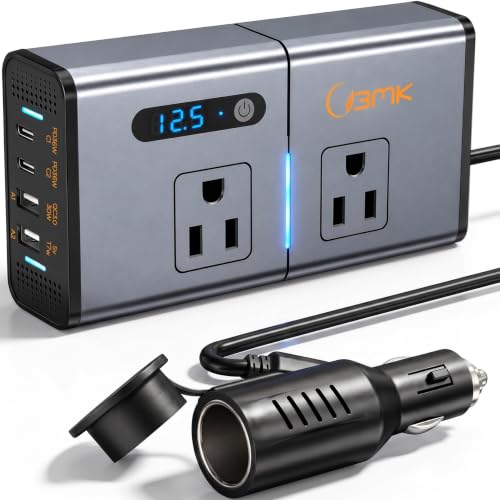
Bestek 300W pure sine inverter, 11-17V input, PD 30W
300W pure sine11-17V input30W USB-C PDPatented body
Check price on Amazon
Best for: Tesla and EV owners who want clean power for a laptop or CPAP.

Two things set this Bestek apart for an EV: a stated input range of 11 to 17V and a pure sine output. The listing says the range was upgraded specifically to suit Tesla and other newer vehicles, which is the single most relevant claim a buyer can look for. A wide input range prevents the nuisance shutdown that older fixed-range units show when the car's auxiliary system sits near the top of its band.

Pure sine at 300W suits a CPAP, a camera charger and a laptop with a sensitive power supply. A PD 30W USB-C port covers phones and tablets without an AC brick. Two AC outlets sit alongside it for a laptop adapter and a lamp.

The ceiling is the usual one: the 12V outlet in a car is a small circuit, so check your owner's manual for its current limit and stay below it. Plan real power at about 120 to 180W regardless of the label. It sits near the top of the price tiers, and its advantages are waveform and range, not capacity. For a Tesla owner who tows a laptop and a CPAP into the backcountry, this is the safest single choice.

What works

  • States an 11 to 17V input range for newer cars
  • Pure sine output suits CPAPs and sensitive chargers
  • PD 30W USB-C charges phones and tablets
  • Two AC outlets for a laptop adapter and a lamp

Watch out for

  • Upper price tier for a small unit
  • Socket current limit still caps real output
  • 30W USB-C is slow for a large laptop

Spec sheet

Continuous output
300W
Waveform
Pure sine
Input range
11V to 17V
USB-C
PD 30W
Fit
Tesla and other newer cars
02
Bestek 300W inverter, 700W surge, PD30 and QC18
300W continuous700W surge30W USB-C PD18W USB-A QC
Check price on Amazon
Best for: Owners who want published continuous and surge figures for a second or older vehicle.

Candor about ratings is the most useful trait in this unit. The listing states 300W of continuous output and 700W of peak surge at startup, which lets you reason about a small charger or a fan without guessing. A surge allowance of more than twice the continuous figure is typical and adequate for a brief inrush.

It carries a PD30 USB-C and a QC18 USB-A port plus two AC outlets, with a high-efficiency circuit and heat-dissipation design. What it does not state is an input range, so do not assume it tolerates a high-voltage EV socket. Check the manual or contact the seller before relying on it in a Tesla.

The tier is moderate, below the pure sine unit. If you own an older gasoline car as well, this is the sensible one to keep there. In an EV, choose the ranged model first. Treat the 300W label as headroom and keep the real load under what the car's socket allows. A well-documented, modest unit is a good fit for a second vehicle.

What works

  • Lists 300W continuous and 700W surge
  • PD30 USB-C and QC18 USB-A ports
  • High-efficiency circuit reduces heat
  • Moderate position in the price tiers

Watch out for

  • No stated EV-friendly input range
  • Waveform not stated
  • Socket current limit still caps real output

Spec sheet

Continuous output
300W
Surge rating
700W
USB-C
PD 30W
USB-A
QC 18W
AC outlets
2
03
Blubluman 300W inverter, 11-17V, Starlink Mini adapter
300W11-17V inputStarlink Mini adapter30W PD, 24W USB-A
Check price on Amazon
Best for: EV campers who run a Starlink Mini from the vehicle.

A bundled Starlink Mini adapter is this unit's unusual feature. Campers who run a small satellite dish from a vehicle often need a specific DC or AC feed, and the listing includes an adapter designed for it. The input range is also stated at 11 to 17V and marked as Tesla compatible, so it ticks the EV box too, which is not guaranteed for the adapter-focused listings in this category.

It offers two 110V AC outlets, a 30W PD USB-C port and a 24W USB-A port in a compact body of 5 by 2.68 by 1.4 inches that weighs 9.03 ounces. The listing aims it at road trips, camping, RV travel and off-grid use, which makes sense for the adapter. Waveform is not stated, so treat it as modified sine.

It sits in the lower-middle tier. A Starlink Mini draws modest power, which a 300W inverter handles easily, but check the dish's own power rating and the car's socket limit before a long session. Over ownership, keep the adapter's connectors clean and dry. It is the clear choice for a connected camper; everyone else should look at the Bestek units.

What works

  • Includes a Starlink Mini adapter
  • 11 to 17V input marked Tesla compatible
  • 30W PD USB-C and 24W USB-A ports
  • Compact 9.03 oz body

Watch out for

  • Waveform not stated
  • Adapter is useful only for Starlink Mini owners
  • Real output limited by the vehicle outlet

Spec sheet

Rating
300W
Input range
11V to 17V
Adapter
Starlink Mini
USB-C
30W PD
Size and weight
5 x 2.68 x 1.4 in, 9.03 oz
04
Bestek 150W inverter, 11-17V, 30W USB-C, 18W USB-A, back clip
150W11-17V input30W USB-C PDBack clip
Check price on Amazon
Best for: EV owners who need a tiny, honest AC outlet for a laptop or camera.

At 4.2 by 2.8 inches with a back clip, this is the smallest unit here, and its 150W rating is the most honest for a vehicle outlet. The listing states an 11 to 17V wide voltage range and describes it as suited to all vehicles, which includes EVs. A 30W PD USB-C and an 18W USB-A port sit beside a single AC outlet.

The back clip is a clever bit of packaging. It lets the unit hang on a vent or a console edge so the cable is not pulling on the socket, a real reliability point in cars where the outlet is in an awkward spot. One AC outlet limits you to a single device at a time, which is fine for a laptop brick.

It sits at the lowest tier, the cheapest of the five. It is the right size for a phone, a laptop and a camera battery, and it stores in a door pocket without being noticed. For a CPAP or anything with a motor, step up to the pure sine unit. For a tidy, honest backup, this is excellent.

What works

  • Honest 150W rating fits the vehicle outlet
  • 11 to 17V input suits EVs
  • Back clip relieves strain on the socket
  • Lowest tier of the five

Watch out for

  • One AC outlet only
  • Waveform not stated
  • Too small for any appliance

Spec sheet

AC output
150W
Input range
11V to 17V
USB-C
PD 30W
USB-A
18W
Size
4.2 x 2.8 inches
05
200W 7-in-1 car inverter, dual 36W USB-C, QC 3.0 30W
200W combinedModified sineDual 36W USB-C7 ports
Check price on Amazon
Best for: Families who need many ports and who confirm the voltage range for an EV.

Seven connections in one body is the pitch: two AC outlets, two USB-C ports, two USB-A ports and a pass-through socket. The two USB-C ports each deliver up to 36W and the dedicated QC 3.0 port reaches 30W. The output is described as modified sine and the 200W is a total combined figure, which is a candid way to state a shared budget.

For an EV, the catch is that the listing gives a 12V input and no wide range. Before you plug it into a Tesla, check the manual or the seller about the supported voltage. In a gasoline car it is a very capable charging hub, especially for a family.

The pass-through socket keeps the original outlet available, and an AC control makes it possible to switch off the AC side while USB charging continues. That saves battery, and it sits at a middle tier. Treat it as the pick for a gasoline family car or an EV where the seller confirms the voltage range. Ask the seller in writing, because a stated range on the listing is better evidence than a guess.

What works

  • Two USB-C ports at 36W each
  • Pass-through socket keeps the outlet free
  • AC control switches the AC side off
  • Seven connections serve a full back seat

Watch out for

  • No wide input range is stated
  • Modified sine only
  • 200W is a shared combined budget

Spec sheet

Combined output
200W
Waveform
Modified sine
USB-C
Two PD 36W ports
QC USB-A
30W QC 3.0
Ports
Seven including AC

Spec sheet decoder

What the numbers on the box really mean

The specs manufacturers lead with, translated into what they tell you about real-world performance.

Input range

The DC voltage window the inverter accepts. A wider range tolerates EV and newer-car systems.

Watch forThe Bestek 300W, Bestek 150W and Blubluman list 11 to 17V.

Combined output

A total rating shared across all ports. It is not a per-port figure.

Watch forThe 7-in-1 unit lists 200W as a combined number.

Surge

A short startup allowance. It lasts a second or two.

Watch forThe Bestek 300W with 700W surge states it.

PD wattage

USB-C power delivery output. Higher is faster for laptops.

Watch forThe 7-in-1 unit's 36W is the highest here.

Pass-through socket

A 12V outlet on the inverter that restores the socket it occupies.

Watch forThe 7-in-1 unit includes one.

Methodology

How We Evaluated These Car Power Inverters for Tesla

Input range

We gave the most weight to units that state an 11 to 17V range. The Bestek 300W pure sine, Bestek 150W and Blubluman 300W do. Units without a stated range lost points for EV use.

Waveform

We credited the Bestek 300W pure sine for stating a clean output. The 7-in-1 unit states modified sine honestly. Others were scored as modified.

Honest ratings

We looked at whether the listed output matches what a vehicle outlet can deliver. The Bestek 150W is the most honest, and the 7-in-1 unit's combined 200W is clear. Larger labels earned less.

Charging ports

We compared USB-C wattage and port count, from 30W on the Bestek units to dual 36W on the 7-in-1. A strong USB-C reduces the need for AC.

Packaging

We considered size, clip design and pass-through sockets, since a unit that hangs awkwardly from a recessed socket loosens its own contacts over time. The Bestek 150W's clip and the Blubluman's 9.03 oz body both help in a recessed EV outlet.

Decision guide

How to Choose the Right Car Power Inverters for Tesla

By Need

SituationPickWhy
CPAP or sensitive gearBestek 300W pure sinePure sine and wide range
Starlink Mini on the roadBlubluman 300WAdapter included
Laptop and phone in a TeslaBestek 150WHonest rating and wide range
Family with many devices7-in-1 200WSeven ports and two 36W USB-C
Second or older carBestek 300W 700W surgeDocumented ratings

By Budget

SituationPickWhy
Lowest tierBestek 150WCheapest and honest
ModerateBestek 300W 700W surgeDocumented ratings
Lower-middleBlubluman 300WAdapter and wide range
Middle7-in-1 200WPort count
UpperBestek 300W pure sinePure sine and wide range

Wide Range vs Standard 12V

Wide 11 to 17V

The Bestek 300W pure sine, Bestek 150W and Blubluman 300W tolerate a higher-voltage EV system. They avoid nuisance shutdowns and suit Teslas and newer cars.

Standard 12V

The Bestek 300W with 700W surge and the 7-in-1 unit state no wide range. They suit older gasoline cars, but in an EV confirm the voltage first.

Choose a stated wide range for any EV.

Mounting Style

SituationPickWhy
Recessed outletBlubluman 300WCompact 9.03 oz body
Clip to a ventBestek 150WBack clip
Keep the original outlet7-in-1 200WPass-through socket
Console mountBestek 300W pure sineStandard body
Glove-box storageBestek 300W 700W surgeSmall and documented

For a Tesla Specifically

Look for

A stated 11 to 17V input range, a modest load and a unit that does not strain the socket. Check your owner's manual for the outlet's current limit and keep the load below it. A 150W load draws about 13A at 12V.

In this comparison

The Bestek 300W pure sine is the full match, with the range and a clean waveform. The Bestek 150W and Blubluman 300W also state the range and suit lighter needs.

When to Spend More

Spend more if

You run a CPAP or sensitive electronics from an EV. The Bestek 300W pure sine pays back in clean power and range.

Save if

You only charge phones and a laptop. The Bestek 150W covers that at the lowest tier with the same range.

Ownership

Maintenance schedule

The upkeep that decides whether this machine lasts two seasons or ten.

TaskIntervalWhy it matters
Clean outlet contactsEvery 6 monthsDust and oxidation raise resistance. A flickering output means a dirty contact.
Check the plug for heatEvery 3 monthsA warm or discolored plug means too much load or a loose fit. Stop using it until you find out why, because a hot plug in a recessed outlet can melt the socket.
Clear ventsEvery 3 monthsBlocked vents raise temperature. Use compressed air.
Check the accessory fuseWhen output stopsThe vehicle's outlet fuse blows before the inverter. Replace with the exact rating and keep a spare, since the fuse is cheap and a trip is not.
Unplug when parkedEvery stopSome outlets stay live. A plugged-in unit drains the battery slowly, which matters in an EV where you care about every bit of range.

FAQ

Frequently Asked Questions

Why does an EV need a different inverter?

The auxiliary system in some EVs sits at a higher voltage than a traditional 12V system, which can trip an inverter that cuts out near 15V. Look for an 11 to 17V input range.

Can I run a laptop from a Tesla outlet?

Yes, a laptop brick draws 60 to 90W, which fits inside the outlet's limit. Use USB-C if your laptop supports it to avoid conversion loss. Doing so also leaves the AC side free for a lamp or a camera charger.

Will an inverter drain my Tesla battery?

It draws from the auxiliary system, and small loads cost little. Check whether the outlet stays live when the car is off and unplug the inverter when you leave. A habit of unplugging removes the question entirely.

Is pure sine necessary?

For a CPAP or sensitive electronics, yes. For phone and laptop chargers, no. The Bestek 300W pure sine is the clean option. Medical devices are the strongest reason to pay for it.

Can I run a heater or kettle?

No. A vehicle outlet cannot support them. Use a purpose-built power station for those loads. A heating element draws far more than a small circuit can carry safely.

What does the Starlink adapter do?

It connects a Starlink Mini dish to the inverter. It is useful only if you own that dish. Check the dish's power draw against the outlet's limit before a long session.

Bottom line

The short version

Browse more car power inverters for teslaon Amazon →
James Miller, Lead Machine Editor

About the author

James Miller

Lead Machine Editor, MachineFanatic

James Miller leads MachineFanatic's buying guides, turning spec sheets, manuals and owner feedback into clear verdicts on power tools, outdoor power equipment, shop machines and kitchen machines.

More from James →

Keep reading

Related guides