
Amazon affiliate links - we earn a commission.Affiliate disclosure

Buying guide · 15 min read · Updated 2026-11-06

Best Cordless Orbital Sanders Under $100 (2026)

Five cordless orbital sanders under $100 compared on pad size, orbits per minute, dust collection and battery platform, plus what a cordless sander gives up.

James MillerBy James MillerLead Machine Editor5 machines comparedSpec-sheet verified
Best Cordless Orbital Sanders Under $100

At a glance

Our top picks

Side by side

Spec comparison

A random orbital sander spins a round pad while it also moves in a small orbit, so no abrasive grain follows the same path twice. That is why it leaves fewer swirls than a plain spinning disc, and it is the workhorse for furniture, trim and deck refinishing.

This guide explains how orbit rate, pad design and dust collection decide the quality of a cordless sander at a low price, which compromises matter and which are fine for a homeowner.

Before you buy

6 Criteria to Look For Before Buying a Cordless Orbital Sander Under $100

  1. 01

    Orbit rate and variable speed

    Orbit rate, in orbits per minute, sets how fast the pad moves. 12,000 OPM removes material quickly and 8,000 to 9,000 is better for finishing. A sander with variable speed, like the DeWalt's 8,000 to 12,000 or the AVID's six steps, lets you match the speed to the work. A single-speed tool is fine for quick jobs, but it will leave visible swirls on stained hardwood if you cannot slow it down. On softwoods like pine, high speed can also smear resin and gum up the abrasive, so a variable-speed tool saves discs.

  2. 02

    Brushless vs brushed

    A brushless motor wastes less heat and runs longer on a pack, which matters on a battery tool that runs continuously. The DeWalt is brushless. The others use brushed motors, which are fine for light use, and brushes are cheap to replace on a corded sander but harder to reach on a sealed cordless one.

  3. 03

    Battery capacity

    A sander runs steadily, so runtime depends on pack size. A 2.0Ah pack lasts a short session, and a 4Ah or 5Ah pack lasts through a tabletop. Kits with 2.0Ah packs are for light work. A sander runs continuously without the short bursts a drill has, so a small pack drains in a quarter hour or so, and a 4Ah pack roughly doubles that. If you will sand a whole tabletop, plan for a spare pack.

  4. 04

    Dust collection

    A random orbital sander generates fine dust. A vacuum hose on the port captures more than a bag, because the bag on a small sander filters poorly and clogs within minutes of fine sanding. Fine dust from paint and treated lumber is also a health matter, so wear a dust mask even with collection. The CRAFTSMAN and DeWalt have vacuum connections, and the AVID has eight holes in the pad.

  5. 05

    Pad size and shape

    A 5-inch round pad is the standard for random orbit sanders. A rectangular pad, like the WEN's 5 by 3.75, reaches corners but leaves a different finish. Match the pad to the work. A round pad overlaps its own orbit across a flat panel, while a rectangular pad is steered by hand into corners, so many refinishers own one of each.

  6. 06

    Bare tool vs kit

    Bare tools cost less but add the cost of batteries. If you own the platform, a bare tool is the better value. If not, a kit like the BLACK+DECKER is cost-effective.

Detailed reviews

The 5 best cordless orbital sanders under $100, explained

01
DEWALT DCW210B 20V MAX 5 in Brushless Orbital Sander (Tool Only)
20V MAXBrushless8,000-12,000 OPMLow profile
Check price on Amazon
Best for: DeWalt 20V owners who want a brushless sander with documented speed control.

The DCW210B is a brushless 5-inch random orbital sander with variable speed from 8,000 to 12,000 orbits per minute. A low-profile body lets you get your palm close to the surface, which improves control and reduces the tendency to rock the pad. Dust collection comes through a bag or a vacuum hose connection, and a brushless tool also means the vent path stays cooler when you hold a long session.

Variable speed matters more than it sounds. A lower speed is better for finish sanding and softwoods that gum up, while a higher speed removes paint and old finish faster. Compared with the CRAFTSMAN CMCW220B, which tops out at 12,000 OPM without a listed low end, the DeWalt gives you a documented range.

It is a bare tool, so add the cost of a battery and charger unless you own DeWalt 20V gear. A compact 2Ah pack gives light sanding time, while a 5Ah pack lasts through a tabletop. Keep a few discs on hand, replace them often and use a vacuum on the port for cleaner work. A disc that looks fine can already be clogged, and a clogged disc burns paint and polishes wood, which then refuses stain.

What works

  • Brushless motor for longer runtime
  • Variable speed 8,000 to 12,000 OPM
  • Low profile for control
  • Vacuum port and onboard dust bag

Watch out for

  • Tool only, battery extra
  • Pad hook-and-loop wears over time

Spec sheet

Platform
DeWalt 20V MAX
Motor
Brushless
Speed
8,000 to 12,000 OPM
Pad
5 inch random orbit
Kit
Tool only
02
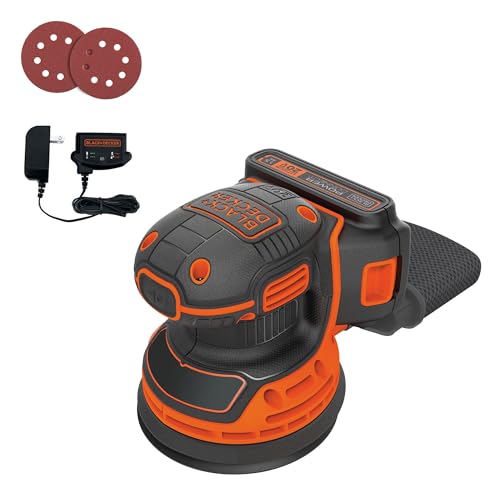
BLACK+DECKER BDCRO20C 20V MAX Orbital Sander Kit
20V MAX12,000 OPMBattery includedHook-and-loop
Check price on Amazon
Best for: Buyers who want a ready-to-use kit with battery and charger.

The BDCRO20C is the kit to buy if you own no battery platform. It ships with a 20V MAX battery, a charger and two sandpaper sheets, so you can sand the day it arrives. It runs at 12,000 orbits per minute with a hook-and-loop pad for easy paper changes.

The compact design reduces muscle fatigue, which is useful on vertical work like a door or cabinet side. Compared with the DeWalt DCW210B, it has a single speed and no brushless motor, and the DeWalt costs more once you add a battery. The B+D kit is cost-effective if you plan to use the sander lightly. Because the pad is a simple hook-and-loop design, you can also buy generic discs, which keeps running costs low.

Ownership notes: a single battery limits long jobs, so plan to sand in sessions and let the pack cool. The battery fits other BLACK+DECKER 20V MAX tools, which is useful if you own a string trimmer or a drill from the same family. Use finer grits for finishing and keep the pad free of dust. Work in overlapping passes with the grain on the final grit, and wipe the surface with a tack cloth before applying finish.

What works

  • Battery and charger included
  • 12,000 OPM removes material quickly
  • Compact design reduces fatigue
  • Shares battery with other 20V MAX tools

Watch out for

  • Single speed only
  • One battery limits long jobs

Spec sheet

Platform
BLACK+DECKER 20V MAX
Speed
12,000 OPM
Pad
Hook-and-loop
Included
Battery, charger, 2 sandpaper sheets
Design
Compact
03
CRAFTSMAN V20 CMCW220B 5 in Random Orbit Sander (Tool Only)
V2012,000 OPM5 inDust bag
Check price on Amazon
Best for: CRAFTSMAN V20 owners who want a cordless random orbital sander.

The CMCW220B is a 5-inch random orbital sander with a 12,000 OPM maximum, an onboard dust bag and a connection for a 1-1/4-inch vacuum hose. It is a bare tool for the V20 system, which shares batteries with a large range of Craftsman tools.

Compared with the DeWalt, the CRAFTSMAN does not list a brushless motor or a low-end speed. It is positioned as a general-purpose sander for homeowners who already own V20 batteries. The vacuum hose connection is a good feature, since a vacuum collects more fine dust than a bag. If you own a shop vacuum with a 1-1/4-inch hose, check that an adapter exists before you buy.

For ownership, add a battery if you do not own one, and clean the bag after each session. The pad's hook-and-loop surface wears out, so replace it when sandpaper stops sticking. If you own V20 gear, it is a good value. A sander is also an easy way to test whether a platform suits you, since the tool is simple and light and a day of sanding shows how the battery feels in your hand.

What works

  • Works with V20 batteries
  • Onboard bag and vacuum hose connection
  • 12,000 OPM maximum speed
  • Low-cost bare tool

Watch out for

  • Tool only, battery extra
  • No documented low speed

Spec sheet

Platform
CRAFTSMAN V20
Speed
12,000 OPM maximum
Pad
5 inch random orbit
Dust
Onboard bag plus 1-1/4 in vacuum hose fit
Kit
Tool only
04
AVID POWER 20V Cordless 5 in Random Orbital Sander
20V6 speeds7,000-11,000 RPM2.0Ah battery
Check price on Amazon
Best for: Hobbyists who want variable speed and a battery at a low outlay.

The AVID POWER is a 5-inch cordless sander with six speeds from 7,000 to 11,000 and a 2.0Ah battery in the kit. Eight vacuum holes in the pad improve dust collection when you connect a hose. Six speeds give you more control than a single-speed tool.

Its top speed of 11,000 is lower than the 12,000 of the BLACK+DECKER and CRAFTSMAN, so it removes material slightly slower. The 2.0Ah battery is small, which limits runtime. It makes sense for light sanding and small projects.

Ownership notes: a small battery on a sander drains quickly, so plan to sand in short sessions. Because the brand is lesser known, parts and warranty support are thinner. If you want the lowest outlay for a cordless sander with variable speed, it is a reasonable option. Before sanding, check that the pad is clean and flat, because a pad with a nick or a burr will leave a mark in a finish coat.

What works

  • Six speeds from 7,000 to 11,000
  • Battery included
  • Eight-hole pad for dust extraction
  • Light and one-handed

Watch out for

  • Small 2.0Ah battery
  • Thin brand support

Spec sheet

Voltage
20V
Speed
6 speeds, 7,000 to 11,000
Pad
5 inch
Battery
2.0Ah
Dust
8 vacuum holes
05
WEN 20401 20V Cordless Palm Sander with Battery
20V5 x 3.75 in padAngled nose2.0Ah
Check price on Amazon
Best for: Furniture and trim work where corners matter.

The WEN 20401 is a palm-style sander with a 5 by 3.75-inch rectangular pad and an angled nose for inside corners. It is a different tool from a round random orbital sander: a rectangular pad reaches corners, and a dual-grip design lets you hold it by the handle or in your palm.

A rectangular pad does not give the swirl-free finish of a random orbit pad, but it is the better tool for corners, trim and small flat surfaces. Compared with the 5-inch round sanders in this lineup, it is slower on large surfaces and better in tight spots. It ships with a 2.0Ah battery and charger.

For ownership, use fine grits and move with the grain on visible surfaces. Hook-and-loop paper changes are simple, and the pad's shape means you can cut a standard quarter sheet to fit. If you want a corner sander more than a general-purpose one, it fits the job. Because the pad is rectangular, the sander can follow the edge of a panel and reach into a corner where a round pad leaves a gap, so it pairs well with a round sander on a refinishing project.

What works

  • Angled nose reaches inside corners
  • Dual-grip for palm or handle use
  • Battery and charger included
  • Hook-and-loop paper change

Watch out for

  • Not a random orbit finish
  • Small 2.0Ah battery

Spec sheet

Voltage
20V Max
Pad
5 x 3.75 inch
Nose
Angled for inside corners
Grip
Dual-grip, handle or palm
Battery
2.0Ah, charger included

Spec sheet decoder

What the numbers on the box really mean

The specs manufacturers lead with, translated into what they tell you about real-world performance.

OPM (orbits per minute)

The number of times the pad completes its orbit each minute. 12,000 is typical for general sanding.

Watch forSome brands quote RPM, which measures the pad spin, not the orbit.

Random orbit

A motion where the pad spins and orbits at the same time, so no grain follows the same path twice.

Watch forA fixed pad leaves straight scratch lines.

Orbit diameter

The size of the orbit, often 3/32 to 3/16 inch. A larger orbit removes material faster.

Watch forFew budget tools publish it.

Hook-and-loop

A pad surface that grips paper with tiny hooks, so you change discs without adhesive.

Watch forThe hooks wear out and the paper starts to slip.

Tool only

A tool sold without a battery or charger.

Watch forAdd the cost of a battery and charger.

Methodology

How We Evaluated These Cordless Orbital Sanders Under $100

Speed and control

We compared orbit rates and speed ranges, from the DeWalt's 8,000 to 12,000 OPM to the AVID's six steps.

Motor and runtime

We looked at brushless and brushed motors and battery sizes, from the 2.0Ah kit packs to bare tools that take larger packs. A sander is a continuous-load tool, so runtime per pack was a major factor in the ranking.

Dust collection

We checked bags, vacuum ports and pad hole patterns because dust control is the biggest quality-of-life feature in a sander.

Pad design

We separated round random orbit pads from the WEN's rectangular palm pad.

Fit for the cap

Every sander has a live price at or below the cap. We ranked each by how much usable sanding capacity a homeowner gets for the money, and we counted a bundled battery as value only when its capacity was large enough to finish a small project. Kits with a 2.0Ah pack earned credit for convenience and lost it for runtime.

Decision guide

How to Choose the Right Cordless Orbital Sanders Under $100

By Project

ScenarioPickWhy
Tabletops and doorsDeWalt DCW210BBrushless and variable speed
Occasional sanding with no batteriesBLACK+DECKER BDCRO20CKit with battery
Craftsman V20 ownersCRAFTSMAN CMCW220BShares batteries
Light projects on a budgetAVID POWER 20VSix speeds
Corners and trimWEN 20401Angled nose

By Budget Tier

TierPickWhy
LowestAVID POWER 20VKit with battery
LowWEN 20401Palm sander kit
MidCRAFTSMAN CMCW220BBare tool
UpperBLACK+DECKER BDCRO20CComplete kit
Top of the capDeWalt DCW210BBrushless

Round vs Palm Pad

Round random orbit

Swirl-free finish and fast removal on flat surfaces. The DeWalt, BLACK+DECKER, CRAFTSMAN and AVID use round pads.

Rectangular palm

Reaches corners and trim. The WEN uses a 5 by 3.75 inch pad.

Choose round for large surfaces and palm for corners.

Bare Tool vs Kit

PreferencePickWhy
Own DeWalt batteriesDeWalt DCW210BBare tool
Own V20 batteriesCRAFTSMAN CMCW220BBare tool
Own no batteriesBLACK+DECKER BDCRO20CBattery included
Own no batteries, lowest costAVID POWER 20VBattery included

For Furniture Refinishing Specifically

Look for

Variable speed, good dust collection and a pad that grips paper. Start with 80 or 120 grit and step to 220.

In this comparison

The DeWalt has documented speed control and a vacuum port. The WEN reaches corners the round pads cannot.

When to Spend More

Spend more if

You sand weekly or want a corded-level runtime. A corded sander or a 5Ah pack runs longer.

Save if

You sand a few projects a year. The AVID or BLACK+DECKER kit is enough.

Ownership

Maintenance schedule

The upkeep that decides whether this machine lasts two seasons or ten.

TaskIntervalWhy it matters
Replace sanding discsWhen they clogA clogged disc scratches and burns the surface.
Clean the padMonthlyDust in the hooks makes paper slip.
Empty the dust bagAfter each sessionA full bag reduces airflow and cooling.
Store batteries coolAlwaysHeat shortens lithium cell life.
Replace the padWhen paper slipsA worn pad loses grip.

FAQ

Frequently Asked Questions

Is a cordless sander as good as a corded one?

It is convenient, but runtime is limited and a battery adds weight. A corded sander is better for long jobs.

Which grit should I start with?

80 to 120 for raw wood, 150 to 220 for finishing. Do not skip more than one grit step. Jumping from 60 to 220, for example, leaves deep scratches that the fine paper cannot remove, and they show up when you stain.

Why does my sander leave swirls?

Too fast a speed, skipped grits or too much pressure. Let the sander do the work. Pressing harder does not cut faster, it only stalls the pad's orbit, which turns the random motion into a straight scratch.

Do I need a vacuum?

A vacuum collects more dust than a bag. Use one for indoor work.

Can I sand with the grain?

Yes. A random orbit sander is more forgiving, but finish passes should follow the grain.

What does tool only mean?

It means no battery or charger. Add the cost of a pack if you do not own one.

Bottom line

The short version

Browse more cordless orbital sanders under $100on Amazon →
James Miller, Lead Machine Editor

About the author

James Miller

Lead Machine Editor, MachineFanatic

James Miller leads MachineFanatic's buying guides, turning spec sheets, manuals and owner feedback into clear verdicts on power tools, outdoor power equipment, shop machines and kitchen machines.

More from James →

Keep reading

Related guides