
Amazon affiliate links - we earn a commission.Affiliate disclosure

Buying guide · 15 min read · Updated 2026-11-09

Best Random Orbital Sanders Under $50 (2026)

Five random orbital sanders under $50 compared on orbits per minute, amp draw, dust collection, hook-and-loop pads and what budget sanders leave out.

James MillerBy James MillerLead Machine Editor5 machines comparedSpec-sheet verified
Best Random Orbital Sanders Under $50

At a glance

Our top picks

Side by side

Spec comparison

A random orbital sander spins its round pad while it also moves in a small orbit, so no scratch pattern repeats and the surface comes out flat without the swirls a plain rotary sander leaves. It is the one sander that does most jobs well, which is why it is the first one most homeowners buy.

At a low price the differences are in the pad, the vibration and the dust handling rather than raw power. This guide explains what each spec means in use, which compromises are harmless and which will leave marks in your finish. The quick picks are above, and the reviews below show where each sander fits.

Before you buy

6 Criteria to Look For Before Buying a Random Orbital Sander Under $50

  1. 01

    OPM, not RPM, tells the story

    OPM counts orbits per minute and RPM counts spins. The SKIL lists 13,000 OPM, the DCA 4,000 to 12,000 OPM and the DEKOPRO 14,000 RPM, which is not the same measure. A random orbital sander's finish depends on both spin and orbit, so compare like with like and prefer listings that give OPM. If a listing quotes only RPM, ask whether it also states orbits per minute, since only OPM predicts how fast the sander removes material.

  2. 02

    Variable speed protects finish

    Running at full speed on paint or finish melts it and leaves swirls. The SKIL and DCA offer variable speed, with the DCA ranging from 4,000 to 12,000 OPM. Use low speeds for finish removal and high for rough stock. For paint stripping, start with 60 or 80 grit and use the slowest speed that still cuts, since heat softens paint into gummy ridges.

  3. 03

    Hole pattern matches discs

    A pad's vacuum holes must match the disc's holes. The HYCHIKA uses eight holes and needs eight-hole discs. A five-hole disc on an eight-hole pad blocks the extra holes and reduces dust pickup. Matching disc holes to pad holes is a ten-second check that can double disc life, so do it every time you buy discs.

  4. 04

    Dust collection needs a vacuum

    Onboard bags, like the DCA's 0.3L bag, and the SKIL's cyclonic box capture some dust but not all. Connect a shop vacuum through the dust port for much cleaner air and longer disc life. Especially with old paint, always use a vacuum. Check for lead before sanding old paint in older homes, and use a vacuum with a HEPA filter if you suspect it.

  5. 05

    Motor amps versus real power

    The DCA's 3.0 amp motor, the SKIL's 2.8 and the DEKOPRO's 2.5 look different, but sander results depend on orbit and pad speed more than amps. A strong motor helps under pressure, but pressing hard slows the orbit and causes marks. A sander that is heavy on the front or rear will tilt, so hold it flat and let the weight work.

  6. 06

    Pad and vibration

    A soft, worn pad leaves marks and a loose one wobbles. Check the pad's hook-and-loop face and replace it when discs stop sticking. Budget sanders vibrate, and a rubber grip, like the HYCHIKA's, helps. Replace a worn pad as soon as discs start to peel, since a sander that throws discs is both annoying and unsafe.

Detailed reviews

The 5 best random orbital sanders under $50, explained

01
SKIL SR211601 5-Inch Random Orbital Sander, 2.8 Amp, Cyclonic Dust Box
2.8 amp, 13,000 OPMVariable speedCyclonic dust box5-inch pad
Check price on Amazon
Best for: Homeowners who want one reliable sander for furniture, doors and trim.

The SKIL SR211601 is the best buy because it gets the most important feature for a budget sander right: variable speed. Random orbital sanders cut fastest at high speed and finish best at lower speed, and many cheap models run flat out all the time. Lowering the speed lets you sand paint and finish without melting it and reduces the swirl marks that come from running too fast.

A 2.8 amp motor at 13,000 orbits per minute is a middle-of-the-road figure for this price, and orbits per minute, or OPM, is the number that counts, because it measures how many times the pad completes its orbit each minute. The cyclonic dust box spins dust out of the air stream into a container that empties with a quick twist. Compared with a cloth bag, a cyclonic box clogs less, which keeps suction steady.

For sanding furniture, doors and small decks it is a good all-rounder. Against the DCA's wider speed range, the SKIL gives you a better-known brand and a more dependable dust box. Keep the pad's hook-and-loop face clean, and let the sander's weight do the work, because pressing hard slows the orbit and leaves marks. Sand in overlapping passes at a walking pace, which is slow enough that the pad cuts without burning the surface.

What works

  • Variable speed reduces swirl marks on finish work
  • Cyclonic dust box clogs less than a bag
  • 13,000 OPM is a solid budget figure
  • Established brand with replacement pads

Watch out for

  • 2.8 amp motor is not the strongest here
  • Dust box still leaves fine dust in the air
  • Fewer discs included than the DEKOPRO

Spec sheet

Model
SR211601
Motor
2.8 amp corded
Orbit speed
13,000 orbits per minute
Speed control
Variable
Dust handling
X-flow cyclonic dust box
Pad
5-inch hook and loop
02
DCA 3.0 Amp Random Orbital Sander, 4,000-12,000 OPM, 5-Inch
3.0 amp, 300W4,000-12,000 OPM6 speeds0.3L dust bag
Check price on Amazon
Best for: Users who sand both delicate veneers and rough stock and want a wide speed range.

The DCA has the biggest motor in this group at 3.0 amps and the widest speed range, 4,000 to 12,000 OPM across six steps. A low speed of 4,000 is slow enough for delicate work like removing finish from a veneered tabletop without cutting through, and 12,000 is fast enough for rough stock removal. That range makes it the most flexible sander in the lineup.

A 0.3 liter dust bag with a rubber seal on the dust port is an upgrade over loose-fit bags that leak dust back into the air. The bag is small, so it fills fast, and you will empty it often. Ten sanding discs come in the box, so you can start immediately, though sandpaper is a consumable and you will buy more.

Against the SKIL, the DCA has more motor and a wider speed range, but its brand is less established and its dust bag is a less effective collector than a cyclonic box. Hook it to a shop vacuum if you can, since the port accepts a hose and makes a much bigger difference than the bag. A fresh sheet of sandpaper is the cheapest upgrade you can make, since worn paper does more damage than any motor difference.

What works

  • Largest motor in the group at 3.0 amps
  • 4,000 to 12,000 OPM range suits delicate and rough work
  • Rubber-sealed dust port reduces leaks
  • 10 discs included

Watch out for

  • Small 0.3L dust bag fills quickly
  • Less established brand than SKIL
  • 12,000 OPM top speed is the lowest here

Spec sheet

Motor
3.0 amp, 300W copper
Orbit speed
4,000 to 12,000 OPM
Speed steps
6
Dust bag
10 fl oz (0.3L) with rubber seal
Pad
5-inch hook and loop
Included
10 sanding discs
03
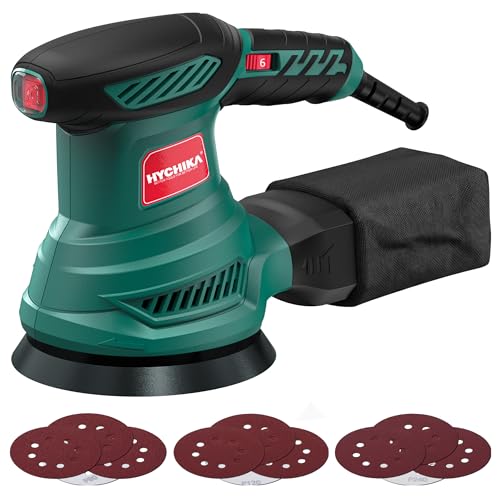
HYCHIKA 5-Inch Random Orbital Sander, 300W, 13,000 RPM, 8 Vacuum Holes
300W motor13,000 rpm8 vacuum holes6 speeds
Check price on Amazon
Best for: Indoor sanders who connect a shop vacuum and want the cleanest air.

The HYCHIKA is the dust-collection pick. Its pad has eight vacuum holes, and the sanding discs have matching holes, so dust is pulled through the pad into the dust port instead of settling on the work. A pad with more holes draws dust from more of the sanding surface, which keeps the sandpaper from clogging and lengthens disc life. Dust that is not removed also scratches the surface as the pad drags it around.

A 300W motor and six speeds up to 13,000 are a typical budget combination, with the textured rubber grip reducing hand fatigue. It ships with 12 discs. Compared with the DEKOPRO, which also lists a detachable dust box and 16 discs, the HYCHIKA focuses on the vacuum holes, which pay off when you connect it to a shop vacuum.

Use discs with a matching eight-hole pattern, since a five-hole disc on an eight-hole pad blocks most of the holes and defeats the point. Always connect a vacuum when sanding old paint, because the dust may contain lead and a dust bag is not enough. If the dust box comes loose in use, check the port seal first, because a loose fit is the most common cause.

What works

  • Eight vacuum holes pull dust through the pad
  • Six speeds up to 13,000
  • Textured rubber grip reduces fatigue
  • 12 discs included

Watch out for

  • Needs matching eight-hole discs
  • Bag collects less dust than a vacuum
  • Brand has limited service support

Spec sheet

Motor
300W
Speed
13,000 maximum, 6 steps
Pad
5-inch with 8 vacuum holes
Dust collection
Vacuum port and dust bag
Grip
Textured rubber
Included
12 sanding discs
04
DEKOPRO 2.5A 5-Inch Random Orbital Sander, 6 Speeds, 16 Discs
2.5 amp, 14,000 RPM6 speeds16 sanding discsDetachable dust box
Check price on Amazon
Best for: First-time buyers who want a full grit progression in the box.

The DEKOPRO is the sander that starts you with the most sandpaper. Sixteen discs covering 60, 80, 120, 240, 400 and 1,000 grit mean you can run an entire sanding progression, from rough to polish, without a trip to the store. A grit progression is the habit that gives a smooth surface: coarse removes material, and each finer grit removes the scratches of the previous one.

Its maximum speed is quoted in RPM, 14,000, which is a different measure from orbits per minute and not directly comparable with the SKIL's 13,000 OPM. A 2.5 amp motor is the weakest in the group, so it will slow under heavy pressure. Its detachable dust box is a modest improvement over a cloth bag.

Against the DCA, the DEKOPRO has more discs and a higher quoted top speed, but less motor and a narrower stated speed range. It is a good first sander for light jobs like refreshing a table or sanding trim, and the large pack of discs is a genuine head start. Do not skip grits, and keep the pad moving. Run the sander on a scrap panel before the real work, which reveals swirl marks before they matter.

What works

  • 16 discs from 60 to 1,000 grit included
  • Six speeds up to a quoted 14,000 RPM
  • Detachable dust box
  • Lowest priced in the group

Watch out for

  • 2.5 amp motor is the weakest here
  • RPM figure is not comparable with OPM
  • Limited brand support

Spec sheet

Motor
2.5 amp
Top speed
Up to 14,000 RPM
Speed steps
6
Discs included
16 from 60 to 1,000 grit
Dust collection
Detachable dust box
Pad
5-inch hook and loop
05
ZFE 5-Inch and 6-Inch Pneumatic Random Orbital Sander with Extra Pad
Air-powered5 and 6 inch padsAll-steel movementDust bag included
Check price on Amazon
Best for: Shop owners with a compressor who sand for long periods.

The ZFE is an air sander, which changes the economics. A pneumatic sander has no electric motor, so it is lighter, runs cooler and can sand for hours without overheating, and the all-steel rotor and cylinder are built for long life. It uses a 5-inch pad and an extra plate for 6-inch work, so you can match the pad to the job.

The catch is the compressor. An air sander typically consumes several cubic feet per minute at 90 PSI, which a small pancake compressor cannot sustain, so it pauses to refill and the sander stutters. Unless you already own a compressor that can keep up, the effective price is much higher than the sticker. A dust bag connects with a suction tube, but it works less well than a vacuum.

Buy it if you have a compressor and an air line, and especially if you sand for long sessions in a workshop. Against the corded models, it is lighter in the hand and more durable but needs air-tool oil and a drained air line. A few drops of oil in the inlet each day keep the rotor alive. Use a light film of oil on the air inlet before each session, and drain the compressor tank regularly.

What works

  • Lighter and cooler than a corded sander
  • All-steel rotor and cylinder resist wear
  • 5 and 6 inch pad options
  • Extra pads and sandpapers included

Watch out for

  • Requires a compressor that can keep up
  • Needs air-tool oil and a dry air line
  • Dust bag collects less than a vacuum

Spec sheet

Power
Compressed air
Pad sizes
5 inch plus an extra backing plate for 6 inch
Build
All-steel rotor and cylinder
Dust
Dust bag with suction tube
Extras
Sponge polishing pads and sandpapers
Requires
Air compressor (not included)

Spec sheet decoder

What the numbers on the box really mean

The specs manufacturers lead with, translated into what they tell you about real-world performance.

OPM (orbits per minute)

OPM counts how many times the pad completes its orbit each minute. Higher OPM removes material faster. A 5-inch pad sands about 20 square inches at a time, so large surfaces take time at any speed.

Watch forRPM is a different measure, so do not compare the DEKOPRO's 14,000 RPM with the SKIL's 13,000 OPM.

Amps

Amps measure current draw. Higher amps mean a bigger motor. Orbit diameter is rarely stated on budget sanders, but it decides how aggressive the sander feels.

Watch forA bigger motor does not guarantee a better finish.

Hook and loop

A fabric-hook system that grips discs and allows quick changes. A 300W motor draws about 2.5 amps at household voltage, which is why the amp and watt figures often agree.

Watch forWorn hook faces make discs fly off.

Vacuum holes

Holes in the pad that match the disc's holes, drawing dust into the port. Hook-and-loop pads are cheap to replace, which makes them a good item to keep as a spare.

Watch forMatch the hole pattern, since five-hole and eight-hole discs are not interchangeable.

Orbit diameter

The size of the pad's orbit sets how aggressive it is. Larger orbits remove material faster. A sander that vibrates a lot is usually one with a poorly balanced pad or a worn bearing.

Watch forMost budget listings do not state it, so judge by results.

Methodology

How We Evaluated These Random Orbital Sanders Under $50

Orbit and speed

We compared OPM and speed ranges, giving the DCA the widest range and the SKIL the most dependable figure. We checked whether speed was variable and over what range, since fixed-speed sanders are harder to control.

Dust handling

We credited vacuum holes, cyclonic boxes and sealed ports. We counted discs and grits included and noted where a hole pattern mattered.

Consumables

We counted discs included, since a grit progression is a head start. We compared dust handling on whether the listing mentions a vacuum port, a cyclonic box or a sealed bag.

Motor and build

We compared amps, grips and construction, including the ZFE's all-steel air motor. We treated the pneumatic ZFE as a separate case that depends on a compressor.

Fit across the lineup

Each sander was placed by owner type. We ranked by what each sander suits.

Decision guide

How to Choose the Right Random Orbital Sanders Under $50

By Job

Pick the sander by what you sand. The best sander is the one whose speed range matches your work, so check speed first.

JobRecommended pickWhy
Furniture and doorsSKIL SR211601Variable speed and cyclonic box.
Veneers and rough stockDCA 3.0 amp4,000 to 12,000 OPM.
Indoor dust controlHYCHIKAEight vacuum holes.
Full grit progressionDEKOPRO16 discs.
Long shop sessionsZFE pneumaticCool-running air tool.

Match the grit progression to the job, skipping no more than one step.

By Budget

Relative tiers in this group. Prices in this tier are close, so features such as dust handling and discs often decide.

TierPickWhat you get
LowestDEKOPRO16 discs.
LowDCAWidest speed range.
MidHYCHIKAEight-hole dust control.
UpperZFE pneumaticAir tool.
TopSKIL SR211601Brand, cyclonic box.

The ZFE is cheap only if you own a compressor.

Corded vs Pneumatic

The power source changes the tool. Corded versus air is a question of what you already own.

Corded

The SKIL, DCA, HYCHIKA and DEKOPRO plug in and work anywhere with power. They are heavier and can overheat.

Pneumatic

The ZFE runs on air, is lighter and cooler, but needs a compressor and oil.

Choose corded unless you already own a compressor.

Dust Handling

Dust collection affects cleanup and finish. Dust handling affects both your health and your finish, so it deserves attention.

PreferencePickReason
Best with a vacuumHYCHIKAEight holes.
No vacuumSKILCyclonic box.
Rubber-sealed portDCASeal reduces leaks.
Detachable boxDEKOPROEasy to empty.
Air tool bagZFEBag with tube.

A vacuum always beats a bag.

For Refinishing Furniture Specifically

Refinishing needs control and dust handling. Refinishing rewards slow speeds and patience.

Look for

Variable speed, a wide range and a vacuum port. Use 80, 120 and 220 grit in order.

In this comparison

The DCA's 4,000 OPM low setting and the SKIL's variable speed are best for delicate work.

When to Spend More

Budget sanders have limits. A budget sander is a fine start, and you will know when you need an upgrade.

Spend more if

You sand cabinets or decks for hours. A premium sander offers lower vibration and better pads.

Save if

You sand a few pieces a year. The DEKOPRO or DCA will do.

Ownership

Maintenance schedule

The upkeep that decides whether this machine lasts two seasons or ten.

TaskIntervalWhy it matters
Replace the padWhen discs stop stickingA worn hook face lets discs fly off. Unplug before changing discs.
Empty the dust box or bagEvery useA full box cuts suction and clogs discs. Dust inside bearings shortens life.
Clean the ventsAfter dusty jobsDust overheats the motor. A cracked dust port ruins suction.
Check the cordEach useA damaged cord is a hazard. Wipe the hook face with a brush.
Oil pneumatic sandersDailyAir tools need a few drops of oil to protect the rotor. Store it dry.

FAQ

Frequently Asked Questions

What grit should I start with?

Start with 80 for rough surfaces, then 120 and 220. Skip no more than one step. Let the sander sit flat before you switch it on, and lift it off before switching it off.

Why does my sander leave swirl marks?

Usually speed too high, pressure too heavy or a dirty or worn pad. Slow down and lighten up. Wear a dust mask or respirator, since wood dust is a health hazard.

Do I need a vacuum?

Yes for indoor work and old paint. A bag catches only part of the dust. Clean the surface with a tack cloth between grits so coarse grit does not scratch the finer pass.

Can I use any sandpaper?

Use hook-and-loop discs with a matching hole pattern.

Is a pneumatic sander better?

It is lighter and cooler but needs a compressor that keeps up.

How long do discs last?

Discs wear in minutes on hard materials. Replace them when they stop cutting.

Bottom line

The short version

Browse more random orbital sanders under $50on Amazon →
James Miller, Lead Machine Editor

About the author

James Miller

Lead Machine Editor, MachineFanatic

James Miller leads MachineFanatic's buying guides, turning spec sheets, manuals and owner feedback into clear verdicts on power tools, outdoor power equipment, shop machines and kitchen machines.

More from James →

Keep reading

Related guides