
Amazon affiliate links - we earn a commission.Affiliate disclosure

Buying guide · 13 min read · Updated 2026-11-09

Best Drywall Sanders (2026)

Drywall sanders compared by motor, speed range, head design, pole reach and vacuum dust collection for finishing joint compound on walls and ceilings.

James MillerBy James MillerLead Machine Editor6 machines comparedSpec-sheet verified
Best Drywall Sanders

At a glance

Our top picks

Side by side

Spec comparison

A drywall sander is a long-reach disc sander built to smooth dried joint compound on walls and ceilings. The head spins or orbits on a pole so you work standing, and a vacuum hose draws most of the fine dust into a bag or an extractor instead of into the room.

Drywall dust is extremely fine and clings to everything, so the dust system matters as much as the motor. This guide explains head design, speed and extraction, then points you to the top picks above and the reviews below.

Before you buy

6 Criteria to Look For Before Buying a Drywall Sander

  1. 01

    Dust collection method

    Drywall dust is fine and stays airborne. Built-in vacuums, like those on the MAXXT 820W and KUPERIA, use a bag, while the DeWalt DCE800B pairs with a HEPA extractor and the WEN DW5084 uses your vacuum. A bag fills quickly, so an extractor is better for large jobs. No system replaces a respirator. Dust that settles on wet paint or fresh compound ruins the next coat, so seal the room first.

  2. 02

    Head design and size

    Heads are circular or triangular. The WEN DW5084 ships with both, and the POPULO has a 9 inch head. A circular head covers flats and a triangular head reaches corners. A bigger head is faster but harder to keep flat. On a ceiling job, the extra pole weight is the hidden cost, so ask what the sander weighs fully assembled.

  3. 03

    Speed range

    Ranges run from 600 RPM up to 2,800 on the handheld MAXXT. Low speeds protect the surface during final sanding, and high speeds level ridges. Speed dials matter more on drywall than on wood because compound is soft. A middle grit like 150 handles most second coats, and 220 only polishes.

  4. 04

    Pole reach and weight

    Reach decides whether you need a ladder. The POPULO extends to 63 inches, and the DeWalt has a telescoping shaft. A motor at the head, as on the WEN DW5084, adds weight at the tip, which tires your shoulders over a ceiling. Pick the shortest pole that reaches comfortably, because extra length adds flex.

  5. 05

    Corded versus cordless

    Corded sanders give steady power but add a cord to the dust and hose. The DeWalt DCE800B is cordless and brushless, which suits professionals. Cordless needs batteries and an extractor, so the real cost is higher. If you rent an extractor, check the hose diameter matches before you start.

  6. 06

    Disc and compound match

    Use 120 to 150 grit for most compound, finishing at 220. Coarse discs on soft compound gouge. Let the tool float, and keep it moving so you do not dig the surface. Keep a handful of spare discs ready, since a loaded disc stops cutting.

Detailed reviews

The 6 best drywall sanders, explained

01
DEWALT DCE800B 20V MAX Cordless Drywall Sander (Tool Only)
20V MAX brushlessTelescoping shaftWireless tool controlTool only
Check price on Amazon
Best for: Professional finishers and serious remodelers on 20V MAX.

The DCE800B is a cordless drywall sander with a brushless motor, a telescoping shaft for reaching confined or high areas, and Wireless Tool Control that can switch a paired dust extractor on and off with the sander. It runs on 20V MAX batteries and is sold as a tool only.

The brushless motor improves runtime and removes brush changes. Cordless is the big advantage on a drywall job, because you drag a vacuum hose but not a power cord across a wet floor. The wireless link means the extractor starts when you pull the trigger, which keeps the dust under control without a second switch. Compared with the corded WEN DW5084 it costs far more, but the dust control and convenience are in a different class.

The tool is aimed at professionals, so the buying cost is the tool plus batteries plus an extractor. Use a HEPA extractor and a drywall-grade hose. Change discs often and keep the head hooks clean. Before the first job, pair the sander with the extractor and test the wireless link. A job that starts with the dust system failing is miserable.

What works

  • Brushless cordless motor
  • Telescoping shaft for ceilings
  • Wireless link to a dust extractor
  • Tool-free comfort for long sessions

Watch out for

  • Priced as a pro tool
  • Needs batteries and an extractor for best results

Spec sheet

Platform
20V MAX
Motor
Brushless
Shaft
Telescoping
Dust
Pairs with a dust extractor
Control
Wireless Tool Control compatible
Kit
Tool only
02
WEN DW5084 5 Amp 2-in-1 Variable Speed Dual-Head Drywall Sander
5 amp motor600-1,500 RPMTwo heads15 ft dust hose
Check price on Amazon
Best for: DIYers finishing a room who want corner and flat-wall heads.

The DW5084 is a corded 5 amp drywall sander with two interchangeable heads, triangular and circular, that attach without tools. The head-mounted motor drives hook-and-loop discs at 600 to 1,500 RPM, and a 15 foot hose connects to a vacuum.

A triangular head reaches into corners, and a circular head covers walls quickly. Having both in one kit is the reason to buy it over single-head sanders. Head-mounted motors put weight at the end of the pole, which is more tiring than a motor at the base but delivers direct torque to the disc. It is a more modest machine than the DeWalt but costs a fraction.

A shop vacuum with a good filter is needed, since the hose connects to your own vacuum. Keep the hose clear and the filter clean. Check that the head locks tight on the pole, since a loose head chatters on the wall. Store the unused head in the box so it does not go missing between jobs.

What works

  • Triangular and circular heads in one kit
  • 600 to 1,500 RPM variable speed
  • 15 foot dust hose included
  • Tool-free head changes

Watch out for

  • Head-mounted motor adds weight at the pole tip
  • Needs a separate vacuum for extraction

Spec sheet

Motor
5 amp, head-mounted
Speed
600 to 1,500 RPM
Heads
Triangular and circular, tool-free
Hose
15 ft dust hose
Attachment
Hook and loop
03
MAXXT 820W Drywall Sander with Vacuum Dust Collection
820W motor600-1,900 RPMBuilt-in vacuumFoldable pole
Check price on Amazon
Best for: Buyers who want built-in vacuum suction without a separate shop vac.

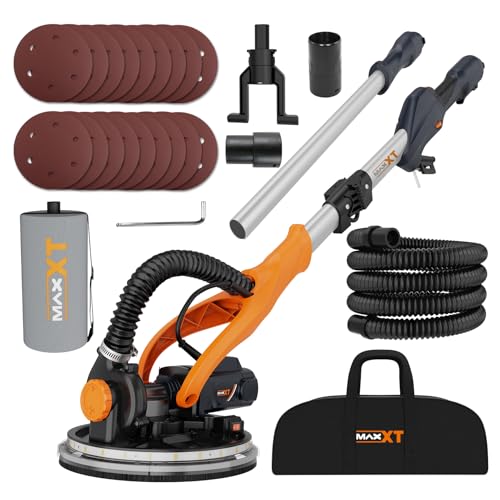
The MAXXT drywall sander has an 820 watt motor, a speed range from 600 to 1,900 RPM and a built-in vacuum that draws dust through the sanding head. A foldable telescoping pole makes it easier to carry and store, and a removable edge helps with corners.

Built-in suction means the sander does not need a separate vacuum, which makes it a complete tool. The wide RPM range gives you slow speed for finishing and fast speed for rough work. Compared with the WEN DW5084 at 5 amps, the 820 watt motor is a larger machine, though wattage claims from lesser-known brands are marketing figures.

Empty the dust bag often, since built-in vacuums lose suction as the bag fills. Replace discs when they load with compound. Because the vacuum is part of the sander, run it for a few seconds before touching the wall so the airflow is established. Rinse the filter when suction drops, and let it dry fully before reuse.

What works

  • 820 watt motor with 600 to 1,900 RPM
  • Built-in vacuum suction
  • Foldable pole for storage
  • Removable edge for corners

Watch out for

  • Built-in bag fills quickly
  • Less-established brand and parts support

Spec sheet

Motor
820 watt
Speed
600 to 1,900 RPM
Dust
Built-in vacuum suction
Pole
Foldable telescoping
Edge
Removable edge with spring
04
MAXXT 810W Handheld Drywall Sander, 1,500-2,800 RPM
810W motor1,500-2,800 RPMHandheldDust-sealed motor
Check price on Amazon
Best for: Patch sanding and small rooms where a pole is unnecessary.

This MAXXT is a handheld drywall sander with an 810 watt motor and a speed range of 1,500 to 2,800 RPM. It has two modes, rough sanding to level flat walls quickly and fine sanding to finish, and its design keeps dust out of the motor.

It is a handheld tool, so it works at arm's length, which suits patching and lower walls but not ceilings. The high speed range is faster than the pole sanders, which makes it more aggressive on compound but harder to control. A large switch reduces accidental starts.

Use it for patch sanding and small rooms, and pair it with a vacuum. Wear a respirator in any case, since fine dust escapes any system. Hold it with both hands when you start, since a fast handheld disc can walk across the wall. Keep a respirator on, and tape plastic over doorways, because handheld sanding throws dust outward.

What works

  • 810 watt motor with a wide speed range
  • Handheld for patch work
  • Dust kept out of the motor
  • Large guarded switch

Watch out for

  • Not suited to ceilings
  • Fast speeds are harder to control

Spec sheet

Motor
810 watt
Speed
1,500 to 2,800 RPM
Style
Handheld
Use
Rough and fine sanding
Switch
Large, guarded
05
POPULO 9 in Drywall Sander with Dust Collection
9 in head63 in extendedVariable speedHose and bag
Check price on Amazon
Best for: Open walls where a wide head saves time.

The POPULO has a 9 inch sanding head, variable speed and a foldable handle that extends to 63 inches. A hose and a collection bag help manage dust when connected correctly.

A wide 9 inch head covers a large area per pass, which speeds up finishing on open walls. At 63 inches it reaches an 8 foot ceiling from the floor with a short step. It is a simpler design than the DeWalt and gives less data on motor power.

Secure the hose connections before starting, because a loose port leaks dust. Check the speed dial before you press the disc to the wall. Walk the sander along the wall in overlapping strokes, and avoid pressing at the edge of the head, which cuts a groove. Confirm the hose clamp is tight before you start.

What works

  • Wide 9 inch head
  • 63 inch extended length
  • Variable speed
  • Foldable for storage

Watch out for

  • Motor power is not published
  • Less documentation than major brands

Spec sheet

Head
9 in
Length
63 in extended
Speed
Variable
Handle
Foldable
Dust
Hose and collection bag
06
KUPERIA 8.5 Amp Drywall Sander with Built-In Vacuum
8.5 amp motor800-1,800 RPM7 speedsDual-pipe vacuum
Check price on Amazon
Best for: Budget buyers who want a stronger motor and built-in suction.

The KUPERIA is a corded 8.5 amp drywall sander with seven speed settings from 800 to 1,800 RPM and a built-in vacuum with a dual-pipe channel design. The dual pipes are meant to improve airflow through the head.

At 8.5 amps it has the most listed motor current of any corded sander in this guide besides the other budget models, which helps hold speed against dense compound. Seven settings give you steps rather than a continuous dial.

It is a budget tool, so inspect the hose and pole connections on arrival, and keep the filter clean. Because the dual-pipe design depends on a clear path, check the pipes for compound lumps after each session. Tighten the pole fittings before use. The tool suits a single room better than a daily workload.

What works

  • 8.5 amp motor
  • Seven speed settings
  • Built-in vacuum
  • Dual-pipe airflow design

Watch out for

  • Budget build quality
  • Brand has limited parts support

Spec sheet

Motor
8.5 amp
Speed
800 to 1,800 RPM, 7 settings
Dust
Built-in vacuum, dual pipes
Style
Pole sander
Power
Corded

Spec sheet decoder

What the numbers on the box really mean

The specs manufacturers lead with, translated into what they tell you about real-world performance.

Watts versus amps

Watts equal volts times amps. A 5 amp motor at 120 volts is about 600 watts, and an 820 watt sander is about 6.8 amps.

Watch forCompare the same unit. Budget listings mix watts and amps and may use peak numbers.

RPM

RPM is how fast the disc turns. Slower speeds leave a finer finish, and faster speeds level faster.

Watch forA 2,800 RPM top speed on a handheld sander is aggressive on soft compound.

Brushless

A brushless motor needs no brushes and runs cooler. It extends battery life on cordless tools like the DeWalt.

Watch forIt does not change the sanding result, only runtime and durability.

HEPA extractor

A HEPA extractor filters very fine particles that standard vacuums pass through. It is the right way to capture drywall dust.

Watch forA built-in bag is not HEPA and leaks fine dust.

Wireless Tool Control

A wireless link switches the extractor on when you start the sander. It saves a step and keeps dust down.

Watch forIt only works with compatible extractors, so check before buying.

Methodology

How We Evaluated These Drywall Sanders

Dust control

We compared built-in vacuums, hoses and extractor links. The DeWalt DCE800B with extractor pairing ranked top, and the MAXXT and KUPERIA offer built-in suction.

Head and reach

We looked at head size, shape and pole length. The WEN DW5084 offers two heads and the POPULO a 9 inch head.

Motor and speed

We compared motor ratings and speed ranges, from the WEN at 5 amps to the KUPERIA at 8.5 and the handheld MAXXT at up to 2,800 RPM.

Weight and balance

We considered where the motor sits. Head-mounted motors add weight, and cordless adds a battery.

Cost to own

We counted extra costs: batteries, extractors, discs and vacuums.

Decision guide

How to Choose the Right Drywall Sanders

By Type of Job

ScenarioPickWhy
Professional finishingDEWALT DCE800BCordless with extractor link
Whole-room DIYWEN DW5084Two heads and 15 ft hose
Built-in suctionMAXXT 820WVacuum in the sander
PatchingMAXXT 810W handheldHandheld
Open wallsPOPULO 9 inWide head

By Budget

TierPickWhy
EntryKUPERIA 8.5 AmpBudget with built-in vacuum
ValueWEN DW5084Two heads
Mid-rangeMAXXT 820WStrong suction
UpperPOPULO 9 inWide head
ProDEWALT DCE800BCordless brushless

Built-In Vacuum vs Extractor

Built-in vacuum

The sander has its own suction and bag. The MAXXT 820W and KUPERIA use this design, which is convenient but has limited capture.

Extractor

A separate HEPA extractor captures more dust. The DeWalt DCE800B and WEN DW5084 connect to one.

Pick built-in for small jobs and an extractor for whole houses.

Pole vs Handheld

PreferencePick
CeilingsDEWALT DCE800B
Corners and flatsWEN DW5084
PatchesMAXXT 810W
Wide wallsPOPULO 9 in

For Ceilings Specifically

Look for

Look for light weight, a telescoping pole and strong dust control, since dust falls on your face.

In this comparison

The DeWalt DCE800B with its telescoping shaft is the best fit.

When to Spend More

Spend more if

Spend more on the DEWALT DCE800B if you finish drywall for a living.

Save if

Save with the WEN DW5084 or KUPERIA for one project.

Ownership

Maintenance schedule

The upkeep that decides whether this machine lasts two seasons or ten.

TaskIntervalWhy it matters
Replace discsWhen loaded with compoundA clogged disc gouges. Replace as soon as it stops cutting.
Empty the bag or canisterEvery 10 minutesA full bag cuts suction. Dust returns to the wall.
Clean the hoseAfter each jobCompound dust clogs hoses. Flush with air.
Inspect the head hooksMonthlyWorn hooks drop discs. Replace the head pad.
Check batteriesSeasonallyCordless packs age. Charge them every few months.

FAQ

Frequently Asked Questions

Do I need a drywall sander?

For a large room, it saves hours over hand sanding. For a small patch, a sanding sponge is enough. Plan the job around dust control first, since cleanup takes longer than sanding.

What grit should I use?

Use 120 to 150 grit and finish at 220. Coarser discs gouge compound. Plan the job around dust control first, since cleanup takes longer than sanding.

Is a built-in vacuum enough?

It reduces dust but does not capture it all. Wear a respirator and use an extractor for large jobs. Plan the job around dust control first, since cleanup takes longer than sanding.

Can a drywall sander remove popcorn ceilings?

Some listings advertise it, but test a small area first. Texture removal creates much dust and may contain asbestos in older homes. Plan the job around dust control first, since cleanup takes longer than sanding.

Should I buy cordless?

Only if you own the batteries or work professionally. Corded is cheaper for a single project. Plan the job around dust control first, since cleanup takes longer than sanding.

How do I avoid gouges?

Keep the head flat and moving, and use light pressure. Let the disc float. Plan the job around dust control first, since cleanup takes longer than sanding.

Bottom line

The short version

Browse more drywall sanderson Amazon →
James Miller, Lead Machine Editor

About the author

James Miller

Lead Machine Editor, MachineFanatic

James Miller leads MachineFanatic's buying guides, turning spec sheets, manuals and owner feedback into clear verdicts on power tools, outdoor power equipment, shop machines and kitchen machines.

More from James →

Keep reading

Related guides