
Amazon affiliate links - we earn a commission.Affiliate disclosure

Buying guide · 15 min read · Updated 2026-11-09

Best Detail Sanders Under $30 (2026)

Five detail sanders under $30 compared on pad shape, orbits per minute, amp draw, dust handling and whether a mouse, file or pen sander fits your corners.

James MillerBy James MillerLead Machine Editor5 machines comparedSpec-sheet verified
Best Detail Sanders Under $30

At a glance

Our top picks

A detail sander has a small pad, often a triangle, that fits into corners and tight shapes a larger sander cannot reach. It is a niche tool but a handy one, and it costs little enough that most workshops keep one for chair spindles, louvered doors and window sashes.

Under thirty dollars the design matters more than the specifications, since each shape of sander does a different job. This guide explains which style fits which task, what the speed numbers mean, and how to avoid the dust and clogging problems that plague cheap models. The quick picks are above, and the reviews below match each sander to a job.

Before you buy

6 Criteria to Look For Before Buying a Detail Sander Under $30

  1. 01

    Pad shape sets the job

    A triangular mouse pad, as on the DEKOPRO and HYCHIKA, reaches corners. The WEN 6301's larger pad with an angled tip covers more area. The WEN 6307's belt reaches slots and curves, and the SHALL pen sander reaches carvings. Choose the shape that matches your hardest spot first. A good rule is to choose the sander for the hardest spot on the project, because the easy spots can be handled with any tool.

  2. 02

    OPM versus RPM and FPM

    The HYCHIKA lists 14,000 OPM and the WEN 6301 13,500 OPM, while the DEKOPRO lists 13,000 RPM and the WEN 6307 lists belt speed in feet per minute. These are different measures and are not directly comparable. Compare like with like, and prefer OPM for pad sanders. A pad sander's triangle tip does the real work in a corner, so keep the tip fresh by rotating the sheet when one corner wears.

  3. 03

    Dust collection on tiny pads

    Small pads clog fast, and clogged paper burns the wood. The HYCHIKA's six-hole system and the DEKOPRO's hose help. Connect a vacuum whenever you sand, since a small bag fills in minutes. A vacuum hose also reduces hand fatigue, because the hose supports part of the weight and keeps dust off your arm.

  4. 04

    Paper cost and availability

    Detail sanders use small, shape-specific sheets that wear out quickly. The DEKOPRO includes 15 sheets and the HYCHIKA 12. Check that replacement sheets are sold in standard sizes, since proprietary shapes cost more and sell out. Buy a variety pack of sheets before you start, since a run to the store mid-project interrupts the finish.

  5. 05

    Amps and light-duty limits

    At 1 to 1.6 amps these sanders are light-duty tools. The HYCHIKA's 1.6 amps is the strongest, and the DEKOPRO and WEN 6301 are about one amp. Pressing harder does not speed the work and slows the orbit. A light touch with a one-amp motor is better than a heavy hand, because pressure only stalls the orbit.

  6. 06

    Grit progression in corners

    A corner shows scratches more than a flat. Work from 80 to 120 to 240, as the HYCHIKA's sheets allow. Skipping grits leaves scratches that show under finish, and a detail sander removes material slowly enough that skipping rarely saves time. Wipe the surface with a tack cloth between grits to avoid dragging coarse grit across the finer pass.

Detailed reviews

The 5 best detail sanders under $30, explained

01
HYCHIKA 14,000 OPM Detail Sander, 1.6 Amp, 6-Hole Dust Collection
1.6 amp motor14,000 OPM6-hole dust system12 sheets included
Check price on Amazon
Best for: Anyone who sands trim, furniture corners and louvers and wants the strongest motor here.

The HYCHIKA is the best buy because it pairs the strongest motor in the group, 1.6 amps, with the highest orbit rate at up to 14,000 OPM. Orbits per minute is the number that counts for a detail sander, because the small pad has to cut quickly to be useful in a corner. A faster orbit takes more material off per pass without pressing harder.

A six-hole dust collection system routes dust through holes in the pad into a bag, which keeps sandpaper from clogging and keeps the cut line visible. In a corner the sandpaper clogs fast, and clogged paper burns the wood, so dust pickup matters more here than on a large sander. The kit includes 12 sheets in P80, P120 and P240, so you can run a coarse-to-fine sequence immediately.

Against the DEKOPRO, which is a 1 amp tool, the HYCHIKA has a more powerful motor and a dust bag, and against the WEN 6301 it offers a faster orbit. Replace the paper before it glazes, and work with the tip of the triangle in corners, since pressing the whole pad flat on a small area removes too much material. Rotate the paper as the tip dulls so the pad keeps cutting, and replace it when all three corners are worn.

What works

  • 1.6 amp motor is the strongest in the group
  • Up to 14,000 OPM cuts quickly in corners
  • Six-hole dust system keeps paper clean
  • 12 sheets in three grits included

Watch out for

  • Small dust bag fills quickly
  • Triangular pad wears at the tip
  • Less established brand for replacement pads

Spec sheet

Motor
1.6 amp corded
Orbit speed
Up to 14,000 OPM
Pad
Hook and loop, 6-hole
Dust collection
Dust bag
Sheets included
12 in P80, P120 and P240
Suited to
Wood, metal and plastic in tight spaces
02
WEN 6301 Electric Detailing Palm Sander, 1 Amp, 13,500 OPM
1 amp motor13,500 OPM3.75 x 5.5 in pad2 lb weight
Check price on Amazon
Best for: Owners who want a larger pad with an angled tip at the lowest price.

The WEN 6301 is the largest-pad sander here, with a 3.75 by 5.5 inch pad and an angled tip for precision work. A bigger pad covers more area per pass, which makes it faster than the mouse-style sanders on flat sections between corners, while the angled tip reaches into the corners themselves. That combination makes it a good compromise between a detail sander and a quarter-sheet sander.

Its one-amp motor delivers 13,500 OPM, a quick orbit for a light tool, and it weighs only two pounds, so it will not tire your hand during a long session of window sashes or cabinet doors. Against the HYCHIKA, it has a lower amp rating but a bigger pad, which spreads the effort.

The WEN is the lowest-priced option in the lineup, which makes it a sensible first detail sander. Use hook-and-loop or adhesive sheets cut to size, and replace them often, since small sheets wear out quickly. Do not press hard, because a one-amp motor slows noticeably under load and leaves swirls. Work from the tip of the pad into the corner, never from the flat toward the tip, which can chew the edge.

What works

  • Largest pad in the group at 3.75 x 5.5 inches
  • Angled tip reaches into corners
  • 13,500 OPM orbit rate for a light tool
  • Only two pounds, so easy on the hand

Watch out for

  • One-amp motor slows under pressure
  • No dust bag or extras listed
  • Pad is bigger than a true mouse sander

Spec sheet

Model
6301
Motor
1 amp
Orbit speed
13,500 OPM
Pad
3.75 x 5.5 inches with angled tip
Weight
2 pounds
Positioning
Detailing palm sander
03
DEKOPRO 1A Electric Mouse Detail Sander, 13,000 RPM, 15 Sheets
100W, 1 amp13,000 RPM no-load15 sheets, 5 gritsDust bag and hose
Check price on Amazon
Best for: First-time buyers who want a full grit set and a vacuum hose in one box.

The DEKOPRO is the sander that arrives with the most paper. Fifteen four-hole sheets in P60, P120, P240, P400 and P1,000 give you three of each grit, which covers rough shaping, smoothing and a fine finish. A full grit progression is the secret to a smooth detail job, and having all five grits in the box saves buying a set.

Its 100W motor is about one amp, and the 13,000 RPM figure is a no-load speed, a different measure from orbits per minute, so it is not directly comparable with the HYCHIKA's 14,000 OPM. The kit includes both a dust bag and an extraction hose, which gives you the option of connecting a vacuum, a feature that many cheap sanders skip.

It is a mouse-style sander with a small triangular pad, ideal for tight spaces. Against the WEN 6301, it has a smaller pad but more sandpaper and a dust hose. Keep a stock of sheets since small pads consume paper quickly, and match the four-hole pattern to the sheets you buy. Test the sander on scrap before working a finished surface, and keep a light touch.

What works

  • 15 sheets across five grits included
  • Dust bag and vacuum hose both included
  • Compact mouse shape reaches tight spaces
  • Very low price

Watch out for

  • RPM figure is not directly comparable with OPM
  • One-amp motor is modest
  • Four-hole sheets limit disc options

Spec sheet

Motor
100W, 1 amp
No-load speed
Up to 13,000 RPM
Sheets included
15 four-hole sheets, 60 to 1,000 grit
Dust collection
Bag plus extraction hose
Format
Mouse sander
Use
Tight spaces
04
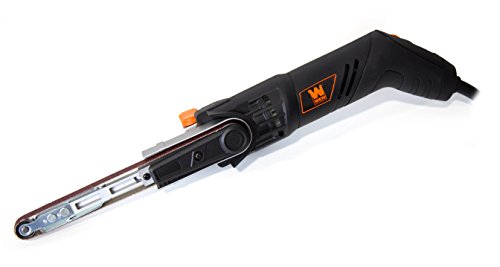
WEN 6307 Variable Speed Detailing File Sander, 1/2 x 18 Inch Belt
1/2 x 18 in belt1,080-1,800 FPMAuto-tracking beltPivots 55 degrees
Check price on Amazon
Best for: Woodworkers who sand curves, slots and cutouts that pads cannot reach.

The WEN 6307 is a different kind of sander: a belt file. A narrow 1/2 by 18 inch belt runs over a nose that pivots up to 55 degrees, so it reaches into slots, curved edges and the inside of cutouts where a triangular pad cannot go. It is the tool for smoothing scroll-saw cuts, the inside of a chair arm or a curved bracket.

Variable speed from 1,080 to 1,800 feet per minute lets you slow down for delicate shaping or speed up for stock removal, and the auto-tracking belt means you never tension or adjust it. Belt sanding removes material faster than an orbital action, so it takes a lighter touch. Against the HYCHIKA, it handles profiles instead of corners.

Because a belt cuts aggressively, keep it moving and work with the grain when possible. The 1/2 inch width suits slots and curves, not flat surfaces. Replace belts when they glaze, and keep a few grits on hand, since belt sizes are specific to the tool. Replace belts as soon as they glaze, because a glazed belt burns the wood and slows the cut.

What works

  • Narrow belt reaches slots and tight curves
  • Variable speed from 1,080 to 1,800 FPM
  • Auto-tracking belt needs no tensioning
  • Pivots up to 55 degrees

Watch out for

  • Not suitable for flat surfaces
  • Belts are tool-specific and must be bought separately
  • Aggressive cut can gouge if pressed

Spec sheet

Model
6307
Belt
1/2 x 18 inches
Belt speed
1,080 to 1,800 feet per minute
Tracking
Auto-tracking, no tensioning
Pivot range
Up to 55 degrees
Format
Detailing file sander
05
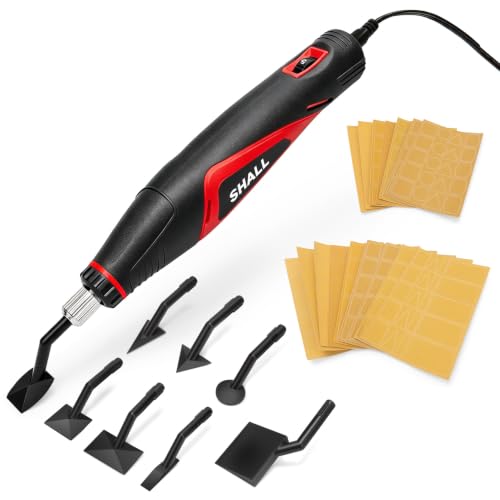
SHALL Mini Pen Sander, 4 Speeds, 8 Sanding Heads, Corded
Pen-style micro sander4 speeds8 sanding headsReciprocating action
Check price on Amazon
Best for: Model makers, restorers and anyone sanding carved or very small details.

The SHALL pen sander is the most precise tool in the group. Its slender body is held like a pen, and a reciprocating head moves the sanding tip back and forth in a tiny stroke. It comes with eight heads, including square, rectangular, slim and triangular shapes, so you can match the tip to a groove, a corner or a carved detail.

Four speeds let you control the aggressiveness, and the pen shape lets you sand with fingertip control, which is why it is popular with model makers and furniture restorers. It is not a stock removal tool, because the head moves in a short stroke with little power. Against the HYCHIKA, it can reach grooves and carved details that no pad can, but it removes material far more slowly.

Use it for finishing touches on small, intricate parts, and keep the sandpaper fresh since small heads wear fast. A corded pen sander is lighter than a pad sander and gives a steady feed, but its small size means it overheats if you press hard. Let it run at a comfortable pace. Take frequent breaks, since a small corded tool heats up in a long session.

What works

  • Pen-style grip gives fingertip control
  • Eight interchangeable sanding heads
  • Four speeds for different materials
  • Reaches grooves and carved detail

Watch out for

  • Very slow for stock removal
  • Small heads wear and need replacing
  • Little power for hard wood

Spec sheet

Style
Pen-style reciprocating sander
Speeds
4 adjustable
Heads
8 shapes including square, slim and triangular
Power
Corded
Grip
Slender, easy to hold
Use
Micro detail and model work

Spec sheet decoder

What the numbers on the box really mean

The specs manufacturers lead with, translated into what they tell you about real-world performance.

OPM (orbits per minute)

OPM counts how often the pad completes an orbit. Higher means faster cutting. A mouse sander's name comes from its shape, which is rounded at the back and pointed at the front.

Watch forDo not compare RPM with OPM, as the DEKOPRO's 13,000 RPM is a different measure.

FPM (feet per minute)

FPM measures belt speed on a belt sander, like the WEN 6307's 1,080 to 1,800. A belt sander removes material by cutting along the belt, which is why it is more aggressive than an orbital pad.

Watch forA belt cuts faster than a pad at the same power.

Amps

Amps measure current draw, a proxy for motor size. Even a one-amp motor draws enough current to heat a thin cord, so do not use a coiled extension cord.

Watch forAt this size, amps are low across the board.

Hook and loop vs adhesive

Hook and loop lets you change sheets quickly, while adhesive sheets are cheaper but stick once. Adhesive-backed sheets stay put better on a small pad but cost more over time.

Watch forCheck which type the sander uses before buying paper.

Dust holes

Holes in the pad that draw dust through to a bag or hose. A pad with no dust holes will clog quickly, so choose one with holes if you work with softwood.

Watch forMatch the hole pattern of sheets to the pad.

Methodology

How We Evaluated These Detail Sanders Under $30

Pad and reach

We compared pad shape and reach, since a detail sander's job is to reach corners. We judged each sander by the spot it reaches, since reach is the job of the category.

Speed and power

We compared OPM and amps, giving the HYCHIKA credit for 1.6 amps and 14,000 OPM. We looked at how many sheets and grits were in the box.

Dust handling

We credited holes, bags and hoses. We noted whether dust handling involved a bag, a hose or both.

Paper included

We counted sheets and grits in the box. We treated the belt and pen sanders as a different style, and weighed them separately.

Fit across the lineup

Each sander was placed by task. We assumed a home user doing furniture and trim work.

Decision guide

How to Choose the Right Detail Sanders Under $30

By Task

Pick the sander by the spot you must reach. The best detail sander is the one that reaches your hardest corner.

TaskRecommended pickWhy
Corners and louversHYCHIKATriangular pad, strong motor.
Window sashes and doorsWEN 6301Larger pad, angled tip.
Full grit setDEKOPRO15 sheets.
Slots and curvesWEN 6307Narrow belt.
Carved detailSHALL pen sanderEight heads.

A detail sander is slow on flat panels.

By Budget

Relative tiers in this group. Prices in this tier are tiny, so shape and dust handling decide the winner.

TierPickWhat you get
LowestWEN 6301Large pad.
LowDEKOPRO15 sheets.
MidHYCHIKAStrongest motor.
UpperWEN 6307Belt file.
TopSHALL pen sanderPen-style detail.

Prices in this tier are all low, so pick by shape.

Pad vs Belt vs Pen

Three styles solve different problems. Pad, belt and pen styles are different tools, and many shops own more than one.

Pad sanders

The HYCHIKA, WEN 6301 and DEKOPRO sand corners and flats with a small orbiting pad.

Belt and pen

The WEN 6307 belt and SHALL pen reach slots, curves and carvings no pad can.

Many workshops keep one of each.

Dust Handling

Dust control matters on small pads. Dust control affects your health as well as your finish.

PreferencePickReason
Six-hole padHYCHIKADraws dust through.
Vacuum hoseDEKOPROHose included.
Light and portableWEN 6301Two pounds.
Belt sandingWEN 6307Belt dust is large.
Pen sandingSHALLFine dust, wear a mask.

Always wear a dust mask.

For Louvered Doors Specifically

Louvers need slim access. Delicate work rewards patience and a light touch.

Look for

A narrow pad or tip, a low profile and light weight. Hold it at an angle to the slats.

In this comparison

The HYCHIKA's triangular tip and the SHALL pen sander's slim heads work best.

When to Spend More

Detail sanders are cheap and limited. A budget detail sander is all most people ever need.

Spend more if

You sand for hours. A cordless or premium sander has less vibration.

Save if

You sand a few pieces a year. Any pick here will do.

Ownership

Maintenance schedule

The upkeep that decides whether this machine lasts two seasons or ten.

TaskIntervalWhy it matters
Replace sandpaperWhen it glazesGlazed paper burns wood. Unplug before changing paper.
Empty the dust bagEvery useA full bag cuts suction. Clean the pad face with a brush.
Clean the padMonthlyDust packs the hook face. Check the dust bag seam.
Check the cordEach useA damaged cord is a hazard. Inspect the cord strain relief.
Replace the padWhen it wearsA worn pad loses sheets. Store it dry.

FAQ

Frequently Asked Questions

What is a detail sander used for?

Corners, spindles, trim and tight spots where a larger sander cannot fit. Wear a dust mask, and sand outside or with a vacuum when possible.

Can I use it on flat surfaces?

You can, but it is slow. Use a random orbital sander instead. Replace the sheet when the cut slows, since worn paper rubs rather than cuts.

What grit should I use?

Start with 80 or 120 and finish with 240. Use the sander at a slight angle so the leading edge does the work.

Do I need dust collection?

Yes. Small pads clog fast and dust is a health hazard.

Are belt file sanders worth it?

For slots and curves, yes. They cut quickly.

How do I avoid gouges?

Keep the sander moving and use light pressure.

Bottom line

The short version

Browse more detail sanders under $30on Amazon →
James Miller, Lead Machine Editor

About the author

James Miller

Lead Machine Editor, MachineFanatic

James Miller leads MachineFanatic's buying guides, turning spec sheets, manuals and owner feedback into clear verdicts on power tools, outdoor power equipment, shop machines and kitchen machines.

More from James →

Keep reading

Related guides