
Amazon affiliate links - we earn a commission.Affiliate disclosure

Buying guide · 15 min read · Updated 2026-11-09

Best Drywall Sanders Under $150 (2026)

Five drywall sanders under $150 compared on motor placement, variable speed, dust extraction, pole reach and when a vacuum hand sander beats a power sander.

James MillerBy James MillerLead Machine Editor5 machines comparedSpec-sheet verified
Best Drywall Sanders Under $150

At a glance

Our top picks

Side by side

Spec comparison

Sanding joint compound is the dustiest job in a renovation, and a drywall sander exists to move that dust into a vacuum before it fills the room. The tool is a spinning disc on a long pole or a hand block with a hose, and the real work is done by how well it extracts dust at the source.

At a low price the trade-offs are weight, balance and how much of the dust actually gets captured. This guide explains the choices between power and hand tools, how pole reach and speed control matter, and which compromises are acceptable for patching and finishing a room. The quick picks are above, and the reviews below show which tool fits which job.

Before you buy

6 Criteria to Look For Before Buying a Drywall Sander Under $150

  1. 01

    Head motor versus handle motor

    The WEN DW5062 mounts a 5 amp motor in the head, which delivers torque at the disc and keeps the pole light. Tools with motors at the handle drive the head through a shaft that loses power and adds weight. A head motor costs more but makes a long ceiling session tolerable. If you sand overhead, the weight at the end of the pole matters more than the amp rating, so check the tool weight when you can.

  2. 02

    Variable speed prevents gouges

    Joint compound is soft, and a fast disc digs into it. The WEN offers 600 to 1,500 rpm, the IMQUALI 800 to 1,800 in seven steps and the Borsstyne 800 to 2,100 in nine. Start at the lowest speed on a patch and raise it only if the cut is too slow. A disc that is too coarse leaves scratches that show under paint, so finish with 220 grit before priming.

  3. 03

    Dust extraction decides the cleanup

    A built-in vacuum helps, but an external wet/dry or shop vacuum does most of the work. The WEN's 15-foot hose and the Hyde's 6-foot hose both connect to one. Without a vacuum, expect a fine white film on every surface within 20 feet. A kinked or undersized vacuum hose loses suction, so use the hose the tool was designed for.

  4. 04

    Reach and storage

    A collapsible pole like the IMQUALI's folds into a carry case and extends for ceilings. Fixed poles are stiffer but need space. Choose by where you will store the tool and how high your ceilings are. Check ceiling height and storage before buying, since a fixed pole may not fit a small closet.

  5. 05

    Hand tool or power tool

    A power sander finishes a room in an hour, while a hand sander takes much longer but gives control. For patches and corners, hand tools like the Hyde and Ray's are enough. For a whole room, a power sander saves a day. Cutting time matters, and a power sander can finish a bedroom in an hour that would take a hand sander a day.

  6. 06

    Health and dust hazards

    Drywall dust is fine and irritating, and older textured ceilings may contain asbestos. Wear a respirator rated for fine dust, seal off the room and test old texture before sanding. A vacuum reduces but does not eliminate the dust. Keep a spare respirator cartridge, since drywall dust clogs filters quickly.

Detailed reviews

The 5 best drywall sanders under $150, explained

01
WEN DW5062 Variable Speed 5-Amp Drywall Sander with 15-Foot Dust Hose
5 amp head motor600-1,500 rpm15-foot dust hoseHole-pattern disc
Check price on Amazon
Best for: Homeowners and renovators who sand a whole room and want a head motor with variable speed.

The WEN DW5062 puts the motor in the sanding head, which is the design professionals prefer. A head-mounted motor drives the disc directly, delivering torque where it is needed, and the pole carries only the weight of the hose and cord. A motor at the handle end drives the head through a long shaft or flexible cable, which adds weight to the end you hold and loses power.

Variable speed from 600 to 1,500 rpm is the feature that prevents gouges. Joint compound is soft, and a disc running flat out can dig a trough in a patch, while a slow disc feathers the edge. A 15-foot dust hose connects to a shop vacuum, with an improved hole pattern that maximizes dust pickup, so most of the dust goes into the vacuum rather than the air.

It only accepts DW series discs, which means you must buy compatible paper, a small catch that matters when you run out mid-job. Against the IMQUALI, the WEN is a fixed-length tool with a lower amp rating, but its head motor and longer hose make it the more serious option. Use 120 to 220 grit, and let the disc float across the surface rather than pressing in. Use a respirator rated for fine dust, and replace the filter often.

What works

  • Head-mounted 5 amp motor puts torque at the disc
  • Variable speed from 600 to 1,500 rpm
  • 15-foot hose gives room to move
  • Disc hole pattern improves dust pickup

Watch out for

  • Accepts only DW series discs
  • Heavy at the end of a long pole
  • Needs a shop vacuum to work as intended

Spec sheet

Model
DW5062
Motor
5 amp, head-mounted
Speed
600 to 1,500 rpm variable
Dust hose
15 feet
Disc
Improved hole pattern for dust pickup
Note
Compatible only with DW series discs
02
IMQUALI 8-Amp Collapsible Drywall Sander, 7 Speeds 800-1,800 RPM
8 amp copper motor800-1,800 rpm, 7 speeds10-hole discCollapsible pole
Check price on Amazon
Best for: Renters and small-space owners who want a power sander that folds away.

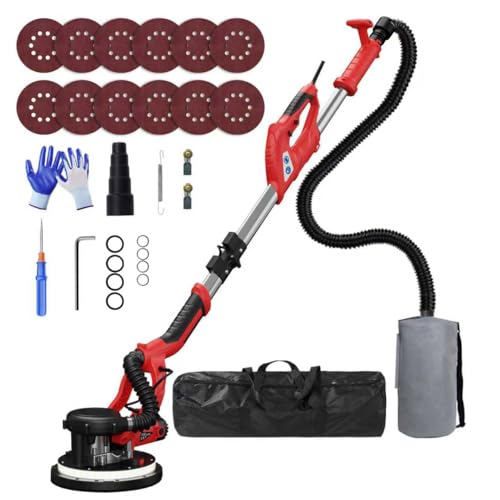
The IMQUALI is the choice for people who need a power sander that stores in a closet. Its collapsible pole folds into a carry case, and an extendable length reaches ceilings and walls from the floor. An 8-amp copper motor is the strongest in the group on paper, and seven speeds from 800 to 1,800 rpm give fine control.

It includes a built-in vacuum system and a 10-hole sanding disc, which is designed to pull dust through the disc into the collector. Built-in vacuums on a cheap sander are modest, and most of the dust control still comes from connecting an external vacuum. The same maker sells several near-identical listings with small changes to the title and speed range, so check that you are comparing the same model.

Against the WEN, the IMQUALI has more motor and a collapsible pole but a shorter dust path, and a bigger motor is not an advantage if the disc runs too fast. Start at the lowest speed and test on a scrap patch. Wear a respirator, because drywall dust is fine and irritating regardless of the dust system. Sand with a light touch and let the disc float, which gives an even surface.

What works

  • 8 amp copper motor is the strongest here
  • Seven speeds from 800 to 1,800 rpm
  • Collapsible pole stores in a carry case
  • 10-hole disc improves dust capture

Watch out for

  • Built-in vacuum is modest compared with an external one
  • Several near-identical listings can confuse
  • Unknown brand with limited support

Spec sheet

Motor
8 amp copper
Speed
800 to 1,800 rpm, 7 steps
Disc
10-hole design with built-in vacuum
Pole
Collapsible, carry case included
Reach
Extendable pole for walls and ceilings
Note
Several near-identical IMQUALI listings exist
03
Borsstyne Electric Drywall Sander, 9 Speeds 800-2,100 RPM, LED Ring
9 speed steps800-2,100 rpmBuilt-in dust controlLED light strip
Check price on Amazon
Best for: Users who sand patches and remove textured ceilings and want fine speed control and a work light.

The Borsstyne has the finest speed control in the group: nine steps from 800 to 2,100 rpm. A wide range lets you run slow for feathering compound edges and fast for removing a textured ceiling. The top speed of 2,100 rpm is the highest of any sander here, which is useful for removing popcorn texture but dangerous on a fresh patch.

A bright LED strip circles the sanding base, which is more than a gimmick. Drywall work is judged by raking light, and a light on the tool shows the high and low spots as you sand. The built-in dust control is described as absorbing fine particles automatically, though as with other integrated systems, an external vacuum captures more.

If you remove popcorn ceilings, test the texture for asbestos first if the house was built before the 1980s, since sanding releases fibers. Against the IMQUALI, the Borsstyne offers more speed steps and a light but a less detailed motor specification. Keep the speed low near edges, and use fresh discs, since a clogged disc leaves swirl marks. Work in raking light from a lamp so you can see the high and low spots as you sand.

What works

  • Nine speed steps from 800 to 2,100 rpm
  • LED light strip shows high and low spots
  • Built-in dust control system
  • Suits both drywall and texture removal

Watch out for

  • Motor amps are not stated on the listing
  • 2,100 rpm top speed can gouge a patch
  • Built-in dust control needs a vacuum for best results

Spec sheet

Speed
9 variable steps, 800 to 2,100 rpm
Dust control
Built-in system that absorbs fine particles
Lighting
LED strip around the sanding base
Use
Drywall and popcorn ceiling removal
Format
Pole-mounted electric sander
Positioning
Wall and ceiling sanding
04
Hyde 09165 Dust-Free Drywall Vacuum Hand Sander with 6-Foot Hose
Vacuum hand sander6-foot hoseSanding screenNo motor
Check price on Amazon
Best for: Patchers and small-room finishers who want control and low cost.

The Hyde vacuum hand sander is the quiet, light option. It has no motor, so its price is low and the only power is your arm, but the sanding head connects to a wet/dry vacuum through a 6-foot hose, which captures dust at the source. A sanding screen, a mesh abrasive that does not clog, does the cutting, so it lasts through a lot of compound.

For patch repairs, nail pops and small rooms, a hand sander gives more control than a power tool, because you feel the surface and do not risk gouging. It will not match a pole sander on a large ceiling, since reaching up with a hand tool is tiring. Compared with the WEN, it is slower on large areas but far more precise on small ones.

A vacuum hand sander turns the dustiest job into a manageable one, and it costs a fraction of a power sander. Keep the screen clean, since packed compound reduces cutting. Use light strokes and let the screen do the work. It is a good companion to a power sander for finishing edges. A fresh screen cuts much faster than a clogged one, so rinse it often.

What works

  • Vacuum port captures dust at the source
  • Sanding screen resists clogging
  • No motor, so light and quiet
  • Precise control for patches

Watch out for

  • Slow on large walls and ceilings
  • Needs a wet/dry vacuum to work
  • Tiring overhead

Spec sheet

Model
09165
Type
Hand sander with vacuum port
Hose
6 feet
Included
Sanding screen and coupling adaptor
Vacuum
Connects to a wet/dry vacuum
Use
Patching and joint compound
05
Ray's Drywall Corner Sander, 150 Grit, Female Painter's Pole Connector
150 gritPole connectorFeathered edgesInside corners
Check price on Amazon
Best for: Anyone finishing inside corners who already owns a painter's pole.

Ray's is a specialty tool: a corner sander that mounts on a standard painter's pole with a 3/4 inch by 5 ACME thread. Its feathered edges produce a crisp corner without gouging or cutting, a job that a flat disc cannot do because the disc cannot reach into the angle. Inside corners are where most drywall finishes fail, and a dedicated tool fixes them.

It is a hand tool with 150 grit paper, a good grit for finish sanding joint compound before primer. The female connector means it fits male-threaded poles, so check your pole's thread before you order, since the male version exists for other poles. Against the power sanders, it is slow but it does one job that none of them can.

Use it with light pressure and a straight pull along the corner. A corner sander is not a primary tool for a whole room, but combined with a power sander on the flats it gives a professional corner finish. Replace it when the grit wears flat, and wear a mask, since this tool has no dust capture. Keep a stock of 150 grit spares, since a single worn sheet slows the whole job.

What works

  • Feathered edges make crisp corners without gouging
  • Fits standard painter's pole threads
  • Does a job power sanders cannot
  • Very low cost

Watch out for

  • No dust collection
  • Only handles corners
  • Female connector fits only male-threaded poles

Spec sheet

Grit
150
Connector
Female, 3/4 in x 5 ACME painter's pole thread
Use
Inside corners of walls and ceilings
Action
Hand-pushed on a pole
Edge design
Feathered to avoid gouging
Format
Hand tool

Spec sheet decoder

What the numbers on the box really mean

The specs manufacturers lead with, translated into what they tell you about real-world performance.

RPM range

Disc speed in rotations per minute. Lower speeds are gentler on compound. A slow disc leaves fewer marks, and a fast disc leaves more, which is why speed control is the key spec.

Watch forA 2,100 rpm top speed like the Borsstyne's is for texture removal, not for finishing.

Amps

Amps measure current draw. The IMQUALI lists 8 amps and the WEN 5. A 5 amp head motor can produce more torque at the disc than an 8 amp handle motor, because power is lost in the shaft.

Watch forA bigger motor does not mean a better finish and may be harder to control.

Head-mounted motor

A motor in the sanding head drives the disc directly with more torque and less pole weight. Built-in vacuums on cheap sanders mostly route air through the disc, and they rely on a hose for the bulk of the dust.

Watch forCheck where the motor is, since some sanders put it at the handle.

Disc hole pattern

Holes in the disc align with vacuum ports to draw dust through. A coupling adaptor lets one hose fit several vacuum port sizes.

Watch forOnly DW series discs fit the WEN, so buy compatible paper.

Grit

Grit numbers measure abrasive coarseness. 120 to 220 is typical for joint compound. A mesh sanding screen does not load with dust the way paper does.

Watch forCoarser grit leaves scratches that show under paint.

Methodology

How We Evaluated These Drywall Sanders Under $150

Motor design

We favored head-mounted motors and sufficient amps. We checked motor location and speed range on each listing and noted where specs were missing.

Speed control

We compared speed ranges and steps, since control prevents gouges. We assumed a homeowner who finishes a room or two and patches in between.

Dust extraction

We credited hoses, vacuum ports and disc hole patterns. We counted hoses, vacuum ports and disc designs as part of the dust story.

Reach and storage

We considered poles, weight and collapsibility. We treated hand tools as a separate tier and weighed them for patch and corner work.

Fit across the lineup

Each tool was placed by job: whole room, patch or corner. We ranked by job fit.

Decision guide

How to Choose the Right Drywall Sanders Under $150

By Job

Pick the tool by the work. The right tool depends on the scale of the job, so start by estimating the area.

JobRecommended pickWhy
Whole room finishingWEN DW5062Head motor, long hose.
Small storage spaceIMQUALI collapsibleFolds into a case.
Texture removal and patchesBorsstyneNine speeds, LED.
Patches and nail popsHyde vacuum hand sanderControl, vacuum.
Inside cornersRay's corner sanderFeathered edges.

Use a power sander for the flats and a hand tool for corners.

By Budget

Relative tiers in this group. Prices in this tier are close, so features like motor location and dust capture decide.

TierPickWhat you get
LowestRay's corner sanderHand tool.
LowHyde hand sanderVacuum hand sander.
MidBorsstyneNine speeds.
UpperWEN DW5062Head motor.
TopIMQUALI8 amp collapsible.

Hand tools cost little, but cost time.

Power vs Hand Sanders

The main decision is power or hand. Power and hand tools are partners, not alternatives.

Power sanders

The WEN, IMQUALI and Borsstyne sand large areas fast, but need dust control and care.

Hand sanders

The Hyde and Ray's are slow but precise and gentle.

Choose power for rooms and hand for patches.

Dust Plan

Plan the dust before you start. Dust planning is half the job, and a vacuum is more important than a premium sander.

SetupPickReason
Shop vacuum availableWEN DW506215-foot hose.
Wet/dry vacuumHyde6-foot hose.
Built-in dust controlBorsstyneIntegrated system.
Built-in vacuum discIMQUALI10-hole disc.
No vacuumRay'sUse a mask.

Always seal the room and wear a respirator.

For Skim Coats Specifically

Skim coats need gentle, even sanding. Skim coats reward patience and low speed.

Look for

Variable speed, a wide pad and good dust control. Use 120 to 220 grit.

In this comparison

The WEN's 600 rpm floor and the Borsstyne's nine speeds suit it best.

When to Spend More

Budget drywall sanders have limits. A budget sander is fine for one project, and a pro sander is for daily use.

Spend more if

You finish drywall often. A professional sander has better balance and dust capture.

Save if

You patch a few holes a year. A hand sander is enough.

Ownership

Maintenance schedule

The upkeep that decides whether this machine lasts two seasons or ten.

TaskIntervalWhy it matters
Empty the vacuumEvery useA full vacuum loses suction and dumps dust. Unplug before changing discs.
Replace the discWhen it clogsA clogged disc leaves swirls. A cracked hose leaks dust.
Check the hoseEach useA kinked hose cuts suction. Wipe dust from vents.
Inspect the cordEach useA damaged cord is a hazard. Store the pole dry.
Clean the screenAfter each jobPacked compound reduces cutting. Check the coupling for wear.

FAQ

Frequently Asked Questions

Do I need a power sander?

For a whole room, yes. For patches, a hand sander is enough. Seal doors and vents with plastic sheeting before you start, and run a fan to exhaust air outside.

What grit should I use?

120 to 220 grit for joint compound. Replace the disc when sanding slows, since a loaded disc burns the compound.

Is the dust dangerous?

It is irritating, and old textured ceilings may contain asbestos. Wear a respirator. Let the compound cure fully before sanding, or it will clog the paper.

Can I use it without a vacuum?

You can, but the dust will spread. Seal the room and wear a mask.

Why does my sander leave swirls?

Speed too high, disc clogged or pressure too heavy.

Does a collapsible pole feel solid?

It is less stiff than a fixed pole. Use light pressure.

Bottom line

The short version

Browse more drywall sanders under $150on Amazon →
James Miller, Lead Machine Editor

About the author

James Miller

Lead Machine Editor, MachineFanatic

James Miller leads MachineFanatic's buying guides, turning spec sheets, manuals and owner feedback into clear verdicts on power tools, outdoor power equipment, shop machines and kitchen machines.

More from James →

Keep reading

Related guides