
Amazon affiliate links - we earn a commission.Affiliate disclosure

Buying guide · 12 min read · Updated 2026-11-07

Best Dual Fuel Generators for RVs (2026)

Six dual fuel generators for RVs compared on gas versus propane output, 30 amp outlets, noise and upkeep, so your coach runs on any fuel you carry.

James MillerBy James MillerLead Machine Editor6 machines comparedSpec-sheet verified
Best Dual Fuel Generators for RVs

At a glance

Our top picks

Side by side

Spec comparison

MachineGas outputPropane outputSafetyClass
Westinghouse iGen4000DF 4000 Peak Watt Dual Fuel InverterBest OverallWestinghouse iGen4000DF 4000 Peak Watt Dual Fuel Invertern/an/an/an/a
WEN 3600 Watt Dual Fuel RV-Ready Inverter GeneratorBest ValueWEN 3600 Watt Dual Fuel RV-Ready Inverter Generator3,600 surge, 2,900 rated3,500 surge, 2,600 ratedFuel shutoffRV ready
Pulsar GX400BN 4000W Dual Fuel Parallel Ready GeneratorBest for Parallel PairingPulsar GX400BN 4000W Dual Fuel Parallel Ready Generator4,000 peak, 3,200 rated3,600 peak, 2,800 ratedn/aRV ready, ultra quiet
ERAYAK 4500W Dual Fuel Inverter, 30A RV Ready, 54 lbBest Auto Fuel SwitchingERAYAK 4500W Dual Fuel Inverter, 30A RV Ready, 54 lb4,500 peak, 3,500 ratedn/an/a30A RV ready
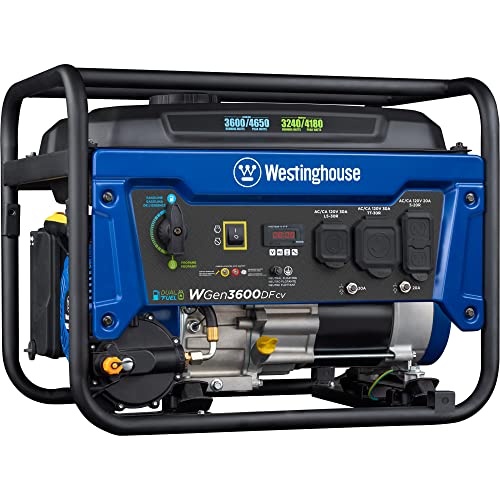
Westinghouse 4650 Peak Watt Dual Fuel Generator, 30A OutletBest Open Frame Dual FuelWestinghouse 4650 Peak Watt Dual Fuel Generator, 30A Outlet4,650 peak, 3,600 rated4,650 peak, 3,240 ratedCO sensorn/a
WEN 6800 Watt Dual Fuel RV Ready Inverter with CO WatchdogBest High OutputWEN 6800 Watt Dual Fuel RV Ready Inverter with CO Watchdog6,800 surge, 5,100 rated6,000 surge, 4,500 ratedWEN Watchdog CO shutoffn/a

Dual fuel is the one feature that changes how an RV generator is owned. Gasoline gives full output and is easy to buy on the road, while propane stores for years and is already on board. The question is what each fuel costs you in watts and in convenience.

Most coaches ask for only a modest circuit, so the real decision is how much power you lose on propane, whether the machine switches on its own, and how a quiet inverter compares with a rugged open frame. This guide separates those trade-offs.

Before you buy

6 Criteria to Look For Before Buying a Dual Fuel Generator for RVs

  1. 01

    Propane output loss

    Propane has less energy per unit than gasoline, so every dual fuel machine gives up watts. The WEN 3600 falls from 2,900 to 2,600 rated, the Pulsar from 3,200 to 2,800, and the Westinghouse 4650 only from 3,600 to 3,240. Size the generator for the propane figure, not the gasoline one, if propane will be your main fuel.

  2. 02

    30 amp circuit sizing

    A 30 amp coach can draw up to 3,600 watts at 120 volts, and most run on 2,500 to 3,200 with one air conditioner. The 3,300 rated Westinghouse iGen4000DF and the 3,500 rated ERAYAK fit that budget, while the WEN 3600 is tight. Add up your actual appliances before buying.

  3. 03

    Manual versus automatic fuel switching

    On most dual fuel units you pick the fuel with a switch and swap hoses when a bottle empties. The ERAYAK 4500 moves from propane to gasoline on its own, so the engine does not stall when the tank runs dry. That is the one feature that matters most if you sleep with the air conditioner on.

  4. 04

    Inverter versus open frame

    An inverter converts to DC and back, which gives clean power and lets engine speed follow load. The Westinghouse 4650 open frame skips that and costs less per watt. If you charge laptops or run a CPAP, choose inverter; if you only need lights and a fridge, open frame saves money.

  5. 05

    Noise at the campsite

    Listed decibel numbers are taken at quarter load, so real noise at full load is higher. Inverter machines like the WEN 6800 stay in the range of normal conversation at part load, while an open frame is noticeably louder. Parks with quiet hours will ask you to shut an open frame down early.

  6. 06

    Carbon monoxide shutoff

    An automatic CO sensor is a worthwhile layer of protection that the Westinghouse 4650 and the WEN 6800 offer. It does not replace placing the generator outdoors, well away from windows, doors and vents. Never run any generator in a garage or an enclosed compartment.

Detailed reviews

The 6 best dual fuel generators for rvs, explained

01
Westinghouse iGen4000DF 4000 Peak Watt Dual Fuel Inverter
3300 rated wattsUnder 3% THD30A outletRecoil start
Check price on Amazon
Best for: A typical 30 amp trailer that wants clean power and a readout of runtime.

The standout feature is the LED data center, which rotates through fuel level, output, remaining run time and voltage. On a dual fuel machine that is more useful than it sounds, because you can see how long a propane tank will last at the load you are actually drawing instead of guessing. The inverter design puts clean power below 3 percent distortion, which is why it is safe for laptops and a CPAP.

It sits one step below the 5000 watt Westinghouse in this family, and at 3,300 rated watts it is sized for a typical 30 amp coach with one 13,500 BTU air conditioner. Starting is by recoil in this version, so you pull a cord; the remote start units cost more and are listed separately. A telescoping handle and wheel kit make it easy to move around a campsite.

Upkeep is simple if you remember the propane side. Rubber hoses and the regulator diaphragm dry out when a unit sits for a year, so connect and run it on propane at least twice a season. Change the oil after the first 20 hours, because small inverter crankcases hold little oil and get hot.

What works

  • Rotating display shows runtime on either fuel
  • Under 3 percent THD protects electronics
  • RV-ready 30 amp outlet plus two USB ports
  • Telescoping handle and wheels for campsite moves

Watch out for

  • Recoil start only on this version
  • 3,300 rated watts limits two-air-conditioner coaches

Spec sheet

Peak watts
4,000
Rated watts
3,300
Power quality
Under 3% THD
Outlets
5-20R, TT-30R, two USB
Display
Rotating LED data center
02
WEN 3600 Watt Dual Fuel RV-Ready Inverter Generator
2900 rated wattsDual fuelFuel shutoffRV ready
Check price on Amazon
Best for: Small travel trailers with one air conditioner and no electric water heater.

WEN publishes both fuel ratings, which is the honest way to sell a dual fuel machine, and the numbers tell a clear story: 2,900 rated watts on gas, 2,600 on propane, a loss of about 300 watts. That drop is enough to matter when a 13,500 BTU air conditioner is starting, so on propane you should keep the microwave off during startup.

It is the lowest rated machine in this lineup apart from the camping-sized units, and that is the reason it is the value pick: you only pay for the watts a small trailer uses. A fuel shutoff valve lets you run the carburetor dry before storage, which prevents the gummed jets that are the top cause of failed starts.

Compared with the 4800 watt WEN it gives up a thousand rated watts but is lighter and cheaper to feed. Plan to change the oil early, and keep the vent slots clear because a compact inverter case traps heat.

What works

  • Both fuel ratings are published openly
  • Fuel shutoff valve for clean storage
  • Lowest buy-in of the inverter units here
  • Inverter output is safe for phones and laptops

Watch out for

  • Only about 2,600 watts available on propane
  • Starting an air conditioner leaves little headroom

Spec sheet

Gas output
3,600 surge, 2,900 rated
Propane output
3,500 surge, 2,600 rated
Design
Inverter, quiet
Safety
Fuel shutoff
Class
RV ready
03
Pulsar GX400BN 4000W Dual Fuel Parallel Ready Generator
3200 rated wattsParallel ready149cc engineDual fuel
Check price on Amazon
Best for: Owners who want to start small and grow output later by adding a second unit.

The reason to look at the Pulsar is parallel capability. Two of these joined with a parallel kit double the available watts, so you can start with one unit for a small trailer and add a second later for a bigger coach. The 149cc engine is a short stroke, 5.5 horsepower design typical of lightweight inverter models.

The propane figure is lower than gas, 2,800 rated watts compared with 3,200, a gap of 400 watts. That is a larger loss than on the WEN 3600, which is something to remember when you plan around a propane-only weekend. Pulsar markets it for emergency home backup too.

Ownership is where the parallel feature earns its keep, because two small machines are easier to carry and each is a backup for the other. The downside is that you carry two sets of fuel, and a parallel cable and a second set of maintenance. Run each unit under load monthly and keep the same oil change schedule on both.

What works

  • Parallel capable for doubling output later
  • Lightweight 149cc inverter engine
  • Dual fuel for stored propane
  • Matches 30 amp coach demands

Watch out for

  • Propane output drops 400 rated watts from gas
  • Parallel kit is a separate purchase

Spec sheet

Gas output
4,000 peak, 3,200 rated
Propane output
3,600 peak, 2,800 rated
Engine
149cc, 5.5 HP
Expansion
Parallel capable
Class
RV ready, ultra quiet
04
ERAYAK 4500W Dual Fuel Inverter, 30A RV Ready, 54 lb
3500 rated wattsGas priority switch54 lb30A RV outlet
Check price on Amazon
Best for: Boondockers who do not want to be woken when a propane bottle runs dry.

ERAYAK built its pitch around a smart fuel switch: a propane tank runs the machine first, and when the tank runs empty the engine moves over to gasoline. That means no midnight shutdown when a bottle runs out while you are asleep with the air conditioner running, which is exactly the failure that plagues manual dual fuel systems.

At 54 pounds it is easy to lift into a truck bed, yet it supplies 3,500 rated watts, the highest sustained number of the lightweight inverter models here. In a 30 amp coach it can start a single air conditioner and carry normal loads.

As a newer brand its parts network is thinner than the major names, so check what the warranty actually covers before buying. Keep the fuel line connection clean and replace the propane hose if it ever shows cracking, since a leaking hose both wastes fuel and creates a safety problem.

What works

  • Automatic hand-off from propane to gasoline
  • 54 pounds is easy to carry
  • 3,500 rated watts outperforms smaller siblings
  • 30 amp RV outlet for direct plug-in

Watch out for

  • Brand has a shorter service record
  • Compact case needs open airflow when hot

Spec sheet

Gas output
4,500 peak, 3,500 rated
Weight
54 lb
Dimensions
19.88 x 16.93 x 20.25 inches
Fuel logic
Gas priority auto-switch
Class
30A RV ready
05
Westinghouse 4650 Peak Watt Dual Fuel Generator, 30A Outlet
3600 rated watts4 gal tankCO sensorL5-30R and TT-30R
Check price on Amazon
Best for: Buyers who need the lowest cost per watt and have a tolerance for noise.

This is not an inverter. It is a conventional open-frame generator, which is why it costs less per watt and carries a four gallon tank with a gauge. The propane figure holds up better than most, 3,240 rated watts against 3,600 on gasoline, a loss of only about 10 percent.

The cost of that simplicity is noise and power quality. It is louder than any inverter here, and without inverter electronics the output has more distortion, so keep sensitive electronics on a separate circuit or a power strip with surge protection. A built-in CO sensor will shut the machine down if gas builds up.

It arrives with oil, a funnel and a tool kit, so a first start is easy. Fuel stability matters more on a four gallon tank that sits unused, so add stabilizer or run the carburetor dry, and check the wheel kit hardware before every trip.

What works

  • Four gallon tank means fewer refueling stops
  • CO sensor shuts it down automatically
  • Only about 10 percent propane loss
  • Lowest cost per watt in the lineup

Watch out for

  • Open frame noise bothers neighbors
  • Distortion is higher than an inverter unit

Spec sheet

Gas output
4,650 peak, 3,600 rated
Propane output
4,650 peak, 3,240 rated
Tank
4 gallons
Outlets
5-20R, TT-30R, L5-30R
Safety
CO sensor
06
WEN 6800 Watt Dual Fuel RV Ready Inverter with CO Watchdog
5100 rated watts224cc engineCO Watchdog240V Level 2 charge
Check price on Amazon
Best for: Large coaches with two roof air conditioners that want inverter-quiet power.

This is the machine for a coach with two air conditioners. At 5,100 rated watts on gasoline and 4,500 on propane it carries roughly 1,500 more watts than the 3,600 class, and it is a true inverter so it stays quieter than an open frame at that size.

The bonded-neutral 240 volt configuration is an unusual extra. It lets the generator provide low-power Level 2 charging for an electric or hybrid vehicle, which suits an RV owner who tows with a plug-in. The built-in Watchdog sensor shuts the engine off if carbon monoxide builds up.

The cost is weight and price. This is much heavier than the 54 pound ERAYAK, so plan a wheel kit and a ramp. Keep the engine well oiled, because a 224cc crankcase runs hotter under sustained 5,000 watt load, and use the monthly exercise run to keep the carburetor clean.

What works

  • 5,100 rated watts handles two air conditioners
  • CO Watchdog shuts engine off automatically
  • 240V output allows low-power vehicle charging
  • Inverter design is quieter than an open frame

Watch out for

  • Much heavier than the lightweight 30 amp units
  • Propane drops to 4,500 rated watts

Spec sheet

Gas output
6,800 surge, 5,100 rated
Propane output
6,000 surge, 4,500 rated
Engine
224cc
Safety
WEN Watchdog CO shutoff
Extra
Bonded-neutral 240V output

Spec sheet decoder

What the numbers on the box really mean

The specs manufacturers lead with, translated into what they tell you about real-world performance.

Rated watts on each fuel

The sustained output on gasoline and on propane. Propane is nearly always lower.

Watch forThe Pulsar loses 400 watts on propane while the Westinghouse 4650 loses about 360.

Surge versus rated

Surge covers a few seconds of motor start, while rated is the continuous number. Never size on the surge figure.

Watch forThe WEN 6800 lists 6,800 surge against 5,100 rated.

TT-30R outlet

The 30 amp, 120 volt receptacle that matches a standard RV shore cord. It limits you to 3,600 watts through that outlet.

Watch forThe Westinghouse iGen4000DF has a TT-30R, while the bigger WEN uses its own configuration.

Total harmonic distortion

How far the waveform departs from a clean sine wave. Under 3 percent is safe for sensitive electronics.

Watch forOnly the inverter units here publish a clean-power figure.

Parallel capability

The ability to link two matching units for double output through a kit.

Watch forThe Pulsar GX400BN is the parallel-ready pick in this lineup.

Methodology

How We Evaluated These Dual Fuel Generators for RVs

Output on both fuels

We compared published rated watts on gasoline and propane wherever listings gave both. The spread ran from about 300 watts on the WEN 3600 to 400 on the Pulsar. Machines that hid propane output were marked down.

Fit for a 30 amp coach

We matched rated watts against a normal coach load of one air conditioner plus lights, a fridge and a microwave. The iGen4000DF and ERAYAK 4500 fit comfortably, while the WEN 3600 is marginal. The WEN 6800 was assessed for dual air conditioner coaches.

Switching logic

We looked at how each unit handles a propane bottle running empty. The ERAYAK's automatic hand-off stood out. Others require a manual switch.

Safety features

We considered CO shutoff, fuel shutoff valves and low oil protection. The Westinghouse 4650 and WEN 6800 offer CO shutdown. A fuel shutoff valve on the WEN 3600 aids storage.

Ownership burden

Based on owner feedback patterns, we weighed weight, tank size and the propane regulator upkeep. The 54 pound ERAYAK was easiest to handle; the 6,800 watt WEN is the heaviest.

Decision guide

How to Choose the Right Dual Fuel Generators for RVs

By Coach Load

SituationPickWhy
Small trailer, one air conditionerWEN 36002,900 rated watts suffices for a small rig
Typical 30 amp trailerWestinghouse iGen4000DF3,300 rated watts with a runtime display
Coach that sleeps with the AC onERAYAK 4500Auto switch avoids stalled propane runs
Two roof air conditionersWEN 68005,100 rated watts on gasoline
Lowest cost per wattWestinghouse 4650Open frame with a four gallon tank

By Budget

TierPickWhy
Lowest outlayWEN 3600Small output, inverter quiet
Low per-watt costWestinghouse 4650Open frame trades noise for savings
Mid tierPulsar GX400BNParallel capable for later growth
Upper midERAYAK 4500Auto fuel switching and 3,500 watts
Highest costWEN 6800Largest output and 240V charging

Propane vs Gasoline

Propane first

Stores for years, burns cleaner and needs less engine upkeep. The Westinghouse 4650 loses only about 10 percent, so it is the strongest propane runner. The Pulsar loses about 12 percent and the WEN 6800 about 12 percent too.

Gasoline first

Gives full output and is easy to buy on the road, but stale fuel is a storage risk. Machines with a fuel shutoff, like the WEN 3600, let you run the carburetor dry before storage.

Choose propane first if you boondock with a large tank; choose gasoline first if you travel far from refill points.

Inverter vs Open Frame

PreferencePickWhy
Quietest runningWEN 6800Inverter output at higher wattage
Clean power for CPAPWestinghouse iGen4000DFUnder 3 percent THD
Light enough to carryERAYAK 4500Only 54 pounds
Rough duty and low costWestinghouse 4650Open frame, four gallon tank
Growth by adding a unitPulsar GX400BNParallel ready

For Boondocking Specifically

Look for

Auto fuel switching, a large tank or propane supply, and rated watts that cover your air conditioner on the weaker fuel. Check that a CO sensor is present.

In this comparison

The ERAYAK 4500 is the best fit because it moves between fuels without a shutdown, while the Westinghouse iGen4000DF is the runner-up with its runtime readout.

When to Spend More

Spend more if

You run two air conditioners, you want vehicle charging or you value quiet. The WEN 6800 delivers 5,100 rated watts and a CO Watchdog.

Save if

You camp with a small trailer or only run lights, a fridge and a fan. The WEN 3600 or the Westinghouse 4650 covers that without paying for a larger engine.

Ownership

Maintenance schedule

The upkeep that decides whether this machine lasts two seasons or ten.

TaskIntervalWhy it matters
Exercise on propaneEvery 2 to 3 monthsRegulator diaphragms and rubber hoses stiffen when idle. A run under load keeps seals pliable and shows leaks early.
Change engine oilAfter the first 20 hours, then every 50 hoursSmall inverter crankcases hold little oil and run hot. Fresh oil is the cheapest insurance on a 224cc or smaller engine.
Inspect propane hoseBefore every tripCracks or hardened rubber leak fuel. Replace any hose that shows wear.
Stabilize or run dryBefore storageEthanol gasoline gums carburetor jets within weeks. Use the fuel shutoff to burn off the bowl.
Clean air filter and spark plugEvery 100 hoursA dirty filter starves the engine and raises fuel use. A fouled plug causes hard starts.

FAQ

Frequently Asked Questions

Is dual fuel better than gasoline only for an RV?

For most RV owners, yes. Propane stores for years and is already on board for many coaches, while gasoline gives full output when you need it. The cost is a few hundred fewer watts on propane.

How much power do I lose on propane?

Between 10 and 15 percent on the units here. The WEN 3600 drops 300 rated watts and the Pulsar drops 400. Check the propane figure, not the gasoline one.

Which is the best value pick?

The WEN 3600 is the lowest outlay among the inverter units and publishes both fuel ratings. The Westinghouse 4650 is cheaper per watt if you accept open-frame noise.

Does a bigger peak number mean more power?

No. Peak is a short surge for starting a motor. The WEN 6800 lists 6,800 peak but only 5,100 rated, so size by the rated figure.

Can I run it while the RV is parked in a campground?

Only where the rules allow it and during permitted hours. Place the generator outdoors, well away from windows and doors, and never run it in an enclosed space.

Can I run two air conditioners on one of these?

Only on the WEN 6800 at 5,100 rated watts, and even then you should stagger startups. The smaller 30 amp units handle one air conditioner at a time.

Bottom line

The short version

Browse more dual fuel generators for rvson Amazon →
James Miller, Lead Machine Editor

About the author

James Miller

Lead Machine Editor, MachineFanatic

James Miller leads MachineFanatic's buying guides, turning spec sheets, manuals and owner feedback into clear verdicts on power tools, outdoor power equipment, shop machines and kitchen machines.

More from James →

Keep reading

Related guides