
Amazon affiliate links - we earn a commission.Affiliate disclosure

Buying guide · 12 min read · Updated 2026-11-28

Best Food Dehydrators Under $50 (2026)

Food dehydrators under $50 compared on maximum temperature, tray material, airflow design and capacity, from 240 W compacts to a 400 W stainless unit.

James MillerBy James MillerLead Machine Editor5 machines comparedSpec-sheet verified
Best Food Dehydrators Under $50

At a glance

Our top picks

Side by side

Spec comparison

A dehydrator is a small heater and a fan in a box, and the whole job is moving warm, dry air across food slowly enough that the surface does not harden before the middle dries. At the entry price range, nearly every unit is a stackable design with the fan at the top or bottom.

That layout works for fruit, herbs and vegetables, but it dries unevenly and asks you to rotate trays. The temperature ceiling matters more than most buyers expect, since jerky needs to reach safe temperatures. This guide ranks units that fit under the cap at listing prices when it was updated. Prices move, so check the live listing.

Before you buy

6 Criteria to Look For Before Buying a Food Dehydrator Under $50

  1. 01

    Maximum temperature

    A dehydrator's top temperature decides what it can safely dry. Fruit dries at about 135 degrees Fahrenheit, vegetables at 125 and herbs at 95 to 115, while jerky needs 145 to 165. Guidance for meat often calls for reaching 160 degrees, which the Cosori at 165 degrees and the OSTBA at 160 can meet. The Elite Gourmet stops at 158 and the Konfintos does not state a ceiling. Buyers who skip this check dry raw meat at a temperature that does not kill bacteria. Verify with a probe thermometer at each tray level.

  2. 02

    Airflow design

    Stackable units push air through the stack from the base or top, so trays closest to the fan dry faster than the rest. Rear-mounted fan shelf units move air horizontally across every tray and dry evenly, but they cost more and need more counter space. All five picks here are stackable, so plan to rotate trays every hour or two. Uneven drying is the commonest complaint at this price. A smaller batch spread across fewer trays dries more evenly than a full stack.

  3. 03

    Tray material

    Plastic trays like those on the Cosori and Elite Gourmet wash easily and cost little, but they can stain and hold odors from garlic, onion and marinades. Stainless trays like those on the OSTBA and Magic Mill resist odors and last longer. Check the tray spacing as well, since the OSTBA offers 0.55 and 1.02 inch settings. Thin plastic can warp near the heater. Use mesh sheets for small items and fruit leather sheets for purees.

  4. 04

    Heater power and batch size

    Wattage affects how fast the unit recovers heat after you open it and how much food it can dry at once. The OSTBA at 400 watts leads the group, the Cosori sits at 350, and the Magic Mill and Konfintos run at 240 and 250 watts. Airflow design matters more than watts, but a very low heater lengthens drying times with a full stack. A bigger tray count only helps if the heater can keep up.

  5. 05

    Timer and auto shutoff

    A timer prevents over-drying, which turns fruit into leather and jerky into chips. The OSTBA and Magic Mill list digital timers up to 48 hours, and the FOHERE style units also offer timers, but the Elite Gourmet dial has none. Auto shutoff matters for overnight drying. Digital controls beat dials for repeatability, though they add a part to fail. If you pick a dial model, set a separate kitchen timer.

  6. 06

    Noise, footprint and cleanup

    Fan noise on most units is similar to a bathroom fan, which is tolerable in a kitchen but loud in a studio. Footprint matters because trays stack tall, and the Elite Gourmet reaches about 10.75 inches. Wipe trays after each use, and soak greasy residue in a degreasing solution. Trays that nest save cabinet space. Plan where the machine will sit for twelve hours, since it needs room around it for airflow. Keep at least a few inches of clearance on every side, and avoid setting it under a wall cabinet where warm moist air can condense on the underside. Drying releases a surprising amount of moisture into the room, so a kitchen with a vent fan or an open window helps, and a garage or porch is often the better home for a multi-day jerky run. Also check the cord length, because an extension cord on a heating appliance is a poor idea, and place the unit on a heat-safe surface rather than a laminate counter that can discolor. Finally, consider the smell: dried meat and onion fill a small apartment for hours, which is a practical reason some buyers prefer a unit with a lid they can seal.

Detailed reviews

The 5 best food dehydrators under $50, explained

01
Cosori 5-tray 350W dehydrator, 165F, expandable to 7 trays
350 W165 F maximum5 traysExpands to 7
Check price on Amazon
Best for: Jerky makers who need a temperature ceiling above 160 F.

Cosori sets the top temperature here at 165 degrees Fahrenheit, which is the point of the model. Many stackable units stop at 158 degrees, and that seven degree gap decides whether you can dry jerky within the range recommended by food safety guidance. A 350 watt heater and a stackable layout keep it simple, and the listing says the tray count expands from five to seven for bigger batches.

The trays are BPA-free plastic, which wash easily but can hold odors from garlic or jerky marinades over time. Against the Elite Gourmet, you gain the higher ceiling and a digital style control, while the Elite is a cheaper dial design that tops out at 158. Compared with the OSTBA, the Cosori trays are plastic where the OSTBA offers stainless.

Ownership is simple. Rotate the trays halfway through a batch, wipe them after use and store them nested. The fan sits in the base or top, so keep it free of juice drips. For jerky, verify with a probe thermometer at each tray level rather than trusting the dial.

What works

  • 165 F ceiling reaches jerky temperatures
  • Expandable from 5 to 7 trays for bigger batches
  • BPA-free trays wash by hand easily
  • 350 W heater recovers heat quickly

Watch out for

  • Plastic trays can hold marinade odors
  • Stackable airflow needs mid-batch tray rotation

Spec sheet

Power
350 W
Temperature
Up to 165 F
Trays
5 BPA-free, expandable to 7
Design
Stackable
Material
Solid plastic housing
02
OSTBA 400W 5-tray stainless dehydrator with digital timer
400 W95 to 160 FStainless trays1 to 48 h timer
Check price on Amazon
Best for: Buyers who dry strongly flavored foods and want odor-resistant trays.

OSTBA is the only model here with stainless steel trays, and it pairs them with a 400 watt heater and a digital cycle that spans 95 to 160 degrees with a timer from one to 48 hours. Stainless resists staining and odors, which is a real advantage for anyone who dries onions, garlic or marinated meat. A ceiling of 160 degrees just reaches jerky range, a notch under the Cosori.

Two tray heights give 0.55 inch spacing for sliced strawberries and 1.02 inches for thicker pieces, which is a small but useful flexibility. Compared with the Konfintos, the OSTBA has more power and a longer temperature range, and compared with the Magic Mill it has higher wattage for similar tray count.

Upkeep follows the stainless pattern. Soak greasy trays in a degreasing solution, dry them fully to avoid water spots and keep the fan clear of dust. A heavier tray set is a little harder to handle than plastic when stacked full.

What works

  • Stainless trays resist stains and odors
  • Digital timer runs from 1 to 48 hours
  • Two tray spacing options for thick or thin food
  • 400 W is the strongest heater in the group

Watch out for

  • 160 F ceiling is just at the jerky threshold
  • Stackable design still needs tray rotation

Spec sheet

Power
400 W
Temperature
95 to 160 F
Timer
1 to 48 hours
Trays
5 stainless steel
Tray spacing
0.55 in or 1.02 in
03
Elite Gourmet 5-tray dehydrator with adjustable dial
95 to 158 F5 trays11.4 in traysExpandable
Check price on Amazon
Best for: Occasional users who dry fruit and herbs and want a simple dial.

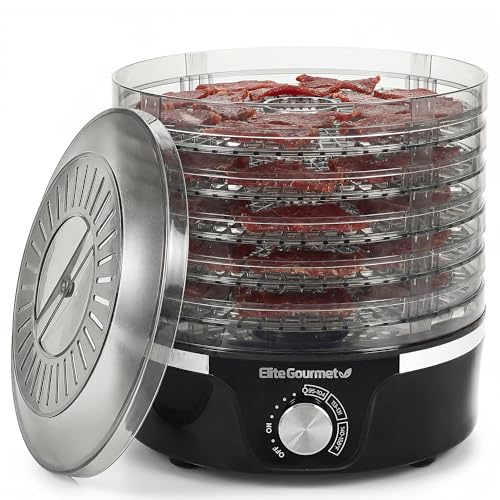
Elite Gourmet makes the classic budget dehydrator, a dial for temperature between 95 and 158 degrees, a power indicator and five clear 11.4 inch trays. The stack grows from about 8.5 to 10.75 inches tall, which accommodates thicker fruit pieces. There is no timer, so you check batches by eye or use a separate kitchen timer.

The dial is easy to read and has little to fail. The 158 degree maximum is fine for fruit, herbs and vegetables, but it falls below the 160 degree mark recommended for jerky, so heat meat in the oven first and use the dehydrator only to dry it. Compared with the Cosori, it costs less and is simpler, and it gives up the extra seven degrees. A 350 watt version is also listed.

Ownership is easy. Rotate trays, wipe them after each batch and keep the base fan free of drips. It suits a household that dries fruit and herbs a few times a season.

What works

  • Simple dial with a power indicator light
  • Clear trays show drying progress
  • Stack grows to fit thicker pieces
  • Low cost of entry for a first dehydrator

Watch out for

  • No timer, so you must watch batches
  • 158 F ceiling falls short for raw jerky

Spec sheet

Temperature
95 to 158 F dial
Trays
5 clear BPA-free, 11.4 in
Height
8.5 to 10.75 in stacked
Control
Dial with power light
Use
Jerky, fruit, herbs
04
Magic Mill 240W 5-tray stainless dehydrator, 48H timer
240 W5 stainless trays48 h timerDigital control
Check price on Amazon
Best for: Overnight drying of fruit and herbs with a digital timer.

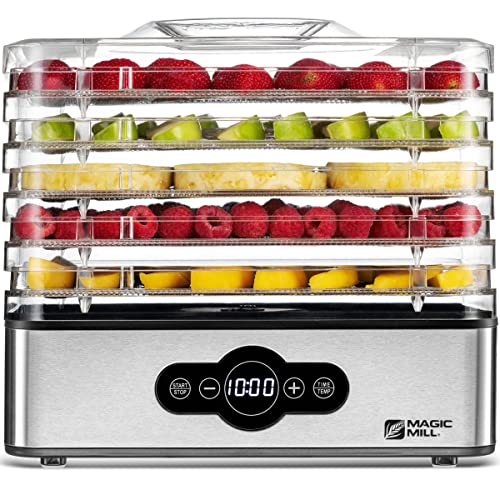
Magic Mill delivers digital control and stainless steel trays in a compact stackable body, with a 240 watt heater that is the lowest in the group except the Konfintos. A timer up to 48 hours and adjustable temperature suit overnight drying of herbs and fruit. The trays are adjustable in height.

The lower wattage means slower heat recovery after you open the door, so drying times run longer than on the OSTBA at 400 watts. Against the Elite Gourmet, you get a digital timer and stainless trays, and you pay with lower power. For a batch of apple slices, the difference shows as a few extra hours.

Upkeep is easy: wash the trays, wipe the base and keep the vent free of lint. The maker has less name recognition, so keep the receipt and confirm the warranty terms.

What works

  • Digital timer runs up to 48 hours
  • Stainless trays resist stains and odors
  • Compact body suits a small kitchen
  • Adjustable temperature suits herbs and fruit

Watch out for

  • 240 W heater is slow to recover heat
  • Maker is less established for support

Spec sheet

Power
240 W
Trays
5 stackable stainless steel
Timer
Up to 48 hours
Control
Digital, adjustable
Type
Compact stackable
05
Konfintos 250W compact 5-tray dehydrator for small batches
250 W5 traysHeight adjustableCompact body
Check price on Amazon
Best for: Single users who dry small batches in a small kitchen.

Konfintos aims at small batches, with a 250 watt heating system, five height-adjustable transparent trays and a body that saves counter space. The maker lists jerky, fruit, herbs and pet treats as the targets. Transparent trays make it easy to watch progress without opening the unit.

A 250 watt heater limits batch size, since each added tray adds load and lengthens the drying time. Against the OSTBA, it offers less power and no stainless trays, and against the Cosori it lacks the higher temperature ceiling. The listing gives few temperature details, so confirm the range before drying meat.

Ownership is the usual routine of rotating trays and wiping the base. It suits a single person who dries a tray of fruit or pet treats once in a while.

What works

  • Compact body saves counter space
  • Height-adjustable trays fit varied foods
  • Transparent trays show progress
  • Targets pet treats as well as snacks

Watch out for

  • 250 W limits batch size and speed
  • Temperature range is thinly documented

Spec sheet

Power
250 W
Trays
5 transparent BPA-free
Spacing
Height adjustable
Use
Jerky, fruit, herbs, pet treats
Size
Compact counter footprint

Spec sheet decoder

What the numbers on the box really mean

The specs manufacturers lead with, translated into what they tell you about real-world performance.

Temperature range

The range states the lowest and highest settings. A high ceiling allows jerky, and a low floor suits herbs.

Watch forThe Cosori reaches 165 F, the OSTBA 160 F and the Elite Gourmet 158 F.

Wattage

Wattage is heater power, which affects heat recovery and batch size. Airflow design still matters more.

Watch forThe OSTBA is 400 W and the Magic Mill is 240 W.

Tray count

More trays means more surface area per batch. Expandable stacks add trays later.

Watch forThe Cosori expands from 5 to 7 trays.

Timer range

A timer ends the cycle automatically. A range up to 48 hours covers overnight drying.

Watch forThe OSTBA and Magic Mill list timers, and the Elite Gourmet has none.

Tray spacing

Spacing is the gap between trays and decides how thick a piece fits. Adjustable gaps handle strawberries and thick apple rings.

Watch forThe OSTBA lists 0.55 and 1.02 inch settings.

Methodology

How We Evaluated These Food Dehydrators Under $50

Temperature ceiling

We compared the stated maximum temperatures, since jerky needs about 160 degrees. The Cosori at 165 led. Units that did not state a ceiling scored cautiously.

Airflow and batch size

We read the heater wattage and tray count together. The OSTBA at 400 W led on power. All five are stackable, so evenness was scored equally.

Tray material and spacing

We compared stainless against plastic and noted adjustable spacing. The OSTBA and Magic Mill use stainless. The OSTBA's two heights added flexibility.

Controls

We compared digital timers against dials. The OSTBA and Magic Mill offer timers up to 48 hours. The Elite Gourmet dial has none.

Footprint and ownership

We considered stack height, cleanup and brand support. The Elite Gourmet stack reaches about 10.75 inches. Smaller brands scored cautiously on support.

Decision guide

How to Choose the Right Food Dehydrators Under $50

By What You Dry

SituationPickWhy
Beef jerky regularlyCosori 5-tray 350WA 165 F ceiling reaches jerky temperatures
Strongly flavored foods such as onionOSTBA 400W stainlessStainless trays resist odors
Fruit and herbs a few times a yearElite Gourmet 5-trayA simple dial at a low cost
Pet treats and small batchesKonfintos 250WA compact body with adjustable trays

By Budget

Budget tierPickWhy
Lowest outlayElite Gourmet 5-trayA dial model with the lowest cost of entry
MiddleKonfintos 250WA compact unit with adjustable trays
Near the capOSTBA 400W stainlessStainless trays and a digital timer

Plastic Trays vs Stainless Trays

Plastic trays

The Cosori and Elite Gourmet use BPA-free plastic. They are light and cheap but can hold odors from marinades and garlic.

Stainless trays

The OSTBA and Magic Mill use stainless steel, which resists stains and odors. They are heavier and cost more.

Odor-sensitive cooks pick the OSTBA, and fruit drying households pick the Elite Gourmet.

Controls and Timing

PreferencePickWhy
Overnight drying with auto stopMagic Mill 240WA digital timer up to 48 hours
Highest temperature controlCosori 5-tray 350WAdjustable up to 165 F
Simple dial, no screenElite Gourmet 5-trayA dial with a power indicator
Thick or thin slicesOSTBA 400WTwo tray heights fit both

For Jerky Specifically

Look for

A ceiling of at least 160 degrees and a probe thermometer. Food safety guidance often calls for heating meat to 160 degrees, so verify at each tray level.

In this comparison

The Cosori at 165 F is the best fit, and the OSTBA at 160 F just meets it. The Elite Gourmet at 158 F needs the meat pre-heated in an oven.

When to Spend More

Spend more if

You dry meat weekly or in big batches. A rear-fan shelf unit dries evenly without rotation.

Save if

You dry fruit and herbs seasonally. The Elite Gourmet covers the job.

Ownership

Maintenance schedule

The upkeep that decides whether this machine lasts two seasons or ten.

TaskIntervalWhy it matters
Wash the traysAfter each batchSugar and fat dry into a film that is hard to remove. Soak greasy trays in a degreasing solution.
Wipe the base and fan areaAfter each batchJuice drips can reach the fan and heater. A damp cloth keeps the air path clear.
Rotate the traysEvery 1 to 2 hoursStackable units dry unevenly. Swapping top and bottom trays evens the result.
Check the temperatureEach new batchDials drift, so verify with a probe thermometer. This matters most for jerky.
Store with trays nestedAfter cleaningNested trays save space and prevent warping. Keep the unit dry between uses.

FAQ

Frequently Asked Questions

Can a budget dehydrator make safe jerky?

Only if it reaches a high enough temperature. The Cosori at 165 F and the OSTBA at 160 F can. Units capped at 158 F need the meat heated to 160 F first. Check with a probe thermometer.

How much should I spend?

The units here sit under the $50 cap at listing prices when the guide was updated, and prices move. The cap buys a stackable design with modest airflow. Jerky bakers should consider a rear-fan shelf unit.

How long do dehydrators last?

A well-kept unit can run for years, since the parts are simple. The fan and heater are the wear items. Keep juice out of the base and avoid overloading.

Do more watts mean faster drying?

Somewhat, but airflow design matters more. The OSTBA at 400 W recovers heat faster than the Magic Mill at 240 W. A full stack still needs rotation.

Do I need to rotate trays?

Yes with stackable designs, because trays near the fan dry faster. Rotate every hour or two. A rear-fan shelf unit does not need it.

Can I dry herbs and fruit together?

Avoid mixing strongly flavored foods, since flavors transfer. Dry herbs at low temperature on their own. Fruit and vegetables use different temperatures.

Bottom line

The short version

Browse more food dehydrators under $50on Amazon →
James Miller, Lead Machine Editor

About the author

James Miller

Lead Machine Editor, MachineFanatic

James Miller leads MachineFanatic's buying guides, turning spec sheets, manuals and owner feedback into clear verdicts on power tools, outdoor power equipment, shop machines and kitchen machines.

More from James →

Keep reading

Related guides