

Amazon affiliate links - we earn a commission.Affiliate disclosure

Buying guide · 12 min read · Updated 2026-11-07

Best Infrared Heaters for RVs (2026)

Six infrared heaters for RVs compared: quartz tube towers, dual PTC hybrids and wall or ceiling panels, with wattage, noise and mounting notes.

James MillerBy James MillerLead Machine Editor6 machines comparedSpec-sheet verified
Best Infrared Heaters for RVs

At a glance

Our top picks

Side by side

Spec comparison

MachinePowerOutputElementsControl
Dr. Infrared DR-968 1500W Dual Quartz and PTC HeaterBest OverallDr. Infrared DR-968 1500W Dual Quartz and PTC Heater1500WUp to 5,200 BTUInfrared quartz plus PTCn/a
WEWARM 1500W Infrared Heater with 6 Quartz Tubes and 12H TimerBest Quiet ValueWEWARM 1500W Infrared Heater with 6 Quartz Tubes and 12H Timer1500W, three settingsn/a6 quartz tubesAdjustable thermostat and ECO
RealSmart 1500W Infrared Heater with Quartz Elements and ECO ModeBest Smart Thermostat PickRealSmart 1500W Infrared Heater with Quartz Elements and ECO Mode1500Wn/a6 quartz tubesSmart thermostat and ECO
Heat Storm Phoenix 750-1500W Infrared Heater with RemoteBest Portable or Wall HangHeat Storm Phoenix 750-1500W Infrared Heater with Remote750W to 1500WAbout 5,200 BTUn/aRemote
Dr. Infrared DR-978 Hybrid Dual Heating Heater with RemoteBest Hybrid UpgradeDr. Infrared DR-978 Hybrid Dual Heating Heater with Remote1500W5,200 BTU per hourPTC plus infraredRemote
Econat 1500W Wall or Ceiling Mount Infrared HeaterBest Mounted PanelEconat 1500W Wall or Ceiling Mount Infrared Heater1500Wn/an/aAdjustable thermostat

Infrared heaters work by radiation. A glowing quartz tube or a hot panel sends energy to whatever is in front of it, the same way sunshine warms your face on a cold day. The air in between barely changes temperature, which is why infrared feels warm even in a draughty space.

That behavior suits some RV spots and not others. A seating area, a bed wall or a work corner gets immediate, quiet comfort, while a long cabin with closed doors needs moving air to equalize. Think about where you sit before you think about wattage.

Before you buy

6 Criteria to Look For Before Buying an Infrared Heater for RVs

  1. 01

    Radiant heat needs line of sight

    Infrared warms what it faces, so a heater behind a couch or around a corner does little. The WEWARM and RealSmart radiate forward in a tower format, while the Dr. Infrared hybrids add a fan. In a long RV, aim the unit at where you sit, and move it with you through the evening instead of expecting it to heat the whole length from one corner.

  2. 02

    Hybrid vs pure infrared

    The Dr. Infrared DR-968 and DR-978 combine quartz and PTC with a fan, so they warm both people and air. Pure quartz or panel units are silent but slower to warm a whole cabin. Pick based on whether you value silence or coverage. A common mistake is buying a quiet quartz tower for a long, narrow trailer and then wondering why the bedroom stays cold with the door shut.

  3. 03

    Amp draw on a 30 amp service

    At 1500 watts, a heater draws about 12.5 amps. The Phoenix offers a 750 watt step at about 6 amps, which leaves more headroom. Avoid running any 1500 watt unit with the air conditioner at the same time.

  4. 04

    Mounting and tip-over risk

    Tower heaters tip easily on a moving floor, while wall or ceiling panels like the Econat cannot. The Phoenix can do either with its attachable feet. Fixed mounting is safest, as long as it is anchored in structure. Thin wall skins flex, so screw into a stud or a backing plate.

  5. 05

    Noise and timers

    Without a large fan, radiant heaters are quiet. WEWARM quotes 34 dB and a 12 hour timer. Treat noise numbers as claims, and use a timer so the unit is never running unattended all night.

  6. 06

    Fragile elements

    Quartz tubes can crack if the heater is dropped or jolted. Pad any tower for travel and inspect the tubes each season. A cracked tube is a reason to replace the unit.

Detailed reviews

The 6 best infrared heaters for rvs, explained

01
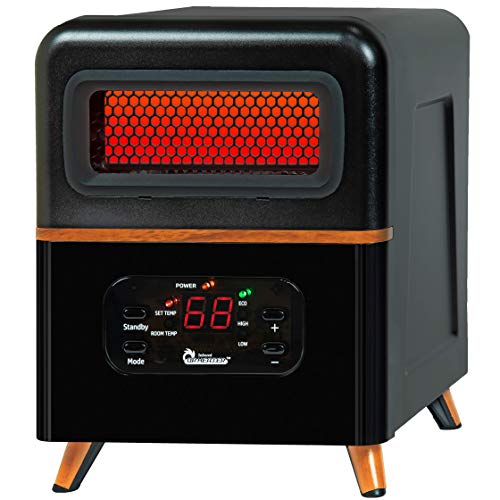
Dr. Infrared DR-968 1500W Dual Quartz and PTC Heater
1500W dual heatingQuartz plus PTC5,200 BTUTip-over protection
Check price on Amazon
Best for: RV living areas that need both direct warmth and air circulation.

The DR-968 combines two ideas in one cabinet. Infrared quartz tubes throw radiant warmth forward while a PTC ceramic element and fan move heated air around, so you get the instant feel of a radiant heater and the room-filling reach of a fan unit. That hybrid is what makes it the strongest all-rounder for a varied RV floor plan.

The listing claims it heats spaces up to 1000 square feet, which is optimistic for 1500 watts, since the usual rule is about 10 watts per square foot, or 150 square feet. In a typical RV that rule still means one unit covers the main living area comfortably. Next to the DR-978 sibling, it is the more established model and a bit simpler.

Plan for 12.5 amps on high, and do not run it with the air conditioner on a 30 amp circuit. Clean the dust from the intake each month, because radiant tubes smell when lint bakes on them. Store it upright and secure it before you drive, ideally in a closet with a bungee across the front. Owners who skip this step are the ones who report cracked housings and rattling parts by midseason.

What works

  • Quartz plus PTC gives radiant and fan heat
  • 5,200 BTU output at 1500 watts
  • Tip-over and overheat protection
  • Established model with a long listing history

Watch out for

  • Full 12.5 amp draw strains a shared 30 amp circuit
  • Listing coverage claim is generous
  • Fan adds some noise

Spec sheet

Power
1500W
Output
Up to 5,200 BTU
Elements
Infrared quartz plus PTC
Airflow
Fan assisted
Safety
Tip-over and overheat protection
02
WEWARM 1500W Infrared Heater with 6 Quartz Tubes and 12H Timer
1500W quartz34 dB claim12H timerECO mode
Check price on Amazon
Best for: Bedside and dinette use where silence matters.

WEWARM puts six quartz infrared tubes behind a grille with three power settings, an adjustable thermostat and an ECO mode. The maker quotes 34 dB operation, which is a claim rather than a measured figure here, but the design has little to make noise: there is no big fan, only the hum of the controls. A 12 hour timer completes the bedside package.

Quartz tubes warm up in seconds and radiate forward, so the unit suits a bunk or a dinette where you sit in front of it. Against the RealSmart in this roundup it adds a longer timer and an explicit quiet claim. The tradeoff is the usual one for radiant heaters: the far end of the RV stays cooler.

Set it at medium for overnight and use the timer so it is not running unattended for hours. Quartz tubes are fragile, so pad it when traveling. Wipe the grille with a dry cloth and check the tubes for cracks each season. If you hear a buzz or smell hot dust beyond the first run, stop and clean it before using it again, since baked-on lint is the most common nuisance with radiant units.

What works

  • Six quartz tubes warm up in seconds
  • Quoted 34 dB operation suits sleeping areas
  • 12 hour timer prevents unattended running
  • ECO mode and adjustable thermostat

Watch out for

  • Radiant heat leaves distant corners cooler
  • Quartz tubes need careful handling
  • Noise figure is a maker claim

Spec sheet

Power
1500W, three settings
Elements
6 quartz tubes
Timer
Up to 12 hours
Noise claim
34 dB
Control
Adjustable thermostat and ECO
03
RealSmart 1500W Infrared Heater with Quartz Elements and ECO Mode
1500W quartz6 elementsThermostatECO mode
Check price on Amazon
Best for: Living areas where several people sit in front of one unit.

RealSmart builds a 1500 watt tower with six quartz tubes and a thermostat that includes an ECO routine. That routine adjusts output toward your target temperature, which cuts wasted watts. It is marketed as whisper quiet, a claim that fits a design with no large fan.

The even warmth it provides suits a living area where several people sit in front of it. Beside the WEWARM, it leans on thermostat control rather than a long timer. Both are similar in raw output, so the choice comes down to how you prefer to control the temperature and how much you trust a newer brand.

Tower units tip more easily than low boxes, so secure it before driving. Keep curtains and bedding well clear of the front. Inspect the cord and plug for heat discoloration at the start of each season. A radiant tower sits close to where people lounge, so the clearance rule of three feet matters more here than with a fan unit that blows away from you.

What works

  • ECO routine trims wasted power
  • Six quartz tubes for even radiant warmth
  • Tip-over and overheat protection
  • Quiet design without a large fan

Watch out for

  • Tower shape needs securing in transit
  • Warms what it faces, not the whole cabin
  • Brand has a shorter track record

Spec sheet

Power
1500W
Elements
6 quartz tubes
Control
Smart thermostat and ECO
Safety
Tip-over and overheat protection
Noise
Marketed as whisper quiet
04
Heat Storm Phoenix 750-1500W Infrared Heater with Remote
750W to 1500W5,200 BTUHang or standRemote
Check price on Amazon
Best for: Owners who want one heater that can stand or mount.

The Phoenix offers 750 and 1500 watt steps in a compact case that you can stand on attachable feet or hang on a wall. That choice is useful in an RV: it can live on the floor during summer storage and move up to a wall in winter. The maker describes a heat exchanger design intended to keep the air from drying out.

A remote makes bedtime adjustments easy. That 750 watt step is the helpful feature for a shared 30 amp circuit, drawing about 6 amps against 12.5 for full power. Against the Dr. Infrared hybrid, it lacks a fan, so it relies fully on radiation.

Wall mounting removes tip-over risk and frees the floor. If you hang it, use proper anchors and locate studs. Dust it with a soft cloth and check the mount screws after long drives. In summer, take it down, wrap the cord loosely and store it in its box so the feet and the remote stay together.

What works

  • Choice of floor feet or wall mounting
  • 750W step suits shared circuits
  • Remote included
  • Compact case

Watch out for

  • No fan, so air warms slowly
  • Mounting needs studs and anchors
  • Not as strong as hybrid units for large cabins

Spec sheet

Power
750W to 1500W
Output
About 5,200 BTU
Mounting
Floor feet or wall hang
Control
Remote
Technology
Heat exchanger with moisture-retaining design
05
Dr. Infrared DR-978 Hybrid Dual Heating Heater with Remote
1500W hybridPTC plus infrared5,200 BTURemote
Check price on Amazon
Best for: Larger RV living areas needing quiet air movement.

The DR-978 is the updated hybrid from the same maker, with a larger blower that pushes more air at low noise. It pairs PTC with infrared, much like the DR-968, and adds a remote. The listing stresses that there are no exposed heating elements, which is a safety plus around children and pets.

The bigger blower means it spreads warmth further than the DR-968 while staying quiet. If you want the hybrid concept but with a bit more air movement, this is the one to pick. The wattage and BTU figures are the same, since 1500 watts is 1500 watts.

The remote suits a bedside placement. Keep the intake clear and vacuum it monthly. Never place it where bedding can fall onto the grille. The remote makes it tempting to adjust from under the covers, so keep a clear radius around the front and re-check it after you rearrange the bunk.

What works

  • Larger blower moves more air at low noise
  • Hybrid design adds radiant and air heat
  • No exposed heating elements
  • Remote included

Watch out for

  • Still draws 12.5 amps at full power
  • Hybrid design is bulkier than a pure panel
  • Newer than the DR-968 with less history

Spec sheet

Power
1500W
Output
5,200 BTU per hour
Elements
PTC plus infrared
Fan
Larger blower, low noise
Control
Remote
06
Econat 1500W Wall or Ceiling Mount Infrared Heater
1500WWall or ceiling mountThermostatRadiant
Check price on Amazon
Best for: Fixed overhead warmth in a dinette or awning area.

Econat's 1500 watt panel mounts to a wall or ceiling and is marketed for patios, balconies and garages as well as interiors. The adjustable thermostat gives simple control, and the mounting keeps the floor clear. In an RV that could mean an overhead mount above a dinette.

Pure infrared panels warm people and surfaces without moving air, which feels pleasant in a draughty rig. The listing positions it for covered outdoor areas, so check that your use falls within its intended conditions. Set against the Phoenix, it is fixed and gives up portability.

Ceiling mounting removes the heater from the floor entirely. Make sure the fastening is in solid structure, not thin paneling. Inspect the cable and mount after long trips. If the awning area is where you plan to use it, read the maker guidance on damp conditions first, because an indoor rating and a covered patio are not the same thing.

What works

  • Wall or ceiling mounting keeps floors clear
  • Adjustable thermostat
  • Silent radiant output
  • Suited to garages and covered patios too

Watch out for

  • Fixed location, no portability
  • Requires solid anchoring
  • Interior RV use needs clearance checks

Spec sheet

Power
1500W
Mounting
Wall or ceiling
Control
Adjustable thermostat
Type
Infrared radiant
Use
Patios, garages and interiors

Spec sheet decoder

What the numbers on the box really mean

The specs manufacturers lead with, translated into what they tell you about real-world performance.

Infrared quartz

Quartz tubes glow and emit radiant energy forward. It warms surfaces and people directly, not the air.

Watch forWEWARM and RealSmart each list six quartz tubes.

Dual heating

Dual systems pair a radiant element with a PTC ceramic element and fan. They give both direct and air heat.

Watch forDr. Infrared DR-968 and DR-978 are dual designs.

BTU rating

BTU measures heat per hour. 1500 watts produces about 5,100 BTU, whatever the technology.

Watch forThe Dr. Infrared and Phoenix both cite about 5,200 BTU.

Coverage claims

Coverage is a marketing estimate. The practical rule is about 10 watts per square foot.

Watch forThe DR-968 claims up to 1000 sq ft, but 1500 watts suits roughly 150 sq ft.

Mount type

Mounting decides where the heater lives and how it handles road vibration. Fixed mounts avoid tip-over.

Watch forEconat mounts to a wall or ceiling, while the Phoenix can stand or hang.

Methodology

How We Evaluated These Infrared Heaters for RVs

Heat delivery

We separated pure radiant, hybrid and mounted designs and judged each for where it works best. The hybrids score for coverage, and the quartz towers score for quiet. We relied on spec sheets and owner feedback patterns.

Electrical fit

We compared wattage steps with a 30 amp RV service. The Phoenix's 750 watt step stands out for shared circuits, while the rest are 1500 watt units that need headroom.

Stability and mounting

We checked whether each heater can mount or stand safely on a moving floor. Wall and ceiling options earned the highest scores, and tall towers earned the lowest.

Noise and timers

We looked for fan-free designs, timers and quiet claims. The WEWARM leads with a 12 hour timer. Maker decibel figures were treated as claims.

Safety listing

We confirmed tip-over and overheat protection in the listing text. Where the listing was silent we gave no credit, and fragile quartz tubes were noted as a handling concern.

Decision guide

How to Choose the Right Infrared Heaters for RVs

By Where You Sit

SituationPickWhy
Main living area with a long layoutDr. Infrared DR-978Larger blower moves air as well as radiant warmth.
Bedside or bunkWEWARM 1500WQuiet claim and a 12 hour timer.
Dinette benchRealSmart 1500WEven radiant warmth with ECO control.
Overhead above a seating areaEconat panelCeiling mount keeps the floor clear.

By Budget

Budget tierPickWhy
LowestWEWARM 1500WValue-priced quartz tower.
Lower to middleRealSmart 1500WAdds ECO thermostat control.
MiddleDr. Infrared DR-968Proven hybrid design.
HigherHeat Storm PhoenixFlexible mounting and a remote.

Pure Infrared vs Hybrid

Pure infrared

The WEWARM, RealSmart, Econat and Phoenix radiate heat with little or no fan. They are quiet and feel warm fast, but leave distant corners cooler.

Hybrid

The Dr. Infrared DR-968 and DR-978 add a PTC element and fan. They warm both you and the air, at the cost of some noise and bulk.

Choose pure infrared for silence at a seat, and hybrid for whole-area warmth.

By Mounting Style

PreferencePickWhy
Floor, no installDr. Infrared DR-968Stands on its own.
Wall or floorHeat Storm PhoenixAttachable feet or wall hang.
Ceiling or wallEconat panelFixed mount, no tipping.
Tower in a cornerRealSmartSlim footprint.

For Draughty Older RVs Specifically

Look for

Prefer radiant output, since it warms people even when the air leaks. Check that the heater is aimed at where you sit and keep clearance from fabrics.

In this comparison

The Econat and the WEWARM suit a leaky rig best because they warm people directly. The Dr. Infrared hybrids work too but spend part of their output on air.

When to Spend More

Spend more if

You want mounting flexibility or hybrid coverage. The Phoenix and DR-978 earn their cost through versatility and air movement.

Save if

You only need a bedside heater. The WEWARM covers it.

Ownership

Maintenance schedule

The upkeep that decides whether this machine lasts two seasons or ten.

TaskIntervalWhy it matters
Dust the grille and tubesMonthly in useLint burns off with an odd smell. A soft cloth keeps the front clean.
Inspect quartz tubesEach seasonCracked tubes fail and can be a hazard. Replace the unit if any are damaged.
Check mountsTwice a yearVibration loosens screws. Tighten anchors before travel.
Test tip-over switchStart of seasonA tilted unit should cut power. It confirms the safety switch works, and it takes less than a minute at the start of each winter.
Replace remote cellsYearlyWeak batteries cause missed commands. A spare set avoids cold nights.

FAQ

Frequently Asked Questions

Is an infrared heater better than a ceramic one for an RV?

Infrared warms people and surfaces, which suits seated comfort and draughty cabins. Ceramic fan heaters warm the air faster across a closed space. Many owners use both: a ceramic fan unit to take the chill off the cabin in the morning and an infrared panel for steady comfort at the table.

Do infrared heaters use less electricity?

No. At 1500 watts they draw the same as any other electric heater. They can feel warmer at lower thermostat settings because they warm you directly.

Can I leave one running overnight?

Use a unit with tip-over and overheat protection and a timer, and keep it clear of bedding. Never leave a heater on when you leave the RV.

How much space does 1500 watts heat?

The practical rule is about 150 square feet. Marketing figures of 1000 square feet are optimistic.

Are quartz tubes fragile?

They can crack if the unit is dropped or jolted. Pad towers for travel and check the tubes before use.

Will it trip my RV breaker?

At 12.5 amps it can on a shared 30 amp circuit. Use the 750 watt step of the Phoenix or turn off other loads such as the water heater element while the heater is on high.

Bottom line

The short version

Browse more infrared heaters for rvson Amazon →
James Miller, Lead Machine Editor

About the author

James Miller

Lead Machine Editor, MachineFanatic

James Miller leads MachineFanatic's buying guides, turning spec sheets, manuals and owner feedback into clear verdicts on power tools, outdoor power equipment, shop machines and kitchen machines.

More from James →

Keep reading

Related guides