
Amazon affiliate links - we earn a commission.Affiliate disclosure

Buying guide · 12 min read · Updated 2026-11-07

Best Power Inverters Under $750 (2026)

Six power inverters under $750 compared on continuous watts, pure sine vs modified sine, inverter charger design and real cable demands.

James MillerBy James MillerLead Machine Editor6 machines comparedSpec-sheet verified
Best Power Inverters Under $750

At a glance

Our top picks

Side by side

Spec comparison

The upper end of the budget inverter market is where the stakes change. Ratings climb into the range where a loose cable can melt a terminal, and the choice between clean and stepped output starts to decide whether a tool runs properly.

This is also where an inverter can double as a charger, a fixed install or a self contained battery unit. Knowing which of those you actually need is worth more than any single number on the box.

Before you buy

6 Criteria to Look For Before Buying a Power Inverter Under $750

  1. 01

    Continuous watts and headroom

    Size to continuous watts and leave about 20 percent headroom. The BELTTT lists 1500W continuous and 3000W surge, the TWING 1000W, and the Tripp Lite, Ampeak and Schumacher 750W. A corded saw with a 1000W running draw needs the BELTTT, because motor startup can need two to three times running watts. A 750W unit running a 600W load sits near its limit, while the 1500W BELTTT would barely notice it.

  2. 02

    Pure sine vs modified sine

    The BELTTT and EGO state pure sine, which runs motors, audio and sensitive chargers cleanly and efficiently. The TWING is modified sine, fine for lights and chargers but prone to hum or heat with motors. The Tripp Lite, Ampeak and Schumacher listings do not clearly state the waveform, so check before connecting electronics.

  3. 03

    Inverter only vs inverter charger

    The Tripp Lite APS750 also charges a battery from AC and passes power through, which suits RV and backup systems. The others only convert DC to AC. If you want one box for shore power and battery, only the Tripp Lite does it in this lineup. Without the charger function you need a separate battery charger, which is another box and another cable run.

  4. 04

    DC current and cable demands

    DC current equals AC watts divided by 12, plus losses. A 750W unit draws about 70 to 80A, a 1000W unit about 90 to 100A, and the 1500W BELTTT about 135 to 150A. Use short thick cable, a fuse near the battery and a bank that can feed it. A battery bank that cannot deliver the current will sag in voltage and trigger low voltage shutdown early.

  5. 05

    Fuse and protection design

    The Ampeak has two external replaceable 50A fuses, which are easy to service. The TWING uses a mini slip fuse. A protected unit still needs a fuse near the battery, because the inverter's internal fuse protects the unit, not the cable. Keep a spare fuse of the exact type in the vehicle, because most failures happen away from a shop.

  6. 06

    Lighter plug limits

    A cigarette lighter socket is fused around 10 to 15A, so roughly 120 to 180W at 12V. The Ampeak and Schumacher can use a plug for small loads, but their 750W ratings need the battery clips. A thin plug can brown out before a fuse blows. If in doubt, treat the lighter plug as a phone and laptop connection only.

Detailed reviews

The 6 best power inverters under $750, explained

01
BELTTT 1500W pure sine inverter, 3000W surge, LCD
1500W continuousPure sine wave3000W surgeLCD display
Check price on Amazon
Best for: Workshop and truck users running corded tools and electronics.

This BELTTT offers 1500W continuous and 3000W surge on a pure sine wave, with dual AC sockets, a 5V 2.1A USB port, an LCD and 3 foot thick cables. The pure sine output matches the grid, so motors, audio gear and sensitive chargers run properly. A 1500W rating is enough for a coffee maker, a small compressor or a corded saw, one at a time.

The tradeoff is current. At 1500W it draws roughly 135 to 150A from a 12V battery, so it needs a large deep cycle bank and heavy cable. Compared with the Tripp Lite APS750 it delivers twice the continuous output but cannot charge a battery.

Check lug tightness and fan dust as part of yearly upkeep, and start the engine for long heavy loads. It is the pick for people who want real tool power in a vehicle or workshop.

What works

  • 1500W continuous with a clean pure sine wave
  • 3000W surge handles motor startup
  • Short thick cables included
  • LCD shows input and output

Watch out for

  • Draws roughly 135 to 150A at full load
  • Cannot charge a battery from shore power

Spec sheet

Continuous
1500W
Surge
3000W
Waveform
Pure sine wave
Outlets
2 AC, 1 USB 2.1A
Cables
3 ft thick cables
02
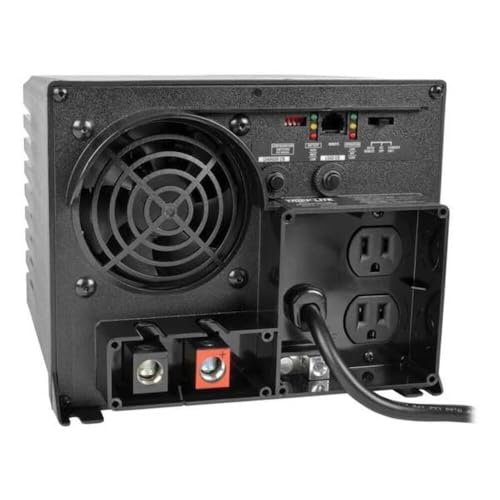
Tripp Lite APS750 750W inverter charger, 12V DC to 120V AC
750W continuousInverter and charger1125W reserve6 ft cord
Check price on Amazon
Best for: RV and backup power systems that switch between shore power and battery.

The Tripp Lite APS750 delivers 750W continuous with 1,125W of reserve power for up to an hour, and it works as both an inverter and a charger. It delivers clean 120V power from either an AC or DC source, which makes it useful for RV and backup systems that switch between shore power and a battery. It comes with a 6 foot cord.

The tradeoff is output against the BELTTT 1500W, which doubles it. The listing does not spell out the waveform in the data we reviewed, so verify before running sensitive gear.

It is a fixed install unit. Check connections yearly and keep the fan clear. It suits RV, cabin and backup users who want automatic charging and power in one box.

What works

  • Works as both inverter and battery charger
  • Reserve rating handles a brief 1,125W load
  • Clean 120V output from AC or DC source
  • 6 foot cord eases placement

Watch out for

  • 750W is half the BELTTT 1500W
  • Waveform is not stated in the listing

Spec sheet

Continuous
750W
Reserve
1,125W, up to 1 hour
Design
Inverter and battery charger
Input
12V DC or 120V AC
Cord
6 ft
03
Ampeak 750W inverter, 1500W peak, 11 protections
750W continuous1500W peak11 protections50A fuses
Check price on Amazon
Best for: Vehicle owners who want 750W with easy fuse replacement.

The Ampeak lists 750W continuous and 1500W peak with two AC outlets, two 2.4A USB ports and eleven protections. It offers two connection methods, a battery clip cable for high power and a lighter plug for small loads, with two replaceable 50A external fuses. External fuses are a practical touch because a blown fuse is a thirty second fix.

The tradeoff is that it sits at the same output as the Tripp Lite APS750 but without charging. It is also less capable than the BELTTT for motors. Check the waveform on the listing before running sensitive devices.

Keep a spare 50A fuse in the kit and tighten the clips regularly. It suits car and truck users who want 750W with clear protection.

What works

  • External 50A fuses are quick to replace
  • Eleven listed protections
  • Clip cable for high power and plug for small loads
  • Two AC outlets and dual USB

Watch out for

  • No battery charging function
  • Same 750W output as cheaper rivals

Spec sheet

Continuous
750W
Peak
1500W
Outlets
2 AC, 2 USB 2.4A
Fuses
2 replaceable 50A
Connection
Clip cable or terminals
04
Schumacher XI75DU 750W inverter, 1500W peak, USB
750W continuous1500W peak2 AC outlets2A USB
Check price on Amazon
Best for: Emergency and occasional use where brand familiarity matters.

The Schumacher XI75DU is a 750W unit with a 1500W peak, two AC outlets and a 2 amp USB port. It converts vehicle power to 120V household power. Schumacher is a long established battery and charger maker, which is its main selling point in this lineup.

The tradeoff is that the data we reviewed lists few details, so protections, waveform and cable length are not spelled out. Against the Ampeak it offers the same rated output, with fewer stated features.

Use it for emergency and light work. Check your connection and keep vents clear. It suits buyers who prefer a familiar brand for occasional use.

What works

  • 750W continuous with 1500W peak
  • Two AC outlets and a USB port
  • Made by an established battery brand
  • Simple use with few controls

Watch out for

  • Few stated protections or waveform details
  • Same output as cheaper rivals

Spec sheet

Continuous
750W
Peak
1500W
Outlets
2 AC
USB
2 amp port
Use
Vehicle and emergency power
05
TWING 1000W modified sine car inverter, dual AC
1000W continuousModified sineDual AC outletsDigital display
Check price on Amazon
Best for: Simple 1000W loads such as lights, chargers and small appliances.

The TWING gives 1000W continuous on a modified sine wave, with dual AC outlets, USB ports up to 2.4A, a digital display, a cooling fan and a mini slip fuse. It offers more capacity than the 750W units for less complexity than a pure sine design.

The tradeoff is waveform. Modified sine can hum in audio gear and run motors hot, so it suits lights, chargers and resistive loads. Against the BELTTT 1500W it offers lower capacity and a rougher output.

Keep the fan clear and fuse close to the battery. It is for users who want 1000W for simple loads.

What works

  • 1000W continuous gives headroom over 750W units
  • Digital display shows status
  • Cooling fan and fuse protection
  • Dual AC outlets with USB

Watch out for

  • Modified sine can upset audio gear and motors
  • Less capable than the BELTTT pure sine

Spec sheet

Continuous
1000W
Waveform
Modified sine wave
Outlets
2 AC, USB 2.4A
Display
Smart digital display
Protection
Cooling fan and slip fuse
06
EGO Power+ PAD5003 400W pure sine inverter kit with 56V battery
400W continuous800W peakPure sine wave56V 4.0Ah kit
Check price on Amazon
Best for: Job site and yard users who already own EGO batteries.

The EGO PAD5003 runs from a 56V tool battery instead of a vehicle. The kit includes the inverter, a 4.0Ah battery and a 100W PD charger, giving 400W continuous and 800W peak on a pure sine output. It suits sites without a vehicle.

The tradeoff is runtime. A 4.0Ah 56V pack stores roughly 224Wh, so a 100W load drains it in about two hours. Against the BELTTT 1500W it has far lower output, but nothing to wire or fuse.

Extra EGO batteries stretch the runtime. Store the pack partly charged. It is the pick for quiet, portable AC at a yard or site.

What works

  • Runs from a tool battery, no vehicle needed
  • Pure sine at 400W continuous
  • Kit includes battery and charger
  • No cables or fuses to install

Watch out for

  • About 224Wh limits runtime
  • Output is far below the 750W to 1500W units

Spec sheet

Continuous
400W
Peak
800W
Waveform
Pure sine wave
Kit
56V 4.0Ah battery, 100W PD charger
Power source
EGO 56V battery

Spec sheet decoder

What the numbers on the box really mean

The specs manufacturers lead with, translated into what they tell you about real-world performance.

Continuous vs surge

Continuous is the sustained rating. Surge or reserve covers a brief startup. Manufacturers print the larger number in bigger type, which misleads first time buyers.

Watch forThe BELTTT's 3000W surge sits beside a 1500W continuous rating, and only 1500W is sustainable.

Reserve power

A higher output allowed for a limited time, often minutes to an hour, before the unit protects itself.

Watch forThe Tripp Lite quotes 1,125W reserve for up to one hour above its 750W continuous rating.

Pure vs modified sine

Pure sine matches grid power. Modified sine is a stepped approximation.

Watch forThe BELTTT 1500W and EGO are pure sine, and the TWING is modified sine.

Inverter charger

A unit that both converts battery power to AC and charges the battery from AC. It saves a separate charger but adds cost and complexity to the install.

Watch forOnly the Tripp Lite APS750 offers this among the six.

Input amps

DC input current equals AC watts divided by 12, plus losses, and sets cable and fuse size.

Watch forThe 1500W BELTTT draws roughly 135 to 150A, much higher than the 750W units.

Methodology

How We Evaluated These Power Inverters Under $750

Rated output

We evaluated continuous watts first and treated surge as secondary. The range runs from 400W on the EGO to 1500W on the BELTTT. We checked whether the stated rating matches a realistic cable and battery setup. Units that quote a big surge next to a small continuous number were scored on the smaller figure.

Waveform

We favored stated pure sine and downgraded units that do not state waveform. The BELTTT and EGO state it, and the TWING is modified. Waveform decided the top two.

Functional design

We looked at inverter charger designs and fuse access. The Tripp Lite's charger and the Ampeak's external fuses scored well. Owner feedback patterns often mention hard to reach fuses as a nuisance.

Installation load

We weighed cable gauge, battery bank size and mounting for each rating. A 1500W unit needs a larger installation than a 750W unit. The EGO needs none. We also considered how forgiving each unit is when a cable run is slightly too long.

Brand and stated detail

Based on the spec sheet, we credited units that spell out protections and ratings. The Schumacher offers a familiar name but less stated detail. Unstated features were not assumed. Where the listing was thin we said so rather than filling the gap with guesses.

Decision guide

How to Choose the Right Power Inverters Under $750

By Load

SituationPickWhy
Corded saw or compressorBELTTT 1500W1500W continuous, pure sine
RV with shore power and batteryTripp Lite APS750Inverter and charger in one
Car or truck with fuses to serviceAmpeak 750WExternal 50A fuses
Occasional emergency powerSchumacher XI75DUEstablished brand, 750W
Lights and chargers up to 1000WTWING 1000WModified sine, more headroom
Yard work without a vehicleEGO PAD5003Own 56V battery

By Budget

Spend levelPickWhy
Cheapest in this guideAmpeak 750WSimple unit with clear protection
LowTWING 1000WMore headroom at a modest tier
Lower middleSchumacher XI75DUBrand backed 750W
MiddleBELTTT 1500WPure sine with large rating
Upper middleEGO PAD5003Battery kit included
Top of this guideTripp Lite APS750Inverter and charger

Inverter Only vs Inverter Charger

Inverter only

The BELTTT, Ampeak, Schumacher, TWING and EGO convert battery power. They suit vehicles and portable use, and are simpler and cheaper.

Inverter charger

The Tripp Lite APS750 also charges the battery from AC and passes power through. It suits RV, cabin and backup installs.

Pick the Tripp Lite if you have shore power or a generator; pick an inverter only unit for vehicle and portable use.

Installation Size

PreferencePickWhy
Largest rating with proper cableBELTTT 1500WShort thick cables included
Mid sized battery bankTWING 1000WAbout 90 to 100A at full load
Small bank or clampsAmpeak 750WClip cable included
No wiring at allEGO PAD5003Own battery pack

For RV and Backup Use Specifically

Look for

Shore power charging, clean output for electronics and a rating that matches your battery bank. A 750W load at 12V draws about 70 to 80A.

In this comparison

The Tripp Lite APS750 combines charger and inverter, and the BELTTT 1500W suits larger tool loads. Pair either with a properly fused bank.

When to Spend More

Spend more if

You need to run a microwave, air conditioner or 2000W tools, or want a 24V system. The BELTTT 1500W is the ceiling here.

Save if

You only run chargers, lights and a laptop. The Ampeak 750W or Schumacher covers that.

Ownership

Maintenance schedule

The upkeep that decides whether this machine lasts two seasons or ten.

TaskIntervalWhy it matters
Check cable lugs and clipsMonthlyLoose or corroded connections cause voltage drop and heat. Re-tighten and clean them. Vibration in a truck loosens lugs over time, so a firm check pays off.
Inspect fusesEvery 3 monthsA repeatedly blown fuse signals overload or a poor connection. Replace with the correct rating only.
Clear fan and ventsEvery 6 monthsDust raises temperature and trips thermal protection. Blow it out gently. A clogged fan is the most common reason a healthy unit trips on a warm day.
Check battery voltageBefore heavy useA low battery triggers alarms and shutdown. Start the engine for long heavy loads.
Store the EGO batteryEvery 3 monthsLithium packs self-discharge. Store partly charged in a cool place.

FAQ

Frequently Asked Questions

Is a 750W inverter enough?

For laptops, lights, chargers and a small TV, yes. A coffee maker or compressor may need the BELTTT 1500W. Add up the continuous watts you plan to run at once. The common mistake is sizing to the surge number, which only lasts a moment, instead of the continuous rating that applies for the whole run.

Pure sine or modified sine?

Choose pure sine for motors, audio and sensitive chargers. Modified sine such as the TWING suits lights and simple chargers. When unsure, pure sine is safer. The difference shows up as a hum in speakers, a hot adapter or a motor that runs slower than it should.

What does an inverter charger add?

It also charges the battery from AC and passes power through, so shore power and battery work in one unit. Only the Tripp Lite APS750 offers it in this guide. It is most useful when a cabin or RV is plugged in most of the time and the battery should stay topped up without a separate charger.

How long will an inverter last?

With clear vents and tight connections, many years. Failures usually come from undersized cable, blown fuses or overheating. Keep the fan clear. Inexpensive units tend to fail at the fan or output stage first, so keep the vents open and the load within the rating.

Do prices change and is the cap exact?

Prices move often, and the cap reflects listing prices when this guide was updated. Check the current price before buying.

Can I use the lighter socket?

Only for small loads, about 120 to 180W. For 750W and above, connect directly to the battery. A thin plug wire can overheat long before the fuse blows, so do not trust the fuse alone.

Bottom line

The short version

Browse more power inverters under $750on Amazon →
James Miller, Lead Machine Editor

About the author

James Miller

Lead Machine Editor, MachineFanatic

James Miller leads MachineFanatic's buying guides, turning spec sheets, manuals and owner feedback into clear verdicts on power tools, outdoor power equipment, shop machines and kitchen machines.

More from James →

Keep reading

Related guides