


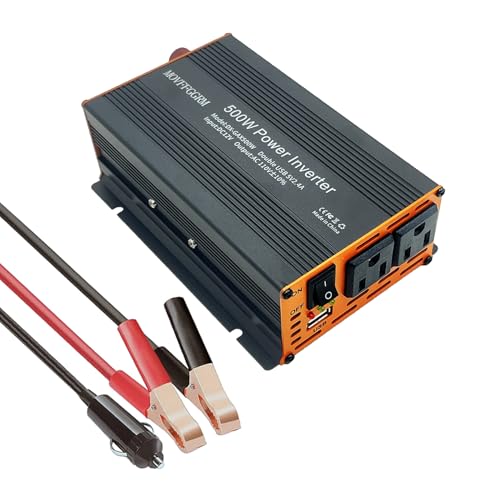

The Effortway pairs a 500 watt continuous rating with two ways to connect, and that second connection is what makes the rating usable. The lighter plug works for devices under about 150 watts, while the alligator clamps connect directly to the battery for loads up to the full 500 watts. The 1000 watt peak figure is only a brief surge allowance, so size to the continuous number. DC current is roughly the AC watts divided by 12, so a full 500 watt load pulls more than 40 amps from the battery before efficiency losses.
The reason for two connection methods is simple. A cigarette lighter socket is fused at roughly 10 to 15 amps, which is about 120 to 180 watts at 12 volts. A 500 watt load draws more than 40 amps at 12 volts, and the lighter socket and its thin wiring cannot carry that safely. Clamping to the battery with short, thick leads removes that bottleneck.
Compared with the Movffggrm, which quotes the same 500 and 1000 watt figures, the Effortway lists its connection options clearly and includes overload protection. Keep the cable run short, fuse near the battery, and run the engine when you use heavy loads so the starting battery does not drain.
What works
- 500W continuous with battery clamps
- Two AC outlets and a USB port
- Lighter plug for light loads
- Built-in overload protection
Watch out for
- Peak figure is only a short surge
- Modified-style output is unsuited to motors
- Clamp connection needs short thick cabling
Spec sheet
- Continuous power
- 500W
- Peak power
- 1000W
- AC outlets
- 2
- USB
- 2.1A port
- Connection
- Lighter plug and battery clamps