

Amazon affiliate links - we earn a commission.Affiliate disclosure

Buying guide · 12 min read · Updated 2026-11-13

Best Power Stations for RVs (2026)

Six power stations for RV and camper use compared on capacity, 30A outlets, air conditioner startup surge, solar input, weight and how each one is charged.

James MillerBy James MillerLead Machine Editor6 machines comparedSpec-sheet verified
Best Power Stations for RVs

At a glance

Our top picks

Side by side

Spec comparison

An RV can use a power station in two very different ways: as a bolt-on supplement to a house battery bank, or as the main source of power for a small camper or van that has no real electrical system. The right size and connection depend entirely on which job it has.

Capacity alone is not enough. An RV owner needs the right outlets, enough surge to start a compressor, a sensible way to recharge on the road and a case that can be lifted into a bay. This guide compares six stations against those practical needs.

Before you buy

6 Criteria to Look For Before Buying a Power Station for RVs

  1. 01

    Air conditioner reality check

    A rooftop air conditioner draws about 1300 to 1800 watts running and more at start, so a 3000Wh station lasts only about an hour and a half at that load. The BLUETTI Elite 300's 3014Wh and Pecron's 3072Wh stretch it a little, and anything near 1024Wh is not an option. Plan cooling around a generator or shore power.

  2. 02

    RV-native outlets

    A TT-30 outlet lets the trailer's own cord plug into the station, and a 12V 30A DC output feeds RV systems directly. Only the BLUETTI Elite 300 lists both, while others need adapters. Adapters work but add heat and failure points.

  3. 03

    Recharge on the road

    A station that takes 12 hours to refill is useless on a travel day. The Delta 3 Max charges to 80 percent in 1.13 hours, the Pecron fills in about 2 hours at 1800W and the Delta Pro in 1.8 hours at 3000W on 240V. Check which input you will have.

  4. 04

    Weight and fixed placement

    A 3kWh station is heavy, and lifting it into a bay is a real chore. The Jackery 1000 v2 and UDPOWER S1200 are one-person units, while the Delta Pro and Elite 300 are two-person lifts. Choose a spot before you buy. Strap it down with a rated cargo strap, because a sliding 40 pound battery is a hazard in a braking event.

  5. 05

    Solar input

    Solar charging depends on input wattage and voltage window. The UDPOWER accepts up to 400W, the Delta 3 Max up to 500W. Match panel voltage and connectors to the unit.

  6. 06

    Surge for compressors

    A refrigerator or soft-start air conditioner needs surge. The Elite 300 lists 4800W surge, the Delta 3 Max 3400W in X-Boost and the Jackery 3000W peak. Match the surge to the biggest motor.

Detailed reviews

The 6 best power stations for rvs, explained

01
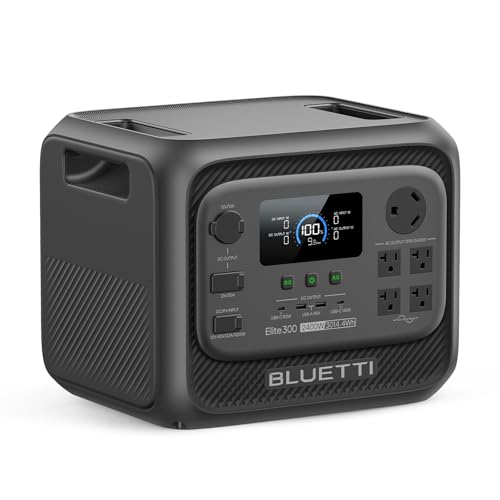
BLUETTI Elite 300 3014Wh 2400W RV Power Station
3014Wh LFP2400W outputTT-30 RV outlet12V 30A DC
Check price on Amazon
Best for: Travel trailers and vans wanting 3kWh with a native 30 amp RV outlet.

A TT-30 outlet, the 30 amp RV plug, is the feature that makes the Elite 300 genuinely RV-friendly, because it lets you run the trailer's shore cord straight from the station without an adapter dance. A high-current 12V 30A DC output also feeds the RV's 12V systems directly, avoiding inverter losses for lights, pumps and fans. It stores 3014 watt-hours in LFP cells and delivers 2400 watts with a 4800 watt surge.

That output is enough for a microwave, a coffee maker and a refrigerator at the same time, and a rooftop air conditioner with a soft start can run for a while, though not all night. The listing claims the case is nearly 59 percent smaller than traditional large stations, which matters when the storage bay is fixed. Against the 2048Wh EcoFlow Delta 3 Max it carries nearly half again the energy, and against the 3600Wh Delta Pro it is smaller and cheaper.

Plan the wiring: use a proper 30 amp cord, keep the station dry and ventilated, and set an alarm for the battery level. Recharge it from the tow vehicle, a generator or solar, and expect to lift it with two hands.

What works

  • TT-30 RV outlet fits a trailer's shore cord
  • 12V 30A DC output for RV systems
  • 3014Wh with 2400W output
  • Compact case for its capacity

Watch out for

  • Heavy for a two-hand lift into a bay
  • A rooftop air conditioner cannot run all night
  • Higher outlay than the 2kWh class

Spec sheet

Capacity
3014.4Wh LFP
AC output
2400W, 4800W surge
RV outlet
TT-30
DC output
High-current 12V 30A
Size
Nearly 59 percent smaller than traditional large stations
02
EcoFlow DELTA 3 Max 2048Wh 2400W Power Station
2048Wh LFP2400W output3400W X-Boost1.13 hr to 80%
Check price on Amazon
Best for: Weekend trailers and vans wanting fast recharge and room to grow.

Charging from empty to 80 percent in 1.13 hours means the Delta 3 Max can top up while you drive or while the generator runs for an hour, which is a practical match for RV life. It stores 2048 watt-hours in LFP cells, outputs 2400 watts and reaches 3400 watts in X-Boost mode for resistive loads. A sub-10 millisecond transfer keeps electronics steady when switching between shore power and battery.

For a weekend trailer it covers a refrigerator, lights, a fan and a microwave, but a rooftop air conditioner will drain it in a couple of hours. Compared with the 3014Wh Elite 300 it has less energy, no TT-30 outlet and a lower price, and against the 1191Wh UDPOWER it carries roughly double the energy. The ecosystem allows expansion later.

Bring an adapter for the RV plug if your trailer uses a 30 amp cord, and plan where it lives so ventilation is not blocked. Keep it indoors in cold weather, because charging below freezing is not supported. If the trailer has an existing converter, a short run from the tow vehicle's 12V line can keep the station topped up while you drive.

What works

  • 0 to 80 percent charge in 1.13 hours
  • 2400W with 3400W X-Boost for resistive loads
  • Sub-10ms transfer for electronics
  • Expansion batteries extend capacity

Watch out for

  • No native 30A RV outlet
  • 2048Wh cannot run an air conditioner for long
  • Expansion adds significant cost

Spec sheet

Capacity
2048Wh LFP
AC output
2400W, 3400W in X-Boost
Charging
0 to 80 percent in 1.13 hours
Switchover
Under 10 milliseconds
Expansion
Ecosystem batteries available
03
Pecron F3000LFP 3072Wh 3600W Power Station
3072Wh LiFePO43600W pure sine2 hour AC charge13 devices
Check price on Amazon
Best for: Long RV stays where capacity and output matter more than ecosystem polish.

Three kilowatt-hours and a 3600 watt pure sine inverter at a lower price than the big-name rivals is the Pecron's pitch, and the numbers back it up. It supports heavy appliances including refrigerators, microwaves and a soft-start air conditioner, and a full recharge takes about two hours from AC at 1800 watts, which the listing calls 30 percent faster than others.

Six AC outlets, two USB-C ports with 100 watt PD, two USB-A ports, a car port and two DC outputs let it serve an RV kitchen and a bedroom at once. Against the 3014Wh Elite 300 it has slightly more capacity and a stronger inverter, but lacks the dedicated TT-30 and 12V 30A outputs. Compared with the 2048Wh Delta 3 Max it offers more energy and output with less polish in the ecosystem.

Check the warranty terms and the app before buying, since the brand is less established. Keep the station level and ventilated, use a heavy cord for the air conditioner and treat the 3600 watt rating as a ceiling for short runs.

What works

  • 3072Wh and 3600W pure sine output
  • Full AC recharge in about 2 hours at 1800W
  • Six AC outlets plus 100W USB-C PD
  • Powers up to 13 devices at once

Watch out for

  • No native RV TT-30 outlet
  • Less established brand and support
  • Heavy, needs a fixed spot

Spec sheet

Capacity
3072Wh LiFePO4
AC output
3600W pure sine wave
AC charging
0 to 100 percent in 2 hours at 1800W
Outlets
Six AC, two USB-C, two USB-A, car, two DC 5525
Devices
Powers up to 13 at once
04
EcoFlow DELTA Pro 3600Wh 3600W Power Station
3600Wh LFP3600W outputExpands to 4500W1.8 hr 240V charge
Check price on Amazon
Best for: Large RVs and boondockers who want maximum capacity and expansion.

A 3600 watt-hour pack that can recharge in 1.8 hours from a 240 volt outlet or 2.7 hours from a standard wall outlet makes the Delta Pro the most capable station in the lineup for a big RV. Its 3600 watt AC output can expand to 4500 watts with companion hardware, and the unit can chain more battery capacity for long boondocking stays.

The cost is mass: it is a two-person lift and a fixture in a bay, not a sensible grab-and-go item. For a 30 amp rig it can run a microwave, a refrigerator and a soft-start air conditioner for a few hours, but an all-night cooling plan still needs more storage. Compared with the 3014Wh Elite 300 it holds more energy and output but has no TT-30 outlet, and next to the 3072Wh Pecron it offers a more mature ecosystem.

Consider a transfer switch and a proper 30 amp adapter, and keep the station inside the conditioned space where it will not overheat. Use solar or the generator to refill, and handle the weight carefully when loading.

What works

  • 3600Wh with 3600W output
  • Fast 1.8 hour charge on a 240V outlet
  • Expandable output up to 4500W
  • Mature ecosystem with expansion options

Watch out for

  • Very heavy and awkward to move
  • No native 30A RV outlet
  • Highest outlay in the group

Spec sheet

Capacity
3600Wh LFP, expandable
AC output
3600W, expandable to 4500W
240V charging
1.8 hours at 3000W
Wall charging
2.7 hours at 1800W
Use
Home backup and large RVs
05
Jackery Explorer 1000 v2 1024Wh Power Station
1024Wh LiFePO41500W output3000W peak50 min charge
Check price on Amazon
Best for: Vans, truck campers and small trailers with modest loads and light lifting.

Smaller trailers, truck campers and vans do not need three kilowatt-hours, and the Explorer 1000 v2 gives a sensible 1024 watt-hours in a case a person can carry with one arm. Its 1500 watt output and 3000 watt peak run a microwave, a coffee maker or a small induction burner, and a 50 minute fast charge makes it easy to refill from the vehicle or a generator.

A 10 millisecond UPS function keeps a router or a laptop running if shore power drops, which suits RV parks with unreliable pedestals. Against the 2048Wh Delta 3 Max it has half the energy, and against the 1191Wh UDPOWER it has slightly less energy but a stronger brand and support network. It will not run an air conditioner for any useful length of time.

Use it for lights, a fan, a fridge and electronics, and keep a separate plan for cooling. Store it where it stays above freezing in winter. Many owners pair it with a small folding panel and call it done for a long weekend of lights, a fan and a fridge.

What works

  • 1500W output with 3000W peak in a one-arm carry
  • 50 minute full recharge
  • 10ms UPS keeps a router running
  • Pure sine AC outlets

Watch out for

  • 1024Wh cannot sustain an air conditioner
  • Only two AC outlets
  • No RV-specific outlet

Spec sheet

Capacity
1024Wh LiFePO4
AC output
1500W, 3000W peak
Fast charge
0 to 100 percent in 50 minutes
UPS function
10 millisecond switchover
Outlets
Two pure sine AC, USB-C, USB-A, car
06
UDPOWER S1200 1191Wh 1200W Power Station
1191Wh LiFePO41200W pure sine14 outputs400W solar input
Check price on Amazon
Best for: Small campers wanting many ports and a modest, solar-friendly battery.

Fourteen outputs mean the UDPOWER S1200 can replace the power strip in a camper, with five AC outlets, four USB-A ports, two USB-C ports, two DC outputs and a car outlet. The 1191 watt-hour LiFePO4 pack and 1200 watt pure sine output suit a small RV's electronics, a fridge and a few kitchen items.

A 400 watt solar input means a pair of roof or portable panels can top it up on a sunny day, and the battery is claimed to retain at least 80 percent of capacity across its rated cycles. Compared with the 1024Wh Jackery it has a bit more energy and many more outlets, and against the 3072Wh Pecron it is a third of the energy at a much lighter weight.

Read the manual for its AC input limits before relying on pass-through use, and check the brand's warranty terms. It suits a small camper that wants lots of ports and a modest battery. A short strap or a non-slip mat keeps it from sliding on rough roads, since the case has no tie-down points.

What works

  • Five AC outlets and 14 outputs total
  • 1191Wh LiFePO4 pack with pure sine output
  • 400W solar input
  • Long cycle life claim

Watch out for

  • 1200W cannot start a rooftop air conditioner
  • Less established brand with limited support
  • No RV-specific outlet

Spec sheet

Capacity
1191Wh LiFePO4
AC output
1200W pure sine wave
Outputs
Five AC, four USB-A, two USB-C, two DC, one car
Solar input
Up to 400W
Cycle claim
At least 80 percent capacity retained over rated cycles

Spec sheet decoder

What the numbers on the box really mean

The specs manufacturers lead with, translated into what they tell you about real-world performance.

TT-30 outlet

The 30 amp, 120 volt RV receptacle. It lets a trailer's shore cord plug in directly.

Watch forThe BLUETTI Elite 300 lists it, and the others do not.

Watt-hours

The stored energy, which sets runtime. A 1500W load empties 1500Wh in about an hour.

Watch forThe lineup runs from 1024Wh to 3600Wh.

AC input charging

The wall or generator input power. Higher input means a faster refill.

Watch forThe Pecron lists 1800W and the Delta Pro 3000W on 240V.

Surge watts

A brief allowance for compressor starts.

Watch forThe Elite 300 lists 4800W surge.

Solar input

The maximum panel wattage the station accepts.

Watch forThe UDPOWER accepts up to 400W.

Methodology

How We Evaluated These Power Stations for RVs

RV integration

We looked for TT-30 and 12V DC outputs that fit an RV. The BLUETTI Elite 300's TT-30 and 12V 30A put it ahead.

Capacity and output

We compared watt-hours and rated watts against RV appliance loads. The Delta Pro and Pecron lead, and the Jackery 1000 v2 suits smaller rigs.

Recharge speed

Road recharging decides whether a station is usable. The Delta 3 Max's 1.13 hours to 80 percent and the Pecron's 2 hour full charge led.

Weight and fit

We considered lifting and bay placement. Lighter units earned points for flexibility, and the Delta Pro lost some.

Ownership realism

Support, app polish and fan noise came from spec sheets and owner feedback patterns. Established brands earned credit for warranty reach.

Decision guide

How to Choose the Right Power Stations for RVs

By Rig Type

SituationPickWhy
Van or truck camper, modest loadsJackery Explorer 1000 v21024Wh and a one-arm carry
Small camper wanting many portsUDPOWER S120014 outputs and 400W solar input
Weekend trailerEcoFlow DELTA 3 Max2048Wh with fast recharge
Travel trailer with 30 amp cordBLUETTI Elite 300TT-30 and 12V 30A outputs

By Budget

TierPickWhy
Lowest outlayJackery Explorer 1000 v2Smallest and cheapest in the group
Low to middleEcoFlow DELTA 3 MaxMore capacity for a moderate step
MiddlePecron F3000LFPMost capacity per outlay
HighestEcoFlow DELTA ProLargest and most expandable

Single Station vs House Battery Bank

Single station

A Delta 3 Max or Elite 300 is portable, needs no wiring and can leave with you. It suits weekend use and rigs without a proper electrical system.

House battery bank

A permanent bank with an inverter gives more capacity and wiring integration for full-time living. It costs more and takes installation.

Choose a station for flexibility and a bank for full-time rigs.

Charging Style

PreferencePickWhy
Fastest road rechargeEcoFlow DELTA 3 Max1.13 hours to 80 percent
Full recharge in two hoursPecron F3000LFP1800W AC input
Large 240V chargingEcoFlow DELTA Pro1.8 hours at 3000W

For Boondocking Specifically

Look for

Enough watt-hours for a night, a solar input that matches your panels and a refill path from the vehicle or generator. Skip air conditioning on battery.

In this comparison

The Pecron and Elite 300 give three kilowatt-hours, the UDPOWER takes 400W of solar and the Delta 3 Max recharges fastest.

When to Spend More

Spend more if

You stay off-grid for days or want a 30 amp plug. The Elite 300 and Delta Pro justify the premium.

Save if

You camp at hookup sites. The Explorer 1000 v2 handles the gaps.

Ownership

Maintenance schedule

The upkeep that decides whether this machine lasts two seasons or ten.

TaskIntervalWhy it matters
Store at partial chargeDuring storageAbout 40 to 60 percent reduces cell stress. A full or empty pack ages faster.
Avoid heat and freezingAlwaysA hot RV bay degrades cells, and charging below freezing can damage them.
Check cords and adaptersEvery seasonA loose adapter heats under 30 amp loads. Replace worn cords.
Clean ventsTwice a yearDust blocks cooling during fast charging.
Update firmwareYearlyApp updates improve charge limits and fix bugs.

FAQ

Frequently Asked Questions

Can a power station run an RV air conditioner?

For a short time, yes, if the inverter can start the compressor. A 3000Wh station runs a 1500W air conditioner for roughly an hour and a half, so it is not an all-night solution.

How big a station does a weekend trailer need?

Add the daily watt-hours: a refrigerator about 800, lights and fans about 300 and electronics about 200. A 2000Wh station covers a weekend without air conditioning. Add a 25 percent margin for cold nights and cloudy days.

Can I charge it while driving?

Yes, through a 12V car socket or a DC-to-DC charger, but the current is limited, so it may add only a few hundred watt-hours per hour of driving.

Do I need a TT-30 outlet?

It is convenient, not required. An adapter works, but a native outlet avoids extra connections and heat. A short 30 amp adapter cord is cheap insurance.

Is LiFePO4 better for an RV?

Yes. It tolerates heat better and lasts thousands of cycles, which suits a battery that rides in a warm bay.

Can I run it while charging?

Many models support pass-through use, but it adds heat and wear. Use it for light loads, not as a routine way to run heavy appliances.

Bottom line

The short version

Browse more power stations for rvson Amazon →
James Miller, Lead Machine Editor

About the author

James Miller

Lead Machine Editor, MachineFanatic

James Miller leads MachineFanatic's buying guides, turning spec sheets, manuals and owner feedback into clear verdicts on power tools, outdoor power equipment, shop machines and kitchen machines.

More from James →

Keep reading

Related guides