
Amazon affiliate links - we earn a commission.Affiliate disclosure

Buying guide · 13 min read · Updated 2026-11-09

Best Random Orbital Sanders Under $100 (2026)

Five random orbital sanders at or under $100, corded electric and pneumatic, compared on orbit speed, counterweights, dust handling and pad size.

James MillerBy James MillerLead Machine Editor5 machines comparedSpec-sheet verified
Best Random Orbital Sanders Under $100

At a glance

Our top picks

Side by side

Spec comparison

A random orbital sander spins its pad while also moving it in tiny ellipses, so no abrasive grain follows the same path twice and the surface avoids the straight scratches of an ordinary sander. The sanders that feel best are those that keep vibration low and hold the pad flat, which has little to do with the amp number on the box.

This guide explains what a modest budget buys in a random orbital sander, why counterweights, orbit speed and dust ports decide finish quality, and where pneumatic models fit. The picks are listed above, with the reviews below. Listing prices move, and the cap reflects prices when this guide was updated.

Before you buy

6 Criteria to Look For Before Buying a Random Orbital Sander Under $100

  1. 01

    Counterweight and vibration

    A counterweight moves opposite to the pad to cancel vibration, and a separate counterweight cancels more. The DEWALT DWE6423 and DWE6421K use one. Vibration numbs your hand over time, so choose low-vibration designs if you sand for more than half an hour. A quick test is to rest the sander on a flat board with the switch on and a coin balanced on the housing; a coin that dances off signals a rough machine.

  2. 02

    OPM and speed control

    OPM is orbits per minute, and it controls aggressiveness. The DEWALT DWE6423 ranges from 8,000 to 12,000, the SKIL reaches 13,000, and the DWE6421K is fixed at 12,000. Lower speeds suit veneer and finish coats. Variable speed prevents swirls in soft materials. Veneer and thin finish coats are the reason variable speed exists, because a fixed high speed can burn through a veneer layer in a few passes.

  3. 03

    Dust port and collection

    A vacuum port beats any onboard bag. The SKIL's cyclonic box collects dust better than a cloth bag. Dust left on the surface scratches the work, so collection affects finish quality. Match the disc hole pattern to the pad. Use the same vacuum hose size as the port, with an adapter if needed, since a loose hose leaks suction.

  4. 04

    Pad size

    A 5 inch pad is the standard for electric sanders, and a 6 inch pad covers more area per pass but needs more power. The air sanders here use 6 inch pads. A 5 inch pad is easier to control on contours. Switching from a 5 inch to a 6 inch pad changes how much pressure the sander needs, so adjust your grip rather than pressing harder.

  5. 05

    Electric versus pneumatic

    Pneumatic sanders are light and cool but need a compressor that supplies air continuously. A small compressor cannot keep up. Electric sanders plug in and work. Choose pneumatic only with an adequate compressor. A mid-size compressor that delivers about 6 to 8 CFM at 90 PSI can run most air sanders in short bursts, but continuous work needs more.

  6. 06

    Switch and durability

    Dust kills switches. The DEWALT DWE6423 has a dust-sealed switch. Metal gear parts, as in the ZFE, resist wear. Consider how long the tool must last. Replacement pads and switches are easy to find for the DEWALT models, which extends their usable life.

Detailed reviews

The 5 best random orbital sanders under $100, explained

01
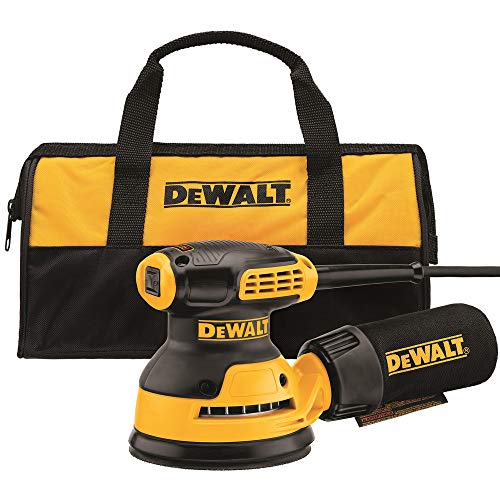
DEWALT DWE6423 5 Inch Variable Speed Random Orbit Sander, 3 Amp
3 amp motor8,000 to 12,000 OPM5 inch padVariable speed
Check price on Amazon
Best for: Woodworkers who want a smooth, low-vibration electric sander with speed control for finish work.

A separate counterweight is a small mass that moves opposite to the sanding pad, cancelling the vibration that would otherwise travel into your hand. DEWALT builds this sander with the counterweight apart from the motor shaft, which keeps vibration lower than designs that balance the pad on the motor itself. A 3 amp motor spins the pad between 8,000 and 12,000 orbits per minute, and the variable dial lets you drop to 8,000 for delicate finishes and veneers.

A dust-sealed switch protects the part that fails first on most sanders, because fine wood dust works into an open switch and wears out the contacts. The variable speed range is the key difference from the DWE6421K, which is a fixed 12,000 OPM kit. Compared with the SKIL SR211601, the DEWALT is smoother but its dust handling relies on a bag and vacuum port.

Ownership: use a hook-and-loop disc that matches the hole pattern of the pad, because mismatched holes cut dust extraction in half. Connect a shop vacuum for best results, and replace the pad when the hooks flatten. Work through grits in order, skipping no more than one step, and let the sander do the work without pressing.

What works

  • Separate counterweight keeps vibration low for long sessions
  • Variable 8,000 to 12,000 OPM suits veneer and hardwood
  • Dust-sealed switch resists the most common failure
  • 3 amp motor holds speed under light pressure

Watch out for

  • Onboard dust bag catches only part of the dust
  • Fixed 5 inch pad limits large panel work
  • Higher relative price than the other electric picks

Spec sheet

Motor
3 amp corded
Speed
8,000 to 12,000 OPM, variable
Pad
5 inch
Vibration
Separate counterweight
Switch
Dust-sealed
02
DEWALT DWE6421K 5 Inch Random Orbital Sander Kit, 3 Amp, 12,000 OPM
3 amp motor12,000 OPM5 inch padKit with case
Check price on Amazon
Best for: Workshop users who sand bare lumber and rough surfaces and prefer a simple fixed-speed sander.

A shorter overall height keeps your hand closer to the work surface, which gives more control when sanding edges and tight areas. The 3 amp motor spins the pad at 12,000 orbits per minute with no speed dial, which makes the tool simple and aggressive. It shares the DWE6423's separate counterweight design, so vibration is held down the same way.

The tradeoff against the DWE6423 is the lack of variable speed. A fixed 12,000 OPM is fast for stripping paint and sanding rough lumber, but too aggressive for veneer and thin finishes, where the 8,000 OPM setting of the variable model helps. It comes as a kit with a case, which keeps the sander and discs organized. For a general workshop sanding bare wood, the fixed speed is fine.

Ownership: check that the pad is flat, and replace it if the hook-and-loop wears out. Keep the dust port clear, and store the sander in its case. Use a vacuum to keep dust down and extend the life of the discs.

What works

  • Short profile gives control on edges and corners
  • Fixed 12,000 OPM removes stock quickly
  • Separate counterweight keeps vibration low
  • Kit includes a case for storage

Watch out for

  • No variable speed for veneer and delicate finishes
  • Dust bag catches only part of the dust
  • Fixed speed can swirl-mark soft finishes

Spec sheet

Motor
3 amp corded
Speed
12,000 OPM
Pad
5 inch
Height
Short profile for control
Vibration
Separate counterweight
03
SKIL SR211601 5 Inch Random Orbital Sander with Cyclonic Dust Box
2.8 amp motor13,000 OPMCyclonic dust boxVariable speed
Check price on Amazon
Best for: Homeowners who sand furniture and trim without a shop vacuum and want easy dust cleanup.

A cyclonic dust box spins dust air in a vortex and drops the heavier particles into a container, which keeps the airflow cleaner than a cloth bag and makes emptying easy. This SKIL pairs it with a 2.8 amp motor and a top speed of 13,000 orbits per minute, with variable speed control for different materials. A faster orbit rate removes material quickly but needs a lighter touch.

Compared with the DEWALT DWE6423, the SKIL has a slightly weaker motor but a better onboard dust system. If you do not own a shop vacuum, the cyclonic box is a real advantage. Compared with the DEWALT, it lacks the separate counterweight, so vibration is a bit higher. For a homeowner sanding furniture and trim, the dust box makes cleanup far easier.

Ownership: empty the cyclone box often, since a full box kills suction. Use discs with the right hole pattern, and replace the pad when the hooks wear. Keep the vents free of dust, and store the sander in a dry place.

What works

  • Cyclonic dust box keeps suction up and empties easily
  • 13,000 OPM top speed removes material quickly
  • Variable speed control for different materials
  • Lower relative price than the DEWALT sanders

Watch out for

  • Vibration is higher than counterweighted designs
  • 2.8 amp motor is a bit weaker than the DEWALT
  • Basic included sanding sheets

Spec sheet

Motor
2.8 amp corded
Speed
13,000 OPM, variable
Pad
5 inch
Dust
X-flow cyclonic dust box
Included
3 sanding sheets
04
6 Inch Professional Pneumatic Random Orbital Palm Sander, Low Vibration
Pneumatic6 inch padLow vibrationBalanced pad
Check price on Amazon
Best for: Shops with a compressor that sustain air flow and want a light, cool-running 6 inch sander.

A pneumatic sander runs on compressed air through a vane motor, so it has no windings to overheat and is light for its power. The listing emphasizes a balanced pad and a low center of gravity, which is how a good air sander gives a swirl-free finish. A 6 inch pad covers more area per pass than a 5 inch pad.

The tradeoff is the compressor. Air sanders consume a large volume of air continuously, and a small pancake compressor runs constantly or cannot keep up. Compared with the electric DEWALT sanders, this pneumatic unit is lighter and cooler, but it is only as good as your air supply. If you do auto body work or sand all day, a pneumatic sander is a sensible choice.

Ownership: oil the air inlet daily with a few drops of pneumatic tool oil. Use a water separator on the line, since moisture ruins the motor. Check the pad for wear, and use a regulator to keep pressure correct. Avoid running it dry.

What works

  • Light body with a low center of gravity reduces fatigue
  • Balanced pad gives swirl-free results
  • 6 inch pad covers more area per pass
  • Vane motor has no windings to burn out

Watch out for

  • Needs a compressor that can sustain high air flow
  • Requires daily oiling and a water separator
  • Not usable without an air supply

Spec sheet

Power
Compressed air
Pad
6 inch
Design
Low center of gravity
Vibration
Low, balanced pad
Use
Shop and auto body work
05
ZFE Pneumatic Random Orbital Palm Sander, 5 and 6 Inch Pads
Pneumatic5 and 6 inch padsAll-steel partsDust bag included
Check price on Amazon
Best for: Shops with a compressor that want both 5 and 6 inch pads with accessories included.

An all-steel rotor and cylinder hold up to air tool wear better than aluminum or plastic parts, and the listing says the movement is quenched for hardness. The sander ships with both a 6 inch and an extra 5 inch backing plate, plus sponge polishing pads and sandpapers, so you can switch pad sizes. A dust bag connects through a suction tube.

Compared with the other air sander in this roundup, the ZFE offers a second pad size and a ready-to-go accessory kit. Compared with the DEWALT electric sanders, it requires a compressor and daily oiling. It is a good fit for auto body and woodworking in a shop that already runs compressed air.

Ownership: put oil in the inlet before each use, drain the compressor tank regularly, and use a regulator. Check the hose fittings for leaks, and replace the pad when hooks wear. Store the sander dry to prevent rust on steel parts.

What works

  • Ships with 6 inch and 5 inch backing plates
  • All-steel rotor and cylinder resist wear
  • Sponge polishing pads and sandpapers included
  • Dust bag included

Watch out for

  • Needs a compressor and daily oiling
  • Accessories are basic quality
  • Not usable without an air supply

Spec sheet

Power
Compressed air
Pads
6 inch with an extra 5 inch plate
Build
All-steel rotor and cylinder
Included
Dust bag, sponge pads and sandpapers
Use
Auto body and woodworking

Spec sheet decoder

What the numbers on the box really mean

The specs manufacturers lead with, translated into what they tell you about real-world performance.

OPM (orbits per minute)

OPM counts how many orbits the pad makes per minute. Higher OPM removes material faster.

Watch forThe SKIL's 13,000 OPM is a top speed, and some work needs a lower speed. Do not compare OPM figures across brands without checking orbit size.

Orbit diameter

Orbit diameter is how wide the pad's ellipse is. A larger orbit cuts faster but leaves coarser scratches.

Watch forFew listings state it, including these. Orbit size is the unlisted number that most affects how fast a sander cuts.

Amps

Amps measure motor draw. A 3 amp motor holds speed under light pressure.

Watch forThe SKIL's 2.8 amps is not a meaningful gap versus the DEWALT's 3. Judge a sander by how it feels at 20 minutes, not by amps.

Hook-and-loop

Hook-and-loop lets discs stick to the pad and change quickly. Worn hooks lose grip.

Watch forCheap discs shed sooner, so buy matching hole patterns. Replace discs before hooks flatten, since a smooth hook face cannot grip.

Pneumatic CFM

CFM is cubic feet per minute of air the tool consumes. Air sanders need a steady supply.

Watch forNeither air sander lists CFM clearly, so check before buying. Ask the seller for the air consumption before buying a pneumatic sander.

Methodology

How We Evaluated These Random Orbital Sanders Under $100

Vibration control

We looked at counterweight design. The DEWALT sanders use a separate counterweight, which cuts vibration. We treated a separate counterweight as the strongest single indicator of a smooth finish.

Speed range

We compared OPM, from 8,000 to 13,000, and noted fixed versus variable. We noted that fixed speed is acceptable for rough stock but limiting for finish work.

Dust handling

We checked collection, favoring the SKIL's cyclone. Collection quality counted heavily because dust is the main cause of scratches.

Power source

We split electric from pneumatic and noted compressor needs. Pneumatic models were judged on the assumption of an adequate compressor.

Relative value

We used price tier to compare what extra spending buys. We used relative price only and never quoted any listing amount.

Decision guide

How to Choose the Right Random Orbital Sanders Under $100

By Work Type

Match the sander to the surface first, then to the dust plan, because finish quality depends on both more than on the motor.

WorkPickWhy
Furniture and veneerDEWALT DWE6423Variable speed and low vibration
Rough lumber and strippingDEWALT DWE6421KFixed 12,000 OPM
Trim without a vacuumSKIL SR211601Cyclonic dust box
Auto body in a shop6 inch Pneumatic SanderLight and cool
Mixed shop workZFE Pneumatic5 and 6 inch pads

By Budget

Relative tiers only: the price gap between a basic electric sander and a counterweighted one is modest, while the compressor needed for an air sander is the larger hidden cost.

TierPickWhy
LowestSKIL SR211601Basic with dust box
Low-middleZFE PneumaticAir sander kit
Middle6 inch Pneumatic SanderAir sander
Upper-middleDEWALT DWE6421KKit with case
UpperDEWALT DWE6423Variable speed

Electric vs Pneumatic

Electric

Plug in and work, with no compressor needed. The DEWALT DWE6423, DWE6421K and SKIL fall here.

Pneumatic

Light and cool, but needs a compressor. The 6 inch Pneumatic Sander and ZFE fall here.

Choose electric for home shops and pneumatic if you already own a strong compressor.

By Dust Strategy

StrategyPickWhy
Shop vacuum connectedDEWALT DWE6423Port and sealed switch
Onboard collection onlySKIL SR211601Cyclone box
Bag and hoseZFE PneumaticDust bag included
Air line dust6 inch Pneumatic SanderNeeds a vacuum
Basic dust handlingDEWALT DWE6421KBag and port

For Sanding Furniture Before Finishing Specifically

Look for

Furniture needs low vibration, variable speed and good dust control. Work through grits from 80 to 220 without skipping.

In this comparison

The DEWALT DWE6423 is best for finish work. The SKIL SR211601 is a good value for cleanup.

Work from 80 to 120 to 180 to 220 grit, wipe the surface between grits, and let the sander's weight set the pressure.

When to Spend More

Spend more if

You sand daily or need a 6 inch brushless model. The DEWALT DWE6423 shows where refinement begins.

Save if

You sand a few projects a year. The SKIL SR211601 covers that.

Ownership

Maintenance schedule

The upkeep that decides whether this machine lasts two seasons or ten.

TaskIntervalWhy it matters
Replace the padWhen hooks flattenA worn pad loses grip and discs spin off. Replace it when discs slip. Match the new pad's hole pattern to your discs.
Empty the dust box or bagEvery sessionA full container kills suction. Empty it often. Tap the container clean outdoors.
Clean the ventsAfter dusty jobsDust blocks cooling. Compressed air clears vents. Use a soft brush on the housing slots.
Oil pneumatic sandersDailyAir tools need oil in the inlet. Dry vanes wear out. Use a few drops of pneumatic tool oil.
Replace discsWhen cutting slowsWorn discs burn wood. Fresh discs cut faster. Store discs flat to stop them curling.

FAQ

Frequently Asked Questions

Electric or pneumatic?

Electric sanders plug in and work. Pneumatic ones need a compressor. Choose electric for most home shops. Auto body shops often prefer pneumatic for lightness.

What does the cap buy?

It buys a decent corded sander or a pneumatic model. Listing prices move, so check the live cost. Expect to buy a pack of quality discs as the first accessory.

How long do sanders last?

With care, many years. Pads and switches wear first. Keep the switch free of dust to avoid the most common failure.

Why do I get swirl marks?

Swirls come from too much speed, skipped grits or pressing hard. Slow down and keep the pad flat. Also check that the disc holes line up with the pad holes.

Which grit should I use?

Start at 80 for rough work, then 120, 180 and 220. Skip no more than one step. Wipe dust off between grits so coarse particles do not scratch.

Do I need a vacuum?

It helps a lot. Dust scratches the work and clogs discs. A shop vacuum on the dust port pulls dust off the surface before it scratches.

Bottom line

The short version

Browse more random orbital sanders under $100on Amazon →
James Miller, Lead Machine Editor

About the author

James Miller

Lead Machine Editor, MachineFanatic

James Miller leads MachineFanatic's buying guides, turning spec sheets, manuals and owner feedback into clear verdicts on power tools, outdoor power equipment, shop machines and kitchen machines.

More from James →

Keep reading

Related guides