
Amazon affiliate links - we earn a commission.Affiliate disclosure

Buying guide · 13 min read · Updated 2026-11-25

Best RV Water Pumps Under $100 (2026)

Five RV fresh water pumps that list for under $100, from branded 12V diaphragm units to 110V shore power models, with real notes on pressure and upkeep.

James MillerBy James MillerLead Machine Editor5 machines comparedSpec-sheet verified
Best RV Water Pumps Under $100

At a glance

Our top picks

Side by side

Spec comparison

Stepping beyond the cheapest pumps buys a more recognisable design, a better warranty or an AC-powered option for rigs that sit plugged in. The job is unchanged: sense a tap opening, push water, stop at a set pressure.

The real decision at this level is voltage and pressure. A battery-powered pump works anywhere the battery does, while a household-voltage pump only works with shore power or an inverter. We ranked by how well each pump matches the plumbing it will feed. Prices move, and the $100 cap reflects listing prices when this guide was updated.

Before you buy

6 Criteria to Look For Before Buying a RV Water Pump Under $100

  1. 01

    12V or 110V power

    A 12V pump runs off the camper battery and works anywhere, while a 110V pump needs shore power or an inverter. The two SEAFLO 33 variants and the ECO-WORTHY AC model show the split. If you ever boondock, a 12V pump is the only answer. If your rig stays plugged in, an AC pump removes a big current load from the battery and often costs less to run than you expect.

  2. 02

    Pressure against plumbing

    RV plumbing is typically built for 40 to 55 PSI, and the 45 PSI SEAFLO pumps sit comfortably there. The VEVOR at 70 PSI and the SEAFLO 22 at 100 PSI exceed it. If you choose them, add a pressure regulator or confirm the line material can take it. Above roughly 70 PSI the risk of fitting leaks grows quickly.

  3. 03

    Flow for your fixtures

    A single sink needs well under 2 GPM, but a shower with a pump-assisted head runs better at 3 to 4. The SEAFLO 22 at 1.3 GPM fits a galley tap, the SEAFLO 33 at 3.0 fits a small camper and the VEVOR at 5.5 fits a washdown hose. Oversizing wastes current and adds noise. Count the outlets you expect to run together, then add a modest margin for the water heater's inlet and the hose to the outside spigot. Most small campers never need more than 3 GPM, and a pump that runs briefly and quietly outlasts one that runs hard.

  4. 04

    Certification and warranty

    The SEAFLO AC model lists NSF/ANSI 61 and 372 for potable water, NSF 24 for RV plumbing and a four-year limited warranty. Those claims matter for drinking-water safety and long-term support. Cheaper pumps seldom document them, so confirm the claims on the listing. A warranty is only as useful as the seller's willingness to honour it, so keep the order record and the model number. For drinking water, also prefer a pump whose wetted parts are described as food-safe or potable-rated.

  5. 05

    Head design and noise

    A three-chamber diaphragm head, as on the 33 series, runs smoother than a two-chamber design. Pulsing causes noise and strains the plumbing. Mount the pump on rubber and add an accumulator if it chatters. The cheapest improvement is a section of braided hose between the pump and the rigid plumbing, which breaks the path that carries vibration into the walls. Mounting the pump to a heavy panel, rather than thin plywood, lowers the drumming further.

  6. 06

    Self-prime and protection

    Most diaphragm pumps lift water about 6 to 10 feet, with the ECO-WORTHY AC unit quoting 9.8. Thermal overload protection guards the motor if it stalls. Check these before you commit.

Detailed reviews

The 5 best rv water pumps under $100, explained

01
SEAFLO 33 Series 12V 3.0 GPM 45 PSI RV water pump
3.0 GPM45 PSI3-chamberFilter included
Check price on Amazon
Best for: Travel trailers and vans that want a stock-style, easily serviced pump.

This is the 33 series layout that many travel trailers use as a stock pump: three diaphragm chambers, a 3.0 gallon per minute open flow and a 45 PSI shut-off. The three-chamber design is the reason it delivers smooth, consistent flow, since each chamber pumps in turn and the pulses overlap. The box includes a filter and two half inch FNPT-to-barb fittings, so a straight swap needs no extra parts.

The 3.0 GPM figure is lower than the 4 and 5.5 GPM competitors here, but for a camper with one sink and a small shower it is more than adequate, and its modest current draw is easier on a small battery bank. Measured against the VEVOR in this list it moves less water and runs at lower pressure, which is a plus for older plumbing.

In ownership terms, the common failures are a clogged inlet filter and a worn pressure switch. Clean the filter at the start of each season, mount the pump on rubber pads and keep the suction hose short. Because the design is a widely copied one, replacement heads and switches are easy to find, which is the best argument for choosing it. Fit a short flexible hose on each side of the pump so vibration does not travel along rigid pipe, and consider an accumulator if you hear a drumming at low flow. If the pump ever runs on for several seconds after the tap closes, suspect a worn check valve or a leak before you blame the switch.

What works

  • Three-chamber head smooths pulsing
  • Filter and fittings included
  • Forty-five PSI suits standard plumbing
  • Parts and heads are easy to source

Watch out for

  • Lower flow than 4 GPM rivals
  • Not suited to a bigger multi-fixture camper

Spec sheet

Model
SFDP1-030-045-33
Voltage
12 volt DC
Open flow
3.0 GPM
Shut-off pressure
45 PSI
In the box
Filter and two half inch fittings
02
SEAFLO 33 Series 115V AC 3.3 GPM 45 PSI pump
115V AC3.3 GPM45 PSI4-year warranty
Check price on Amazon
Best for: Stationary rigs and tiny houses that stay on shore power.

This SEAFLO runs from household 115 volt power instead of a battery, so it suits a rig that spends most of its life plugged in, such as a park model, a tiny house or a shed. The listing quotes 3.3 gallons per minute at a 45 PSI shut-off and a smart pressure switch, so it still cycles on demand.

It cites compliance with NSF/ANSI 61 and 372 for potable water safety, NSF 24 for RV plumbing and UL 778, plus a four-year limited warranty. The certifications are the main reason to pick it, because they speak to materials that touch drinking water. Against the 110V ECO-WORTHY here, it offers lower pressure and flow but better documented standards and warranty.

The big caveat is that it stops working the moment the AC power goes away, so a boondocking camper should skip it. Install it with a rubber mount, keep the strainer clean and drain it before freezing weather. If you intend to run it from an inverter, check that the inverter handles the motor's starting surge. A pure sine inverter is the safest match, because a cheap modified sine unit can make an AC motor hum and run warm. Since drinking water is involved, flush the tank and lines with a mild sanitising solution before first use, then rinse until the smell is gone.

What works

  • Documented potable water and RV standards
  • Four-year limited warranty
  • Runs on household power
  • Smart pressure switch saves wear

Watch out for

  • Dead without AC power
  • Lower flow than the other AC pump

Spec sheet

Model
SFDPA1-033-045-33
Voltage
115 volt AC
Flow
3.3 GPM
Shut-off pressure
45 PSI
Warranty
Four-year limited
03
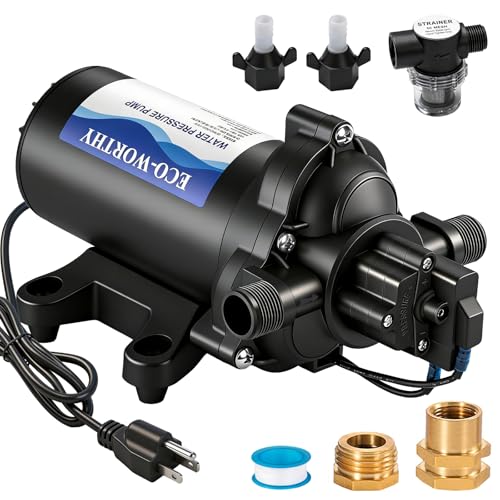
ECO-WORTHY 110V AC 4.0 GPM 50 PSI 33-series pump
110V AC4.0 GPM50 PSI9.8 ft prime
Check price on Amazon
Best for: Cabins and tiny houses that need stronger flow on household power.

ECO-WORTHY builds this 33-series style pump for 110 volt use and rates it at 4.0 gallons per minute and 50 PSI. It self-primes up to 9.8 vertical feet and lifts up to 131 feet according to the listing, and thermal overload protection guards the motor against overheating. The smart switch turns the pump on and off on demand and shuts it off when the flow stops.

The extra flow and pressure make it a good match for a house-style setup with a shower and a washing area, where the 3.3 GPM SEAFLO would feel slow. Next to the SEAFLO AC pump, it moves nearly a quarter more water but lacks the documented potable-water standards on that model.

As with any AC pump, it needs mains power and is not for a camper that boondocks. Keep it dry, mount it on a rubber base to reduce noise and check the thermal cut-out by noticing if it ever stops mid-run. Drain it before winter. Because the motor is powered from the wall, put it behind a GFCI outlet and keep the plug off the floor, where a leak could reach it. If the pump hums but does not move water, check the inlet screen and the tank valve before you replace anything.

What works

  • Four gallons per minute on AC power
  • Thermal overload protection
  • Self-primes nearly ten feet
  • Lift rating of 131 feet

Watch out for

  • Requires mains power
  • Fifty PSI stresses older fittings

Spec sheet

Voltage
110 volt AC
Flow
4.0 GPM
Shut-off pressure
50 PSI
Self-prime
9.8 vertical feet
Lift
Up to 131 feet
04
VEVOR 12V 5.5 GPM 70 PSI diaphragm water pump
12V DC5.5 GPM70 PSISelf-priming
Check price on Amazon
Best for: Large rigs or washdown hoses that need serious volume.

VEVOR sells this unit as an open-flow monster: 5.5 gallons per minute and 70 PSI rated pressure on a 12 volt supply. It is clearly aimed at more than RVs, with lawn and marine uses on the listing, and it carries an automatic pressure switch that stops the motor when the line is full.

That output is the most in the list, but it brings trade-offs. 70 PSI is above the 40 to 55 PSI window most RV plumbing is built for, so you would want a pressure regulator in the line. It also draws much more current than the 3.0 GPM SEAFLO, so fuse and wire it heavily and check the battery bank.

In ownership, treat it as a high-output pump for long lines, a washdown hose or a large system. Add an accumulator to smooth its pulses and keep the inlet strainer clean. If you only need a sink and a small shower, the SEAFLO 33 is the saner choice. Anyone who buys it for an RV should plan on a regulator and a short pigtail of flexible hose to calm the pulses before they hit the faucets.

What works

  • Largest flow in the list at 5.5 GPM
  • Automatic pressure switch
  • Works for RV, marine and lawn tasks
  • Self-priming 12 volt design

Watch out for

  • Seventy PSI needs a regulator in RV plumbing
  • High current draw taxes small batteries

Spec sheet

Voltage
12 volt DC
Open flow
5.5 GPM
Rated pressure
70 PSI
Control
Automatic pressure switch
Uses
RV, marine, lawn spraying
05
SEAFLO 22 Series 12V 1.3 GPM 100 PSI pump
1.3 GPM100 PSI3/8 in barbsOn demand
Check price on Amazon
Best for: Single-faucet galleys, van sinks and small boat plumbing.

The 22 series is a smaller, lower-flow sibling of the 33 series. It is rated at 1.3 gallons per minute and a 100 PSI shut-off, with 3/8 inch barbs, which makes it a fit for a single faucet in a boat, a van or a bar sink. The on-demand design means it starts when a tap opens and stops when the line pressurises.

A 100 PSI shut-off is high, and the plumbing must be able to take it, so this is not a drop-in for a standard camper with thin lines. At 1.3 GPM it will feel slow for a shower, and against the SEAFLO 33 it gives up more than half the flow. Its virtue is a small footprint and a low current draw.

Use it for a dedicated tap, a pull-out sink or a small galley. Keep the filter clean, mount it on a rubber pad and check the barbs for weeping at the first fill. A pump this small is not meant to run for long periods, so avoid using it to fill a bucket or flush a tank. Thread sealant on the fittings and a short strain-relief loop on the hose keep the connections from loosening after a rough road.

What works

  • Compact and low current draw
  • Fits a single sink well
  • Three eighths inch barbs for small hose
  • On-demand pressure switch

Watch out for

  • Too slow for a shower
  • One hundred PSI needs tough plumbing

Spec sheet

Model
SFDP1-013-100-22
Voltage
12 volt DC
Open flow
1.3 GPM
Shut-off pressure
100 PSI
Fittings
3/8 inch hose barbs

Spec sheet decoder

What the numbers on the box really mean

The specs manufacturers lead with, translated into what they tell you about real-world performance.

Open flow

Gallons per minute with no restriction. Real flow in a camper is lower.

Watch forThe VEVOR states 5.5, the ECO-WORTHY AC 4.0, and the SEAFLO 22 only 1.3.

Shut-off pressure

The pressure where the pump stops. It sets spray force and the stress on fittings.

Watch forThe two SEAFLO 33 pumps stop at 45 PSI and the SEAFLO 22 at 100.

Voltage

The power source. DC runs from the battery and AC needs mains or an inverter.

Watch forTwo of the five here are AC, so they fail in a power cut.

Self-prime lift

How far below the pump the water can sit and still be drawn up.

Watch forThe ECO-WORTHY AC lists 9.8 feet; verify the others against your tank.

Pump series

A series number describes the head size and layout. A 33 series is a larger head than a 22 series.

Watch forThe SEAFLO 22 shares a brand but not a flow class with the 33.

Methodology

How We Evaluated These RV Water Pumps Under $100

Power source fit

We separated 12V and 110V pumps before comparing, since a boondocking camper cannot use an AC unit. The SEAFLO 33 12V earned credit for flexibility. The two AC units were ranked against each other.

Pressure match

Shut-off pressure was compared with the common 40 to 55 PSI plumbing window. The 45 PSI SEAFLO pumps fit it, the VEVOR at 70 and the SEAFLO 22 at 100 do not. Higher pressure lost points unless a use case justified it.

Flow and current

Open flow was weighed against likely current draw. The VEVOR at 5.5 GPM is the most powerful but also the most demanding. The SEAFLO 22 at 1.3 is the lightest.

Documentation

Certifications, warranty length and included parts were checked. The SEAFLO AC unit's potable-water standards and four-year warranty stand out. Listings that showed no standards scored lower.

Cap compliance

Each pump was checked against the $100 cap at the time of writing. We used the spec sheet and owner feedback patterns. This guide shares no products with the lower-cap sibling.

Decision guide

How to Choose the Right RV Water Pumps Under $100

By Power Source

SituationPickWhy
Boondocking trailerSEAFLO 33 12VBattery powered, stock-style
Park model on shore powerSEAFLO 33 115V ACDocumented standards and warranty
Cabin with a showerECO-WORTHY 110V ACFour gallons per minute
Washdown or long linesVEVOR 5.5 GPMHighest volume
Single galley faucetSEAFLO 22 SeriesCompact, low flow

By Budget

TierPickWhy
Lowest in this listSEAFLO 22 SeriesSmall low-flow pump
Lower middleVEVOR 5.5 GPMHighest flow for the money
MiddleSEAFLO 33 12VStandard camper pump
Upper middleECO-WORTHY 110V ACAC power with 4 GPM
Top of the capSEAFLO 33 115V ACWarranty and standards

12V vs 110V

12V (SEAFLO 33, VEVOR, SEAFLO 22)

Works off the battery, so it runs anywhere. It draws current, so wiring and fuse choice matter.

110V (SEAFLO 33 AC, ECO-WORTHY AC)

Draws no battery power, but it stops the moment shore power fails. It suits stationary rigs.

Choose 12V for travel and 110V for a fixed setup.

Pressure Needs

PreferencePickWhy
Gentle on old plumbingSEAFLO 33 12VForty-five PSI
Firm showerECO-WORTHY 110V ACFifty PSI
High pressure with regulatorVEVOR 5.5 GPMSeventy PSI rating
Dedicated tapSEAFLO 22 SeriesOne hundred PSI, low flow

For Tiny Houses Specifically

Look for

An AC pump with potable-water documentation and a smart pressure switch. Tiny houses live on household power and need a pump that is safe for drinking water.

In this comparison

The SEAFLO 33 115V AC fits that profile. The ECO-WORTHY AC unit suits a bigger load but documents fewer standards.

When to Spend More

Spend more if

You want a variable-speed pump or a bundled accumulator tank. Those come above this cap.

Save if

Your camper has one sink and a small shower. The SEAFLO 33 12V covers it.

Ownership

Maintenance schedule

The upkeep that decides whether this machine lasts two seasons or ten.

TaskIntervalWhy it matters
Clean the inlet filterSeason startGrit clogs the check valves. Flow loss is the first symptom.
Check fittings for dripsAfter the first tripBarbs loosen under vibration. A slow weep makes the pump cycle.
Inspect wiring and fuseAnnuallyCorrosion adds resistance. Voltage drop makes the motor run hot.
WinterizeBefore freezing weatherIce cracks the pump head. Antifreeze through the line prevents it.
Refresh rubber mountsEvery two yearsHardened rubber stops absorbing vibration. Noise creeps up.

FAQ

Frequently Asked Questions

How do I choose between 12V and 110V?

If you ever camp away from hookups, pick 12V. If the rig stays plugged in, an AC pump saves battery power. Remember that an AC pump stops during a power cut.

Will 70 PSI hurt my plumbing?

It may. RV plumbing is typically built for 40 to 55 PSI, so a 70 PSI pump needs a regulator. Without one, fittings can weep or fail.

What does the extra budget buy over the cheapest pumps?

A stock-style three-chamber head, documented standards on some models and AC power options. Flow and pressure also range wider.

Can I run an AC pump from an inverter?

Yes, if the inverter handles the motor's starting surge. A small inverter may trip on startup, so check the rating.

Why does my pump cycle by itself?

It usually means a leak or a failing check valve. Close all faucets and listen for repeated starts, then check the fittings.

Does the $100 cap change?

Listing prices move. The cap reflects prices when this guide was updated, so check the live listing.

Bottom line

The short version

Browse more rv water pumps under $100on Amazon →
James Miller, Lead Machine Editor

About the author

James Miller

Lead Machine Editor, MachineFanatic

James Miller leads MachineFanatic's buying guides, turning spec sheets, manuals and owner feedback into clear verdicts on power tools, outdoor power equipment, shop machines and kitchen machines.

More from James →

Keep reading

Related guides