
Amazon affiliate links - we earn a commission.Affiliate disclosure

Buying guide · 12 min read · Updated 2026-11-25

Best RV Water Pumps Under $50 (2026)

Four 12V RV fresh water pumps that list for under $50, compared on flow, shut-off pressure, noise control, inlet filtering and long-term reliability.

James MillerBy James MillerLead Machine Editor4 machines comparedSpec-sheet verified
Best RV Water Pumps Under $50

At a glance

Our top picks

Side by side

Spec comparison

MachineVoltageFlowShut-off pressureControl
DC HOUSE 33 Series 12V 3.5 GPM 45 PSI RV water pumpBest OverallDC HOUSE 33 Series 12V 3.5 GPM 45 PSI RV water pump12 volt DC3.5 GPM45 PSIBuilt-in adjustable pressure switch
ECO-WORTHY 12V 3.5 GPM 45 PSI fresh water pumpBest ValueECO-WORTHY 12V 3.5 GPM 45 PSI fresh water pump12 volt DC3.5 GPM45 PSIOn-demand pressure switch
Gidrox 12V 4.0 GPM 45 PSI quiet RV water pumpBest High FlowGidrox 12V 4.0 GPM 45 PSI quiet RV water pump12 volt DC4.0 GPM45 PSIn/a
12V 4.0 GPM 50 PSI on-demand RV diaphragm pumpBest Higher Pressure12V 4.0 GPM 50 PSI on-demand RV diaphragm pump12 volt DC4.0 GPM50 PSIn/a

An RV water pump is a small diaphragm machine that waits for a faucet to open and then pushes water through the plumbing until the faucet closes. Because it runs from the camper battery and mounts on a thin floor, noise and current draw matter almost as much as flow.

The budget tier is crowded with near-identical pumps, and the differences are in the details: shut-off pressure, rubber mounts, whether an inlet strainer is included and how the switch behaves when a line leaks. We ranked by those details. Prices move, and the $50 cap reflects listing prices when this guide was updated.

Before you buy

6 Criteria to Look For Before Buying a RV Water Pump Under $50

  1. 01

    Shut-off pressure

    Most RV plumbing is built for roughly 40 to 55 PSI, and 45 PSI pumps like the DC HOUSE are the safe default. A 50 PSI pump gives a firmer shower but pushes harder on old fittings. If your camper has older plastic fittings, stay at 45. Below about 40 PSI the flow feels weak, and above about 70 the risk of a leak rises sharply. If you want to confirm the real number in your own camper, a cheap inline gauge at a faucet shows the static pressure when the pump shuts off. Compare that with what the plumbing is rated for before you decide the 50 PSI pump is a good idea.

  2. 02

    Flow in gallons per minute

    Flow ranges from 3.5 to 4.0 GPM across these four pumps. A pump with more flow fills a bucket faster, but it also draws more current from the battery. For a camper with one sink and a small shower, 3.5 is usually enough, and 4.0 helps only when several outlets run at once. Remember that real flow at the faucet is lower than the open-flow rating because of hose length, elbows and the restriction of the faucet itself. Do not size the pump for a number you will never see at the tap, and remember the water heater and shower head set the practical ceiling.

  3. 03

    Noise and vibration control

    A diaphragm pump hammers as it works, and a thin RV floor amplifies it like a drum. Rubber mounting bases, as on the DC HOUSE and Gidrox, absorb part of that. Flexible hose near the pump and an accumulator tank take care of the rest. Never mount the pump directly to a thin panel with hard screws; use rubber grommets or an isolating pad. Even a modest change in mounting can drop the perceived noise noticeably in a small van.

  4. 04

    Motor protection

    A thermal overload switch, like the one on the ECO-WORTHY, cuts power when the motor overheats. That protects against a closed valve or a kinked hose that makes the motor stall. Pumps without a stated cut-out rely on you to notice a problem. A motor that runs hot and smells of burnt varnish is already damaged, so listen for a pump that runs longer than it should. A pump with the cut-out will restart after cooling, which is a clue that something in the line is wrong.

  5. 05

    Inlet strainer and fittings

    A strainer keeps grit out of the check valves, and a clogged one is among the most common causes of lost flow. The 50 PSI pump includes a 50 mesh strainer and two half inch barbs. Check what comes in the box so you do not need to buy fittings.

  6. 06

    Self-priming and placement

    A diaphragm pump lifts water 6 to 10 feet when it is installed close to the tank. The Gidrox states a 10 foot prime. Long or looping suction lines cause air locks, so keep the hose short and straight. Place the pump lower than the tank outlet if you can, since gravity then does the priming for you. If the tank sits below the pump, expect a few seconds of noise at the first startup after the system has sat empty.

Detailed reviews

The 4 best rv water pumps under $50, explained

01
DC HOUSE 33 Series 12V 3.5 GPM 45 PSI RV water pump
3.5 GPM45 PSI3-chamberAdjustable switch
Check price on Amazon
Best for: Campers that need a quiet, tunable pump for standard 45 PSI plumbing.

This pump follows the long-established 33 series layout: three diaphragm chambers driven by a small motor, so the water arrives in smaller, smoother pulses than a single-chamber design. The listing states 3.5 gallons per minute and a 45 PSI shut-off, which sits in the range most RV plumbing is built for, since 40 to 55 PSI is typical and much more strains thin fittings.

Its built-in pressure switch is described as adjustable, which is unusual at this price. An adjustable cut-off lets you trim the pressure down for old plumbing or up slightly for a long run to a shower. A noise-dampening rubber mounting base absorbs vibration that would otherwise ring through the floor and into the cabin, and that feature matters as much as the motor.

Next to the Gidrox in this list, the DC HOUSE gives up half a gallon per minute of flow but offers the adjustable switch. Fit it close to the tank so it self-primes quickly and keep the suction hose short and straight. Add an inlet strainer if the box does not include one, because a clogged strainer is the most common cause of flow loss, and an accumulator tank will smooth out pulsing if you hear a hammering sound at low flow. When you wire it, fuse the positive lead close to the battery and size the wire for the length of the run. A pump that sags to a lower voltage runs slower, draws more current for the same output and wears its brushes sooner.

What works

  • Adjustable pressure switch for tuning
  • Three-chamber head smooths pulsing
  • Rubber base cuts floor vibration
  • Flow suits most campers

Watch out for

  • Half a gallon less flow than the Gidrox
  • Strainer may need to be added separately

Spec sheet

Voltage
12 volt DC
Flow
3.5 GPM
Shut-off pressure
45 PSI
Pump head
Three-chamber diaphragm
Control
Built-in adjustable pressure switch
02
ECO-WORTHY 12V 3.5 GPM 45 PSI fresh water pump
3.5 GPM45 PSIThermal cut-outSelf-priming
Check price on Amazon
Best for: Campers wanting a solid, protected 3.5 GPM pump at the lowest tier.

The ECO-WORTHY pump matches the DC HOUSE on flow and pressure at 3.5 gallons per minute and 45 PSI, and it adds thermal overload protection to the motor. A thermal cut-out shuts the motor off if it overheats, which is the failure that happens when a pump runs against a closed valve or a clogged line. It is the kind of protection that saves a motor in the one summer a hose kinks.

The on-demand pressure switch starts the pump when a tap opens and stops it when the line reaches shut-off pressure. The listing calls it self-priming, so it can draw water up from a tank mounted below it, though a 6 to 10 foot lift is the practical limit for diaphragm pumps. Compared with the DC HOUSE, the ECO-WORTHY gives you the same flow with the thermal safeguard, but the switch is not marketed as adjustable.

Plan for the usual ownership chores. Use a fused feed at the correct amperage and enough wire gauge to avoid voltage drop, mount it on a rubber pad and check the fittings for weeping after the first trip. Before winter, drain it or run RV antifreeze through the head so ice does not crack it. A cracked pump head is the classic spring surprise, because the damage happens silently in January and only shows up as a spray when you open the first tap. Pumps of this kind are inexpensive to replace, but the labour of rerouting hoses is not, so keep the same port style when you swap.

What works

  • Thermal overload protects the motor
  • Same flow class as the DC HOUSE
  • Self-priming from a lower tank
  • On-demand switch saves current

Watch out for

  • Pressure switch is not adjustable
  • Basic mounting with no extra damping

Spec sheet

Voltage
12 volt DC
Flow
3.5 GPM
Shut-off pressure
45 PSI
Protection
Thermal overload
Control
On-demand pressure switch
03
Gidrox 12V 4.0 GPM 45 PSI quiet RV water pump
4.0 GPM45 PSI10 ft primeVortex noise cut
Check price on Amazon
Best for: Campers with a shower or two sinks where extra flow shortens waits.

Gidrox offers the highest flow among the 45 PSI pumps here at 4.0 gallons per minute. It states a 10 foot self-prime and a 100 foot head, and it adds a vortex noise reduction design plus a rubber vibration-damping base. Dual safeguards are mentioned in the listing, which points to protection against overload and dry running.

The extra half gallon over the 3.5 GPM pumps shows up as faster fills for a sink or a shower with a high-flow head. It also draws more current, so use a properly fused feed and heavier wire than a 3.5 GPM unit calls for. Against the ECO-WORTHY, the Gidrox moves more water and claims quieter operation, but it has no stated thermal cut-out.

In ownership, noise is mostly installation. Rubber feet, short flexible hose sections near the pump and an accumulator tank reduce the hammering you hear through a thin floor. Keep the inlet strainer clean and mount the pump near the tank to prime easily. Because it moves more water, it is also the pump most likely to expose a weak spot in old plumbing, so walk the lines after the first fill and look for weeping joints. If it chatters or hunts at low flow, an accumulator will usually settle it.

What works

  • Four gallons per minute at 45 PSI
  • Ten foot self-prime lift
  • Rubber base and vortex noise reduction
  • Dual safety protection stated

Watch out for

  • Higher current draw needs heavier wire
  • No stated thermal cut-out

Spec sheet

Voltage
12 volt DC
Flow
4.0 GPM
Shut-off pressure
45 PSI
Self-prime lift
10 feet
Head
100 feet
04
12V 4.0 GPM 50 PSI on-demand RV diaphragm pump
4.0 GPM50 PSIDry run short50 mesh strainer
Check price on Amazon
Best for: Longer plumbing runs or showers that need a bit more pressure.

This pump pushes to 50 PSI while keeping the 4.0 gallons per minute rating, so it is the higher-pressure option under the cap. The extra five PSI over the other pumps helps when the run to the shower is long or when a spray head wants more force, and it still sits within the common 40 to 55 PSI window of RV plumbing.

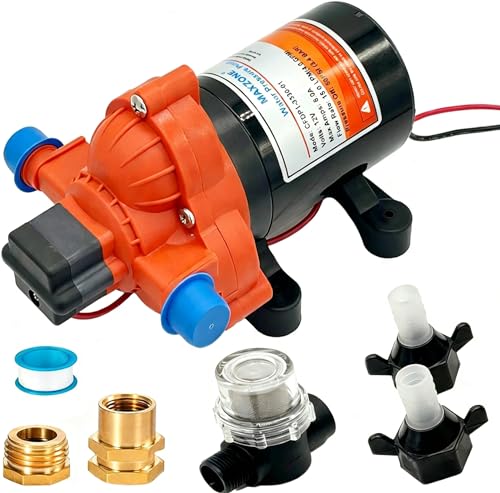
It ships with a 50 mesh inlet strainer and two half inch barbed adaptors, which is a practical bonus: the strainer protects the check valves, and a clogged one is a leading cause of lost flow. Per the listing, it can run dry for a short time without damage, which gives some forgiveness when the tank empties, though extended dry running is still hard on a diaphragm.

Set beside the Gidrox, it gives you five more PSI and a bundled strainer, but it makes no claim about noise-reduction. Install it on rubber mounts and flex hoses. Watch for cycling with no tap open, since that points to a leak or a failing check valve. Because the strainer is a 50 mesh screen, it catches sand and tank scale but not fine silt, so flush the fresh tank before the first fill. Carry a spare strainer on trips, since swapping one takes a minute and rescues a trip that would otherwise lose water pressure.

What works

  • Fifty PSI shut-off for stronger spray
  • Strainer and barbs included
  • Tolerates brief dry running
  • Four gallons per minute flow

Watch out for

  • No noise-reduction claims
  • Higher pressure stresses old fittings

Spec sheet

Voltage
12 volt DC
Flow
4.0 GPM
Shut-off pressure
50 PSI
Inlet filter
50 mesh strainer included
Fittings
Two half inch barbed adaptors

Spec sheet decoder

What the numbers on the box really mean

The specs manufacturers lead with, translated into what they tell you about real-world performance.

GPM

Gallons per minute of open flow with no back pressure. Real flow in the camper is lower once plumbing resistance is added.

Watch forThe Gidrox and the 50 PSI pump state 4.0, while the ECO-WORTHY and DC HOUSE state 3.5.

PSI shut-off

The pressure at which the pump stops and holds. It sets how hard water pushes through the taps.

Watch forThe 50 PSI pump is highest here; the other three stop at 45.

Diaphragm chambers

The number of pumping chambers. More chambers produce smoother flow with less pulsing.

Watch forThe DC HOUSE lists a three-chamber head.

Self-prime lift

How far below the pump the water can sit and still be drawn up.

Watch forThe Gidrox lists 10 feet; check the others against your tank position.

Thermal protection

A switch that shuts the motor off when it overheats.

Watch forOnly the ECO-WORTHY lists a thermal overload among these four.

Methodology

How We Evaluated These RV Water Pumps Under $50

Pressure and plumbing safety

We compared each shut-off pressure against the typical 40 to 55 PSI window. The 45 PSI pumps scored best for older RVs. The 50 PSI pump scored for strength but lost points for stress on fittings.

Flow and current

Flow in GPM was weighed against expected current draw. The Gidrox and the 50 PSI unit lead at 4.0, while the ECO-WORTHY and DC HOUSE state 3.5. A bigger flow only earns credit if the wiring can handle it.

Noise management

Rubber bases, vortex noise features and head design were compared. The DC HOUSE and Gidrox state vibration controls. Pumps without noise features scored lower.

Protection and filtering

Thermal cut-outs, dry-run tolerance and inlet strainers were rated. The ECO-WORTHY and the 50 PSI pump each earned credit in different ways. The notes rely on the spec sheet and owner feedback patterns.

Cap compliance

All four pumps were verified under the $50 cap at the time of writing. Only four items met that test and the topic is limited to them. We did not pad the list with off-topic transfer pumps.

Decision guide

How to Choose the Right RV Water Pumps Under $50

By Plumbing Age

SituationPickWhy
Older camper with brittle fittingsECO-WORTHY 3.5 GPM45 PSI shut-off with thermal cut-out
Modern PEX plumbingDC HOUSE 33 SeriesAdjustable switch for tuning
Long run to the shower12V 4.0 GPM 50 PSI pumpFifty PSI gives extra push
Two outlets at onceGidrox 4.0 GPMHighest flow at 45 PSI

By Budget

TierPickWhy
Lowest in this listDC HOUSE 33 SeriesAdjustable and quiet
Lower middleECO-WORTHY 3.5 GPMThermal cut-out included
Upper middle12V 4.0 GPM 50 PSI pumpStrainer and barbs in the box
Top of the capGidrox 4.0 GPMHighest flow and noise features

3.5 GPM vs 4.0 GPM

3.5 GPM (DC HOUSE, ECO-WORTHY)

Lower current draw, lighter wiring needs and enough flow for a single sink and a small shower.

4.0 GPM (Gidrox, 50 PSI pump)

Faster filling and better with two taps open. It draws more current and needs heavier wire.

Pick 3.5 for small campers and 4.0 for larger ones with a real shower.

Noise Priorities

PreferencePickWhy
Quietest installationGidrox 4.0 GPMVortex noise feature and rubber base
Smooth pulsingDC HOUSE 33 SeriesThree-chamber head
Basic with protectionECO-WORTHY 3.5 GPMThermal cut-out
Strength over quiet12V 4.0 GPM 50 PSI pumpHigher pressure, no noise claims

For Small Camper Vans Specifically

Look for

A modest 3.5 GPM pump with a rubber base and a protected motor. Small vans have thin floors and short plumbing runs, so quiet matters more than raw flow.

In this comparison

The DC HOUSE 33 Series suits a quiet install, and the ECO-WORTHY suits a protected motor. Skip the Gidrox unless you add a shower.

When to Spend More

Spend more if

You want a long-established brand with an internal bypass or an accumulator tank bundled. Step up to a higher tier for those.

Save if

Your plumbing is simple and your camper is small. The DC HOUSE or ECO-WORTHY covers it.

Ownership

Maintenance schedule

The upkeep that decides whether this machine lasts two seasons or ten.

TaskIntervalWhy it matters
Clean the inlet strainerEvery season startGrit clogs the check valves. A clean strainer keeps flow steady.
Check fittings for weepsAfter the first tripVibration loosens barbs. A slow drip causes cycling with no tap open.
Inspect wiring and fuseAnnuallyVoltage drop starves the motor. A corroded terminal wastes battery power.
Winterize the pumpBefore freezing weatherIce cracks the pump head. RV antifreeze through the line prevents it.
Check the mounting padEach yearRubber hardens and stops absorbing vibration. A fresh pad keeps noise down.

FAQ

Frequently Asked Questions

How do I choose between 3.5 and 4.0 GPM?

Choose 3.5 for a small camper with one sink and a basic shower. Choose 4.0 if you run two outlets at once or want faster fills. Remember the higher flow needs heavier wiring.

Why does my pump cycle with no tap open?

This usually means a leak downstream or a failing check valve. Look for drips at fittings and under sinks. A stuck pressure switch is less common. To find a leak, close the faucets and listen: if the pump kicks on every minute or so, water is escaping somewhere, often at a loose barb or a worn faucet cartridge.

Will a 50 PSI pump damage my plumbing?

It sits inside the common 40 to 55 PSI window, so most modern plumbing handles it. Older fittings may leak sooner, so lean toward 45 if the camper is old.

Do I need an accumulator tank?

It is optional but useful. It reduces pulsing and cuts down the number of times the pump cycles at low flow.

Can these pumps run dry?

Briefly, and some listings state that. Extended dry running damages a diaphragm, so shut the pump off when the tank is empty.

Does the $50 cap change?

Listing prices move. The cap reflects prices when this guide was updated, so confirm the live listing before you buy.

Bottom line

The short version

Browse more rv water pumps under $50on Amazon →
James Miller, Lead Machine Editor

About the author

James Miller

Lead Machine Editor, MachineFanatic

James Miller leads MachineFanatic's buying guides, turning spec sheets, manuals and owner feedback into clear verdicts on power tools, outdoor power equipment, shop machines and kitchen machines.

More from James →

Keep reading

Related guides