
Amazon affiliate links - we earn a commission.Affiliate disclosure

Buying guide · 14 min read · Updated 2026-11-28

Best Sewing Machines Under $500 (2026)

Sewing machines under $500 compared on app control, embroidery upgrade paths, stitch libraries, wide tables and feet for serious home sewers.

James MillerBy James MillerLead Machine Editor4 machines comparedSpec-sheet verified
Best Sewing Machines Under $500

At a glance

Our top picks

Side by side

Spec comparison

The upper end of the home sewing range is where the machine starts to feel like a platform instead of a tool. Larger stitch libraries, connected controls and an upgrade path toward embroidery all appear, along with the wide tables and extra feet that serious projects call for.

Not every extra is worth paying for. Decorative libraries and apps look impressive, but the build, the feed system and the service network decide whether a machine is still running in year ten. This guide ranks machines that fit under the cap at listing prices when it was updated. Prices move, so check the live listing and decide what you will actually use.

Before you buy

6 Criteria to Look For Before Buying a Sewing Machine Under $500

  1. 01

    Connected controls and app value

    The Singer Smart HD 9120 connects to a phone and uses a free app for stitch and design work, which is the headline feature at this tier. An app is convenient, but it adds software that must be updated and a wireless link that can fail. Basic operation should work without the phone, so confirm that the machine's own controls cover everything you need. Ask how long the maker supports the app, since an abandoned app turns a feature into clutter. A connected machine is worth it if you like digital workflows, and a simple LCD is more reliable for sewers who just want to sew.

  2. 02

    Embroidery upgrade path

    The Singer lists a 900E embroidery attachment sold separately, so the machine can grow toward embroidery without forcing the full cost up front. Embroidery needs stabilizer, a hoop that sets the design size, file transfer by USB or Wi-Fi and separate digitizing software. A sewing machine with an attachment is not a dedicated embroidery machine, and the work area is smaller. If embroidery is a real goal, price the attachment and the hoops before counting it as an advantage. If it is only a maybe, ignore it.

  3. 03

    Stitch library versus useful stitches

    The Singer lists more than 200 stitches, the XR9550 lists 165, the CS7000X lists 70 and the XR3774 lists 37. Decorative libraries are pleasant, but utility stitches, a good buttonhole and consistent tension decide results. Most sewers use fewer than twenty stitches. Pay for variety only if you sew decorative or heirloom work. A machine with a smaller menu and a better feed system and table often serves a quilter better than a large library on a weaker build.

  4. 04

    Motor strength and heavy duty

    A heavy-duty machine such as the Singer has a stronger motor and a stronger needle bar, which matters for denim, canvas, upholstery and layered quilts. The Brother machines are computerized and lighter. Domestic machines run around 1,000 stitches per minute, and heavy-duty claims are not standardized, so read the details. Many heavy-duty machines still have plastic housings. If you sew thick fabric weekly, choose power. If you sew cotton and decorative work, a lighter computerized machine is fine.

  5. 05

    Table, throat space and feet

    A wide table supports quilt weight, and the CS7000X, XR9550 and XR3774 all include one. Throat space is the distance from the needle to the right arm, and it decides how much quilt fits under it. Feet change what the machine can do, and the CS7000X includes ten with a quilt guide, the XR9550 and XR3774 eight each. A walking foot and a quarter-inch foot are the quilting essentials. Count what comes in the box, because buying feet separately can add a meaningful amount to the cost.

  6. 06

    Service network and warranty

    A machine at this tier should last a decade, so who services it matters. Brother has a broad dealer and parts network, and Singer has a long history, but the Smart HD 9120 is a new platform. Domestic machines carry one to three years of warranty. Computerized boards and connected electronics are the likely failures, so check the repair path and the cost. Keep the receipt, use a surge protector and book a technician visit every two or three years for tension and timing.

Detailed reviews

The 4 best sewing machines under $500, explained

01
Singer Smart HD 9120 app-control heavy duty machine, 200+ stitches
200+ stitchesApp controlHeavy dutyEmbroidery option
Check price on Amazon
Best for: Sewers who want heavy-duty power plus an embroidery upgrade path.

Singer's Smart HD 9120 combines a heavy-duty body with a connected control scheme, letting you operate the machine from a mobile phone over a wireless link. The library runs to more than 200 stitches, from basic and decorative patterns to mending and buttonholes. An optional 900E embroidery attachment is sold separately, which gives the machine a clear upgrade path without forcing you to buy an embroidery unit up front.

The heavy-duty label is the reason it ranks first. A stronger motor and needle bar push through denim, canvas and layered seams that would stall a lighter computerized machine, while the app and library keep it flexible. Against the Brother XR9550, it offers a larger stitch menu and a connected interface but a newer platform with less track record. Against the CS7000X, it trades the included wide table and ten feet for heavy-duty power.

Ownership needs a plan for the connectivity. Keep the firmware and the app updated, and do not rely on the phone alone for basic operation. Change needles every eight to ten hours, use denim needles for thick cloth and brush lint from the bobbin area. Check what the embroidery attachment costs before counting it as part of the machine.

What works

  • Heavy-duty build handles denim and canvas
  • More than 200 stitches in the library
  • App control adds a modern interface
  • 900E embroidery unit offers an upgrade path

Watch out for

  • Embroidery unit is sold separately
  • Newer connected platform has a short track record

Spec sheet

Stitches
200 plus
Control
Phone app connection
Class
Heavy duty
Upgrade
900E embroidery unit, sold separately
Software
Free app for stitch and design use
02
Brother XR9550 computerized quilting machine, 165 stitches
165 stitchesWide table8 feetLCD
Check price on Amazon
Best for: Decorative sewers and quilters who value a proven dealer network.

Brother's XR9550 gives a 165 stitch library with 110 utility, decorative and heirloom patterns, an LCD, a wide table and a protective hard cover. For the budget it sits comfortably as a decorative and quilting machine, and the drop-in top bobbin and fast needle threading remove the usual beginner snags.

What the extra budget buys here, compared with a lower tier, is the larger stitch menu and a more refined interface. Against the Singer, the XR9550 has fewer stitches and no connectivity, but it sits on a platform with a long dealer and parts history. Against the CS7000X, it has 95 more stitches and two fewer feet, which suits sewers who value variety over accessories.

Upkeep is routine: brush the bobbin area, change needles on schedule and use a surge protector for the computerized board. A hard cover protects the machine in storage. Keep the receipt for service claims.

What works

  • 165 stitches with 110 utility and decorative
  • Wide table supports quilts and curtains
  • Long dealer and parts history
  • Hard cover protects it in storage

Watch out for

  • No app or embroidery upgrade path
  • Lighter motor than a heavy-duty machine

Spec sheet

Stitches
165, with 110 utility and decorative
Display
LCD
Table
Wide table
Feet in box
8
Cover
Protective hard cover
03
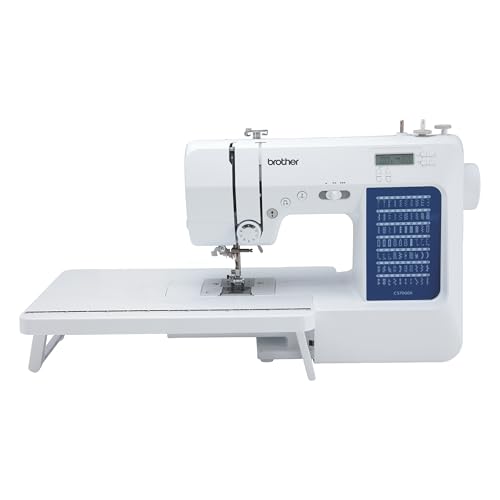
Brother CS7000X quilting machine, 70 stitches, 10 feet
70 stitches10 feetQuilt guideHard case
Check price on Amazon
Best for: Sewers who want the most feet and a quilt guide in the box.

Brother's CS7000X is the accessory-rich option, with ten feet, a quilt guide, a wide table and a hard case around a 70 stitch computerized core. For a sewer who buys feet one at a time, the box contents alone justify part of the price. The LCD and automatic needle threader keep the workflow smooth.

In this tier it plays the value role, since it costs less than the Singer and the XR9550 while delivering the same family of utility stitches. Against the Singer, it lacks heavy-duty power and the app. Against the XR9550, it has fewer stitches and more feet.

Ownership is routine. Change needles, brush lint and cover the machine. A hard case makes it easy to carry to classes. Use a surge protector and keep the manual handy for the stitch chart.

What works

  • Ten feet and a quilt guide in the box
  • Wide table and hard case for classes
  • LCD with automatic needle threader
  • Same utility stitch family as the XR9550

Watch out for

  • Only 70 stitches, which is modest at this tier
  • No heavy-duty motor or app control

Spec sheet

Stitches
70 built-in
Feet in box
10
Extras
Quilt guide, wide table
Display
LCD
Case
Protective hard case
04
Brother XR3774 quilting machine with wide table, 37 stitches
37 stitchesWide table8 feetMachine cover
Check price on Amazon
Best for: Quilters who want a wide table without a computerized interface.

Brother's XR3774 is the simple quilting machine in this tier, with 37 stitches, a wide table, eight feet and a machine cover. It is the least computerized choice here, which means fewer features and fewer parts to fail. The automatic threader and drop-in bobbin cover the basics.

Spending toward the cap rarely makes sense for this machine, because its stitch set matches far cheaper models and the main benefit is the table. Against the CS7000X, it has fewer stitches and no LCD. Against the Singer, it has no heavy-duty motor.

Upkeep follows the usual pattern. Keep the table seated, brush the bobbin area and change needles.

What works

  • Wide table supports bulky quilts
  • Eight feet cover many quilting tasks
  • Simple mechanical operation
  • Machine cover protects it in storage

Watch out for

  • 37 stitches is thin for this budget tier
  • No LCD or computerized stitch settings

Spec sheet

Stitches
37 built-in
Table
Wide extension
Feet in box
8
Threading
Automatic threader, drop-in bobbin
Cover
Machine cover

Spec sheet decoder

What the numbers on the box really mean

The specs manufacturers lead with, translated into what they tell you about real-world performance.

Stitch count

The count is the number of patterns in the library. Only a handful are used for most projects.

Watch forThe Singer lists 200 plus and the XR3774 lists 37.

App control

App control lets you operate or program the machine from a phone. It needs a wireless link and software updates.

Watch forOnly the Singer Smart HD 9120 lists app control.

Embroidery attachment

An attachment adds an embroidery arm to a sewing machine. It is usually sold separately and has a smaller field.

Watch forThe Singer lists a 900E attachment sold separately.

Feet included

Feet are attachments for specific tasks. More feet reduce extra purchases.

Watch forThe CS7000X includes 10 and the XR9550 includes 8.

Heavy-duty class

Heavy duty means a stronger motor and needle bar. The label is not standardized.

Watch forThe Singer is the heavy-duty model here.

Methodology

How We Evaluated These Sewing Machines Under $500

Power and build

We compared heavy-duty claims and body notes. The Singer led for power. The Brother machines scored for a proven build.

Library and controls

We compared stitch counts and interface types. The Singer's 200 plus stitches and app stood out. We weighed usefulness over count.

Workspace

We checked tables, guides and feet. The CS7000X's quilt guide and ten feet led. All Brother models include a wide table.

Upgrade path

We looked at embroidery options and connectivity. The Singer's 900E attachment was the only path. We noted that it is sold separately.

Support and warranty

We considered dealer networks and platform age. Brother scored for history, and the Singer's new platform scored cautiously. Computerized risks were noted.

Decision guide

How to Choose the Right Sewing Machines Under $500

By Sewing Goal

SituationPickWhy
Denim and thick layersSinger Smart HD 9120A heavy-duty motor and needle bar
Decorative and heirloom stitchingBrother XR9550165 stitches with an LCD
Quilting with many accessoriesBrother CS7000XTen feet, a quilt guide and a wide table
Simple quilting, no screenBrother XR3774A wide table with mechanical controls

By Budget

Budget tierPickWhy
Lowest outlayBrother XR3774A basic quilting machine with a table
MiddleBrother CS7000XThe most feet and a quilt guide
Top of the capSinger Smart HD 9120Heavy duty, app control and an upgrade path

Connected vs Classic Controls

Connected

The Singer Smart HD 9120 adds a phone app and over 200 stitches. It suits sewers who like digital workflows but adds software to maintain.

Classic

The Brother machines use an LCD or dials and no app. They are simpler and have long support histories.

Tech-minded sewers pick the Singer, and traditionalists pick the XR9550.

Upgrade Plans

PlanPickWhy
Add embroidery laterSinger Smart HD 9120A 900E attachment is available separately
Stay with sewing onlyBrother CS7000XA complete sewing and quilting kit
Add a walking footBrother XR9550A standard platform with wide accessory support
Keep it basicBrother XR3774Few parts and few features

For Quilting Specifically

Look for

A wide table, generous throat space, a walking foot and a quarter-inch foot. Accessory count matters more than stitch count.

In this comparison

The CS7000X has the quilt guide and ten feet. The XR9550 adds more stitches.

When to Spend More

Spend more if

You want embroidery or a large throat. A dedicated machine above this tier has a larger workspace and a stronger motor.

Save if

You sew garments and simple quilts. A cheaper Brother covers the job.

Ownership

Maintenance schedule

The upkeep that decides whether this machine lasts two seasons or ten.

TaskIntervalWhy it matters
Change the needleEvery 8 to 10 hoursDull needles skip stitches and strain the motor. Use denim needles on thick cloth.
Brush out lintEvery few bobbinsLint packs the feed dogs and hook. Use a brush, not canned air.
Update softwareWhen promptedApp-connected machines need current firmware. Updates fix bugs and add stitches.
Use a surge protectorAlwaysA power spike can damage a computerized board. A protector is cheap insurance.
Service the machineEvery 2 to 3 yearsA technician checks timing and tension. Regular service extends machine life.

FAQ

Frequently Asked Questions

Is an app-connected sewing machine worth it?

Only if you enjoy digital workflows. The app adds convenience and design options but also software to maintain. Make sure the machine works fully without the phone.

What budget should I plan for?

The machines here fit under the $500 cap at listing prices when the guide was updated, and prices move. The cap buys a heavy-duty body or a large stitch library. Add the cost of an embroidery attachment if you plan to use one, along with hoops, stabilizer and design software, which together can rival the price of a mid-range machine. A realistic budget for a serious sewer also includes a walking foot, a quarter-inch foot, a good light, a rotary cutter and mat, and a few hours of a class or video lessons. If you plan to sew thick fabric, consider a heavier needle set and a hump jumper for seams. Finally, set aside a small amount for a service visit every two or three years, because a clean, correctly timed machine sews better than a newer one that has never been maintained, and the cost of a tune-up is small compared with the price of a replacement.

How long do these machines last?

A well-kept machine can run for a decade or more with needle changes, cleaning and periodic service. Computerized boards fail more often than mechanical parts. Brother parts are widely stocked, and a machine with a deep parts pipeline keeps its resale value, which matters if you upgrade later. The wear items are the same on every model: the needle plate and feed dogs scratch from pins, the belt or motor brushes eventually age, and a computerized board can fail from a power spike. Lubrication needs vary, with some modern machines sealed and others needing a drop of oil at the hook, so follow the manual exactly. A machine used weekly and serviced every two years is a long-term tool, while the same machine left in a damp garage with a sagging cover can seize in a few seasons. Store it in a dry room, keep it covered and avoid extreme temperature swings, because condensation inside a computerized unit does lasting damage. If you ever sell it, a service record and the original accessories lift the price noticeably.

Can I do real embroidery on a sewing machine?

With an attachment, yes, but the field is small and you need stabilizer, a hoop and design files. A dedicated embroidery machine has a larger field and better software. Price the attachment before you count on it.

Which machine is best for denim?

The heavy-duty Singer Smart HD 9120, with a denim needle and a slow speed. The Brother machines handle light denim only. Test thick seams on scraps, slow the speed over seam crossings and let the needle do the work instead of pushing the fabric, because pulling thick layers bends needles and throws off timing.

How many stitches do I really need?

Most sewers use fewer than twenty. Utility stitches, a buttonhole and a good feed system matter more than a long menu. Buy variety only for decorative work. A sensible way to decide is to list the projects you plan in the next year and note the stitches each one needs: hems need a straight and a blind hem stitch, stretch fabric needs a stretch stitch or a narrow zigzag, and garments need a good buttonhole. If that list fits on a postcard, a mid-sized library is plenty, and the rest of the budget is better spent on feet, a walking foot, a quality table and a service visit. Decorative stitches are fun for borders, kids' clothes and gifts, but many owners admit they use the same handful every time. Another trap is chasing the biggest number on the box, because stitch counts are inflated by variations in width and length that count as separate patterns. Look instead at how many useful utility stitches the machine offers and how easy it is to find and adjust them on the screen.

Bottom line

The short version

Browse more sewing machines under $500on Amazon →
James Miller, Lead Machine Editor

About the author

James Miller

Lead Machine Editor, MachineFanatic

James Miller leads MachineFanatic's buying guides, turning spec sheets, manuals and owner feedback into clear verdicts on power tools, outdoor power equipment, shop machines and kitchen machines.

More from James →

Keep reading

Related guides