
Amazon affiliate links - we earn a commission.Affiliate disclosure

Buying guide · 13 min read · Updated 2026-11-07

Best Shallow Well Pumps (2026)

Six shallow well jet pumps compared by suction lift, voltage, pressure tank, cast iron versus stainless and single pipe versus convertible setups.

James MillerBy James MillerLead Machine Editor6 machines comparedSpec-sheet verified
Best Shallow Well Pumps

At a glance

Our top picks

Side by side

Spec comparison

A shallow well pump is a surface machine. It lives in a basement, pump house or shed, and it pulls water up a suction pipe from a well that is not far below ground. The limit is atmospheric pressure, which can push water up a suction line only so far, so the whole category is defined by how close the water is to the pump.

Within that limit, the choices are about build, voltage, motor size and what comes with the pump. Some are cast iron workhorses for a house well, some are stainless garden boosters with a pressure tank bolted on. This guide separates them by what they are actually good at and what ownership looks like. Treat any listing that promises a deep well from a surface pump with suspicion.

Before you buy

6 Criteria to Look For Before Buying a Shallow Well Pump

  1. 01

    The 25 foot limit

    A jet pump pulls water up a suction line, and atmospheric pressure caps that lift at roughly 25 feet in practice. The Red Lion RJS-100-PREM and RJS-75-PREM are rated for wells down to 25 feet. If your water sits deeper, you need a convertible setup like the Acquaer or a submersible. Measure the static water level with a weighted tape before you shop, and remember that the level can fall in a dry summer.

  2. 02

    Single pipe or two pipe

    A single-pipe shallow system uses one suction line. A two-pipe deep-set jet uses a drive line and a suction line to an ejector in the well. The Acquaer covers 0 to 25 feet single pipe and 26 to 90 feet two pipe, which makes it adaptable. A two-pipe system also needs a packer or well seal and a drive pipe, which adds cost and time to an install.

  3. 03

    Cast iron or stainless

    Cast iron on the Red Lion and VEVOR 1 HP is rugged and quiet. Stainless on the Aquastrong and the VEVOR 1.6 HP resists corrosion. In a damp pump house, stainless ages better; for heavy duty, cast iron wins. Stainless parts can still corrode in water with high chlorides, so test your water before assuming.

  4. 04

    Pressure tank

    A pump with no tank turns on and off with every faucet draw. The VEVOR 1.6 HP includes a 5 gallon tank; the Red Lion needs a separate tank. Size the tank for the demand, since a small tank cycles often. A larger tank rests the pump longer, which extends motor and switch life.

  5. 05

    Voltage and current

    The Red Lion and Acquaer run on 115 or 230 volts. 230 V draws half the current, which helps on long runs. Check your panel and set the motor voltage correctly before powering up. Mixing up the voltage setting is a quick way to burn a motor, so double check the label before powering on.

  6. 06

    Priming and leaks

    A jet pump must be primed. One leaking fitting on the suction side lets in air and breaks the prime. Use thread sealant, a foot valve and test the line before burying it. Run the pump for a few minutes after priming to confirm it holds pressure with no drips on the suction side.

Detailed reviews

The 6 best shallow well pumps, explained

01
Red Lion RJS-100-PREM 1 HP cast iron shallow well jet pump
1 HP23 GPM25 ft well115/230 V
Check price on Amazon
Best for: A house on a shallow dug or driven well with the water within 25 feet.

The RJS-100-PREM is the traditional answer for a house on a shallow well. A cast iron casing and volute provide rigidity and long life, a glass-filled thermoplastic impeller resists wear, and a motor that runs on 115 or 230 volts lets you match your supply. The 1-1/4 inch FNPT suction intake keeps friction low on the pull from the well.

It is rated for 23 GPM and for wells down to 25 feet. That limit is a physical one. A jet pump that sits above the water cannot lift it more than the atmosphere allows, so beyond roughly 25 feet you need a convertible setup or a submersible. Compared with the RJS-75-PREM at 3/4 HP and 16 GPM, the 1 HP unit moves roughly 44 percent more water and handles a household better.

Ownership means keeping the suction side airtight, because a single leaking fitting breaks the prime. Fit a foot valve, prime the pump through the plug, and check the pressure tank and switch yearly. A jet pump is easy to service since everything is above ground, which is a real advantage over a submersible. Keep a spare pressure switch and foot valve on the shelf, and drain the pump before a hard freeze.

What works

  • Cast iron casing and volute
  • Selectable 115 or 230 V motor
  • 23 GPM for household demand
  • Easy above-ground service

Watch out for

  • Hard limit at about 25 ft of lift
  • Needs priming and a foot valve
  • Louder than a submersible

Spec sheet

Motor
1 HP, selectable 115 or 230 V
Flow
23 GPM
Well depth
Down to 25 ft
Casing
Cast iron casing and volute
Impeller
Glass-filled thermoplastic
Suction
1-1/4 inch FNPT
02
Red Lion RJS-75-PREM 3/4 HP cast iron shallow well jet pump, 16 GPM
3/4 HP16 GPM25 ft well115/230 V
Check price on Amazon
Best for: A cabin or small home with a shallow well and light demand.

The RJS-75-PREM is the smaller sibling of the RJS-100: the same cast iron casing, thermoplastic impeller and selectable voltage, with a 3/4 HP motor and a 16 GPM rating. It suits a small household, a cabin or a seasonal home.

A smaller motor draws less current, and for a modest demand of one or two fixtures at a time it is enough. The tradeoff is the volume: running a shower, a washing machine and a hose at once can overwhelm 16 GPM and drop the pressure.

It shares the same prime, foot valve and pressure tank maintenance as the 1 HP unit. If you are unsure, the RJS-100 gives headroom at a modest extra cost. If your demand grows, you can swap it for the 1 HP model without changing the pipe, because the suction and discharge connections match. Check the voltage setting after any swap.

What works

  • Same cast iron build as the 1 HP unit
  • Lower current draw
  • Selectable voltage
  • 1-1/4 inch FNPT suction

Watch out for

  • 16 GPM limits simultaneous use
  • 25 ft depth limit
  • Needs priming and a foot valve

Spec sheet

Motor
3/4 HP, selectable 115 or 230 V
Flow
16 GPM
Well depth
Down to 25 ft
Casing
Cast iron
Suction
1-1/4 inch FNPT
03
Acquaer shallow/deep well convertible jet pump with ejector kit
Cast iron0-25 or 26-90 ft115/230 VEjector kit
Check price on Amazon
Best for: Wells that may turn out deeper than 25 feet or fluctuate seasonally.

The Acquaer is a cast iron jet pump that comes with an ejector kit and can be set up two ways: a single pipe for wells from 0 to 25 feet and a two-pipe system with the ejector in the well for 26 to 90 feet. That flexibility is the reason to pick it, since it covers both ranges with a single pump.

It runs on 115 or 230 volts, with a factory setting of 230, and has automatic thermal overload protection that shuts the motor down before it burns. A two-pipe install uses a drive line and a suction line, so it costs more in pipe and takes longer to plumb than a single-pipe setup.

It is the safe choice if your water level is uncertain or seasonal. Compared with the RJS-100, it gives up some brand pedigree for versatility. Check that your well casing can take two pipes and a packer before you commit. A two-pipe setup also lets you adjust the jet nozzle size to the well, so do not skip the manual when you set the ejector. A mismatched nozzle will waste the motor and deliver poor pressure.

What works

  • Works on shallow and 26 to 90 ft wells
  • Includes an ejector kit
  • Thermal overload protection
  • 115/230 V motor

Watch out for

  • Two-pipe install is more work
  • Less brand history than Red Lion
  • Factory set to 230 V

Spec sheet

Type
Convertible jet pump with ejector kit
Single pipe
Wells 0 to 25 ft
Two pipe
Wells 26 to 90 ft
Voltage
115/230 V, factory set 230 V
Protection
Automatic thermal overload
04
VEVOR 1 HP cast iron shallow well jet pump 115 V, 17.6 GPM
1 HP17.6 GPMCast ironPressure switch
Check price on Amazon
Best for: Garden and irrigation use with a shallow source.

The VEVOR 1 HP is a cast iron jet pump rated for 17.6 GPM with a built-in pressure switch that turns the pump on and off with the faucet. It is aimed at garden and agricultural irrigation, where a shallow source needs to be moved under pressure.

Setup is simple: select the voltage, plug it in and attach the matching hoses. At 17.6 GPM it moves less than the Red Lion 1 HP at 23 GPM but more than the 3/4 HP unit at 16 GPM.

It is a good low-cost choice for irrigation and light household use. Confirm priming procedure and the pressure switch settings, and keep an eye on the suction fittings for air leaks. Treat it as a tool for watering and seasonal use more than whole-house service, and check the supplier about warranty before you rely on it for a year-round supply.

What works

  • Cast iron body at a low cost
  • Pressure switch built in
  • Simple plug-in setup
  • 17.6 GPM rated flow

Watch out for

  • Less flow than the Red Lion 1 HP
  • Aimed at irrigation, not whole-house use
  • Brand support is limited

Spec sheet

Motor
1 HP, 115 V selectable
Flow
17.6 GPM
Body
Cast iron
Control
Smart pressure switch
Use
Garden and agricultural irrigation
05
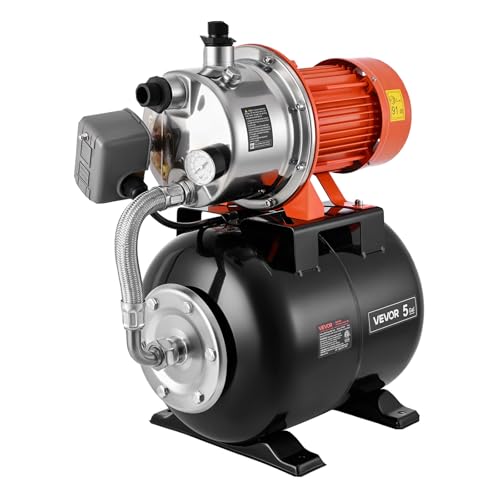
VEVOR 1.6 HP shallow well pump with 5 gallon tank, 1,320 GPH
1.6 HP1,320 GPH5 gal tank304 stainless
Check price on Amazon
Best for: Garden, cabin or booster use where a tank is included.

The VEVOR 1.6 HP comes with a 5 gallon pressure tank, which reduces cycling and extends pump life. It delivers up to 1,320 GPH, about 22 GPM, with a 164 foot maximum head, and its pump head is thick 304 stainless steel.

The tank is small compared with a household tank, so it suits a garden, cabin or booster application, not a full house with several fixtures running. Stainless resists corrosion in a damp pump house but is not a substitute for a long suction pipe's limits.

It is the easiest to set up since the tank is included. Check the pre-charge pressure and keep the suction line airtight. Because the tank is only 5 gallons, expect more frequent cycles than a conventional tank would give, so watch the pump for heat and noise in the first month.

What works

  • 5 gallon tank included reduces cycling
  • 304 stainless steel pump head
  • 1,320 GPH rated flow
  • Automatic pressure system

Watch out for

  • Tank is small for household use
  • Max head is a zero-flow figure
  • Still limited by suction lift

Spec sheet

Motor
1.6 HP, 120 V
Flow
1,320 GPH (about 22 GPM)
Max head
164 ft
Tank
5 gallon pressure tank
Head
304 stainless steel
06
Aquastrong 1.6 HP shallow well pump, stainless steel, 1,320 GPH
1.6 HP1,320 GPHNSF certified20/40 psi switch
Check price on Amazon
Best for: Shallow wells where certified materials matter.

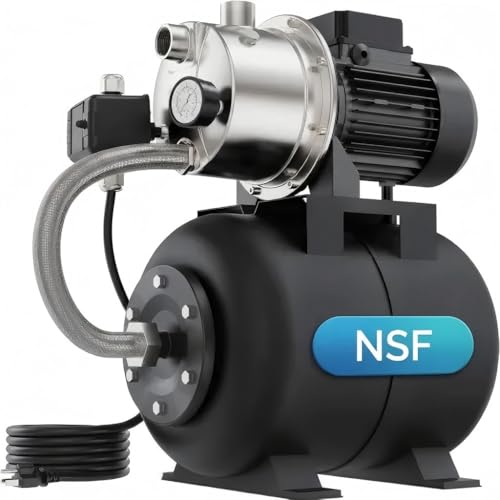
The Aquastrong 1.6 HP is a stainless steel shallow well jet pump with a capacitor motor, an automatic pressure switch and NSF certification of its materials. The switch starts the pump at 20 psi and shuts it off at a higher set point.

NSF certification matters if the pump handles water you drink, since it addresses what leaches from the materials. At 1,320 GPH it matches the VEVOR 1.6 HP on paper, but it does not ship with a tank.

It is a clean, stainless choice for a shallow well where water quality matters. Add a pressure tank, keep the suction line sealed and verify the switch settings. Add a larger tank if you want long rest periods between cycles, since cycles are what wear a pressure switch and a motor.

What works

  • NSF certified materials
  • Stainless steel body
  • 1.6 HP capacitor motor
  • Automatic pressure switch

Watch out for

  • No tank included
  • Still limited to shallow lift
  • Needs a separate tank for household use

Spec sheet

Motor
1.6 HP capacitor, 115 V
Flow
1,320 GPH
Body
Stainless steel
Certification
NSF certified materials
Pressure switch
Starts at 20 psi

Spec sheet decoder

What the numbers on the box really mean

The specs manufacturers lead with, translated into what they tell you about real-world performance.

Suction lift

How far the pump can pull water, capped at about 25 ft. Elevation lowers it, so a pump at altitude lifts less than one at sea level.

Watch forThe Red Lion lists wells down to 25 ft.

Ejector

A venturi device in a two-pipe system that boosts lift. The nozzle size controls the balance of flow and pressure.

Watch forThe Acquaer includes an ejector kit.

GPM vs GPH

GPH divided by 60 equals GPM. Use GPM when comparing against your peak household demand.

Watch forThe VEVOR 1.6 HP lists 1,320 GPH, about 22 GPM.

NSF

A certification of material safety for drinking water contact.

Watch forThe Aquastrong lists NSF certified materials.

Pressure switch

A device that starts and stops the pump at set pressures.

Watch forThe Aquastrong starts at 20 psi.

Methodology

How We Evaluated These Shallow Well Pumps

Match to the well

We compared each pump's depth rating against typical shallow wells. The Red Lion pumps list 25 ft, the Acquaer extends to 90 ft with an ejector. We noted that a pump which cannot reach your water is a failure no matter how well made.

Build and corrosion

We weighed cast iron against stainless in damp pump houses. Water chemistry decides which material lasts.

Flow for the household

We compared 16 GPM, 17.6 GPM, 22 GPM and 23 GPM across the lineup. We treated a household of four as needing roughly 15 to 20 GPM at peak.

Included equipment

We counted what is in the box, such as the VEVOR 1.6 HP's 5 gallon tank. Extras such as a tank change the real cost.

Service

We favored pumps that are simple to prime, drain and service.

Decision guide

How to Choose the Right Shallow Well Pumps

By Well Depth

SituationPickWhy
Water within 25 ftRed Lion RJS-100-PREMCast iron, 23 GPM
Water might be 26 to 90 ftAcquaer convertibleEjector kit included
Small cabinRed Lion RJS-75-PREM16 GPM, lower draw
Garden and irrigationVEVOR 1 HP17.6 GPM with switch
Tank includedVEVOR 1.6 HP5 gallon tank
Seasonal low waterAcquaer convertibleSwitch to two-pipe if the level drops

By Budget

TierPickWhy
LowestVEVOR 1 HPCast iron at a low cost
LowVEVOR 1.6 HP with tankTank included
MidAquastrong 1.6 HPNSF stainless
UpperAcquaer convertibleTwo setups in one
PremiumRed Lion RJS-100-PREMBrand cast iron

Cast Iron vs Stainless

Cast iron

The Red Lion pumps and the VEVOR 1 HP are rugged and quiet. Choose these for a house well.

Stainless

The Aquastrong and VEVOR 1.6 HP resist corrosion. Choose these for a damp pump house or garden use.

Cast iron for the house, stainless for damp spots.

Tank

PreferencePickWhy
Tank in the boxVEVOR 1.6 HP5 gallon tank
Add your own tankRed Lion RJS-100-PREMSized to your demand
Cycle lessAquastrong 1.6 HPPair with a larger tank
FlexibleAcquaer convertibleStandard tank fits

For Whole-House Use Specifically

Look for

At least 20 GPM, a cast iron body, a proper pressure tank and a switch set to a standard range. A household of four typically wants 15 to 20 GPM at peak, plus a tank sized to avoid constant cycling.

In this comparison

The Red Lion RJS-100-PREM at 23 GPM and the VEVOR 1.6 HP at about 22 GPM fit best.

When to Spend More

Spend more if

The pump serves a full house. The Red Lion RJS-100-PREM is the proven option.

Save if

It is for irrigation or a cabin. The VEVOR 1 HP is enough.

Ownership

Maintenance schedule

The upkeep that decides whether this machine lasts two seasons or ten.

TaskIntervalWhy it matters
Check suction fittingsEach springOne air leak breaks the prime. Soap-water on the joints shows a leak as bubbles.
Check tank air chargeYearlyA waterlogged tank cycles the pump. Use a tire gauge with the pump off and the tank drained.
Inspect pressure switchYearlyPitted contacts cause failures. Replace the switch every few years in heavy use as a cheap preventive step.
Drain before freezingEach fallFrozen water cracks a pump casing. Open a drain plug and leave it out over winter.
Clean the foot valve screenYearlySilt blocks the intake. A clean screen also protects the impeller from grit that would otherwise erode it.

FAQ

Frequently Asked Questions

How deep can a shallow well pump work?

About 25 feet from the pump to the water, because atmospheric pressure limits suction lift. Altitude lowers this limit slightly.

What if my water is deeper than 25 feet?

Use a convertible jet with an ejector, like the Acquaer, for up to about 90 feet, or a submersible pump. A pro can measure your static level and recommend the right setup for the depth.

Do I need a pressure tank?

Yes for household use. Without one, the pump cycles on every draw. A tank also reduces the wear on the switch and motor.

115 V or 230 V?

230 V draws half the current and suits longer runs. Set the motor voltage to match your supply. If you are unsure, an electrician can confirm what your panel can supply before you wire the motor.

Why does my pump lose prime?

Usually an air leak in the suction line or a failed foot valve. A leaking fitting on the suction side is easy to miss, so test with soap water.

Cast iron or stainless?

Cast iron for the house and stainless for damp pump houses or garden use. Both work for years if the pump house stays dry.

Bottom line

The short version

Browse more shallow well pumpson Amazon →
James Miller, Lead Machine Editor

About the author

James Miller

Lead Machine Editor, MachineFanatic

James Miller leads MachineFanatic's buying guides, turning spec sheets, manuals and owner feedback into clear verdicts on power tools, outdoor power equipment, shop machines and kitchen machines.

More from James →

Keep reading

Related guides