
Amazon affiliate links - we earn a commission.Affiliate disclosure

Buying guide · 13 min read · Updated 2026-11-07

Best Well Pumps (2026)

Six well pumps compared across deep well submersible and shallow jet designs by head, flow, voltage, motor size and what each does to your pressure tank.

James MillerBy James MillerLead Machine Editor6 machines comparedSpec-sheet verified
Best Well Pumps

At a glance

Our top picks

Side by side

Spec comparison

A well pump is the machine between you and your water supply, and the right one depends almost entirely on the well, not on the shopper. How far down the water sits, how far it must be lifted to the house, how wide the casing is and what voltage your panel offers narrow the field before any brand comparison begins.

There are two main designs. Submersible pumps live in the well and push water up. Jet pumps sit at the surface and pull it up, which limits them to shallow wells. This guide sorts both by head, flow, voltage and ownership, because the cheapest pump that does not match the well is the most expensive one.

Before you buy

6 Criteria to Look For Before Buying a Well Pump

  1. 01

    Know your well first

    Total dynamic head is the depth to water, plus the lift from the wellhead to the house, plus pipe friction, plus the pressure you want at the tap. A well with water at 150 feet and a house 30 feet higher already needs a pump rated well beyond 207 feet to give useful flow. Write down the numbers before you shop, because the supplier will ask for them and a mismatch is expensive to fix once the pump is down the hole.

  2. 02

    Submersible or jet

    Jet pumps like the Red Lion RJS-100-PREM sit above ground and work only to about 25 feet of suction lift. Deep well submersibles like the VEVOR and Hallmark live in the well and push water up. Choose by water depth, not preference. A jet pump on a well deeper than about 25 feet will never lift water, no matter how big the motor is, because atmospheric pressure sets the limit.

  3. 03

    Voltage and current

    230 volt pumps like the Hallmark draw half the current of a 115 volt pump, which reduces voltage drop on long cable runs. A 1.5 HP pump on 115 volts, like the VEVOR, draws heavy current at start. Check your panel before you choose. Ask an electrician whether the existing wire gauge can carry a 1.5 HP load at 115 volts over the distance from the panel to the wellhead.

  4. 04

    Casing diameter

    The VEVOR, Hallmark and ECO-WORTHY submersibles are about 4 inches across or less, so they need a 4 inch or wider casing. Measure the casing before ordering, and allow clearance for a safety rope and drop pipe. A pump jammed in a crooked casing is a costly pull, so also confirm the casing is plumb.

  5. 05

    Flow versus head

    A pump rated 37 GPM and 276 feet cannot do both at once. As head rises, flow falls to zero at the maximum head. Read the pump curve at your total dynamic head. For example, the 1 HP VEVOR is rated for 37 GPM but only 207 feet, so at 150 feet of head it delivers much less than its maximum.

  6. 06

    Pressure tank and control

    A pump that runs on every faucet draw cycles constantly and burns out. A pressure tank and switch cut cycling. Many 115 V submersibles need a control box, so check what the pump needs. A tank sized for roughly one minute of pump run time between cycles is a common guide.

Detailed reviews

The 6 best well pumps, explained

01
VEVOR deep well submersible pump 1.5 HP 115 V, 37 GPM, 276 ft head
1.5 HP37 GPM276 ft head115 V
Check price on Amazon
Best for: A 4 inch drilled well with a mid-depth water table on a 115 V circuit.

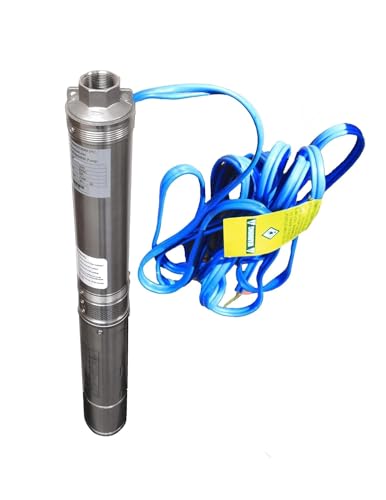
The 1.5 HP VEVOR is a 4 inch deep well submersible built for casings 4 inches or wider. It runs on 115 volts, which makes it a good fit for homes without a 230 volt well circuit, and it is rated for 37 GPM with a 276 foot maximum head. The stainless steel frame and copper motor are the build highlights.

The 276 foot figure is the head at which flow reaches zero. For a domestic well, what matters is the flow at your total dynamic head, which is the water depth plus the lift to the house plus pipe friction plus the pressure you want at the tap. Compared with the 1 HP VEVOR at 207 feet and 37 GPM, the 1.5 HP buys 69 more feet of head at the same peak flow.

Ownership is mostly about the pressure system. Pair it with a correctly sized pressure tank and a pressure switch, wire in a control box if one is needed, and fit a check valve above the pump. Expect to pull it with a rope and a tripod years from now, which is a job for a pro in deeper wells. When the pump eventually fails, the symptoms are usually a drop in pressure, a pump that runs without filling the tank, or a tripped breaker. A pro can pull it, test the motor windings and replace the drop pipe if needed, so keep records of the install depth and the wire gauge.

What works

  • 1.5 HP on 115 V avoids 230 V wiring
  • 276 ft stated head suits mid-depth wells
  • Stainless steel frame resists corrosion
  • Copper motor winding

Watch out for

  • Needs a 4 inch or larger casing
  • Head figure is a zero-flow value
  • Higher current draw on 115 V

Spec sheet

Motor
1.5 HP, 115 V copper
Flow
37 GPM max
Head
276 ft max
Casing
4 inch or larger
Discharge
1-1/4 inch NPT
02
Hallmark Industries MA0419X-12A 2 HP 230 V deep well pump, 420 ft
2 HP35 GPM420 ft head230 V
Check price on Amazon
Best for: Deep wells and larger households that need more head and flow.

The Hallmark MA0419X-12A is a 2 HP, 230 volt stainless steel deep well pump rated for 35 GPM and a 420 foot maximum head. That head rating is the highest in this group, which is why it suits deep wells where the water sits hundreds of feet down.

A 230 volt supply draws half the current of a 115 volt pump of the same power, which means lighter wiring, cooler motor operation and less voltage drop on a long run from the panel. If your well is deep, the voltage drop on a long cable can reduce pump performance significantly, so the 230 volt design is more than a convenience.

It costs more than the VEVOR pumps and the listing offers little detail beyond the headline specs, so confirm the motor type and the control box requirements with the supplier. The tradeoff is a pump built for a harder job. A good habit is to record the static water level and the pumping level when the pump is first installed, because a later drop in the water table is the cause of many pump complaints that look like pump failure.

What works

  • 420 ft stated head leads the group
  • 230 V draws less current than 115 V
  • Stainless steel construction
  • 2 HP motor for heavy demand

Watch out for

  • Needs a 230 V circuit and likely a control box
  • Costs more than the imports
  • Sparse detail in the listing

Spec sheet

Motor
2 HP, 230 V
Flow
35 GPM max
Head
420 ft max
Build
Stainless steel
Role
Deep well submersible
03
VEVOR deep well submersible pump 1 HP 115 V, 37 GPM, 207 ft head
1 HP37 GPM207 ft head115 V
Check price on Amazon
Best for: Shallower drilled wells with modest lift and a 115 V supply.

The 1 HP VEVOR is the lower-powered sibling of the 1.5 HP model: the same stainless steel frame, copper motor and 4 inch diameter, rated for 37 GPM but only 207 feet of head. It runs on 115 volts and a 1-1/4 inch NPT discharge connects to standard pipe.

For a well where the water level and the lift to the house add up to well under 200 feet, this is plenty of pump, and it draws less than the 1.5 HP unit. It is the value choice in a class where horsepower is the main driver of both price and performance.

Compared with the Hallmark 2 HP at 420 feet, it is a lighter-duty machine. Match it to the well's total dynamic head and size the pressure tank so the pump does not short cycle. A lower-powered pump also runs cooler in a well with a shallow water level, since the motor is cooled by the water flowing past it.

What works

  • Lower cost than the 1.5 HP model
  • Stainless steel frame
  • 1-1/4 inch NPT discharge
  • 115 V operation

Watch out for

  • 207 ft head limits deeper wells
  • Needs a 4 inch or larger casing
  • Zero-flow head figure

Spec sheet

Motor
1 HP, 115 V copper
Flow
37 GPM max
Head
207 ft max
Casing
4 inch or larger
Discharge
1-1/4 inch NPT
04
Deep well submersible pump 1 HP 230 V, 33 GPM, 207 ft head
1 HP230 V33 GPM207 ft head
Check price on Amazon
Best for: A 4 inch well with a 230 V circuit and moderate head.

This 4 inch deep well pump pairs a 1 HP motor on 230 volts with a stainless steel body and a heavy duty thermoplastic discharge, rated for 33 GPM and 207 feet. It is described as industrial grade and suitable for home use.

Running on 230 volts halves the current compared with a 115 volt 1 HP pump, so the wiring stays cooler and cheaper. Against the VEVOR 1 HP at 37 GPM and the same 207 foot head, it moves slightly less water on paper in return for the more efficient supply voltage.

It suits a well where you have a 230 volt circuit available. Check what control box or start capacitor it needs, and treat the listing as a starting point and confirm details with the supplier. Because the listing is short, get the control box requirements and the wire gauge in writing before you commit.

What works

  • 230 V halves running current
  • Stainless steel body
  • Thermoplastic discharge resists corrosion
  • Industrial-grade description

Watch out for

  • Brand support is unclear
  • 33 GPM is slightly under the VEVOR
  • Needs 230 V wiring

Spec sheet

Motor
1 HP, 230 V
Flow
33 GPM max
Head
207 ft max
Casing
4 inch
Build
Stainless steel with thermoplastic discharge
05
Red Lion RJS-100-PREM 1 HP cast iron shallow well jet pump, 23 GPM
1 HP23 GPM25 ft well115/230 V
Check price on Amazon
Best for: Shallow dug or driven wells with the water within 25 feet.

The RJS-100-PREM is a surface-mounted jet pump built for wells shallower than about 25 feet. It has a cast iron casing and volute with a glass-filled thermoplastic impeller, a 1-1/4 inch FNPT suction intake and a motor that runs on either 115 or 230 volts, selected to match the supply.

A jet pump sits in a pump house or basement and pulls water up the suction line. That works only to a limit set by atmospheric pressure, which is why this pump is rated for wells down to 25 feet. Unlike a submersible, it is easy to service since the motor is above ground.

Compared with the submersibles in this guide, it moves 23 GPM and cannot reach deep water. It suits a dug or driven well with the water close to the surface. Prime it, check suction line fittings for air leaks and fit a foot valve. Keep a spare pressure switch and a foot valve on the shelf, since those two parts cause most service calls on a jet pump.

What works

  • Cast iron casing and volute
  • Selectable 115 or 230 V motor
  • Easy above-ground service
  • 1-1/4 inch FNPT suction

Watch out for

  • Limited to wells within about 25 ft
  • Needs priming and a foot valve
  • Louder than a submersible

Spec sheet

Motor
1 HP, 115/230 V selectable
Flow
23 GPM
Well depth
Down to 25 ft
Body
Cast iron casing and volute
Impeller
Glass-filled thermoplastic
Suction
1-1/4 inch FNPT
06
ECO-WORTHY 12 V DC submersible deep well pump, 3.2 GPM, 230 ft head
12 V DC3.2 GPM230 ft head3.86 inch dia.
Check price on Amazon
Best for: Off-grid cabins, livestock and solar-powered storage tanks.

The ECO-WORTHY is a different animal: a small 12 volt DC submersible rated for 3.2 GPM with a 230 foot maximum head, built to run from solar panels or batteries. A 304 stainless steel body with IP65 waterproofing and a 3.86 inch diameter lets it fit a standard 4 inch well.

At 3.2 GPM it moves a fraction of what the 115 volt pumps do, which is fine for livestock, a cabin or a garden tank but not for a household with showers and a washing machine running. It fills a storage tank slowly and steadily, which is the right use for off-grid solar.

Compared with the 37 GPM VEVOR pumps, it is a trickle, but one that needs no generator. Pair it with an adequate panel and a storage tank. Solar-pumped systems are best sized by the daily volume you need, then adding a storage tank so cloudy days do not leave you dry.

What works

  • 12 V DC runs from solar or batteries
  • 304 stainless steel IP65 body
  • Fits a 4 inch well
  • 230 ft rated head

Watch out for

  • 3.2 GPM is far too slow for a full household
  • Needs panels and a tank
  • Not for pressurized household use

Spec sheet

Power
12 V DC, solar compatible
Flow
3.2 GPM max
Head
230 ft max
Body
304 stainless steel, IP65
Diameter
3.86 inches

Spec sheet decoder

What the numbers on the box really mean

The specs manufacturers lead with, translated into what they tell you about real-world performance.

Max head

The height at which flow reaches zero, not a working point. Real delivery at a working head is always lower.

Watch forThe Hallmark lists 420 ft; useful flow occurs far below that.

GPM

Gallons per minute at the pump's best flow. Flow falls as head increases.

Watch forThe VEVOR lists 37 GPM, the ECO-WORTHY only 3.2 GPM.

Voltage

The supply the motor needs; 230 V halves current.

Watch forThe Red Lion is selectable between 115 and 230 V.

Suction lift

How far a surface pump can pull water, limited to about 25 ft.

Watch forThe Red Lion is rated for wells down to 25 ft.

IP65

A dust-tight, water-jet-resistant rating.

Watch forThe ECO-WORTHY lists IP65.

Methodology

How We Evaluated These Well Pumps

Match to the well

We compared each pump's head and casing size against typical wells. The Hallmark's 420 ft stands apart from the 1 HP pumps at 207 ft.

Power and voltage

We weighed 115 V convenience against 230 V efficiency. The VEVOR 1.5 HP at 115 V and the Hallmark 2 HP at 230 V represent the two approaches.

Build

We compared stainless steel frames, copper motors and cast iron casings. A stainless steel frame resists the sand and iron in many wells better than a plastic one.

Flow and head honesty

We treated max head as a zero-flow ceiling and looked at flow at a working head. The VEVOR 1.5 HP and the 1 HP differ by 69 feet of head at the same peak flow.

Supporting equipment

We counted what each pump needs, such as a control box, tank or pressure switch.

Decision guide

How to Choose the Right Well Pumps

By Well Depth

SituationPickWhy
Water within 25 ftRed Lion RJS-100-PREMCast iron jet pump
Mid-depth, 115 V onlyVEVOR 1.5 HP276 ft head on 115 V
Moderate depth, light demandVEVOR 1 HP207 ft head at lower cost
Very deep wellHallmark 2 HP420 ft head on 230 V
Off-grid solarECO-WORTHY 12 V3.2 GPM from panels

By Budget

TierPickWhy
LowVEVOR 1 HPLowest cost deep well
Lower mid1 HP 230 V pump230 V efficiency
MidVEVOR 1.5 HPMore head
UpperRed Lion RJS-100-PREMCast iron brand jet pump
PremiumHallmark 2 HP420 ft head

Submersible vs Jet

Submersible

The VEVOR and Hallmark pumps sit in the well and push water up. They handle deep wells and are quieter.

Jet

The Red Lion RJS-100-PREM sits above ground and is easy to service but limited to about 25 ft.

Submersible for deep wells, jet for shallow ones.

By Voltage

SupplyPickWhy
115 V onlyVEVOR 1.5 HPHighest head on 115 V
230 V availableHallmark 2 HPHalf the current
Both possibleRed Lion RJS-100-PREMSelectable voltage
12 V solarECO-WORTHYDC supply

For Household Pressure Specifically

Look for

A pump with at least 20 GPM, a pressure tank sized for the pump, and a pressure switch. A household needs steady pressure, not just flow.

In this comparison

The VEVOR 1.5 HP at 37 GPM and the Hallmark at 35 GPM meet that, while the ECO-WORTHY does not.

When to Spend More

Spend more if

The well is deep or the household is large. The Hallmark 2 HP is built for that.

Save if

The well is shallow or the load is light. The VEVOR 1 HP is enough.

Ownership

Maintenance schedule

The upkeep that decides whether this machine lasts two seasons or ten.

TaskIntervalWhy it matters
Check tank pressureYearlyA waterlogged tank makes the pump cycle constantly. Check air pressure with a gauge. Do it with the tank empty and the pump off.
Inspect pressure switchYearlyPitted contacts cause failures. Replace if burned.
Check for air leaksEach springJet pumps lose prime from a leaky suction fitting. Tighten every fitting and replace worn gaskets.
Test waterYearlySand or iron shortens pump life. Check the water quality. A sediment filter at the tank protects fixtures too.
Pull and inspectEvery 8 to 10 yearsSubmersibles wear out quietly. Plan a pro to pull and check it.

FAQ

Frequently Asked Questions

How do I know which size well pump I need?

Measure the water depth and the lift to the house, add friction and desired pressure, and match that total dynamic head and your flow need to a pump curve.

Submersible or jet pump?

Submersible for deep wells, jet for shallow wells of about 25 feet or less. Jets are easier to service. Check the casing diameter and the water level before deciding.

Can I use a 115 V pump on a deep well?

For moderate depths yes, but a 230 V pump draws half the current and suits longer cable runs and deeper wells.

Why does my pump cycle constantly?

Usually a waterlogged pressure tank or a leaking check valve. Check the tank air pressure first. A failing check valve at the pump can also cause cycling.

What size casing do I need?

Most deep well submersibles are about 4 inches across and need a 4 inch or larger casing.

How long does a well pump last?

Many last a decade or more, depending on water quality and cycling. A proper tank extends life. Sand, iron and a poor pressure tank are the usual shorteners of life.

Bottom line

The short version

Browse more well pumpson Amazon →
James Miller, Lead Machine Editor

About the author

James Miller

Lead Machine Editor, MachineFanatic

James Miller leads MachineFanatic's buying guides, turning spec sheets, manuals and owner feedback into clear verdicts on power tools, outdoor power equipment, shop machines and kitchen machines.

More from James →

Keep reading

Related guides