
Amazon affiliate links - we earn a commission.Affiliate disclosure

Buying guide · 14 min read · Updated 2026-11-07

Best Solar Quiet Generators for Camping (2026)

Battery and solar generators run silent at camp and campground quiet hours. Six camping power stations compared on capacity, output, weight and solar charging.

James MillerBy James MillerLead Machine Editor6 machines comparedSpec-sheet verified
Best Solar Quiet Generators for Camping

At a glance

Our top picks

Side by side

Spec comparison

A solar generator is a battery, an inverter and a charge controller in one case, paired with a folding panel. It makes no engine noise, produces no exhaust and can sit inside the tent, which is why campgrounds with quiet hours and generator bans suit it so well.

Capacity and output are separate promises. Watt-hours decide how long it runs, rated watts decide what it can start, and the solar input decides how fast the sun refills it. A small unit that matches your loads beats a big one you cannot carry to the site.

Before you buy

6 Criteria to Look For Before Buying a Solar Quiet Generator for Camping

  1. 01

    Watt-hours versus watts

    Watt-hours are the tank and watts are the pipe. A 292Wh unit like the Jackery Explorer 300 running a 40 watt CPAP lasts about six hours after losses, while the Jackery 1000 v2's 1,024Wh would last about 20. Add up the watt-hours you need per night before choosing a size.

  2. 02

    Rated output and surge

    Continuous watts decide what the unit can run, and surge decides what it can start. The 1000 v2 offers 1,500W with a 3,000W surge, and the ALLWEI offers 300W with 600W. Heating elements such as kettles and hair dryers exceed 300W units, so check the appliance label.

  3. 03

    Battery chemistry and cycle life

    LiFePO4 cells last for thousands of cycles and tolerate heat better than standard lithium-ion. The Jackery Explorer 300 claims over 4,000 cycles. Cheaper lithium units, like the MARBERO, may last far fewer cycles.

  4. 04

    Solar input and panel pairing

    A panel's real output is often 60 to 80 percent of its label. A 200W panel on the Jackery kit adds roughly 700 watt-hours on a good day, while a 60W panel on the EnginStar adds about 200. Check the panel connector and input voltage window.

  5. 05

    Weight and carry method

    A 1,024Wh unit weighs many pounds more than a 7.5 lb Explorer 300. If you walk to your site, weight matters more than capacity. Car campers can carry the larger unit and enjoy longer runtime.

  6. 06

    Outlets and port mix

    AC outlets feed plug-in gear, USB-C PD feeds laptops and phones, and DC ports feed 12 volt devices. The ALLWEI has one AC outlet and the MARBERO has two. Count your devices and choose the port mix to match.

Detailed reviews

The 6 best solar quiet generators for camping, explained

01
Jackery Solar Generator 1000 v2 with 200W panel, 1024Wh LiFePO4
1,024Wh LiFePO41,500W, 3,000W peak50-min fast charge200W solar panel
Check price on Amazon
Best for: Campers who need a fridge, a CPAP or kitchen loads and want fast recharge plus a panel in one kit.

The Solar Generator 1000 v2 is the camp kitchen and fridge machine in this guide. It stores 1,024 watt-hours in LiFePO4 cells and delivers 1,500 watts continuous with a 3,000 watt surge, enough to run a small fridge, a kettle for a short boil or a blender. A 10 millisecond UPS function keeps a CPAP or router running if it is used as a bridge, and a 50 minute full charge from a wall outlet means it can be topped up between trips.

The included 200 watt panel is the solar half. In real conditions, a 200 watt panel produces about 140 watts for a few hours of strong sun, so a full recharge from empty takes more than one day. That is fine for a weekend, where the battery covers evenings and the panel handles daytime top-ups. Next to the ALLWEI 300W, it has about four times the capacity, and also about four times the weight.

Ownership is easy. Keep it out of direct sun when running, give the fan vents room and store it at a partial charge in a cool place. LiFePO4 cells tolerate many cycles, so year-three battery health is likely to be strong. The panel needs a gentle fold, and the cable connectors should be kept clean.

What works

  • 1,024Wh LiFePO4 with 1,500W continuous output
  • 3,000W surge handles motor starts
  • Full AC recharge in about 50 minutes
  • 200W solar panel included for off-grid refills

Watch out for

  • Heavy compared with 300W-class units
  • One panel gives slow solar recharge in poor light
  • Too small for air conditioners or heaters

Spec sheet

Capacity
1,024Wh LiFePO4
AC output
1,500W, 3,000W surge
Fast charge
0 to 100% in about 50 minutes
UPS
10 ms switchover
Solar
200W panel included
02
Jackery Explorer 300, 292Wh LiFePO4, 7.5 lb
292Wh LiFePO47.5 lb2 AC outlets100W USB-C PD
Check price on Amazon
Best for: Tent campers and day-trippers who want a light, trusted power station for phones, lights and a laptop.

The Explorer 300 is the light, grab-and-go option from a well-known brand. It weighs about 7.5 pounds, stores 292 watt-hours and offers six outputs, including two AC outlets, a 100 watt USB-C PD port, two USB-A ports and a 120 watt car port. The listing claims over 4,000 charge cycles on its LiFePO4 chemistry, which is long for a portable unit.

On a camping trip, 292 watt-hours covers phones, a headlamp, a small fan and a laptop for a weekend. A CPAP that draws 30 to 40 watts will run for roughly six hours of a night, depending on settings. It does not run a kettle or a heater, and heavier loads will trip it. Compared with the 1000 v2, it is much cheaper and easier to carry, but you pay in capacity.

Ownership is low-maintenance. Charge it before a trip, store it cool and keep ports free of dust. Solar charging needs a separate panel, and you should check that the panel's connector and voltage window match the unit. It stands as a good pick for tent campers who count ounces.

What works

  • Light at about 7.5 lb
  • LiFePO4 with a claimed 4,000-plus cycles
  • 100W USB-C PD charges laptops fast
  • Six outputs including two AC outlets

Watch out for

  • 292Wh runs out quickly with larger loads
  • Solar panel sold separately
  • Cannot run kettles or heaters

Spec sheet

Capacity
292Wh LiFePO4
Weight
7.5 lb
AC outlets
2
USB-C
100W PD
Cycle life
Over 4,000 cycles per the listing
03
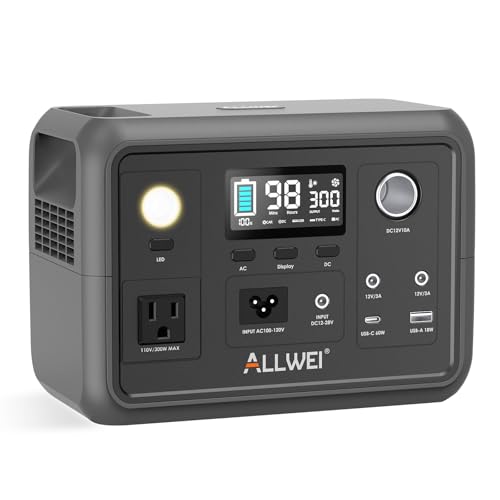
ALLWEI 300W portable power station, 256Wh LiFePO4, 600W peak
256Wh LiFePO4300W, 600W peakPD 60W USB-CPure sine wave
Check price on Amazon
Best for: Weekend campers who need phones, lights and a fan at the lowest sensible cost tier.

The ALLWEI 300W is a small LiFePO4 station that gives you the essentials at a low cost tier. It stores 256 watt-hours, outputs 300 watts continuous with a 600 watt surge on pure sine wave, and has a USB-C port that supplies 60 watts for fast charging. Ports include one AC outlet, two DC5521 ports, a car port and a USB-A with 18 watt fast charge.

The single AC outlet is the main limitation. If you need to plug in two AC devices, you will need a power strip, and total draw must stay under 300 watts. For a weekend, it will run phone and camera charging, LED lights and a small fan comfortably. Its LiFePO4 cells should outlast older lithium-ion packs. Compared with the Jackery Explorer 300, it has slightly less capacity and fewer premium touches.

Maintenance stays minimal. Keep it charged before trips, store it cool and use a compatible solar panel when needed. Check the solar input voltage and connector type before buying a panel, since this is a sensible small backup for campers who do not want to spend heavily.

What works

  • LiFePO4 cells in a low cost tier
  • 300W pure sine wave with 600W surge
  • 60W USB-C PD charges laptops and tablets
  • Compact with DC5521 and car ports

Watch out for

  • Only one AC outlet
  • 256Wh limits runtime on larger loads
  • Solar panel not included

Spec sheet

Capacity
256Wh LiFePO4
AC output
300W continuous, 600W surge
USB-C
60W PD fast charge
Ports
1 AC, 2 DC5521, car port, USB-A 18W
Wave form
Pure sine
04
MARBERO M823 300W portable power station, 237Wh, 2 AC outlets
237Wh300W, 375W peak2 AC outlets2 LED lanterns
Check price on Amazon
Best for: Families who want two AC outlets and built-in lanterns for a simple camp setup.

The MARBERO M823 is the latest 300 watt model in its M82 series, with 237 watt-hours of capacity and two AC wall outlets that support both two-prong and three-prong plugs. It delivers 300 watts with a 375 watt peak and includes two LED flashlights that work as camp lanterns, one on top and one on the side of the unit.

The two AC outlets make it more flexible than the ALLWEI for a small group, since a phone charger and a fan can plug in side by side. The built-in lanterns reduce the number of items you pack. Capacity is a little lower than the ALLWEI and Jackery, and the battery chemistry is described only as lithium, so expect fewer cycles than the LiFePO4 units. Against the powkey 200W, the MARBERO has more capacity and a lower cost tier than the Jackery.

In ownership, keep it away from heat, charge it every few months in storage and watch the surge limit. Use it for small loads and keep the lanterns for emergencies. It fits families who want a simple multi-purpose camping box.

What works

  • Two AC outlets for two-prong and three-prong plugs
  • Built-in LED lanterns on two sides
  • 300W with 375W peak pure sine output
  • Low cost tier

Watch out for

  • Lithium chemistry offers fewer cycles than LiFePO4
  • 237Wh is small for multi-day use
  • Peak rating is modest for motor starts

Spec sheet

Capacity
237Wh lithium
AC output
300W, 375W peak
AC outlets
2, two- and three-prong
Lighting
2 built-in LED lanterns
Wave form
Pure sine
05
Powkey 200W portable power station, 192Wh LiFePO4, 4.7 lb
192Wh LiFePO4200W AC4.7 lb7.1 x 5.3 x 5.5 in
Check price on Amazon
Best for: Hikers and kayak campers who want a very small power box for phones, lights and cameras.

The Powkey is the smallest and lightest unit here, at about 4.7 pounds and 7.1 by 5.3 by 5.5 inches. It carries 192 watt-hours of LiFePO4 storage and a 200 watt AC outlet, and it can be charged from a wall, a car socket or a solar panel, although the panel is not included. A dual white LED flashlight with emergency modes adds utility.

Its capacity suits phones, a small camera battery and a headlamp for a few days, or a laptop for two charges. It is a bad match for anything heavier than a fan or a small light. Compared with the Jackery Explorer 300, it is lighter and lower in cost tier, but offers about two-thirds of the capacity and a lower output limit.

Ownership is simple: keep it charged, store it cool and follow the manual's guidance on solar input. This one is a good fit for hikers and kayakers who need a small box and count every pound.

What works

  • Only about 4.7 lb and fits in a daypack
  • LiFePO4 cells in a small case
  • 200W AC outlet for small devices
  • Three charging methods

Watch out for

  • 192Wh runs out quickly
  • 200W cannot run fans plus laptops at once reliably
  • Solar panel not included

Spec sheet

Capacity
192Wh LiFePO4
AC output
200W
Weight
4.7 lb
Size
7.1 x 5.3 x 5.5 inches
Charging
Solar, wall and car; panel not included
06
EnginStar 300W power station with 60W foldable panel, 80000mAh
300W AC80000mAh60W panel included2 pure sine outlets
Check price on Amazon
Best for: First-time buyers who want a power station and a solar panel in one low-cost box.

The EnginStar bundles a 300 watt power station with a 60 watt foldable solar panel, so you can charge in the sun without a separate purchase. The battery is rated at 80,000 milliamp-hours, which works out to about 296 watt-hours at a typical 3.7 volt cell voltage, and it offers two pure sine wave AC outlets. The case is about 9 by 5.5 by 7.5 inches.

A 60 watt panel is a slow solar source. In good sun it adds roughly 40 watts, so a full recharge of 296 watt-hours takes more than a day, and it works best as a trickle charger for phones and lights. The bundle is great value for someone who wants everything in one box. Compared with the Jackery 1000 v2 kit, it has much lower capacity and a much lower cost tier.

Ownership is basic. Keep the unit and panel clean, avoid leaving it in a hot car and recharge it before trips. Check the panel connector, since proprietary connectors limit upgrades. It counts as a good first solar generator for car campers.

What works

  • 60W foldable panel included
  • About 296Wh of capacity
  • Two pure sine AC outlets
  • Compact and easy to carry

Watch out for

  • 60W panel is slow for full recharges
  • Lithium battery with fewer cycles than LiFePO4
  • Panel connector may limit upgrades

Spec sheet

Battery
80000mAh lithium, about 296Wh
AC output
300W, two pure sine outlets
Panel
60W foldable included
Size
9 x 5.5 x 7.5 inches
Certification
Listed as certified

Spec sheet decoder

What the numbers on the box really mean

The specs manufacturers lead with, translated into what they tell you about real-world performance.

Capacity (Wh)

The stored energy. Runtime is roughly Wh times 0.85 divided by load watts.

Watch forThe Jackery 1000 v2 lists 1,024Wh and the Powkey 192Wh.

AC output (W)

The continuous power the inverter can supply. Exceeding it trips the unit.

Watch forThe 1000 v2 lists 1,500W and the Powkey 200W.

Surge or peak (W)

A brief limit for motor starts. It lasts seconds, not minutes.

Watch forThe ALLWEI lists 600W and the MARBERO 375W.

Charge cycles

How many full charge and discharge cycles the battery lasts before dropping to about 80 percent capacity.

Watch forJackery claims over 4,000 for the Explorer 300.

UPS switchover

The time to switch from wall power to battery when used as a backup. Shorter is safer for sensitive devices.

Watch forThe 1000 v2 lists 10 ms.

Methodology

How We Evaluated These Solar Quiet Generators for Camping

Capacity for camp loads

We matched watt-hours to typical camp loads. The 1,024Wh Jackery 1000 v2 covers a fridge and CPAP, while 192Wh to 296Wh units cover phones and lights.

Output and surge

We compared continuous and surge ratings from 200W to 1,500W. Bigger loads need bigger inverters.

Battery quality

We favored LiFePO4 chemistry and cycle claims. Jackery, ALLWEI and Powkey use LiFePO4.

Solar readiness

We checked whether a panel is included and how fast it can recharge. The Jackery kit includes a 200W panel, the EnginStar a 60W panel.

Portability and value

We weighed weight, size and cost tier. The Powkey is lightest and the Jackery 1000 v2 heaviest.

Decision guide

How to Choose the Right Solar Quiet Generators for Camping

By Camp Loads

SituationPickWhy
Fridge and CPAPJackery Solar Generator 1000 v21,024Wh and 1,500W
Laptop and cameraJackery Explorer 300100W USB-C PD
Phones and lightsALLWEI 300WLow cost tier
Two AC devicesMARBERO M823Two AC outlets
Ultralight hikePowkey 200W4.7 lb

By Budget

SituationPickWhy
Lowest cost tierPowkey 200WSmall and light
Low tier with panelEnginStar 300W bundle60W panel included
Low to middle tierMARBERO M823Two outlets and lanterns
Middle tierALLWEI 300WLiFePO4 300W
Highest tierJackery Solar Generator 1000 v2Kit with 200W panel

Small Unit vs Large Unit

Small unit under 300Wh

The Jackery Explorer 300, ALLWEI, MARBERO, Powkey and EnginStar are light and cheap, ideal for phones, lights and laptops over a weekend.

Large unit around 1,000Wh

The Jackery 1000 v2 runs a fridge, a CPAP or a kettle in short bursts. It weighs far more and costs more.

Choose small to carry; choose large to run appliances.

Panel Included vs Panel Separate

SituationPickWhy
Want a ready kitJackery Solar Generator 1000 v2200W panel included
Cheap starter kitEnginStar 300W bundle60W panel included
Already own a panelALLWEI 300WStandard inputs
Wall-charged onlyJackery Explorer 300Fast AC charge
Tiny car-charged unitPowkey 200WCar and wall charge

For Campground Quiet Hours Specifically

Look for

No engine, a quiet fan and a unit small enough to sit inside the tent. Check that the fan does not roar at moderate loads.

In this comparison

Every unit here is silent apart from fans. The Jackery 1000 v2 is best for running appliances through the night, and the smaller units suit lights and phones.

When to Spend More

Spend more if

You camp for several days or need appliances. The Jackery 1000 v2 kit pays back through capacity and panel.

Save if

You only charge phones and lights. The ALLWEI or Powkey covers this at a low cost.

Ownership

Maintenance schedule

The upkeep that decides whether this machine lasts two seasons or ten.

TaskIntervalWhy it matters
Charge before every tripBefore each tripA full battery avoids surprises. Top up the unit a day before you leave.
Store at partial chargeBetween seasonsBatteries age faster when stored full or empty. Keep them around 50 to 80 percent in a cool place.
Recharge stored unitsEvery 3 monthsSelf-discharge lowers the battery over time. A top-up keeps cells healthy.
Keep vents clearEvery useFan vents clog with dust and sand. Clear them with compressed air.
Check panel cablesEach seasonFolded panels stress cables and connectors. Replace damaged leads.

FAQ

Frequently Asked Questions

Are solar generators really silent?

They have no engine, so there is no combustion noise. A small cooling fan may spin at higher loads, but it is far quieter than a gas generator.

How long will a solar generator run a fridge?

A small camping fridge that averages 40 to 60 watts will run for roughly 15 to 20 hours on a 1,024Wh unit after losses, depending on cycling and temperature.

Can I use it inside the tent?

Yes, because it produces no exhaust. Keep it dry, away from bedding and out of direct heat.

Do I need a solar panel?

Not for a weekend. A panel helps on longer trips, but wall or car charging before the trip is often enough.

Can it run a heater or air conditioner?

Not in these sizes. Heaters and air conditioners need much more power than a 300W unit, and they drain even a 1,024Wh unit within hours.

Is LiFePO4 worth it?

Yes if you plan to keep the unit for years. LiFePO4 lasts thousands of cycles and handles heat better than standard lithium-ion.

Bottom line

The short version

Browse more solar quiet generators for campingon Amazon →
James Miller, Lead Machine Editor

About the author

James Miller

Lead Machine Editor, MachineFanatic

James Miller leads MachineFanatic's buying guides, turning spec sheets, manuals and owner feedback into clear verdicts on power tools, outdoor power equipment, shop machines and kitchen machines.

More from James →

Keep reading

Related guides