

Amazon affiliate links - we earn a commission.Affiliate disclosure

Buying guide · 15 min read · Updated 2026-11-07

Best Solar Quiet Generators for the House (2026)

Whole-home and essentials backup without engine noise or fumes. Six solar generators from 1 kWh to 5 kWh compared on output, expansion and wiring needs.

James MillerBy James MillerLead Machine Editor6 machines comparedSpec-sheet verified
Best Solar Quiet Generators for the House

At a glance

Our top picks

Side by side

Spec comparison

A solar generator for the house is a large battery with an inverter that rides out outages in silence. It sits in a garage or hallway, runs the loads you choose and refills from panels or the grid, so there is no fuel to store and no exhaust to vent.

Home backup is a sizing exercise. The fridge, furnace blower and router are small loads, while a well pump, electric stove or air conditioner can drain a few kilowatt-hours in an hour. Output watts, voltage options and expansion path decide what the unit can actually run.

Before you buy

6 Criteria to Look For Before Buying a Solar Quiet Generator for the House

  1. 01

    Size loads in watts and watt-hours

    List your must-run loads: a refrigerator averages 100 to 200 watts but can need 3 times that to start, a furnace blower 300 to 600, a router 10 and lights 50. Multiply by hours to get watt-hours. A 1,024Wh Anker unit covers a day of fridge, router and lights, while a 5,040Wh Jackery 5000 Plus covers several.

  2. 02

    Output voltage and 240V needs

    Well pumps, dryers and electric ranges use 240 volts. Only some units, like the Jackery 5000 Plus and OSCAL PowerMax 6000, deliver split-phase 120 and 240. A 120-volt-only unit can run fridge, router and lights but not those circuits.

  3. 03

    Home integration and safety

    Plugging extension cords from a battery covers a few appliances, but wiring into the house needs a transfer switch or interlock to prevent back-feeding the grid. Never connect a battery to a house outlet with a male-to-male cord. Have an electrician install the hookup.

  4. 04

    Expansion and solar input

    A big battery is only useful if you can refill it. The OSCAL accepts 2,400 watts of solar and the EcoFlow TITAN 5000 Classic expands from 5 to 30 kilowatt-hours. A bundle with two 200 watt panels is a token amount for large units.

  5. 05

    Noise and placement

    A battery cools with fans and can be loud under heavy loads. The EcoFlow TITAN 5000 Classic lists under 30 dB, which suits indoor placement. Place any unit in a dry, temperate location.

  6. 06

    Cold and heat limits

    LiFePO4 cells cannot be charged below freezing without damage, and the capacity drops in cold. A garage unit may refuse to charge in a winter blackout. Store the battery indoors when possible.

Detailed reviews

The 6 best solar quiet generators for the house, explained

01
Jackery Solar Generator 5000 Plus with 2 x 200W panels, 5,040Wh
5,040Wh7,200W, 14,400W surge120V and 240VExpands to 60kWh
Check price on Amazon
Best for: Homeowners who want multi-day backup with 240V capability and room to expand.

The Solar Generator 5000 Plus is the closest thing here to a true home battery that you can wheel around. It stores 5,040 watt-hours in LiFePO4 cells, delivers 7,200 watts of rated power with a 14,400 watt surge, and supports both 120 and 240 volt output, which means a well pump or a dryer circuit is within reach. The listing says it can expand to 60 kilowatt-hours and keep a home running for days.

The bundle includes two 200 watt panels, which are a token amount for a unit this large. Two panels add perhaps 1 kilowatt-hour a day in good sun, so serious solar recharge needs a much larger array. The listing says it accepts both high-voltage and low-voltage panels and can recharge in about two hours from a strong input. Compared with the EcoFlow DELTA Pro, it offers more capacity and output on paper at a higher cost tier.

Ownership centers on installation. Connecting it to a house panel requires a transfer switch or an interlock, installed by an electrician, to avoid back-feeding the grid. Keep it indoors in a temperate space, because LiFePO4 cells dislike freezing charge conditions. A 10-year design life is a manufacturer claim, so check the warranty before you count on it.

What works

  • 5,040Wh with 7,200W of rated output
  • 120V and 240V output for pumps and dryers
  • Expandable toward 60kWh
  • Accepts high-voltage and low-voltage panels

Watch out for

  • Panel bundle is small for the battery size
  • Needs an electrician-installed transfer switch
  • Top cost tier and very heavy

Spec sheet

Capacity
5,040Wh LiFePO4, expandable to 60kWh
AC output
7,200W rated, 14,400W surge
Voltage
120V and 240V
Solar
Two 200W panels, high and low voltage input
Lifespan
10-year design life per the listing
02
EcoFlow DELTA Pro 3600Wh, 3,600W AC, expandable to 4,500W
3,600Wh LFP3,600W AC1.8-hour 240V chargeExpandable
Check price on Amazon
Best for: Households that want a proven expandable home backup system with fast recharge.

The DELTA Pro is an established whole-home-capable station with 3,600 watt-hours of LFP capacity and 3,600 watts of AC output, expandable to 4,500 watts. The listing quotes a full recharge in 1.8 hours from a 240 volt outlet at 3,000 watts, or 2.7 hours from a standard 1,800 watt wall outlet. That fast charge is valuable when a storm leaves only short grid windows.

The platform is mature, with accessories like extra batteries, a smart home panel and a generator input that tie into home wiring. The tradeoff is cost and weight, because 3,600 watt-hours of LFP is a very heavy box. Against the Jackery 5000 Plus, it has less capacity but a longer track record and more accessories. A typical 150 watt refrigerator that cycles will run for about a day on a full charge, and critical loads like a router and lights stretch it further.

In ownership, a home-backup installation usually involves a transfer panel, and it is worth paying an electrician to do it correctly. Keep the firmware updated, store at a moderate charge and avoid placing it where it can freeze. It suits a household that wants proven hardware.

What works

  • 3,600W output expandable to 4,500W
  • Full charge in 1.8 hours on 240V
  • Mature accessory and panel ecosystem
  • LFP battery with long cycle life

Watch out for

  • Heavy for a portable unit
  • Needs a transfer panel for whole-home use
  • High cost tier before accessories

Spec sheet

Capacity
3,600Wh LFP, expandable
AC output
3,600W, up to 4,500W with expansion
Fast charge
1.8 h on 240V, 2.7 h on 1,800W wall
Use
Home battery backup
Chemistry
LiFePO4
03
EcoFlow TITAN 5000 Classic, 5,017Wh, 4,000W, under 30 dB
5,017Wh LiFePO44,000W AC5 to 30kWh expandableUnder 30 dB
Check price on Amazon
Best for: Families who want a very quiet, expandable battery that lives indoors.

The TITAN 5000 Classic is built for quiet indoor use, and the listing says it runs under 30 decibels, quieter than a whisper. It stores 5,017 watt-hours of LiFePO4 and puts out up to 4,000 watts, enough to run a fridge, microwave, Wi-Fi, lighting and a CPAP at the same time. You can start at 5 kilowatt-hours and expand up to 30 as your needs grow.

The low noise matters in a house, since a battery that sits in a bedroom closet or kitchen cannot have a constantly spinning fan. Output of 4,000 watts is lower than the Jackery 5000 Plus's 7,200 watts, so it will not run very large 240 volt loads on its own. The expansion range gives it a long tail, from a day to a week of essential backup depending on how many batteries you add.

Ownership is about planning the install. Put it on a flat floor, leave space around the vents, and work with an electrician on the connection to a home panel. Next to the DELTA Pro, it has more capacity and a quieter design but lower peak output. For a family that cares about noise, it is the most livable option.

What works

  • Runs under 30 dB for indoor use
  • 5,017Wh with 4,000W of output
  • Expandable from 5 to 30kWh
  • Runs fridge, microwave and CPAP together

Watch out for

  • 4,000W output limits big 240V loads
  • Very heavy and needs a fixed location
  • Expansion batteries add a lot of cost

Spec sheet

Capacity
5,017Wh LiFePO4
AC output
4,000W
Expansion
5 to 30kWh
Noise
Under 30 dB
Runtime claim
About one day to one week of backup as expanded
04
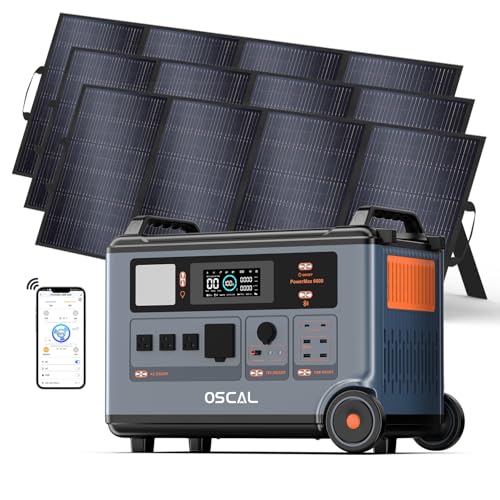
OSCAL PowerMax 6000 with 3 x 400W panels, 6,000W split phase
3,600Wh6,000W, 9,000W surge120V and 240V3 x 400W panels
Check price on Amazon
Best for: Households that want 240V backup with a large solar array included.

The OSCAL PowerMax 6000 is the best-equipped bundle for solar recharging. It ships with three 400 watt panels, for 1,200 watts of array, and the listing quotes a 2,400 watt solar input and a 2,200 watt AC input. A full recharge is claimed in 1.44 hours using both sources, which is fast for a 3,600 watt-hour battery.

The output is also strong: 6,000 watts with a 9,000 watt surge, in split phase 120 and 240 volts. That gives you the ability to run a 240 volt well pump or a small shop. The tradeoff is a brand with a shorter track record, so check warranty terms, parts availability and support responsiveness. Compared with the EcoFlow DELTA Pro, it offers more panels and more output in the same capacity class, at the cost of ecosystem maturity.

Ownership depends on a careful install. Use proper breakers and a transfer arrangement, and keep the panels clean. A 1,200 watt array can add about 4 kilowatt-hours on a sunny day, which refills most of the battery daily. It suits households that want solar recharge ready out of the box.

What works

  • Three 400W panels included for 1,200W of solar
  • 6,000W output with 9,000W surge
  • 120V and 240V split-phase output
  • Claims a full charge in 1.44 hours

Watch out for

  • Shorter brand track record than Jackery or EcoFlow
  • 3,600Wh runs out in hours under heavy load
  • Panels need roof or yard space

Spec sheet

Capacity
3,600Wh LiFePO4
AC output
6,000W, 9,000W surge
Voltage
120V and 240V split phase
Charging
2,200W AC input and 2,400W solar input
Full charge
0 to 100% in 1.44 hours
05
Jackery Solar Generator 2000 v2 with 2 x 200W panels, 2,042Wh
2,042Wh LiFePO42,200W AC39.5 lb20 ms UPS
Check price on Amazon
Best for: Households that want a plug-in essentials backup for a day without wiring work.

The Solar Generator 2000 v2 is the mid-size choice for essentials. It stores 2,042 watt-hours, supplies 2,200 watts and weighs about 39.5 pounds, which the listing calls 41 percent lighter than comparable 2 kilowatt-hour units. It charges to 80 percent in 66 minutes from the wall and ships with two 200 watt panels.

For a house, that capacity covers a fridge, a router, lights and phone charging for roughly a day. A furnace blower and a sump pump add more draw, so plan to ration. The 20 millisecond UPS function is slower than the 10 milliseconds on smaller Jackery models, which is fine for most appliances but less ideal for sensitive computers. Next to the Anker SOLIX C1000 Gen 2, it has twice the capacity and a bigger cost tier.

Ownership is easy by large-battery standards. It rolls or is carried by two people, stores in a closet and refills from the wall or panels. Keep it away from freezing temperatures and charge it every few months. It suits people who want a plug-in solution without an electrician.

What works

  • 2,042Wh with 2,200W of output
  • Light for its class at about 39.5 lb
  • 80 percent charge in 66 minutes
  • Two 200W panels included

Watch out for

  • Cannot run 240V loads
  • 20 ms UPS is slower than smaller models
  • Rationing needed with a furnace and sump pump

Spec sheet

Capacity
2,042Wh LiFePO4
AC output
2,200W
Weight
39.5 lb
AC charge
80% in 66 minutes
UPS
20 ms switchover
06
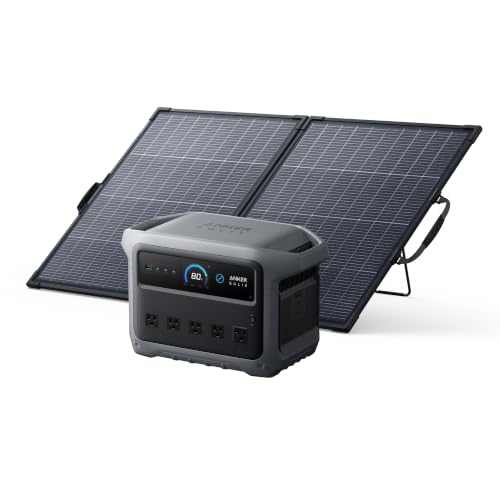
Anker SOLIX C1000 Gen 2 with 200W panel, 1,024Wh, 2,000W
1,024Wh2,000W, 3,000W peak9 ports200W panel
Check price on Amazon
Best for: Renters and light users who want a plug-in battery for the fridge, router and lights.

The SOLIX C1000 Gen 2 is the small, affordable way to keep the essentials alive. It stores 1,024 watt-hours, supplies 2,000 watts with a 3,000 watt peak through nine ports, and the listing calls it 14 percent smaller and 11 percent lighter than similar units. The 200 watt panel ships separately, so confirm that both items arrive.

For a house, it will run a router, laptops, lights and a small refrigerator for most of a day. It does not offer 240 volts, so a well pump or a dryer is out. Against the Jackery 2000 v2, it has half the capacity and a much lower cost tier, which makes it the sensible choice for short outages in mild weather.

Upkeep is light. Charge it, store it in a cool place and top up the battery every few months. You can plug appliances in directly, with no installation. It is the best choice for renters and anyone who wants a basic outage plan.

What works

  • 2,000W output with 3,000W peak
  • Nine ports cover many devices
  • Compact and lighter than similar units
  • Lowest cost tier among the six

Watch out for

  • 1,024Wh gives limited runtime for a fridge plus others
  • No 240V output
  • Panel is dispatched separately

Spec sheet

Capacity
1,024Wh
AC output
2,000W, 3,000W peak
Ports
9 outputs
Size
14% smaller and 11% lighter than similar units per the listing
Solar
200W panel dispatched separately

Spec sheet decoder

What the numbers on the box really mean

The specs manufacturers lead with, translated into what they tell you about real-world performance.

Capacity (Wh)

Stored energy. Runtime is roughly Wh times 0.85 divided by watts.

Watch forThe Jackery 5000 Plus lists 5,040Wh and the Anker C1000 1,024Wh.

Rated AC output

The continuous power the inverter delivers. It limits which appliances can run together.

Watch forThe Jackery 5000 Plus lists 7,200W and the Jackery 2000 v2 lists 2,200W.

Surge output

A brief limit for motor starts that lasts seconds. Compressors need it.

Watch forThe Jackery 5000 Plus lists 14,400W and the OSCAL 9,000W.

Split-phase voltage

Two 120 volt legs that together give 240 volts. It is required for many home circuits.

Watch forThe Jackery 5000 Plus and OSCAL PowerMax 6000 list 120/240V.

AC and solar input

How fast the battery can recharge from the wall and panels. Higher input shortens recovery between outages.

Watch forThe OSCAL lists 2,200W AC and 2,400W solar.

Methodology

How We Evaluated These Solar Quiet Generators for the House

Home loads covered

We matched capacity and output to typical home loads. The Jackery 5000 Plus and OSCAL cover 240V loads, and the Anker C1000 covers essentials.

Voltage and integration

We checked for split-phase output and accessories for home panels. Units with 120V and 240V scored higher for whole-home use.

Recharge capability

We compared AC and solar input and included panels. The OSCAL's 2,400W solar input and 1,200W of included panels led.

Noise and placement

We favored quiet designs. The EcoFlow TITAN 5000 Classic lists under 30 dB.

Value and brand support

We weighed cost tier against track record. The Anker C1000 costs least, and Jackery and EcoFlow have the broadest support.

Decision guide

How to Choose the Right Solar Quiet Generators for the House

By Outage Scenario

SituationPickWhy
Short outage, fridge and routerAnker SOLIX C1000 Gen 21,024Wh at a low tier
One day with a furnace blowerJackery Solar Generator 2000 v22,042Wh and 2,200W
Multi-day with 240V well pumpJackery Solar Generator 5000 Plus5,040Wh and 7,200W
Quiet indoor backupEcoFlow TITAN 5000 ClassicUnder 30 dB
Fast solar recoveryOSCAL PowerMax 60002,400W solar input

By Budget

SituationPickWhy
Lowest cost tierAnker SOLIX C1000 Gen 2Small and simple
Low to middle tierJackery Solar Generator 2000 v2Mid-size with panels
Middle tierOSCAL PowerMax 6000Panels and split phase
Upper tierEcoFlow DELTA ProMature ecosystem
Highest tierJackery Solar Generator 5000 PlusBiggest capacity

Plug-In vs Home-Integrated

Plug-in

The Anker SOLIX C1000 Gen 2 and Jackery 2000 v2 power appliances through their outlets with extension cords. No electrician is needed, but only a few loads can run.

Home-integrated

The Jackery 5000 Plus, EcoFlow DELTA Pro and OSCAL PowerMax 6000 can feed a home panel through a transfer switch. This covers more circuits but needs professional installation.

Choose plug-in for simplicity; choose integrated for whole-home coverage.

120V Only vs 120V and 240V

SituationPickWhy
Fridge, router, lightsAnker SOLIX C1000 Gen 2120V is enough
Well pumpJackery Solar Generator 5000 Plus240V output
Shop toolsOSCAL PowerMax 60006,000W split phase
Home panel backupEcoFlow DELTA ProPanel accessories
Mid-size essentialsJackery Solar Generator 2000 v22,200W at 120V

For Medical Equipment Specifically

Look for

Fast UPS switchover, pure sine wave, enough capacity for the device and a backup plan. Check the device's power draw and consult your provider.

In this comparison

The Jackery 2000 v2 lists a 20 ms UPS and the Anker C1000 offers enough capacity for a CPAP overnight. Do not rely on any battery alone for life-critical equipment.

When to Spend More

Spend more if

You have a well pump, work from home or face multi-day outages. The Jackery 5000 Plus and EcoFlow TITAN 5000 Classic reduce worry.

Save if

Outages are short and loads are small. The Anker C1000 keeps the fridge and router alive.

Ownership

Maintenance schedule

The upkeep that decides whether this machine lasts two seasons or ten.

TaskIntervalWhy it matters
Charge and cycleEvery 3 monthsIdle batteries lose charge. A top-up keeps cells healthy.
Store at moderate chargeBetween outagesKeeping a battery at 50 to 80 percent extends life.
Test the home hookupYearlyTransfer switches and cords can fail. Test them under load.
Clear ventsEvery 6 monthsDust blocks cooling. Clean with compressed air.
Update firmwareTwice a yearManufacturers improve safety and efficiency. Follow the app's update prompts.

FAQ

Frequently Asked Questions

Can a solar generator run my whole house?

Only a very large unit with 240V output can run many circuits, and only for hours. For central air or electric heat, a battery of this size drains quickly, so use it for essentials.

How long will a battery run my fridge?

A typical refrigerator averages 100 to 200 watts, so a 1,024Wh unit lasts roughly 5 to 8 hours and a 5,040Wh unit a day or more, depending on cycling.

Do I need an electrician?

For plug-in use, no. To feed your house panel, yes, because a transfer switch or interlock is required for safety.

Can solar panels recharge during an outage?

Yes if the unit accepts panels and the sun shines. Large batteries need large arrays, since two 200W panels add only a modest daily amount.

Is it safe to keep a battery indoors?

LiFePO4 batteries are among the safest chemistries and produce no exhaust. Keep them dry, ventilated and away from heat.

How does this compare with a gas generator?

A battery is silent, fumeless and ready instantly, but it has a fixed energy limit. A gas generator can run as long as fuel lasts but needs fuel, noise and outdoor placement.

Bottom line

The short version

Browse more solar quiet generators for the houseon Amazon →
James Miller, Lead Machine Editor

About the author

James Miller

Lead Machine Editor, MachineFanatic

James Miller leads MachineFanatic's buying guides, turning spec sheets, manuals and owner feedback into clear verdicts on power tools, outdoor power equipment, shop machines and kitchen machines.

More from James →

Keep reading

Related guides