


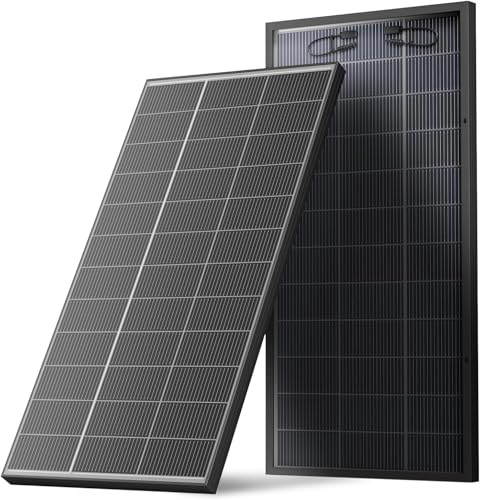

This panel uses A+ grade N-type silicon with eighteen busbars, a combination that spreads current across more conductors so a microcrack or a leaf shadow costs less output. N-type cells also show lower light-induced degradation in their first year, which means the panel holds closer to its label as it ages. On a van roof that bakes all summer, that stability is a real advantage over older P-type panels.
The frame ships with standard pre-drilled holes, so it should line up with common Z brackets and tray mounts without extra drilling. That matters on a roof, where every new hole is another place for sealant to fail. It is designed for 12V and 24V systems, so a series pair can feed a 24V bank through a suitably sized MPPT controller. Compared with the 10BB panel, you get more busbars but a less detailed connector spec.
Expect to pair it with an MPPT controller, because a single 300W panel on a 12V battery would waste output on a PWM unit. Check the sealant at each bracket twice a year, and look for any oxidation at the connector where the roof cable meets the panel. Clean it with a soft brush and water, never a pressure washer. If you park under trees, sap and pollen film the glass faster than dust, and a monthly rinse recovers a few percent of output.
What works
- N-type 18BB cells hold output as they age
- Standard pre-drilled holes fit common brackets
- Works on 12V and 24V systems
- 24.6 percent cell claim with A+ grade wafers
Watch out for
- Connector sealing is not detailed in the listing
- A rigid 300W panel needs real roof space
Spec sheet
- Rated power
- 300W
- Cells
- A+ N-type, 18 busbars
- Efficiency claim
- 24.6 percent
- System
- 12V or 24V battery banks
- Mounting
- Standard pre-drilled holes