
Amazon affiliate links - we earn a commission.Affiliate disclosure

Buying guide · 12 min read · Updated 2026-11-13

Best Flexible Solar Panels for RV (2026)

Six flexible RV solar panels compared on bend radius, shading tolerance, cell type, weight and how long adhesive-mounted panels really last.

James MillerBy James MillerLead Machine Editor6 machines comparedSpec-sheet verified
Best Flexible Solar Panels for RV

At a glance

Our top picks

Side by side

Spec comparison

A flexible RV panel trades the aluminium frame and glass of a rigid module for a thin laminate that bonds to a roof or curved surface. Weight savings are real, and the low profile keeps wind noise and height under control.

The compromise is heat and durability. With no air gap behind it, a glued panel runs hotter and ages faster than a framed one, so the real question is whether your roof shape or weight limit justifies that penalty.

Before you buy

6 Criteria to Look For Before Buying a Flexible Solar Panel for RV

  1. 01

    Roof shape and bend limit

    A flexible panel is only worth its premium if the roof is curved or weight is limited. The Renogy 200W bends within 240 degrees while the Holdwell S 200W is semi-flexible with a 2.5mm PET build, so test-fit the second before gluing. On a flat metal roof, a rigid panel is the better buy.

  2. 02

    Shade tolerance

    A shadow on one cell group can drag down the full string unless bypass diodes isolate it. The Renogy ShadowFlux has up to 30 diodes, while older designs have only a few. If your roof has vents, antennas or tree cover, pay for this feature.

  3. 03

    Cell technology

    N-type and HJT cells tolerate heat better and fade more slowly than PERC, which matters on a panel that has no cooling air gap. The ECO-WORTHY HJT and BougeRV Arch Pro use N-type, while the older Renogy 200W uses half-cut PERC. Choose N-type if you live in a hot region.

  4. 04

    Voltage versus controller limit

    The open-circuit voltage must stay under the controller input, even in cold weather when voltage rises. The BougeRV Arch Pro lists a Voc near 36V, which may exceed the limit of a small controller. Check the controller before adding panels in series.

  5. 05

    Mounting method

    Most flexible panels are glued with marine-grade adhesive, and a poor bond lets wind lift the edge. The ECO-WORTHY and Holdwell offer grommets for mechanical fixing, which helps if you want to remove the panel later. Never glue over seams or loose screws.

  6. 06

    Heat and lifespan

    Heat trapped behind a bonded panel can cut output and shorten life, so a thin air gap or spacer pad helps. Expect a shorter service life than a framed rigid panel, often measured in several years rather than decades. If lifespan is the priority, buy rigid.

Detailed reviews

The 6 best flexible solar panels for rv, explained

01
Renogy 200W ShadowFlux N-Type Flexible Panel
200WN-Type 18BB7.72 lb30 bypass diodes
Check price on Amazon
Best for: RV owners who park under trees or have a roof cluttered with vents.

The ShadowFlux splits each panel into many small cell groups, each with its own bypass diode, so a branch shadow shuts down a slice of the panel instead of choking the whole string. That matters on an RV, where vent covers, antennas and tree limbs routinely drop a shadow across one corner. The cells are N-type 18-busbar with a claimed efficiency of up to 25 percent.

It weighs 7.72 lb and measures only 0.1 inch thick, so one person can lift it and a gentle curve will not stress the laminate. Compared with the older Renogy 200W flexible panel, it moves from PERC to N-type cells and adds the multi-diode shade layout, so it gives more output in partial sun. The tradeoff is price, since you pay for the newer design.

Adhesive installation is the big commitment: plan a clean roof, marine-grade sealant and a panel gap for airflow. Leave a few millimetres of standoff if you can, because a flexible panel pressed flat to a hot roof loses output and ages sooner. Inspect the edges yearly for lifting.

What works

  • Up to 30 bypass diodes tolerate partial shade
  • N-type 18BB cells claim up to 25 percent
  • Only 7.72 lb for a 200W rating
  • Bends over curved roofs without a frame

Watch out for

  • Costs more than older PERC flexibles
  • Adhesive mounting is hard to reverse

Spec sheet

Rated power
200W
Cell type
N-Type 18BB
Weight
7.72 lb
Thickness
0.1 in
Shade design
Up to 30 bypass diodes
02
BougeRV Arch Pro 200W Fiberglass Flexible Panel
200WN-Type 16BBFiberglassVoc 36V
Check price on Amazon
Best for: Travellers who drive through hail country or under low branches and want a tougher surface.

The Arch Pro uses a fiberglass substrate, which is stiffer than a plain ETFE film and tends to resist dents from hail and branch strikes better. Cells are N-type 16-busbar at a claimed 25 percent, and built-in bypass diodes limit shade loss. The stiffness also helps the panel hold shape when bonded to a gently arched roof.

Its open-circuit voltage sits around 36V with a five percent tolerance, which the listing warns may not suit certain controllers. That is a real caution, because a PWM controller or a small MPPT unit with a low input ceiling can exceed its limit on a cold morning. Against the ShadowFlux it offers a tougher surface but a less refined shade layout.

Because fiberglass resists dents, it is a better match for roofs under overhanging branches or road debris. Check the controller input rating before buying, and plan the mounting sealant carefully, since a stiffer panel pulls harder at the adhesive on tight curves.

What works

  • Fiberglass substrate resists dents and impacts
  • N-type 16BB cells at a claimed 25 percent
  • Built-in bypass diode reduces shade loss
  • Holds its shape on gently arched roofs

Watch out for

  • Voc near 36V may exceed some controllers
  • Stiffer than ETFE on tight curves

Spec sheet

Rated power
200W
Cell type
N-Type 16BB
Surface
Fiberglass laminate
Open-circuit voltage
36V plus or minus 5%
Efficiency claim
25%
03
ECO-WORTHY 200W Flexible HJT ETFE Panel
200WHJT N-Type18BBETFE
Check price on Amazon
Best for: RV and boat owners who want a removable mount and a high-temperature-tolerant cell.

ECO-WORTHY uses heterojunction (HJT) N-type cells under an ETFE film, a construction known for low heat loss and solid output at high temperature. The 18-busbar layout spreads current across more contact lines, which helps when micro-cracks form from vibration. The claimed efficiency is 25 percent.

Pre-drilled rust-resistant metal grommets give you an optional mechanical fixing alongside adhesive, which suits boat decks and removable mounts. Compared with the BougeRV Arch Pro it uses a film rather than a fibreglass shell, so it is lighter and bends more readily but offers less impact protection. It also has a less prominent shade-management story than the Renogy ShadowFlux.

Grommet mounting lets you tension the panel with lashing and avoid a full adhesive bond, which makes removal and winter storage much easier. Keep the rope or strap off the cell area, and check that the edge does not chafe against a rough surface.

What works

  • HJT N-type cells tolerate heat well
  • 18BB layout helps against micro-cracks
  • Metal grommets allow a removable mount
  • ETFE film bends easily over curves

Watch out for

  • Film surface dents more easily than fiberglass
  • Fewer shade-management details listed

Spec sheet

Rated power
200W
Cell type
HJT N-Type
Busbars
18BB
Surface
ETFE
Mounting
Metal grommets
04
Renogy 200W Flexible Panel with 240 Degree Bend
200W240 deg bendHalf-cut PERC1000Wh/day est.
Check price on Amazon
Best for: DIY buyers who want a well-documented panel with proven mounting guidance.

This is the older Renogy flexible design, with half-cut PERC cells that cut resistive loss and a bend range of up to 240 degrees. Renogy quotes about 1000 watt-hours of daily energy at five sun hours, a sensible rule-of-thumb figure rather than a guarantee. It is a plain, widely used panel.

Compared with the newer ShadowFlux it uses PERC rather than N-type cells and lacks the many-diode shade layout, so it loses more output when part of the panel is shaded. Its main advantage is track record: it has been sold for years and parts, mounting kits and replacement advice are easy to find. That makes it a good choice for first-time DIY roof installs.

Treat the 240 degree bend as a one-time installation limit, not something to flex repeatedly, because repeated bending cracks cells. Mount it with a thin air gap if possible, and keep a close eye on the edges during the first season.

What works

  • Bends within 240 degrees for curved roofs
  • Half-cut PERC cells reduce resistive loss
  • Long sales history and plenty of install guides
  • Estimated 1000Wh per day at five sun hours

Watch out for

  • PERC cells run hotter than N-type
  • Shade handling is weaker than the ShadowFlux

Spec sheet

Rated power
200W
Bend range
Within 240 degrees
Cell tech
Half-cut PERC
Daily estimate
About 1000Wh at 5 sun hours
Intended use
RV, marine, cabin, van
05
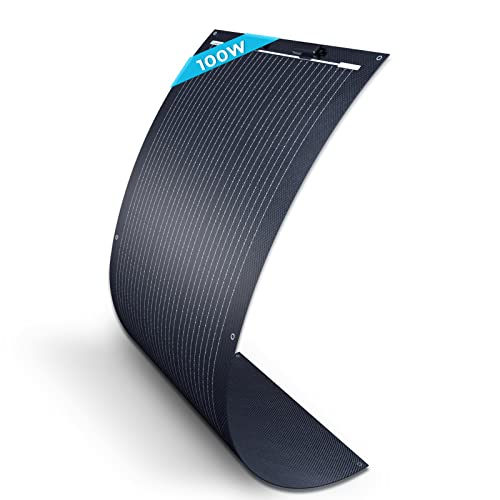
Renogy 100W Flexible Solar Panel, 240 Degree Bend
100W240 deg bendHalf-cut PERC500Wh/day est.
Check price on Amazon
Best for: Small vans and truck campers that have only a patch of free roof.

The Renogy 100W is the small-roof option, using the same half-cut PERC cell design as the 200W but at half the size. Renogy quotes an average of 500 watt-hours per day, which covers a fridge-free weekend setup of lights, phone charging and a fan. It bends within 240 degrees.

Two of these in parallel equal one 200W panel in rating and give you a more placeable footprint on a cluttered roof, since each fits between vents. The tradeoff is more wiring and more mounting points, and the cost per watt runs higher than a single 200W panel. It makes sense when roof space, not budget, is the constraint.

When wiring two or more in parallel, add inline fuses and use matched cable lengths so currents balance. Run the wire through a sealed roof gland rather than an open hole, and recheck the sealant after the first few months of heat cycles.

What works

  • Fits between vents and roof clutter
  • Half-cut PERC cells lower resistive loss
  • Estimated 500Wh per day for light loads
  • Light enough for one-person installation

Watch out for

  • Higher cost per watt than a 200W panel
  • Two panels double wiring and mounting points

Spec sheet

Rated power
100W
Bend range
Within 240 degrees
Cell tech
Half-cut PERC
Daily estimate
About 500Wh
Intended use
RV, marine, van
06
Holdwell S 200W Semi-Flexible PET Panel
200W21.9% eff.6.94 lb2.5mm PET
Check price on Amazon
Best for: Budget-minded owners with a sunny, gently curved roof and no shade issues.

The Holdwell is the lightest panel in this group at 6.94 lb and the lowest in efficiency at 21.9 percent. It is described as semi-flexible, built from a 2.5mm PET-laminated structure that bends only gently, enough for curved RV roofs and boat decks but not for tight arcs. At 53.1 by 30.1 inches it is larger than a 25 percent efficient panel of the same rating.

Compared with the ShadowFlux, you give up the N-type cell and a refined shade layout in return for a lower price. That is a fair trade for a sunny roof with no shade, and the extra panel size is irrelevant if you have the area. Corner grommets allow a mechanical fixing as well as adhesive.

Because it is only semi-flexible, forcing it around a tight curve can crack cells, so test-fit before gluing. Check the roof flatness and avoid bonding over seams or raised screws.

What works

  • Lightest here at 6.94 lb
  • Corner grommets allow mechanical mounting
  • PET laminate bends to curved roofs
  • Lowest cost per watt of the flexibles

Watch out for

  • 21.9 percent efficiency means a larger footprint
  • Semi-flexible, not suited to tight curves

Spec sheet

Rated power
200W
Cell efficiency
21.9%
Weight
6.94 lb
Size
53.1 x 30.1 in
Build
2.5mm PET laminate

Spec sheet decoder

What the numbers on the box really mean

The specs manufacturers lead with, translated into what they tell you about real-world performance.

Bypass diodes

Small components that route current around a shaded cell group. More of them means less output lost when one area is covered.

Watch forThe Renogy ShadowFlux lists up to 30, against a handful on typical flexible panels.

Bend range

The curve the maker says the laminate can take without cell damage. It is an installation limit, not a repeatable flex rating.

Watch forThe Renogy panels quote 240 degrees, while the Holdwell S is only semi-flexible.

Cell efficiency

How much sunlight becomes electricity at the cell. Higher efficiency means more watts from less roof area.

Watch forThe Holdwell S 200W claims 21.9 percent while the ShadowFlux claims up to 25.

Open-circuit voltage

The voltage with no load, which rises in cold weather. The controller input limit must exceed it.

Watch forThe BougeRV Arch Pro lists 36V plus or minus 5 percent, so confirm your controller ceiling.

ETFE versus PET surface

ETFE film sheds dirt and resists UV, while PET laminates are cheaper and slightly stiffer. Neither matches glass for lifespan.

Watch forThe ECO-WORTHY uses ETFE and the Holdwell uses a PET laminate.

Methodology

How We Evaluated These Flexible Solar Panels for RV

Shade management

We checked each listing for bypass diode counts and cell grouping. The ShadowFlux with up to 30 diodes stands apart from panels that list one standard diode. Shade performance counted heavily for roof-mounted use.

Cell and laminate quality

We compared cell types from half-cut PERC through N-type and HJT, plus ETFE, fiberglass and PET surfaces. Heat tolerance mattered more than a one percent efficiency gap. Panels with newer cells scored higher.

Weight and flexibility

Weights run from 6.94 lb for the Holdwell to 7.72 lb for the ShadowFlux, and bend limits differ. We scored how easily one person can install each and how tight a curve it tolerates.

Mounting options

We looked at whether grommets, adhesive or both are offered. Removable mounting earned credit for owners who cannot commit to a permanent bond.

Owner feedback patterns

We reviewed recurring owner comments on edge lifting, hot-spot failures and overstated output. Panels with repeated complaints lost ground in the ranking.

Decision guide

How to Choose the Right Flexible Solar Panels for RV

By Roof Layout

SituationPickWhy
Cluttered roof with vents and antennasRenogy ShadowFlux 200WUp to 30 bypass diodes limit shade loss
Small free patch of roofRenogy 100WFits between obstacles
Gently curved sunny roofHoldwell S 200WLightest and lowest cost per watt
Hail or branch exposureBougeRV Arch Pro 200WFiberglass resists dents
Removable boat or van mountECO-WORTHY 200W HJTMetal grommets

By Budget

TierPickWhy
Lowest outlayHoldwell S 200WLowest cost per watt
Low to midRenogy 100WSmall and proven
Mid-rangeRenogy 200WEstablished and well documented
Upper midECO-WORTHY 200W HJTHJT cells and grommets
PremiumRenogy ShadowFlux 200WBest shade handling

Flexible vs Rigid Panels

Flexible panels

The Renogy ShadowFlux and Holdwell S weigh under 8 lb each and bend over curved roofs. They run hotter, cost more per watt and typically last fewer years.

Rigid panels

A framed rigid panel costs less per watt, cools better and lasts longer. It needs a flat roof and a heavier mount.

Choose a flexible pick only when roof shape or weight forces it; otherwise buy rigid.

Mounting Style

PreferencePickWhy
Permanent adhesive bondRenogy 200WWidely documented method
Removable lashingECO-WORTHY 200W HJTMetal grommets
Corner fixings plus glueHoldwell S 200WCorner grommets
Tough surface against debrisBougeRV Arch Pro 200WFiberglass substrate

For Shaded Campsites Specifically

Look for

Choose a panel with many bypass diodes and cell groups so that a single branch shadow does not cut the whole panel. Confirm the controller is MPPT so it can track the changing output.

In this comparison

The Renogy ShadowFlux 200W is the clear choice with up to 30 bypass diodes. The Holdwell S 200W is the weakest option under shade.

When to Spend More

Spend more if

Spend more on the ShadowFlux 200W when you park under trees or live in a hot climate where N-type cells help. A longer service life also matters if you will not remount the panel.

Save if

Save with the Holdwell S 200W or Renogy 100W when your roof is sunny and the aim is basic charging. It also suits a rental or short-term setup.

Ownership

Maintenance schedule

The upkeep that decides whether this machine lasts two seasons or ten.

TaskIntervalWhy it matters
Check edge adhesionEvery 3 monthsWind and heat cycles lift edges. A lifting edge lets water in and invites a larger tear.
Inspect sealant at cable entryEvery 6 monthsRoof sealant dries and cracks in sun. A cracked gland leaks into the ceiling.
Wash the surfaceMonthly in seasonDust and bird droppings create hot spots. Plain water and a soft cloth do it, and a brush does not.
Check wiring and connectorsEvery seasonVibration loosens MC4 plugs and chafes cables. Tighten and re-tape where needed.
Look for cell discolorationYearlyBrown or dark patches signal a hot spot or moisture ingress. Early detection helps with warranty claims.

FAQ

Frequently Asked Questions

Are flexible RV panels worth the extra cost?

They are worth it when roof curvature or weight limits rule out rigid panels. On a flat roof with spare payload, a rigid panel gives more watts per unit of cost and lasts longer.

How long do flexible panels last?

Expect a shorter life than rigid panels, because there is no air gap and heat ages the laminate. Several years is a typical expectation, and N-type or HJT cells help in hot climates.

Can I walk on a flexible panel?

Most makers warn against it because pressure can crack the cells beneath the laminate. Treat the surface as a non-walking area and mount away from roof access points. Keep a roof walk pad or a ladder rest on the opposite side so nobody needs to step near the panel edges during routine roof checks.

Do I need an MPPT controller?

For a 200W panel or more, MPPT harvests meaningfully more than PWM, especially in cold weather or low light. PWM is workable only for a single small panel.

Can I leave a flexible panel glued over winter?

Yes, if the bond is sound, but snow load and thermal cycling stress it. Brush snow off gently and inspect edges in spring.

What happens if one cell group is shaded?

Without bypass diodes the whole string drops hard. Panels such as the ShadowFlux limit the loss by isolating the shaded group.

Bottom line

The short version

Browse more flexible solar panels for rvon Amazon →
James Miller, Lead Machine Editor

About the author

James Miller

Lead Machine Editor, MachineFanatic

James Miller leads MachineFanatic's buying guides, turning spec sheets, manuals and owner feedback into clear verdicts on power tools, outdoor power equipment, shop machines and kitchen machines.

More from James →

Keep reading

Related guides