
Amazon affiliate links - we earn a commission.Affiliate disclosure

Buying guide · 12 min read · Updated 2026-11-07

Best Gas Tankless Water Heaters (2026)

Six gas tankless water heaters from 102,000 to 199,000 BTU compared on real GPM by temperature rise, venting, condensing design and gas line needs.

James MillerBy James MillerLead Machine Editor6 machines comparedSpec-sheet verified
Best Gas Tankless Water Heaters

At a glance

Our top picks

Side by side

Spec comparison

A gas tankless heater lights a burner only while hot water is running and passes the water over a heat exchanger once, so there is no tank to keep warm and no limit on how long the hot water lasts. Its limit is how many BTU of gas it can burn, which sets how much water it can heat at once.

The headline GPM comes from a gentle temperature rise, so read the BTU input and use the heating formula for your own incoming water. Venting and the gas line then decide whether the install is a simple swap or a rebuild.

Before you buy

6 Criteria to Look For Before Buying a Gas Tankless Water Heater

  1. 01

    Use the heating formula

    Flow in GPM is roughly BTU input times efficiency divided by 500 times the temperature rise. The Rheem RTG at 160,000 BTU and 0.82 gives about 3.7 GPM at a 70F rise, not the 7.0 on the box, which assumes about a 37F rise. Plug in your coldest incoming water, not the maker's number.

  2. 02

    Gas line size

    A 199,000 BTU unit like the GASLAND or Rinnai draws far more gas than a 40 gallon tank heater at about 40,000 BTU. Many homes have a half-inch line that cannot carry it. Ask a plumber to calculate the line from the meter, and budget for upsizing.

  3. 03

    Condensing versus non-condensing

    The Rinnai recovers exhaust heat with a second exchanger, so it vents in PVC but needs a condensate drain. The Rheem RTG, GASLAND and ThermoMate are non-condensing and need metal venting. Venting often decides which is cheaper to install.

  4. 04

    Verify the flow claim

    The MIZUDO lists 10.3 GPM and the GASLAND 7.6 GPM on the same 199,000 BTU input. Only condensing efficiency near 95 percent at a small rise could deliver 10.3. Ask whether the figure is a maximum at a 35F rise and read the performance chart in the manual.

  5. 05

    Vent path and clearances

    Gas units need combustion air and a vent terminating a set distance from windows and doors. A 20 foot vent run with elbows can reduce capacity. Place the heater on an exterior wall if you can, and follow the manual's clearances.

  6. 06

    Hard water and descaling

    Scale coats the heat exchanger and cuts flow and efficiency, so units in hard water need yearly descaling at least. The service valves let you flush the unit with descaling solution. A softener protects the exchanger and pays back. A softener also protects faucets and appliances, which makes it a good investment beyond the heater.

Detailed reviews

The 6 best gas tankless water heaters, explained

01
Rheem RTG 7.0 GPM Natural Gas Tankless, 160,000 BTU, Indoor
7.0 GPM160,000 BTUNon-condensingUEF 0.82
Check price on Amazon
Best for: A two to three bathroom home in a temperate climate with existing metal venting.

The RTG is a non-condensing gas tankless with 160,000 BTU of input and a stated UEF of 0.82. Non-condensing means the burner exhaust leaves at a high temperature, so the unit needs stainless or other approved vent material but produces no acidic condensate to drain.

Using the standard formula, 160,000 BTU at 0.82 gives about 131,000 BTU of useful heat, which is about 3.7 GPM at a 70F rise and 6.5 GPM at a 40F rise. That is why the 7.0 GPM headline suits mild climates. Against the 199,000 BTU units it has about 80 percent of the input, and against the 102,000 BTU ThermoMate it has about 57 percent more.

Ownership is routine: descale yearly in hard water, keep the inlet screen clear and have a technician check combustion. Rheem's service network means parts and technicians are easy to find. If your existing tank heater vents through a masonry chimney, budget for a new dedicated vent, because a chimney liner rarely meets the requirements for a tankless exhaust.

What works

  • Stated UEF of 0.82
  • 160,000 BTU input for two showers in mild climates
  • No condensate line to manage
  • Wide brand service network

Watch out for

  • Needs stainless or approved metal venting
  • Flow falls in cold-water climates
  • Gas line sizing still matters

Spec sheet

Max flow
7.0 GPM
Input
160,000 BTU
Type
Non-condensing
Efficiency
UEF 0.82
Fuel
Natural gas, indoor
02
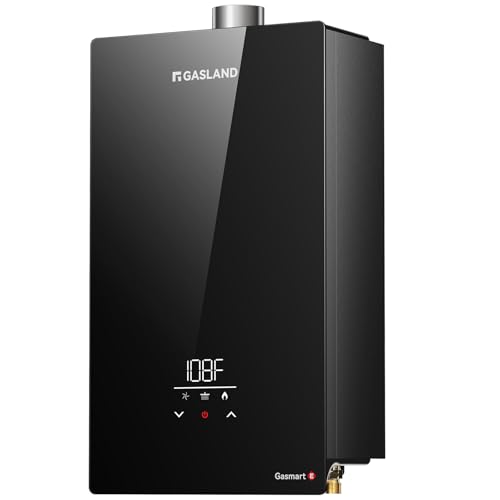
GASLAND Gasmart E 199,000 BTU Gas Tankless, up to 7.6 GPM
199,000 BTUUp to 7.6 GPMUEF 0.8CSA certified
Check price on Amazon
Best for: A three to four bathroom home that wants high input at a lower price tier.

GASLAND's Gasmart E puts 199,000 BTU of input into a whole-house natural gas unit with a stated UEF of 0.8, CSA certification and a rated flow up to 7.6 GPM. The listing claims about 34 percent more efficient than a standard tank, which is a manufacturer comparison.

The formula shows what 199,000 BTU can do: at 0.8 efficiency that is about 159,000 BTU of useful heat, roughly 4.5 GPM at a 70F rise and 8 GPM at a 40F rise. The 7.6 GPM headline therefore assumes a rise near 42F. Compared with the Rheem RTG it has more input and a slightly lower efficiency figure, and compared with the Rinnai it is non-condensing and less costly.

Ownership requires a gas line sized for 199,000 BTU, proper venting and a yearly descale. As a smaller brand, confirm the warranty and keep your receipt. Ask for the gas pressure and line size requirements in writing before you buy, and confirm that the unit is certified for your region.

What works

  • 199,000 BTU input for large households
  • Stated UEF of 0.8
  • CSA certified design
  • Lower price tier than the premium brands

Watch out for

  • Needs a gas line sized for high input
  • Smaller brand with less service depth
  • 7.6 GPM assumes a modest temperature rise

Spec sheet

Input
199,000 BTU
Max flow
Up to 7.6 GPM
Efficiency
UEF 0.8
Certification
CSA
Fuel
Natural gas, indoor
03
MIZUDO 199,000 BTU Natural Gas Tankless, 10.3 GPM
199,000 BTU10.3 GPMPlus or minus 1FIndoor
Check price on Amazon
Best for: A large household in a warm or temperate region that wants the highest listed flow.

MIZUDO lists 199,000 BTU and a 10.3 GPM rating, with gas modulation that holds the temperature within one degree and low-flow response. The listing says it supports 5 to 7 water points.

The 10.3 GPM number deserves a hard look. At 199,000 BTU, only a condensing unit near 95 percent efficiency can deliver that, at a rise near 36F. In a typical 70F rise, even a condensing 199,000 BTU unit makes closer to 5.3 GPM. Against the GASLAND at 7.6 GPM on the same input it claims much more flow, so treat the number as a best case.

Ownership needs the same gas line, venting and descaling routine. Ask the seller whether the unit is condensing or non-condensing, since that decides the venting and the condensate drain. A listing that gives a very high GPM without saying whether the unit is condensing is worth a question to the seller before you order.

What works

  • 199,000 BTU input
  • Temperature held within one degree
  • Low-flow response for small draws
  • Rated for five to seven water points

Watch out for

  • 10.3 GPM claim assumes a small temperature rise
  • Condensing status is not stated in the data
  • Newer brand with less service depth

Spec sheet

Input
199,000 BTU
Max flow
10.3 GPM
Temperature control
Plus or minus 1F
Fixtures
5 to 7 water points
Fuel
Natural gas, indoor
04
APUS 120,000 BTU Natural Gas Tankless, 5.43 GPM, UEF 0.81
120,000 BTU5.43 GPMUEF 0.8195 to 149F range
Check price on Amazon
Best for: A two bathroom home in a temperate region where mid-range input is enough.

APUS's 120,000 BTU unit lists 5.43 GPM, a stated UEF of 0.81, copper heat transfer and temperature control within one degree between 95F and 149F. It is aimed at three to four water points.

Its position is the middle of the lineup. At 120,000 BTU and 0.81 efficiency, the useful heat is about 97,000 BTU, so roughly 2.8 GPM at a 70F rise and 4.9 GPM at a 40F rise. Compared with the Rheem RTG it has about three-quarters of the input, and compared with the ThermoMate it adds about 18 percent.

Ownership is routine. Descale yearly, keep the inlet screen clean and check the vent. The temperature range is a useful control, because setting 120F rather than 140F stretches the flow. A power-vent fan means the unit needs an electrical outlet nearby, so a power cut stops it even when gas is flowing.

What works

  • Stated UEF of 0.81
  • Temperature controlled to one degree
  • Rated for three to four fixtures
  • Middle input suits many homes

Watch out for

  • Flow falls fast in cold climates
  • Smaller brand with less service depth
  • Needs proper vent and gas line

Spec sheet

Input
120,000 BTU
Max flow
5.43 GPM
Efficiency
UEF 0.81
Temperature range
95 to 149F, plus or minus 1F
Fixtures
3 to 4 water points
05
ThermoMate CZ422NG Natural Gas Tankless, 102,000 BTU, up to 5 GPM
102,000 BTUUp to 5 GPMCSA certifiedCopper exchanger
Check price on Amazon
Best for: A small household, condo or secondary bath in a mild climate.

ThermoMate's CZ422NG has 102,000 BTU of input, a rated flow of up to 5 GPM, CSA certification and an oxygen-free copper heat exchanger. The listing highlights boil-dry, freeze, flame-out and overheat protections and says it can run two showers at once.

Two showers at once is a mild-climate claim. At 102,000 BTU the useful heat is about 80,000 BTU, so roughly 2.3 GPM at a 70F rise and 4 GPM at a 40F rise. That serves one shower at a time in a cold climate. Against the APUS 120,000 BTU it has less input, and against the Rheem RTG it costs less.

Ownership centers on yearly descaling, an inlet screen check and an inspection of the vent. The protections are useful, but they do not replace a properly sized gas line. If you keep the setpoint near 120F instead of 140F, the same burner stretches to a larger flow, which is the cheapest way to add capacity.

What works

  • CSA certified with several safety protections
  • Copper heat exchanger
  • Lower input suits smaller gas lines
  • Lower price tier

Watch out for

  • Two simultaneous showers only in mild climates
  • Less capacity than the 120,000 BTU and larger units
  • Smaller brand with less service depth

Spec sheet

Input
102,000 BTU
Max flow
Up to 5 GPM
Certification
CSA
Heat exchanger
Oxygen-free copper
Protections
Boil-dry, freeze, flame-out, overheat
06
Rinnai RX199iN Condensing Gas Tankless, 11.1 GPM, 199k BTU
11.1 GPM199,000 BTUCondensingGas or propane
Check price on Amazon
Best for: A large household where capacity, PVC venting and a long service life matter.

The Rinnai is the only condensing unit here, which means a second heat exchanger extracts extra heat from the exhaust, so the exhaust is cool enough to vent in PVC. That raises efficiency, and the 199,000 BTU input with 11.1 GPM makes it the capacity leader.

Its Versa Vent system lets the same model install indoors or outdoors, and it runs on natural gas or propane. The tradeoff is a condensate drain and a neutralizer to handle the acidic water. Against the MIZUDO at 10.3 GPM it states a condensing design that makes its high number more plausible, and against the Rheem RTG it has far more flow.

Ownership is yearly descaling, a clean inlet screen and a professional check. Rinnai's service network is the deepest here, which counts for a lot in year eight. The built-in protections are only as good as the installation, so use a licensed installer and keep a record of the gas pressure test.

What works

  • Condensing design vents in PVC
  • 11.1 GPM at 199,000 BTU
  • Indoor or outdoor install
  • Natural gas or propane

Watch out for

  • Needs a condensate drain and neutralizer
  • Highest price tier here
  • Gas line must carry 199,000 BTU

Spec sheet

Max flow
11.1 GPM
Input
199,000 BTU
Type
Condensing
Fuel
Natural gas or propane
Install
Indoor or outdoor (Versa Vent)

Spec sheet decoder

What the numbers on the box really mean

The specs manufacturers lead with, translated into what they tell you about real-world performance.

BTU input

The gas energy the burner can use per hour. Higher input allows more flow at a given rise.

Watch forThe lineup runs from 102,000 BTU on the ThermoMate to 199,000 BTU on the Rinnai, MIZUDO and GASLAND.

UEF

Uniform Energy Factor, the DOE efficiency rating for water heaters. Higher means less gas per gallon heated.

Watch forThe Rheem RTG states 0.82, the APUS 0.81 and the GASLAND 0.8.

GPM

Gallons per minute at a stated temperature rise. The rise matters as much as the flow.

Watch forThe range runs from 5 GPM on the ThermoMate to 11.1 GPM on the Rinnai.

Condensing

A design that recovers exhaust heat, allowing PVC venting. It produces acidic condensate that needs draining.

Watch forOnly the Rinnai states a condensing design.

CSA certified

A safety certification from a recognized body for gas appliances.

Watch forThe GASLAND and ThermoMate list CSA certification.

Methodology

How We Evaluated These Gas Tankless Water Heaters

Real capacity

We converted BTU input and stated efficiency into GPM at a 70F and 40F rise instead of relying on the headline. The Rheem RTG gives about 3.7 GPM at 70F, and the 199,000 BTU units give about 4.5 GPM at 70F.

Efficiency evidence

We gave credit to stated UEF figures, 0.82 on the Rheem RTG and 0.81 on the APUS, and treated marketing savings claims as comparisons.

Install burden

We scored gas line demand, vent type and condensate needs. The Rinnai needs a drain, and the non-condensing units need metal venting.

Safety and certification

We counted CSA certification and listed protections such as boil-dry and flame-out. A certified unit scored higher than one with no stated certification.

Support

We considered brand service depth and parts availability based on owner feedback patterns. Rinnai and Rheem scored best, and newer brands scored lower.

Decision guide

How to Choose the Right Gas Tankless Water Heaters

By Household Size

SituationPickWhy
1 to 2 bathrooms, small gas lineThermoMate CZ422NG102,000 BTU
2 bathroomsAPUS 120,000 BTUUEF 0.81
2 to 3 bathroomsRheem RTG 7.0 GPMUEF 0.82
4 or more bathroomsRinnai RX199iN11.1 GPM condensing

By Budget

SituationPickWhy
Lowest costThermoMate CZ422NGSmallest input
Low-to-mid high inputGASLAND Gasmart E199,000 BTU
Mid-range brandRheem RTG 7.0 GPMService network
Highest outlayRinnai RX199iNCondensing and deepest service

Condensing vs Non-Condensing

Condensing

The Rinnai recovers exhaust heat, so it vents in PVC and runs more efficiently, but it needs a condensate drain and neutralizer. It costs more.

Non-condensing

The Rheem RTG, GASLAND, APUS and ThermoMate exhaust hot gas and need stainless venting. They cost less and need no condensate line.

Choose condensing if you can drain condensate and want PVC venting, and non-condensing if a metal vent already exists.

Gas Line and Input

SituationPickWhy
Half-inch line, no upsizingThermoMate CZ422NG102,000 BTU
Three-quarter inch lineAPUS 120,000 BTUMid input
Line can carry 160,000 BTURheem RTG 7.0 GPMUEF 0.82
Line upgraded for 199,000 BTUGASLAND or RinnaiHighest input

For Cold Climates Specifically

Look for

The highest BTU input you can supply and condensing efficiency. A rise of 70F or more cuts flow in half compared with the headline.

In this comparison

The Rinnai RX199iN at 199,000 BTU and condensing is the strongest cold-climate gas option, with the GASLAND as the lower-cost high-input alternative.

When to Spend More

Spend more if

You have a large household, a cold climate or want PVC venting. The Rinnai RX199iN or the Rheem RTG repays the premium.

Save if

The household is small and the climate mild. The ThermoMate CZ422NG or APUS 120,000 BTU does the job.

Ownership

Maintenance schedule

The upkeep that decides whether this machine lasts two seasons or ten.

TaskIntervalWhy it matters
Descale the heat exchangerYearly, more often in hard waterScale cuts heat transfer and flow. Circulate descaling solution through the service valves.
Clean the inlet screenEvery 6 to 12 monthsA clogged screen starves the unit of flow. Rinse it with the water shut off.
Inspect the vent and terminationYearlyA blocked or corroded vent is a safety risk. Clear nests and check the joints.
Have combustion checkedYearlyA technician confirms the flame, gas pressure and carbon monoxide levels. Gas appliances need professional service. Keep the service record, since warranties on gas appliances often depend on it.
Test the temperature settingEach yearA drift in the setpoint can scald or leave water lukewarm. Verify at a tap with a thermometer.

FAQ

Frequently Asked Questions

Is a gas tankless heater worth it?

If you have a gas line and want endless hot water without a tank, yes. The installation cost is higher than a tank heater, and the real savings come from avoiding standby heat loss. Choose a unit sized to your climate so it does not run at its limit.

What size gas tankless do I need?

Add the GPM of fixtures that run at once and size for your coldest incoming water. A 160,000 BTU unit makes about 3.7 GPM at a 70F rise, which suits one shower plus a tap in a cold climate. A simple rule is to size one step up if you are close to the limit.

Do I need a bigger gas line?

Often yes. A 199,000 BTU unit burns about five times the gas of a typical tank heater, and a half-inch line may not carry it. A plumber can calculate the required line from the meter using the appliance BTU loads in the house.

What is the difference between condensing and non-condensing?

A condensing unit recovers exhaust heat and vents in PVC but needs a condensate drain. A non-condensing unit exhausts hotter gas and needs metal venting.

How often should I descale?

About once a year, more often in hard water. The service valves allow you to circulate descaling solution through the unit. Cleaning the inlet screen at the same visit takes only a few minutes.

Can I install a gas tankless myself?

Gas lines and venting are safety-critical, and many places require a licensed plumber or gas fitter. Use a professional and pull the permit.

Bottom line

The short version

Browse more gas tankless water heaterson Amazon →
James Miller, Lead Machine Editor

About the author

James Miller

Lead Machine Editor, MachineFanatic

James Miller leads MachineFanatic's buying guides, turning spec sheets, manuals and owner feedback into clear verdicts on power tools, outdoor power equipment, shop machines and kitchen machines.

More from James →

Keep reading

Related guides