
Amazon affiliate links - we earn a commission.Affiliate disclosure

Buying guide · 12 min read · Updated 2026-11-07

Best Tankless Water Heaters (2026)

Six tankless water heaters, gas and electric, compared on GPM at a real temperature rise, amperage, venting and scale upkeep so you size the unit to your home.

James MillerBy James MillerLead Machine Editor6 machines comparedSpec-sheet verified
Best Tankless Water Heaters

At a glance

Our top picks

Side by side

Spec comparison

A tankless water heater heats water only while a tap is open, using a gas burner or electric elements to raise the temperature in one pass. It removes the standby loss of a tank and the risk of running out, but it trades them for hard limits on flow and a much bigger demand on your gas line or panel.

The label GPM means little without a temperature rise. The same unit that delivers its headline flow in a warm climate delivers far less in a cold one, so size the heater on your coldest incoming water, not on the number printed on the box.

Before you buy

6 Criteria to Look For Before Buying a Tankless Water Heater

  1. 01

    Size on temperature rise, not GPM

    Temperature rise is your target hot temperature minus your coldest incoming water. With 120F hot water and 45F incoming water the rise is 75F, and a unit rated 6.5 GPM at a 45F rise delivers closer to 4.5 GPM at a 77F rise. The Rheem 18kW lists up to 4.4 GPM, but in a cold climate expect a good deal less.

  2. 02

    Know your electrical headroom

    Electric power is amperage times voltage, so 18 kW at 240V draws about 75 amps and 24 kW about 100. The Rheem 11kW draws about 46 amps, which fits small panels. A whole-house electric often forces a 200 amp service, and a panel upgrade can cost more than the heater.

  3. 03

    Gas input and gas line size

    The Rinnai at 199,000 BTU and the Rheem RTG at 160,000 BTU draw much more gas than a tank heater, so the line must carry it. An undersized line starves the burner and the unit shuts down mid-shower. Ask a plumber to calculate the line from the meter before you buy.

  4. 04

    Condensing versus non-condensing

    The Rinnai is condensing, so its exhaust is cool enough for PVC, but it needs a drain for acidic condensate. The Rheem RTG is non-condensing, so it needs stainless venting but no condensate line. The venting is often the larger part of the install cost.

  5. 05

    Hard water and scale

    Mineral scale coats the heat exchanger and cuts flow, so tankless heaters in hard water need descaling about once a year. The service valves let you circulate descaling solution through the unit. A softener or scale inhibitor is cheaper than a heat exchanger.

  6. 06

    Minimum flow and the cold sandwich

    A tankless unit needs a minimum flow to fire, often about 0.25 to 0.5 GPM. Low-flow taps and a brief shutoff can cause cold slugs of water between hot bursts. Check the minimum activation flow if you have low-flow fixtures. Fixing it is usually a matter of keeping a small flow open or choosing a unit with a lower minimum.

Detailed reviews

The 6 best tankless water heaters, explained

01
Rinnai RX199iN Condensing Gas Tankless, 11.1 GPM, 199k BTU
11.1 GPM199,000 BTUCondensingIndoor or outdoor
Check price on Amazon
Best for: A whole house of 3 to 5 bathrooms where gas is available and capacity matters.

The RX199iN is a condensing gas unit, which means a second heat exchanger pulls extra heat from the exhaust, so the flue gas is cool enough for PVC venting. That is the mechanism behind its efficiency and its simpler venting than a non-condensing unit. The 199,000 BTU input and 11.1 GPM rating make it the highest-capacity pick here.

It installs indoors or outdoors with the same model through its Versa Vent system, and it runs on natural gas or propane. The tradeoff is cost and condensate: you need a drain for the acidic condensate and usually a neutralizer. Against the Rheem RTG at 7.0 GPM it moves far more water at a given rise, and against the electric units it avoids panel upgrades but needs a properly sized gas line.

In ownership terms, plan on yearly descaling in hard water, a clean inlet screen and a professional combustion check. Gas tankless units are only as reliable as their venting and water quality. Ask your installer to confirm the vent length and the condensate route on paper before they start, since those two details decide most of the cost of a gas swap.

What works

  • 11.1 GPM at 199,000 BTU input
  • Condensing design vents in PVC
  • Indoor or outdoor install with one model
  • Runs on natural gas or propane

Watch out for

  • Needs a condensate drain and neutralizer
  • Gas line often needs upsizing
  • Highest price tier in the lineup

Spec sheet

Max flow
11.1 GPM
Input
199,000 BTU
Type
Condensing gas
Fuel
Natural gas or propane
Install
Indoor or outdoor (Versa Vent)
02
Rheem RTG 7.0 GPM Natural Gas Tankless, 160,000 BTU, Indoor
7.0 GPM160,000 BTUNon-condensingUEF 0.82
Check price on Amazon
Best for: A 2 to 3 bathroom home in a temperate climate with an existing vent route.

Rheem's RTG is a non-condensing gas unit with a 0.82 Uniform Energy Factor and 160,000 BTU of input, rated at 7.0 GPM. Non-condensing means the exhaust leaves hot, so it needs stainless or other approved vent material, but it avoids the condensate drain.

The listing claims savings up to 34 percent compared with a standard tank, which is a manufacturer comparison, not a guarantee. At 7.0 GPM it handles two showers at once in a temperate climate but will struggle in a cold one. Against the Rinnai it has about 60 percent of the flow and a less expensive venting profile only if you already have a metal vent.

Ownership centers on yearly descaling, a clean inlet filter and a clear vent path. In hard water areas, a scale inhibitor or a softener protects the heat exchanger. If you replace a tank with it, expect the gas line, vent and a new exhaust penetration to be part of the quote, not just the heater.

What works

  • UEF 0.82 efficiency rating
  • 7.0 GPM for two simultaneous showers in mild climates
  • No condensate drain
  • Established brand with service coverage

Watch out for

  • Needs stainless or approved metal venting
  • Flow drops sharply in cold-water climates
  • Gas line sizing still matters

Spec sheet

Max flow
7.0 GPM
Input
160,000 BTU
Type
Non-condensing gas
Efficiency
UEF 0.82
Fuel
Natural gas, indoor
03
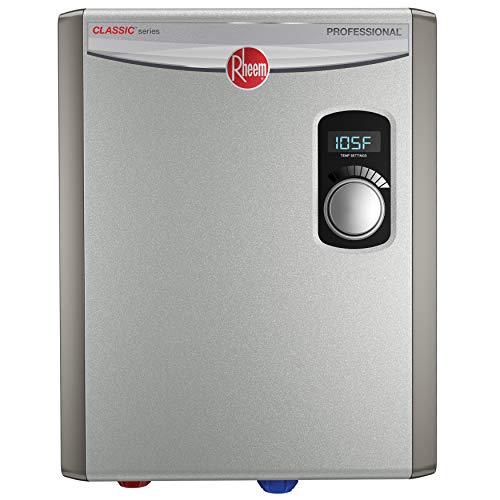
Rheem 18kW 240V Electric Tankless, up to 4.4 GPM
18 kW240VUp to 4.4 GPMDigital thermostat
Check price on Amazon
Best for: A 1 to 2 bathroom home or condo with a 150 amp service and no gas line.

Rheem's 18kW model modulates its power to match the demand, with an external digital thermostat accurate to one degree and two copper immersion heating elements that are field serviceable. It is rated up to 4.4 GPM, which is the maximum under the best conditions.

The electrical load is the main fact. 18 kW at 240V draws about 75 amps, so you need a double-pole breaker in that range and usually a 150 amp service. In a cold climate the 4.4 GPM figure drops sharply, because the same kilowatts must raise colder water. Against the 24kW Rheem it has about three quarters of the capacity, and against the gas units it avoids venting at the cost of panel capacity.

Ownership is simpler than gas: no vent, no combustion check. Flush the heater for scale yearly in hard water and keep the inlet screen clean.

What works

  • No venting or combustion
  • External digital thermostat accurate to one degree
  • Field-serviceable copper elements
  • Self-modulating power

Watch out for

  • Draws about 75 amps at 240V
  • Flow falls sharply in cold climates
  • Needs a panel with spare capacity

Spec sheet

Power
18 kW at 240V
Max flow
Up to 4.4 GPM
Control
External digital, plus or minus 1 degree
Elements
Two copper immersion, field serviceable
Modulation
Self-modulating power
04
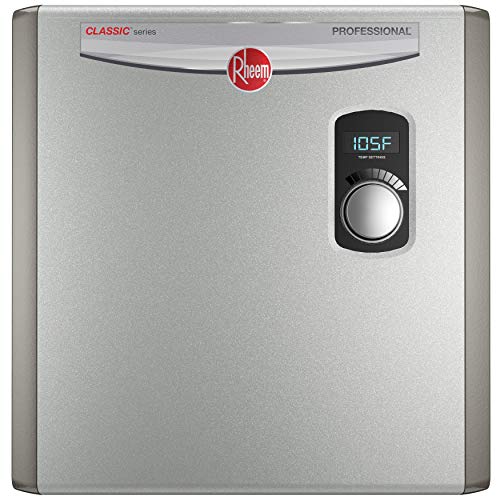
Rheem RTEX-24 24kW Electric Tankless, up to 5.9 GPM
24 kW240VUp to 5.9 GPMMulti-fixture
Check price on Amazon
Best for: A 2 to 3 bathroom home with a 200 amp panel and no gas line.

The RTEX-24 is the largest electric Rheem in the group, at 24 kW and up to 5.9 GPM. It is meant for multiple fixtures, and the listing tells you to verify the electrical requirements before you buy.

The number to check is current: 24 kW at 240V is about 100 amps, which in practice means a 200 amp service panel. Compared with the 18 kW it adds about a third more capacity, but the panel demand is the real cost. In a cold climate it still will not deliver 5.9 GPM, so treat the number as a warm-water figure.

Ownership is similar to the 18 kW model: yearly descaling, a clean inlet screen and attention to the electrical connections. A licensed electrician should size the wire and breaker. Have the electrician check the main breaker and the service cable gauge, since the panel label alone does not prove the service can carry the load.

What works

  • Up to 5.9 GPM for multiple fixtures
  • No venting or gas line
  • Established brand with service coverage
  • Self-modulating electric design

Watch out for

  • Draws about 100 amps
  • Needs a 200 amp service in most homes
  • Flow still falls in cold climates

Spec sheet

Power
24 kW at 240V
Max flow
Up to 5.9 GPM
Supply
240V
Application
Multiple fixtures
Panel need
About 100 amps, a larger service
05
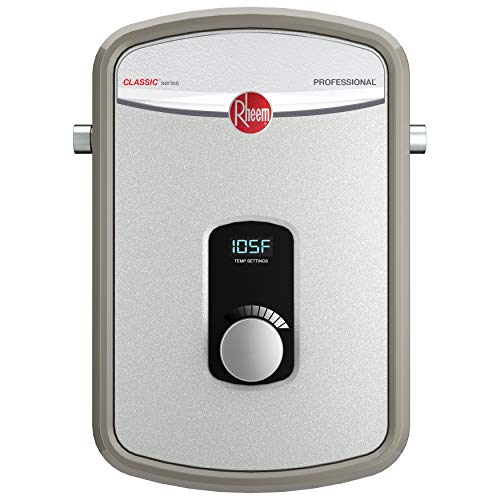
Rheem 11kW Multi-Fixture Electric Tankless, up to 2.68 GPM
11 kW240VUp to 2.68 GPMMulti-fixture
Check price on Amazon
Best for: A condo, cabin or small addition where one fixture runs at a time.

The 11 kW Rheem is the smallest whole-house-style electric here, rated up to 2.68 GPM. That is enough for one shower or a kitchen sink plus a bathroom tap in a warm climate, not two showers at once.

At 240V it draws about 46 amps, which fits within the panel capacity of many apartments and small homes without an upgrade. Compared with the 18 kW unit it has a bit more than half the flow, but it demands far less from your panel. It is a sensible choice for a cabin, an addition or a condo.

Ownership is routine: descaling, a clean inlet screen and secure electrical connections. Do not buy it for a family home with two bathrooms.

What works

  • Modest draw of about 46 amps
  • Suits small panels
  • No venting or gas
  • Established brand

Watch out for

  • Only 2.68 GPM at best
  • Cannot run two showers at once
  • Falls short in cold climates

Spec sheet

Power
11 kW at 240V
Max flow
Up to 2.68 GPM
Supply
240V
Application
Small multiple-fixture use
Panel need
About 46 amps
06
ThermoMate 3500W 120V Under-Sink Tankless, 0.4 to 0.66 GPM
3,500 W120V29.2 ampsHard-wired
Check price on Amazon
Best for: A single sink or utility tap far from the main water heater.

This ThermoMate is a point-of-use heater for a single sink, drawing 29.2 amps at 120V and delivering 0.4 to 0.66 GPM. The listing is clear that it must be hard-wired and has no plug, which means a dedicated 40 amp circuit.

The low flow is the point: it gives a sink hot water in seconds and removes the wait for a distant tank. It cannot run a shower. Compared with the whole-house units it costs a fraction and needs only a short wire run, but it is not a substitute for them.

Ownership is simple, with a periodic check of the aerator and a flush if your water is hard. Treat it as a convenience heater for a far bathroom or workshop sink. Place the heater close to the sink so the pipe run stays short and the benefit of instant hot water is not lost to a long cold line.

What works

  • Hot water in seconds at one tap
  • Compact under-sink size
  • No vent or gas
  • Low flow keeps the temperature rise high

Watch out for

  • Cannot run a shower
  • Must be hard-wired on a dedicated circuit
  • Flow of 0.4 to 0.66 GPM is very low

Spec sheet

Power
3,500 W at 120V
Current
29.2 amps
Flow
0.4 to 0.66 GPM
Install
Hard-wired, no plug
Use
Single sink or lavatory

Spec sheet decoder

What the numbers on the box really mean

The specs manufacturers lead with, translated into what they tell you about real-world performance.

GPM

Gallons per minute of hot water at a stated temperature rise. The rise matters as much as the flow.

Watch forThe range runs from 0.4 to 0.66 GPM on the ThermoMate to 11.1 GPM on the Rinnai.

kW and amps

Electric power in kilowatts, which at 240V draws about 4.2 amps per kilowatt.

Watch forThe Rheem 18kW needs about 75 amps and the 24kW about 100.

BTU input

The gas energy per hour the burner can use. Higher input allows higher flow at a given rise.

Watch forThe Rheem RTG is 160,000 BTU and the Rinnai 199,000 BTU.

UEF

Uniform Energy Factor, the DOE efficiency measure for water heaters. Higher is better.

Watch forThe Rheem RTG lists 0.82, but the others do not state one in the data.

Condensing

A design with a second heat exchanger that recovers exhaust heat, allowing PVC venting.

Watch forThe Rinnai is condensing and needs a condensate drain.

Methodology

How We Evaluated These Tankless Water Heaters

Real flow at a rise

We treated the headline GPM as a best case and compared units on input power. The Rinnai at 199,000 BTU and 11.1 GPM sits far above the Rheem RTG at 160,000 BTU and 7.0 GPM, and the electrics fall in between by kilowatt.

Installation burden

We scored the work each unit demands, from the 100 amp panel for the RTEX-24 to the gas line and condensate drain for the Rinnai. Lower burden earned higher scores.

Efficiency evidence

We gave credit to stated efficiency figures, such as the Rheem RTG at 0.82 UEF, and discounted unsourced savings claims.

Serviceability

We looked at field-serviceable elements, descaling access and brand service networks based on owner feedback patterns. Rheem and Rinnai scored well on parts.

Fit to use

We matched each unit to a real use, from a point-of-use sink heater to a whole-house gas unit. A unit sized for a use it cannot meet lost points.

Decision guide

How to Choose the Right Tankless Water Heaters

By Household Size

SituationPickWhy
Single sink or workshopThermoMate 3500WPoint-of-use
Condo or cabin, one fixture at a timeRheem 11kW46 amps
1 to 2 bathrooms, 150 amp serviceRheem 18kWUp to 4.4 GPM
3 to 5 bathroomsRinnai RX199iN11.1 GPM

By Budget

SituationPickWhy
Lowest costThermoMate 3500WPoint-of-use only
Low for a small homeRheem 11kWSmall electric
Mid-range whole houseRheem RTG 7.0 GPMNon-condensing gas
Highest outlayRinnai RX199iNCondensing capacity

Gas vs Electric

Gas

The Rinnai and the Rheem RTG deliver 11.1 and 7.0 GPM from a gas line and a vent. They handle cold climates better but need venting, gas sizing and a yearly service.

Electric

The Rheem 11kW, 18kW and 24kW need no vent or gas. They demand large breakers and panel capacity, and flow drops in cold climates.

Choose gas for a large house with a gas line, and electric when venting is impossible and the panel is strong.

Climate and Incoming Water

SituationPickWhy
Warm climate, 60F incomingRheem 18kWSmall rise, full flow
Temperate climate, 50 to 55FRheem RTG 7.0 GPMGas holds flow
Cold climate, 40 to 45FRinnai RX199iNHighest capacity
Cold climate, electric onlyRheem RTEX-24Largest electric

For Cold Climates Specifically

Look for

The most input power you can supply, because a rise of 75F or more cuts flow. Gas at 199,000 BTU is the strongest answer, and large electrics need a 200 amp panel.

In this comparison

The Rinnai RX199iN gives the most flow in cold water, and the Rheem RTEX-24 is the strongest electric option if the panel allows it.

When to Spend More

Spend more if

You have a large household or live in a cold climate. The Rinnai RX199iN or the Rheem RTEX-24 repays the premium.

Save if

You need hot water at one fixture. The Rheem 11kW or the ThermoMate does the job.

Ownership

Maintenance schedule

The upkeep that decides whether this machine lasts two seasons or ten.

TaskIntervalWhy it matters
Descale the heat exchangerYearly, more often in hard waterMineral scale cuts heat transfer and flow. Circulate descaling solution through the service valves.
Clean the inlet screenEvery 6 to 12 monthsA clogged screen starves the unit of flow. Rinse it with the water shut off.
Inspect the ventYearlyA blocked or corroded vent is a safety risk on gas models. Have a technician check combustion.
Check electrical connectionsYearlyLoose lugs overheat at high amperage. Have an electrician tighten them.
Test the temperature settingEach yearA drift in the setpoint can scald or leave water lukewarm. Verify at a tap with a thermometer.

FAQ

Frequently Asked Questions

Is a tankless water heater worth it?

If you want endless hot water, save floor space and have the gas line or panel to feed it, yes. It does not save money on installation, and electric units can cost more to run than gas.

How big a tankless water heater do I need?

Add the GPM of fixtures that run at once, then size for your coldest incoming water. A shower at about 2 GPM and a dishwasher at 1.5 GPM need roughly 4 GPM of heated flow, at a rise of 70F or more in a cold climate. When in doubt, size one step up, because a unit running at its limit gives lukewarm water.

Do I need a new panel for an electric tankless?

Often. 18 kW draws about 75 amps and 24 kW about 100, so a 150 or 200 amp service is typical. The Rheem 11kW at about 46 amps fits smaller panels.

What is the difference between condensing and non-condensing?

A condensing unit recovers extra heat from the exhaust, so it can vent in PVC but needs a condensate drain. A non-condensing unit exhausts hotter gas and needs metal venting.

How often should I descale a tankless heater?

About once a year, more often in hard water. Circulate descaling solution through the service valves, and clean the inlet screen at the same time.

How long do tankless heaters last?

Commonly 15 to 20 years with regular descaling and service. Scale and a blocked vent are the usual causes of early failure.

Bottom line

The short version

Browse more tankless water heaterson Amazon →
James Miller, Lead Machine Editor

About the author

James Miller

Lead Machine Editor, MachineFanatic

James Miller leads MachineFanatic's buying guides, turning spec sheets, manuals and owner feedback into clear verdicts on power tools, outdoor power equipment, shop machines and kitchen machines.

More from James →

Keep reading

Related guides