
Amazon affiliate links - we earn a commission.Affiliate disclosure

Buying guide · 12 min read · Updated 2026-11-07

Best Point of Use Water Heaters (2026)

Six point of use water heaters, tankless and mini tank, compared on GPM at a real temperature rise, amps, recovery time and what each sink or shower can run.

James MillerBy James MillerLead Machine Editor6 machines comparedSpec-sheet verified
Best Point of Use Water Heaters

At a glance

Our top picks

Side by side

Spec comparison

A point-of-use heater sits at the fixture it serves, under a sink or on a wall nearby, so hot water arrives in seconds instead of after the long wait for a distant tank. It also saves the water that would otherwise run down the drain while you wait.

There are two designs, a tankless unit that heats on demand and a mini tank that stores a few gallons. They suit different jobs, and the electrical demand and the flow are very different. Pick by the fixture, then by the circuit you have.

Before you buy

6 Criteria to Look For Before Buying a Point of Use Water Heater

  1. 01

    Pick tankless or tank by the draw

    A tankless heater like the ThermoMate 6kW gives a continuous trickle, about 1.0 GPM at a 35F rise, and never runs out. A mini tank like the GE 2.5 gallon gives full flow until it empties, then slow recovery. Short, repeated draws suit tanks, and long steady ones suit tankless.

  2. 02

    The circuit decides the price

    The Rheem 3.5kW draws about 29 amps on 120V and the ThermoMate 6kW about 25 amps on 240V. Both need a dedicated circuit, while the mini tanks at 1,440 to 1,500 watts draw about 12 to 13 amps and plug into a standard outlet. An electrician's visit can cost more than the heater.

  3. 03

    Temperature rise limits flow

    The formula is kW equals GPM times 500 times the rise, divided by 3,412. At 3.5 kW and 0.5 GPM the rise is about 48F, and at 6 kW and 1.0 GPM it is about 41F. Cold incoming water of 40F gives warm, not hot, water from the smaller units. A small tankless heater also cannot deliver its rated flow if the faucet aerator is clogged, so clean it first.

  4. 04

    Recovery time for tanks

    A 1,500 watt element adds about 5,100 BTU an hour. Heating 3.5 gallons from 55F to 120F takes about 22 minutes, and 8 gallons at 1,440 watts takes close to an hour. A tank is a poor fit for back-to-back use, so match the volume to the draw.

  5. 05

    Corrosion and tank material

    The UTank uses 304 stainless steel, and the ThermoMate 8 gallon uses a glass-lined tank. Glass-lined tanks need the sediment flushed and the anode checked, and stainless resists corrosion better. Corrosion is the usual end of a mini tank, so tank material matters.

  6. 06

    Space and mounting

    The UTank measures 14.9 by 10.8 by 11.4 inches and needs cabinet room, while tankless units are far smaller. Check the space under the sink, the plumbing connections and the outlet location before ordering. A heater that does not fit is a return.

Detailed reviews

The 6 best point of use water heaters, explained

01
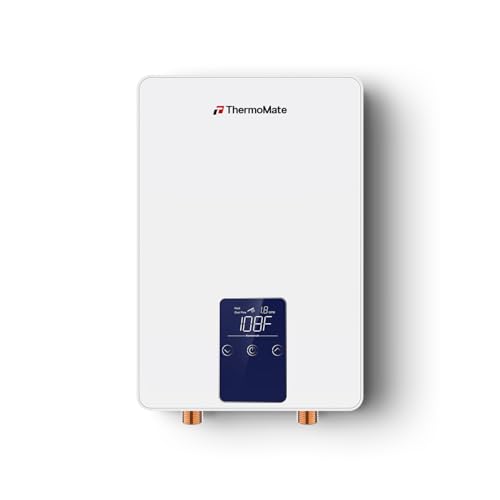
ThermoMate 6kW 240V Hardwired Point-of-Use Tankless, 1.0 GPM at 35F
6 kW240V1.0 GPM at 35F riseETL listed
Check price on Amazon
Best for: A bathroom or kitchen sink where steady hot water is wanted in seconds.

ThermoMate's 6kW unit is a hardwired tankless point-of-use heater rated 1.0 GPM at a 35F rise, with a cast aluminum heating element separated from the water line. The 99.8 percent figure is heater efficiency, which for any electric resistance device is close to 100 percent, so it tells you about conversion and not about your power bill.

The 1.0 GPM at 35F means this unit suits a sink in a mild climate. With 55F incoming water and a target of 105F, the rise is 50F and the flow falls to about 0.8 GPM. At 240V it draws about 25 amps, so it needs a dedicated circuit and a 30 amp double-pole breaker. Compared with the Rheem 3.5kW it has more than twice the flow, and compared with the mini tanks it never runs out.

Ownership is simple: a yearly check of the aerator and a descale in hard water. The hardwired install means an electrician is involved, but the wiring is a short run. Install it within a few feet of the tap, because every foot of uninsulated pipe between the heater and the faucet cools the water and brings the wait back.

What works

  • 1.0 GPM at a 35F rise, stated plainly
  • Heating element separated from the water line
  • ETL listed with 240V hardwired install
  • Never runs out like a mini tank

Watch out for

  • Needs a 240V dedicated circuit
  • Flow falls with colder incoming water
  • Cannot run a shower

Spec sheet

Power
6 kW at 240V
Flow
1.0 GPM at 35F rise
Efficiency
99.8 percent heater
Install
Hardwired, ETL listed
Element
Cast aluminum, separated from water
02
Rheem RTEX-06T 6.5kW 240V Point-of-Use Thermostatic Tankless
6.5 kW240VThermostaticCompact
Check price on Amazon
Best for: A sink or lavatory where a known brand and thermostatic control matter.

Rheem's RTEX-06T is a thermostatic 6.5 kW point-of-use heater that monitors water temperature and controls flow to hold the setpoint. The listing says it is much smaller than a tank unit, which is true of any tankless design.

At 6.5 kW and 240V it draws about 27 amps, and its capacity is about 1 GPM at a 44F rise by the standard formula, which suits a single sink or a bathroom lavatory in most climates. Compared with the ThermoMate 6kW it has a little more power and a brand with wide service coverage, but the data does not state a flow rating.

Ownership is the usual descale and aerator checks. Hire an electrician to wire it, and use a dedicated 30 amp breaker. Because it is thermostatic, it reduces output when the flow drops, which protects against scalding at a low-flow aerator.

What works

  • Thermostatic control holds the setpoint
  • 6.5 kW gives about 1 GPM at a 44F rise
  • Established brand with service coverage
  • Compact wall-mounted body

Watch out for

  • No flow rating stated in the data
  • Needs a 240V dedicated circuit
  • Cannot run a shower

Spec sheet

Power
6.5 kW at 240V
Control
Thermostatic, flow-controlled
Type
Point-of-use tankless electric
Install
240V, professional recommended
Size
Far smaller than a tank unit
03
Rheem 3.5kW 120V Point-of-Use Tankless, up to 0.5 GPM
3.5 kW120VUp to 0.5 GPMOne fixture
Check price on Amazon
Best for: A utility sink or workshop tap where 120V is all you have.

Rheem's 3.5kW point-of-use heater provides up to 0.5 GPM on a 120V supply, aimed at one fixture such as a basement sink or a garage workshop. At 120V it draws about 29 amps, which means a dedicated circuit even though the voltage is low.

The flow is the number to understand: 0.5 GPM at 3.5 kW gives a temperature rise of about 48F, so a 55F incoming supply reaches about 103F. That is warm hand-washing water, not hot. Compared with the ThermoMate 6kW it has half the flow and a lower circuit demand, and compared with the mini tanks it supplies endless water at a trickle.

Ownership is simple. Check the aerator, descale in hard water and make sure the circuit is dedicated. A bigger tap flow than 0.5 GPM leaves the water lukewarm. If your workshop already has a 240V circuit, the ThermoMate 6kW gives roughly twice the flow for a similar install effort.

What works

  • Runs on a 120V supply
  • Thermostatic control
  • Compact under-sink size
  • Endless water at low flow

Watch out for

  • Only 0.5 GPM at best
  • Draws about 29 amps on a 120V line
  • Water is warm, not hot, in cold climates

Spec sheet

Power
3.5 kW at 120V
Max flow
Up to 0.5 GPM
Current
About 29 amps
Use
Basement sink, garage, workshop
Control
Thermostatic
04
GE 2.5 Gallon Mini Tank Water Heater, 120V, Under Sink
2.5 gallons120VPlug-inAdjustable thermostat
Check price on Amazon
Best for: A sink or laundry tap where a plug-in install and short draws are the goal.

GE's mini tank holds 2.5 gallons, plugs into 120V, uses standard half-inch NPT connections and has an adjustable thermostat. The listing positions it for kitchens, bathrooms, laundry rooms, barns, cabins and RVs, and as a booster that feeds a distant tap.

A mini tank works differently from a tankless: it holds hot water ready, so flow is whatever the tap gives, but the 2.5 gallons runs out. At about 1,440 to 1,500 watts, recovery is slow, roughly 15 minutes to reheat the full volume from cold. Compared with the ThermoMate 6kW it needs no wiring and costs less, but it cannot give a continuous supply.

Ownership is easy, with a periodic flush of sediment, a check of the pressure relief valve and a look at the connections. It suits short draws, such as hand washing and dishes. Mount it on a drip tray if it sits above finished cabinet floors, since a leaking fitting is the usual way a small tank heater causes damage.

What works

  • Plugs into a standard 120V outlet
  • No wiring or breaker work
  • Standard half-inch NPT connections
  • Works as a booster for a distant tap

Watch out for

  • Only 2.5 gallons before it runs out
  • Slow recovery after a long draw
  • Standby heat loss that a tankless avoids

Spec sheet

Capacity
2.5 gallons
Supply
120V
Connections
1/2 inch NPT
Control
Adjustable thermostat
Use
Sink, laundry, cabin, RV, garage
05
UTank 3.5 Gallon Under-Sink Tank Heater, 120V, 1500W, 304 Stainless
3.5 gallons1,500 W120V plug-in304 stainless tank
Check price on Amazon
Best for: A kitchen or bathroom sink where a longer-lived stainless tank is preferred.

The UTank holds 3.5 gallons in a 304 stainless steel tank, with a 1,500 watt element, an LED temperature display, a large control knob and a 53 inch plug-in cord. The listing asks you to check the 14.9 by 10.8 by 11.4 inch footprint against your cabinet.

The stainless tank is the ownership advantage, since it resists the corrosion that kills glass-lined mini tanks. At 1,500 watts the recovery from cold is about 20 to 25 minutes for the full 3.5 gallons, which suits a kitchen sink or a bathroom where draws are short. Compared with the GE 2.5 gallon it holds 40 percent more water and recovers at a similar rate.

Ownership is a flush every year, a check of the relief valve and a look at the cord and plug. Do not use it for a shower. Check the relief valve discharge path, because a mini tank that has no drain route can soak a cabinet if the valve opens.

What works

  • 304 stainless steel tank resists corrosion
  • 3.5 gallons of stored hot water
  • LED temperature display
  • Plug-in 120V with a 53 inch cord

Watch out for

  • Only 3.5 gallons before it runs out
  • Slow recovery from cold
  • Needs cabinet space for its footprint

Spec sheet

Capacity
3.5 gallons
Power
1,500 W at 120V
Tank
304 stainless steel
Dimensions
14.9 x 10.8 x 11.4 in
Cord
53 inch plug-in
06
ThermoMate 8 Gallon Point-of-Use Tank Heater, 1440W, 120V
8 gallons1,440 W120V plug-inWall or floor mount
Check price on Amazon
Best for: A utility room or small bath with several short draws and a 120V outlet.

ThermoMate's 8 gallon unit is the largest tank here, with a 1,440 watt 120V plug-in element, a three-layer tank with fused porcelain enamel glass lining and wall or floor mounting. It is rated for 10,000 impulse tests, according to the listing.

Eight gallons is enough for a short shower-like draw or several sinks, but the recovery is slow: at 1,440 watts a full 8 gallon refill from 55F to 120F takes about 55 minutes. Compared with the 3.5 gallon UTank it holds more than twice the water and takes longer to recover, and compared with the tankless units it has standby loss.

Ownership centers on a periodic flush, a relief valve check and a look at the anode if the model has one. Mount it near the fixture and insulate the hot line. Put it on a stand or a shelf rated for the weight, since a full 8 gallons adds about 67 pounds.

What works

  • 8 gallons of stored hot water
  • 1,440 W on a plug-in 120V circuit
  • Glass-lined tank with a three-layer build
  • Wall or floor mounting

Watch out for

  • Takes about 55 minutes to refill from cold
  • Standby heat loss
  • Large and heavy when full

Spec sheet

Capacity
8 gallons
Power
1,440 W at 120V
Lining
Fused porcelain enamel glass
Mounting
Wall or floor
Use
Plug-in point of use

Spec sheet decoder

What the numbers on the box really mean

The specs manufacturers lead with, translated into what they tell you about real-world performance.

kW and watts

The electrical power of the element. At 240V one kilowatt draws about 4.2 amps, and at 120V about 8.3 amps.

Watch forThe range runs from 1,440 watts on the ThermoMate 8 gallon to 6.5 kW on the Rheem RTEX-06T.

GPM at a rise

Flow a tankless heater can raise by a stated temperature difference. Without the rise, GPM means little.

Watch forThe ThermoMate 6kW states 1.0 GPM at 35F and the Rheem 3.5kW lists up to 0.5 GPM.

Gallons

The volume a mini tank stores. It is the amount of hot water available before recovery.

Watch forThe lineup runs from 2.5 gallons on the GE to 8 gallons on the ThermoMate.

Hardwired

A unit connected directly to the circuit with no plug. It requires an electrician and a dedicated breaker.

Watch forThe ThermoMate 6kW is hardwired, and the mini tanks plug in.

ETL listed

A safety listing from a recognized test lab. It shows the design meets a standard.

Watch forThe ThermoMate 6kW lists ETL certification.

Methodology

How We Evaluated These Point of Use Water Heaters

Flow honesty

We compared stated GPM and temperature rise and converted each wattage into a rise. The ThermoMate 6kW at 1.0 GPM at 35F stated its basis, and units with no rating scored lower.

Installation burden

We scored the circuit and wiring each needs. The plug-in tanks avoid an electrician, while the 240V tankless units need a dedicated breaker.

Recovery and capacity

We estimated recovery times from watts and volume, about 22 minutes for the UTank and 55 for the ThermoMate 8 gallon. Faster recovery per gallon scored higher.

Build and longevity

We credited the 304 stainless tank on the UTank and the separated element on the ThermoMate 6kW. Corrosion is the usual end of life for small heaters.

Support

We considered brand service coverage based on owner feedback patterns. Rheem and GE scored higher, and newer brands lower on service.

Decision guide

How to Choose the Right Point of Use Water Heaters

By Fixture

SituationPickWhy
Bathroom sink with 240V availableThermoMate 6kW1.0 GPM at 35F
Utility sink on 120VRheem 3.5kWUp to 0.5 GPM
Kitchen sink with a plugUTank 3.5 gallonStainless tank
Several short drawsThermoMate 8 gallon8 gallons stored

By Budget

SituationPickWhy
Lowest cost plug-inGE 2.5 gallonNo wiring
Low-to-mid tankUTank 3.5 gallonStainless
Mid-range tanklessRheem 3.5kW120V tankless
Higher for steady flowThermoMate 6kW1.0 GPM at 35F

Tankless vs Mini Tank

Tankless

The ThermoMate 6kW, Rheem RTEX-06T and Rheem 3.5kW heat water on demand, so they never run out and have no standby loss. They need a dedicated circuit and give a low continuous flow.

Mini tank

The GE 2.5 gallon, UTank 3.5 gallon and ThermoMate 8 gallon store hot water and plug in at about 13 amps. They give full flow until empty, then recover slowly.

Choose tankless for steady use and no waiting, and a tank for short draws and an easy plug-in install.

Voltage and Wiring

SituationPickWhy
Standard outlet, no electricianGE 2.5 gallonPlug-in 120V
Dedicated 120V circuit availableRheem 3.5kWAbout 29 amps
240V circuit availableThermoMate 6kWAbout 25 amps
240V with brand supportRheem RTEX-06TAbout 27 amps

For Far-End Bathrooms Specifically

Look for

A unit that gives hot water in seconds, enough flow for a sink and a simple install. The cost to run a long hot line often exceeds the cost of a small heater.

In this comparison

The ThermoMate 6kW is the best fit for a bathroom sink on 240V, and the UTank 3.5 gallon is the best plug-in option.

When to Spend More

Spend more if

You want steady hot water at a sink without wiring limits. The ThermoMate 6kW or Rheem RTEX-06T repays the electrical work.

Save if

You need hot water for hand washing only. The GE 2.5 gallon mini tank is enough.

Ownership

Maintenance schedule

The upkeep that decides whether this machine lasts two seasons or ten.

TaskIntervalWhy it matters
Flush the tankYearlySediment collects at the bottom of a mini tank and cuts capacity. Drain a few gallons to clear it.
Test the relief valveYearlyA stuck valve is a safety risk on a tank heater. Lift the lever briefly and confirm it flows.
Clean the aeratorEvery 6 monthsScale in the aerator cuts flow and makes a tankless unit seem weak. Soak it in vinegar.
Check cords and connectionsYearlyA warm plug or loose terminal signals a bad connection. Replace damaged cords.
Descale tankless unitsYearly in hard waterScale coats the element and reduces heat transfer. Circulate descaling solution through the unit.

FAQ

Frequently Asked Questions

What is a point-of-use water heater?

A small heater installed at or near the fixture it serves, either tankless or a mini tank. It delivers hot water in seconds and saves the water wasted waiting for a distant heater.

Can a point-of-use heater run a shower?

Not the small ones here. A shower needs roughly 2 GPM at a 40F to 70F rise, which is roughly 12 kW or more on a tankless unit, so a whole-house tankless is the right tool.

Do I need an electrician?

For the 240V tankless units and the 120V Rheem 3.5kW, yes, because they need dedicated circuits. The plug-in mini tanks use a standard outlet.

Is a mini tank or tankless better?

A tankless suits steady, repeated use, and a tank suits short draws with a simple install. The tank runs out and recovers slowly, and the tankless gives a low continuous flow. If you only ever wash hands, either design is fine and price should decide.

How long does a mini tank last?

Often six to ten years, and a stainless tank like the UTank may last longer. Flushing sediment and checking the relief valve extend life.

Will it give hot water in winter?

Tankless units give less rise when incoming water is colder, so the water may be warm rather than hot. A mini tank holds its set temperature regardless of incoming water, until the tank empties.

Bottom line

The short version

Browse more point of use water heaterson Amazon →
James Miller, Lead Machine Editor

About the author

James Miller

Lead Machine Editor, MachineFanatic

James Miller leads MachineFanatic's buying guides, turning spec sheets, manuals and owner feedback into clear verdicts on power tools, outdoor power equipment, shop machines and kitchen machines.

More from James →

Keep reading

Related guides