
Amazon affiliate links - we earn a commission.Affiliate disclosure

Buying guide · 12 min read · Updated 2026-11-07

Best Outdoor Tankless Water Heaters (2026)

Six gas tankless water heaters built for outdoor wall mounting compared on BTU input, real GPM, freeze protection, clearances and venting-free installation.

James MillerBy James MillerLead Machine Editor6 machines comparedSpec-sheet verified
Best Outdoor Tankless Water Heaters

At a glance

Our top picks

Side by side

Spec comparison

An outdoor tankless water heater mounts on an exterior wall, so the exhaust goes straight to open air and no vent runs through the house. That frees closet space, removes the longest and costliest part of a retrofit and keeps combustion away from the living space.

What you trade is weather. The unit and its water lines face wind, rain and freezing nights, so freeze protection, clearances and a dependable power supply matter more than they do for an indoor installation.

Before you buy

6 Criteria to Look For Before Buying an Outdoor Tankless Water Heater

  1. 01

    Freeze protection needs power

    Outdoor tankless units use electric heaters or circulation to keep the water path from freezing, and they work only with power. In a long outage during a hard freeze, the heat exchanger can freeze and crack. If your area gets multi-day outages below freezing, drain the unit or add a backup power source.

  2. 02

    Real GPM by temperature rise

    Flow is about BTU input times efficiency divided by 500 times the rise. The Rheem RTG 8.4 at 180,000 BTU and 0.82 gives about 4.2 GPM at a 70F rise, not 8.4. Size on your coldest incoming water, not the maker's chart.

  3. 03

    Clearances and wind

    Outdoor units need space around the cabinet for combustion air and service, and a minimum distance from windows, doors and vents. Wind can blow out the burner or push exhaust back, so a windbreak or a sheltered wall helps. Follow the manual's clearances exactly. A wall that faces the prevailing wind is the worst place for an outdoor unit.

  4. 04

    Condensing outdoors

    The Rinnai RX180iN is condensing, so its exhaust is cool and it makes acidic condensate that needs a drain. Outdoors the line can freeze in cold weather. A non-condensing unit such as the Rheem RTG has no condensate line, which suits cold regions.

  5. 05

    Gas line capacity

    A 180,000 BTU or 190,000 BTU unit draws far more gas than a tank heater. The existing half-inch line often cannot carry it, and an exterior wall may need a longer run. Have a plumber size the line from the meter.

  6. 06

    Power and the fan

    Outdoor units need household power for the fan, controls and freeze protection. A nearby outdoor-rated outlet with GFCI protection is typical. Check that the location can host it without extension cords. A dedicated outdoor circuit is better than sharing with lights or a pump.

Detailed reviews

The 6 best outdoor tankless water heaters, explained

01
Rinnai RX180iN Condensing Tankless, 10 GPM, 180k BTU, Indoor or Outdoor
10 GPM180,000 BTUCondensingVersa Vent
Check price on Amazon
Best for: A larger home that wants condensing efficiency and a mounting choice.

The RX180iN is a condensing unit with 180,000 BTU of input and a rated 10 GPM, and the same model installs indoors or outdoors thanks to Rinnai's Versa Vent system. It runs on natural gas or propane, which simplifies buying if you are not sure which you will have.

Condensing means the exhaust is cool and the unit is more efficient, but it also produces acidic condensate. Outdoors that is less of a problem, because the drain can run to a safe spot, though in freezing weather the condensate line itself can ice up. Against the Rheem RTG 8.4 GPM it has more flow and higher efficiency, and against the Westinghouse it is much larger.

Ownership includes a yearly descale, a check of the freeze protection and a look at the vent cap. Rinnai's service network is the deepest here, which matters in year eight. If you choose the outdoor option, route the condensate line with a steady downward slope to a drain and consider a heat-traced line or a short run in a cold region, since a frozen condensate line can shut the unit down. Keep the manual and the installer notes together, because the settings for altitude and fuel type are easy to forget in year five.

What works

  • Condensing design at 180,000 BTU
  • Same model installs indoors or outdoors
  • Runs on natural gas or propane
  • Deepest service network in the group

Watch out for

  • Condensate line can freeze in a hard winter
  • Highest price tier in the lineup
  • Gas line must carry 180,000 BTU

Spec sheet

Max flow
10 GPM
Input
180,000 BTU
Type
Condensing
Fuel
Natural gas or propane
Install
Indoor or outdoor (Versa Vent)
02
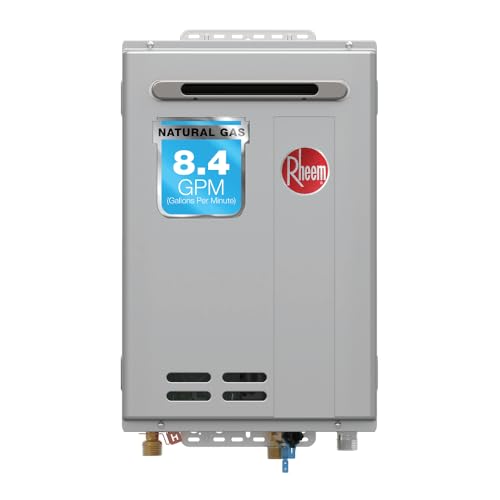
Rheem RTG 8.4 GPM Natural Gas Tankless, 180,000 BTU, Outdoor
8.4 GPM180,000 BTUOutdoorUEF 0.82
Check price on Amazon
Best for: A three to four bathroom home in a mild climate that wants a simple outdoor install.

The RTG 8.4 is a non-condensing outdoor natural gas unit with 180,000 BTU of input, a stated UEF of 0.82 and a rated 8.4 GPM. Because it vents straight out the cabinet, there is no stainless pipe to run, and non-condensing means no condensate drain.

By the standard formula, 180,000 BTU at 0.82 gives about 148,000 BTU of useful heat, so roughly 4.2 GPM at a 70F rise and 7.4 GPM at a 40F rise. That makes the 8.4 headline a best case at a rise near 35F. Compared with the RTG 7.0 it adds about 12 percent more input, and compared with the Rinnai it is simpler but less efficient.

Ownership is routine: a yearly descale, an inlet screen check and a look at the weather shield. Keep the clearances the manual lists around the cabinet. Because the cabinet sits in the weather, inspect the gasket and the vent cap each autumn for cracks, and wire the electrical supply through a weatherproof, GFCI-protected outlet rather than a cord looped across the ground.

What works

  • No vent run and no condensate line
  • Stated UEF of 0.82
  • 180,000 BTU input
  • Wide Rheem service coverage

Watch out for

  • Less efficient than a condensing unit
  • Flow drops in cold-water climates
  • Freeze protection depends on power

Spec sheet

Max flow
8.4 GPM
Input
180,000 BTU
Type
Non-condensing
Efficiency
UEF 0.82
Fuel
Natural gas, outdoor
03
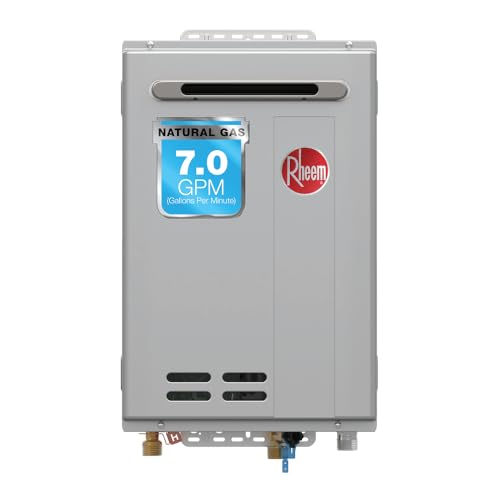
Rheem RTG 7.0 GPM Natural Gas Tankless, 160,000 BTU, Outdoor
7.0 GPM160,000 BTUOutdoorUEF 0.82
Check price on Amazon
Best for: A two to three bathroom home in a mild climate that wants an established brand.

The RTG 7.0 outdoor model is the smaller sibling at 160,000 BTU and 7.0 GPM, with the same 0.82 UEF and no vent run. The listing says it saves up to 34 percent compared with a standard tank, which is a manufacturer comparison.

Its useful heat is about 131,000 BTU, so roughly 3.7 GPM at a 70F rise and 6.5 GPM at a 40F rise. That suits a two to three bathroom home in a mild climate. Compared with the 8.4 GPM model it has about 11 percent less input and a lower price, and compared with the Westinghouse it adds about a third more capacity.

Ownership centers on the same descaling and screen care. Mount it with the manual's clearances, keep snow and leaves away from the cabinet and make sure the gas line is sized for 160,000 BTU. It also suits a home that already has a half-inch gas line near the planned wall, since the lower input is easier to supply than the 180,000 BTU models.

What works

  • No vent run and no condensate line
  • Stated UEF of 0.82
  • 160,000 BTU input
  • Established brand with parts

Watch out for

  • Flow falls in cold-water climates
  • Freeze protection depends on power
  • Less efficient than a condensing unit

Spec sheet

Max flow
7.0 GPM
Input
160,000 BTU
Type
Non-condensing
Efficiency
UEF 0.82
Fuel
Natural gas, outdoor
04
Westinghouse 120,000 BTU Outdoor Natural Gas Tankless, 5.1 GPM
120,000 BTU5.1 GPMPlus or minus 1FOutdoor
Check price on Amazon
Best for: A two bathroom home in a mild climate that wants a lower price tier.

Westinghouse's outdoor unit lists 120,000 BTU and 5.1 GPM, with self-modulating technology that adjusts gas and water flow to hold the setpoint within one degree. It is designed for outdoor wall mounting and whole-house use.

The useful heat at roughly 0.8 efficiency is about 96,000 BTU, so about 2.7 GPM at a 70F rise and 4.8 GPM at a 40F rise. That suits two to three fixtures in a mild climate. Against the Rheem RTG 7.0 it has about 75 percent of the input, and against the Orbek it has a similar rating and a widely known brand name.

Ownership is the usual descale and inlet screen care, plus keeping the cabinet clear of debris. Confirm the freeze-protection behavior in the manual. In snow country, mount it above the expected snow line and keep a clear path to the cabinet, because a drifted cabinet is both a freezing risk and a service headache.

What works

  • Self-modulating output holds plus or minus 1F
  • 120,000 BTU input for mid-size homes
  • Designed for outdoor mounting
  • Known appliance brand name

Watch out for

  • No UEF stated in the data
  • Flow falls fast in cold climates
  • Less capacity than the Rheem units

Spec sheet

Input
120,000 BTU
Max flow
5.1 GPM
Temperature stability
Plus or minus 1F
Modulation
Self-modulating
Fuel
Natural gas, outdoor
05
Orbek 120,000 BTU Natural Gas Tankless, 5.1 GPM, Indoor or Outdoor, WiFi
120,000 BTU5.1 GPMCSA certifiedWiFi and voice
Check price on Amazon
Best for: A two bathroom home that wants app monitoring and a flexible install.

Orbek's unit lists 120,000 BTU and 5.1 GPM, CSA certification, plus or minus 1F stability and WiFi control through its app and voice assistants. It is designed for both indoor and outdoor installation.

The flexibility is the point: you can choose outdoor mounting now and move indoors later, or use the same model across properties. The tradeoff is a newer brand with less service depth. Compared with the Westinghouse it adds CSA certification and an app, and compared with the Rheem units it has less input and no stated UEF.

Ownership is the usual descale, screen and clearance care. Treat the app as a convenience, and make sure the unit works without it. If you pick it, verify in the manual which of its settings assume an indoor install, because outdoor use may change the venting and the freeze protection requirements.

What works

  • CSA certified
  • WiFi app and voice control
  • Indoor or outdoor installation
  • Temperature stability of plus or minus 1F

Watch out for

  • Newer brand with less service depth
  • No UEF stated in the data
  • App adds a software dependency

Spec sheet

Input
120,000 BTU
Max flow
5.1 GPM
Stability
Plus or minus 1F
Certification
CSA
Control
WiFi app and voice
06
Ranein Natural Gas Tankless, 190,000 BTU, 8.5 GPM, Outdoor
190,000 BTU8.5 GPMOutdoor4 to 6 points
Check price on Amazon
Best for: A larger home in a mild climate that wants high input at a lower price tier.

Ranein's outdoor unit lists 190,000 BTU, 8.5 GPM for four to six water points and an under-mounted fan that the listing says prevents smoke backflow. It is a natural gas model built for outdoor mounting.

By the formula, 190,000 BTU at about 0.8 efficiency gives roughly 4.3 GPM at a 70F rise and 7.6 GPM at a 40F rise, so the 8.5 GPM headline needs a rise near 36F. Compared with the Rheem 8.4 it has more input and no stated UEF, and compared with the Rinnai it is non-condensing and less costly.

Ownership is the usual care, with an extra check of the power supply to the fan. Confirm the warranty and parts availability, since the brand is newer. Walk the planned location with the installer before you order, because a 190,000 BTU unit needs a sturdy wall, a larger gas line and open space around the cabinet.

What works

  • 190,000 BTU input for large households
  • Under-mounted fan against smoke backflow
  • Rated for four to six water points
  • Lower price tier than the premium brands

Watch out for

  • No UEF stated in the data
  • Newer brand with less service depth
  • 8.5 GPM claim assumes a small temperature rise

Spec sheet

Input
190,000 BTU
Max flow
8.5 GPM
Water points
4 to 6
Fan
Under-mounted blower
Fuel
Natural gas, outdoor

Spec sheet decoder

What the numbers on the box really mean

The specs manufacturers lead with, translated into what they tell you about real-world performance.

BTU input

The gas energy the burner can use each hour. Higher input allows higher flow at a given rise.

Watch forThe range runs from 120,000 BTU on the Westinghouse and Orbek to 190,000 BTU on the Ranein.

UEF

Uniform Energy Factor, the DOE efficiency measure for water heaters. Higher means less gas per gallon heated.

Watch forThe Rheem RTG units state 0.82, but the others do not in the data.

Condensing

A design that recovers exhaust heat and produces acidic condensate that must drain.

Watch forOnly the Rinnai RX180iN is condensing.

Versa Vent

Rinnai's system that allows one model to be installed indoors or outdoors.

Watch forThe RX180iN uses it, and other units are outdoor-only or flexible by design.

CSA certified

A safety certification for gas appliances from a recognized body.

Watch forThe Orbek lists CSA certification.

Methodology

How We Evaluated These Outdoor Tankless Water Heaters

Outdoor suitability

We checked that each unit was built for outdoor mounting, with a weather-resistant cabinet and freeze protection. The Rheem RTG outdoor units and the Rinnai Versa Vent system scored highest.

Real capacity

We converted BTU input and efficiency into GPM at a 70F rise, giving about 4.2 for the Rheem 8.4, 3.7 for the RTG 7.0 and 2.7 for the Westinghouse. Headline GPM was treated as a best case.

Install burden

We counted gas line demand, condensate handling and power requirements. Non-condensing units avoid a condensate line, and the Rinnai needs a drain.

Certification and control

We credited the Orbek's CSA certification and the Westinghouse's one-degree stability. Features that improve safety and comfort scored higher.

Support

We considered brand service depth based on owner feedback patterns. Rinnai and Rheem scored best, Westinghouse in the middle and newer brands lower.

Decision guide

How to Choose the Right Outdoor Tankless Water Heaters

By Household Size

SituationPickWhy
2 bathrooms, mild climateWestinghouse 120,000 BTU5.1 GPM rating
2 to 3 bathroomsRheem RTG 7.0 GPMUEF 0.82
3 to 4 bathroomsRheem RTG 8.4 GPM180,000 BTU
4 or more bathroomsRinnai RX180iN10 GPM condensing

By Budget

SituationPickWhy
Lowest costWestinghouse 120,000 BTULower price tier
Low-to-mid with CSAOrbek 120,000 BTUCSA and app
Mid-range brandRheem RTG 7.0 GPMService network
Highest outlayRinnai RX180iNCondensing and flexible

Condensing vs Non-Condensing Outdoors

Condensing

The Rinnai RX180iN is more efficient and runs cool exhaust, but it produces condensate that must drain and can freeze. It costs more.

Non-condensing

The Rheem RTG units, Westinghouse, Orbek and Ranein have no condensate line. They cost less and suit cold regions, at lower efficiency.

Choose non-condensing in a freezing climate and condensing in a mild one if efficiency matters.

Climate and Freeze Risk

SituationPickWhy
Mild climate, rare freezesRinnai RX180iNEfficiency
Cold winters, reliable powerRheem RTG 7.0 GPMNo condensate line
Cold winters, outages likelyRheem RTG 8.4 GPMDrain it before outages
Indoor option laterOrbek 120,000 BTUIndoor or outdoor

For Retrofits Specifically

Look for

A unit that avoids a new vent through the house, fits an exterior wall near the gas line and uses the existing water lines. Outdoor mounting often saves more than the unit costs.

In this comparison

The Rheem RTG outdoor models and the Westinghouse are the simplest retrofits, and the Rinnai is the most flexible.

When to Spend More

Spend more if

You have a large household or want condensing efficiency. The Rinnai RX180iN or the Rheem RTG 8.4 repays the premium.

Save if

The home is small and the climate mild. The Westinghouse 120,000 BTU does the job.

Ownership

Maintenance schedule

The upkeep that decides whether this machine lasts two seasons or ten.

TaskIntervalWhy it matters
Descale the heat exchangerYearly, more often in hard waterScale cuts heat transfer and flow. Circulate descaling solution through the service valves.
Clear the cabinet and ventEach seasonLeaves, nests and snow block airflow and exhaust. Keep the clearances free.
Test freeze protectionEach autumnA failed heater or sensor can freeze the heat exchanger. Check that it is powered and working. Do the check before the first hard freeze, not after.
Clean the inlet screenEvery 6 to 12 monthsA clogged screen starves the unit of flow. Rinse it with the water shut off.
Have combustion checkedYearlyA technician confirms the flame, gas pressure and carbon monoxide levels.

FAQ

Frequently Asked Questions

Do outdoor tankless heaters work in winter?

Yes, if they have freeze protection and power. In a long outage during a hard freeze they can freeze, so drain the unit or add backup power in cold regions. A small generator or a battery backup that powers the heater controls is a cheap insurance policy for rural homes.

Why choose outdoor over indoor?

No vent run through the house, no combustion inside and more room indoors. It often reduces the install cost on a retrofit. It also leaves the room that would hold a vent and a gas shutoff free for storage.

Do outdoor units need a condensate drain?

Only condensing models such as the Rinnai RX180iN. The Rheem RTG, Westinghouse, Orbek and Ranein units are non-condensing and have no condensate line.

How much gas does an outdoor tankless need?

A 180,000 BTU unit draws about four times a typical tank heater. Have a plumber check the line size from the meter. A longer run to an exterior wall also loses some pressure, so tell the plumber the distance.

What clearances do I need?

Each manual lists distances from windows, doors, vents and walls, and a service space around the cabinet. Follow them exactly, since wind and snow also matter. An installer can usually fit the unit in the clearances if you describe the wall and the neighboring windows in advance.

How long do outdoor tankless heaters last?

Often 15 to 20 years with yearly descaling and care. Weather exposure makes cabinet and vent checks more important than for an indoor unit. Replacing a damaged weather cover is much cheaper than replacing a corroded cabinet.

Bottom line

The short version

Browse more outdoor tankless water heaterson Amazon →
James Miller, Lead Machine Editor

About the author

James Miller

Lead Machine Editor, MachineFanatic

James Miller leads MachineFanatic's buying guides, turning spec sheets, manuals and owner feedback into clear verdicts on power tools, outdoor power equipment, shop machines and kitchen machines.

More from James →

Keep reading

Related guides