


Amazon affiliate links - we earn a commission.Affiliate disclosure

Buying guide · 12 min read · Updated 2026-11-07

Best Generators for Refrigerators and Freezers (2026)

Four generators that can keep a fridge and chest freezer cold in an outage, ranked by running watts, tank life and startup surge headroom.

James MillerBy James MillerLead Machine Editor4 machines comparedSpec-sheet verified
Best Generators for Refrigerators and Freezers

At a glance

Our top picks

Side by side

Spec comparison

MachineOutputTankRuntimeOutletsStart
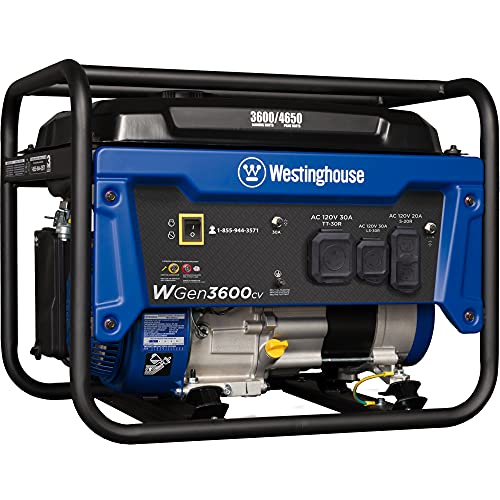
Westinghouse 4650W Portable Generator, RV Ready 30ABest OverallWestinghouse 4650W Portable Generator, RV Ready 30A4,650 peak / 3,600 running W4 gallons with gaugeUp to 14 hours per tankTwo 5-20R, TT-30R, L5-30RRecoil
Oxseryn 4400W Inverter-Style Generator with ECO ModeBest ValueOxseryn 4400W Inverter-Style Generator with ECO Mode4,400 peak / 3,400 running W2 gallons with gaugeUp to 14 hours at 25% loadTwo 120V AC, 12V DC, RV portn/a
Westinghouse 13500W Dual Fuel Home Backup GeneratorBest Long RuntimeWestinghouse 13500W Dual Fuel Home Backup Generatorn/a9.5 gallonsUp to 19 hours at 25% loadn/aRemote electric
Westinghouse 14500W Tri-Fuel Home Backup GeneratorBest for Natural Gas HookupWestinghouse 14500W Tri-Fuel Home Backup Generatorn/an/an/an/an/a

Keeping cold storage alive is the most common reason people buy a generator, and it is more demanding than it looks. A compressor does not draw its nameplate power steadily: it surges when it starts, cycles on and off, and restarts after every cycle.

The goal is food safety at a sensible fuel cost. That means a machine with enough starting headroom for a compressor, a tank that lasts through the night, and a connection method that does not tempt you into a daisy chain of extension cords. The four picks below take different routes to the same outcome.

Before you buy

6 Criteria to Look For Before Buying a Generator for Refrigerators and Freezers

  1. 01

    Compressor startup surge

    A refrigerator compressor can draw two to three times its running watts for a moment at startup, and a chest freezer does the same. A 3,600-watt Westinghouse 4650 or 3,400-watt Oxseryn 4400 has headroom for one of each. Add every other load to the total before you pick.

  2. 02

    Runtime per tank

    Food safety depends on cold, so a machine that runs dry overnight defeats the purpose. The Westinghouse 13500 lists up to 19 hours at a quarter load on 9.5 gallons, while the Oxseryn lists up to 14 hours on two gallons. Check the load basis behind each runtime claim.

  3. 03

    Cycling load and ECO mode

    Fridges cycle, so the generator spends much of its time lightly loaded. ECO mode, as on the Oxseryn, saves fuel but can cause a momentary voltage sag at compressor startup. If a fridge hesitates to restart, turn ECO off.

  4. 04

    Cord and outlet setup

    Use a heavy-gauge cord rated for the load and keep it short. The Westinghouse 4650 has TT-30R and L5-30R outlets for a proper inlet, which beats a chain of thin extension cords. Never plug the generator into a wall outlet.

  5. 05

    Power cleanliness

    Modern refrigerators have control boards that dislike distorted power. Inverter units quote under 3 percent THD, and the Westinghouse 14500 quotes under 5 percent THD with copper windings. A conventional set is fine for older mechanical fridges.

  6. 06

    Food safety timelines

    A closed refrigerator stays safe for about four hours without power, and a full freezer about 48 hours if the door stays shut. That gives you room to cycle the generator rather than run it nonstop, which saves fuel on a longer outage.

Detailed reviews

The 4 best generators for refrigerators and freezers, explained

01
Westinghouse 4650W Portable Generator, RV Ready 30A
3,600W running4 gal tankCO sensorRecoil start
Check price on Amazon
Best for: A refrigerator and chest freezer in a normal home outage.

Most households want to run one refrigerator and one chest freezer, and 3,600 running watts handles both with room for a compressor surge, a lamp and a phone charger. This Westinghouse is a conventional open-frame set, not an inverter, which makes it louder but also simpler and cheaper to repair. The four-gallon tank with a fuel gauge is the real advantage for cold storage because you see the level without opening anything.

It ships with oil, a funnel and a tool kit, so a first-time buyer can have it running the day it arrives. The mix of two household outlets, a TT-30R and an L5-30R lets you choose between direct plug-in and a manual transfer inlet. Compared with the Oxseryn 4400, it has similar output but a larger tank, and a built-in CO sensor that shuts the engine down on dangerous exhaust buildup.

Because it is open-frame, the main ownership chore is keeping it clean and dry. Run it under load once a month, change the oil early, and keep gasoline stabilized, since a freezer-backup generator may sit idle for a year between outages. Recoil starting is easy on a 3,600-watt engine, but a cold unit sometimes needs a few pulls, so practice before you need it. One practical note on placement: a conventional set like this blows hot exhaust and vibrates, so set it on level ground a good distance from the house, and run the cord back along a wall where it will not be stepped on. A fridge that restarts after a power blip should not see the generator hunt up and down, and a steady four-gallon fuel supply is what keeps the engine from surging.

What works

  • 3,600 running watts covers two compressors
  • Four-gallon tank with a fuel gauge
  • Built-in CO sensor shutdown
  • Ships ready with oil and a tool kit

Watch out for

  • Open-frame design is noisy at the house wall
  • Recoil start only on this model

Spec sheet

Output
4,650 peak / 3,600 running W
Tank
4 gallons with gauge
Runtime
Up to 14 hours per tank
Outlets
Two 5-20R, TT-30R, L5-30R
Start
Recoil
02
Oxseryn 4400W Inverter-Style Generator with ECO Mode
3,400W running2 gal tankECO mode14 hrs at 25%
Check price on Amazon
Best for: Cost-conscious owners who want fuel economy on cycling loads.

A refrigerator compressor cycles on for a few minutes and rests, so the generator spends much of its life well below its rating. ECO mode lets the engine drop its speed during those quiet stretches, and that is exactly the usage pattern where this Oxseryn earns its fuel economy. Its fourteen-hour figure is quoted at a quarter load, which is close to the real draw of a single fridge and freezer pair.

The tradeoff is the tank. Two gallons is half what the Westinghouse 4650 carries, so an overnight outage means a mid-night refill if the load is heavier than a quarter. The three-point ports are 120V, a 12V DC outlet and an RV port, which is enough for plug-in appliances but less flexible than the Westinghouse for transfer hookups. Treat its open-frame body as an outdoor-only machine.

One caution: ECO mode can cause brief voltage dips when a compressor starts, so if a fridge is slow to restart, switch ECO off while the compressor cycles. Rotate stabilized fuel through the tank, and use the gauge each time you refuel to avoid running dry, because a lean-out shutdown stops the fridge at the worst moment. For a single apartment-size refrigerator it is a perfectly sensible size, and its lighter frame means one person can carry it from the shed to the patio without a cart. Owners who add a chest freezer should watch the load and keep the total below about 2,400 watts running.

What works

  • ECO mode matches fuel use to light cycling loads
  • 3,400 running watts clears a fridge and freezer
  • Fuel gauge on a two-gallon tank
  • Light enough to move to a better spot

Watch out for

  • Small tank means more refills overnight
  • No electric start or propane option on the listing

Spec sheet

Output
4,400 peak / 3,400 running W
Tank
2 gallons with gauge
Runtime
Up to 14 hours at 25% load
Outlets
Two 120V AC, 12V DC, RV port
Frame
Open frame, ECO mode
03
Westinghouse 13500W Dual Fuel Home Backup Generator
9.5 gal tank19 hrs at 25%Dual fuel500cc engine
Check price on Amazon
Best for: Large outages where cold storage shares the generator with other circuits.

A generator this big is overkill for a single fridge, but it makes sense when the freezer, the fridge, a sump pump and a few circuits all need power through a multi-day outage. The 9.5-gallon tank is the feature for cold storage: at a quarter load, the listing claims up to 19 hours, so one fill carries through the night and into the next morning without a midnight refill.

It also offers a pressure lubrication system, which pushes oil to critical bearings, a design suited to long running times. Dual fuel adds a propane fallback so you are not entirely dependent on gasoline. The downside is size and noise, and the cost of fuel at a large engine's idle burn rate, which is higher than the small units for the same fridge load.

Pair it with the WATS200 automatic transfer switch and it can keep a chest freezer cold while you are away. Without that, you will still need a safe cord setup. Oil changes matter on a unit that runs for days, so check the level after every long run, and keep the battery charged for the push-button start. Expect to size your cords carefully: with this much available capacity, it is easy to plug in more than the cord can carry. Use a cord with a gauge matched to the length and the amperage, and label which cord feeds the fridge so no one unplugs it to charge a phone.

What works

  • 9.5-gallon tank for long unattended runs
  • Pressure lubrication for extended hours
  • Dual fuel with a propane fallback
  • Automatic transfer switch compatible

Watch out for

  • Overkill and fuel-hungry for one fridge alone
  • Large and heavy to position safely

Spec sheet

Peak output
13,500 W
Engine
500cc, pressure lubricated
Tank
9.5 gallons
Runtime
Up to 19 hours at 25% load
Start
Remote electric
04
Westinghouse 14500W Tri-Fuel Home Backup Generator
14,500W peakTri-fuel550cc engineRemote start
Check price on Amazon
Best for: Homes with natural gas service that want hands-off cold storage backup.

The tri-fuel feature is the point. Run on a natural gas line and a chest freezer can stay cold as long as the utility supply holds, with no refueling at all, which is the most reliable cold storage setup in this roundup. Gasoline and propane remain available if the gas line is cut or you move the unit.

Its 550cc engine uses pressure lubrication, and under 5 percent THD with copper windings gives cleaner power than a plain open-frame set for the electronic controls inside a modern refrigerator. As with its dual fuel sibling, it can pair with the WATS200 for automatic backup, so a failing grid at night does not spoil the freezer.

Compare it to the 13500 dual fuel: the 14500 adds a fuel option and a bigger engine at a higher price, so only buy it if you have natural gas service and a plan to connect it correctly. Have a licensed professional run the gas line, test the connection at the start of the season, and run it monthly so the carburetor and the battery stay healthy. If natural gas is not available at your house, the extra fuel option is wasted money, and the 13500 dual fuel will do the same cold storage job with simpler hookups. For a household with a gas meter and a chest freezer in the basement, though, the pairing is hard to beat.

What works

  • Natural gas operation removes refueling
  • Gasoline and propane as fallback fuels
  • Pressure-lubricated 550cc engine
  • Pairs with an automatic transfer switch

Watch out for

  • Natural gas hookup needs professional installation
  • Highest tier and largest footprint here

Spec sheet

Peak output
14,500 W
Fuel
Gasoline, propane, natural gas
Engine
550cc, pressure lubricated
Power quality
Under 5% THD
Automation
WATS200 compatible

Spec sheet decoder

What the numbers on the box really mean

The specs manufacturers lead with, translated into what they tell you about real-world performance.

Running watts

The continuous output the generator can hold. This is the figure to compare against fridge and freezer draw.

Watch forThe Westinghouse 4650 delivers 3,600 running against a 4,650 peak, a roughly 22 percent gap.

Starting surge

A short allowance for motor start, not usable continuously. Compressors need it every cycle.

Watch forThe Oxseryn lists 4,400 peak against 3,400 running, so the surge margin is 1,000 watts.

Runtime at 25 percent load

A fuel economy statement under light load, close to a fridge cycling pattern.

Watch forThe Westinghouse 13500 claims 19 hours from 9.5 gallons, but a heavier load will shorten it.

THD

Total harmonic distortion measures waveform cleanliness. Lower is safer for control boards.

Watch forThe Westinghouse 14500 lists under 5 percent, which is acceptable but looser than an inverter claim.

Tri-fuel rating

The generator accepts gasoline, propane or natural gas, with output varying by fuel.

Watch forThe 14500 listing does not break out running watts per fuel in the data we reviewed, so confirm with the manual.

Methodology

How We Evaluated These Generators for Refrigerators and Freezers

Surge headroom

We compared each machine's running and peak watts against a fridge and chest freezer pair with compressors starting. The Westinghouse 4650 and the Oxseryn 4400 clear that load. Larger machines gain headroom but at a fuel cost.

Runtime and tank

We looked at tank size and the stated runtime basis, since cold storage fails when the engine stops. The 9.5-gallon Westinghouse 13500 scored best, the two-gallon Oxseryn lowest. Fuel flexibility counted toward endurance.

Connection options

We checked outlet types and transfer-switch compatibility, because a clean connection beats extension cord improvisation. The 4650 offers TT-30R and L5-30R outlets, while the 13500 and 14500 pair with an automatic switch.

Power quality

We weighed listed THD and winding materials for modern refrigerator electronics. The 14500 lists under 5 percent THD and copper windings. Inverter-style units generally do better on paper.

Safety and upkeep

CO shutdown, low-oil protection and ease of service were compared by the spec sheet. The Westinghouse 4650 includes a CO sensor. We assumed every unit must run outdoors in open air.

Decision guide

How to Choose the Right Generators for Refrigerators and Freezers

By Appliances Protected

SituationPickWhy
One fridge and one chest freezerWestinghouse 4650W3,600 running watts and a 4-gallon tank
One fridge and a few lightsOxseryn 4400WECO mode saves fuel on cycling loads
Fridge, freezer and a sump pumpWestinghouse 13500WLarge tank and more headroom
Everything, automatic and away from homeWestinghouse 14500WWATS200 compatible, tri-fuel
Garage freezer plus a house fridgeWestinghouse 4650WTwo 120V outlets and a 30A for a transfer inlet

By Budget

SituationPickWhy
Lowest entry costOxseryn 4400WSmallest price tier
Mid-range, simpleWestinghouse 4650WConventional design with a big tank
Large dual fuelWestinghouse 13500WHigher tier for runtime and expansion
Natural gas connectionWestinghouse 14500WHighest tier, three fuels
Value for a fridge onlyOxseryn 4400WFuel economy at the cheapest tier

Small Portable vs Large Home Backup

Small portable

The Westinghouse 4650 and Oxseryn 4400 are easy to store and cheap to run, and they cover a fridge and freezer. Their limit is capacity for extra circuits and the small tank on the Oxseryn.

Large home backup

The Westinghouse 13500 and 14500 carry more circuits, run longer per tank and can run automatically with a transfer switch. They cost more to buy, burn more fuel and need installation.

Buy small if cold storage is the whole job. Buy large only if you also need pumps, heating controls or automatic switchover.

Fuel Strategy

SituationPickWhy
Gasoline only, simpleWestinghouse 4650WFour-gallon tank, no fuel switching
Propane stockpileWestinghouse 13500WDual fuel with stored cylinders
Natural gas supplyWestinghouse 14500WTri-fuel with a line connection
Short outages, low fuel useOxseryn 4400WECO mode on gasoline
Mixed storage planWestinghouse 13500WGasoline and propane fallback

For Chest Freezers Specifically

Look for

Check the freezer's nameplate running watts and plan for a surge of two to three times that value. A full freezer holds temperature for about 48 hours with the door closed, so you can run the generator in cycles of several hours instead of continuously.

In this comparison

The Westinghouse 4650 handles a chest freezer and a fridge together, while the Oxseryn 4400 handles the pair with the least fuel. Choose the 13500 only if the freezer shares the generator with a sump pump or heating circuits.

When to Spend More

Spend more if

Outages last days, you have a stocked chest freezer, or you are away often. The Westinghouse 13500 and 14500 with a transfer switch protect that food without your presence.

Save if

You have a single fridge and outages are short. The Oxseryn 4400 or Westinghouse 4650 keeps it cold for far less money and fuel.

Ownership

Maintenance schedule

The upkeep that decides whether this machine lasts two seasons or ten.

TaskIntervalWhy it matters
Monthly run under loadEvery monthA stored generator fails from stale fuel and a flat battery. Running it for 15 minutes keeps the carburetor and the start battery healthy. Log the date each time so you remember when you last did it.
Oil level checkBefore every startLow-oil shutdown stops the engine and your food starts warming. Small crankcases lose oil quickly under load.
Fuel stabilizerEvery fill that will sit over 30 daysGasoline gums jets over a few months, the top failure cause. Rotate stock regularly.
Fridge thermometer checkEvery outage, every few hoursUse an appliance thermometer to confirm the fridge stays at or below 40 degrees Fahrenheit. This tells you whether to run the generator longer.
Air filter cleaningEvery 25 hoursA clogged filter makes the engine hunt and burn extra fuel. Foam filters can be washed and reoiled.

FAQ

Frequently Asked Questions

How many watts does a refrigerator and freezer need?

A modern refrigerator typically runs on a few hundred watts but can surge to several times that at startup, and a chest freezer is similar. A generator with 3,000 to 3,600 running watts covers both with headroom. Always check the data plate on each appliance rather than guessing, because older units draw noticeably more than newer efficient ones.

Should I run the generator all night?

Not necessarily. A closed refrigerator stays safe for about four hours and a full freezer for about 48 hours, so cycling the generator saves fuel. Check a thermometer in each appliance. Opening the doors as little as possible matters more than any generator choice.

Is an inverter generator better for a refrigerator?

Inverter models give cleaner power for electronic control boards and run quietly, but a conventional set like the Westinghouse 4650 works fine for most refrigerators. The choice is mostly cost versus noise.

Can I use a regular extension cord?

Only a heavy-gauge cord rated for the load, kept short. Thin cords overheat. A proper transfer inlet is safer for hardwired circuits.

Does ECO mode affect a compressor?

It can, because the engine slows at light load and a compressor start then pulls a sudden surge. If the fridge hesitates, turn ECO off during startup.

Where should the generator run?

Outdoors, in open air and well away from windows, doors and vents. Never run a generator in a garage or enclosed space, because carbon monoxide builds up quickly.

Bottom line

The short version

Browse more generators for refrigerators and freezerson Amazon →
James Miller, Lead Machine Editor

About the author

James Miller

Lead Machine Editor, MachineFanatic

James Miller leads MachineFanatic's buying guides, turning spec sheets, manuals and owner feedback into clear verdicts on power tools, outdoor power equipment, shop machines and kitchen machines.

More from James →

Keep reading

Related guides