
Amazon affiliate links - we earn a commission.Affiliate disclosure

Buying guide · 13 min read · Updated 2026-11-13

Best LiFePO4 Solar Generators (2026)

Six LiFePO4 solar generators compared on cycle life, cold charging limits, weight penalty and how much real energy each pack holds per pound.

James MillerBy James MillerLead Machine Editor6 machines comparedSpec-sheet verified
Best LiFePO4 Solar Generators

At a glance

Our top picks

Side by side

Spec comparison

Lithium iron phosphate cells have become the default in serious solar generators because they trade a little energy density for a lot of durability. They tolerate heat, survive far more charge cycles and are less prone to the thermal runaway that makes other lithium chemistries nervous in a hot car or a tent.

That durability is not free. The same watt-hours weigh more, and the cells still cannot be charged below freezing. This guide compares stations that use the chemistry by what it buys in practice: how many cycles you can expect, how much each pack weighs for its capacity, and what else the maker did well.

Before you buy

6 Criteria to Look For Before Buying a LiFePO4 Solar Generator

  1. 01

    Cycle life in real numbers

    LiFePO4 packs are commonly rated for 2,000 to 3,000 cycles to 80 percent capacity, against 500 to 800 for other lithium-ion types. A weekly camper cycles about 50 times a year, so the Jackery 1000 v2 would last decades on paper. Treat vendor cycle numbers as targets, not guarantees.

  2. 02

    Cold charging limit

    LiFePO4 cannot be charged below about freezing without damage, and good units block charging in the cold. Check whether the unit has a low temperature charge cutoff or a heater. If you camp in winter, keep the unit inside the tent or the vehicle cabin.

  3. 03

    Weight per watt-hour

    The Jackery 2000 v2 weighs 39.5 lb for 2042Wh, about 52Wh per pound, while the Daran 1000W reaches about 39Wh per pound at 14.8 lb. Standard lithium-ion packs run 10 to 20 percent denser. For backpacking trips, that gap matters.

  4. 04

    Inverter versus pack

    The Daran has a 1000W inverter on a 576Wh pack, which empties in about half an hour at full load, while the UDPOWER's 1200W on 1191Wh lasts about an hour. A balanced ratio of 1 to 1 watt to watt-hour is typical. Strong inverters on small packs suit bursts.

  5. 05

    Fast charging

    LiFePO4 handles fast charging well. The Jackery 1000 v2 refills in 50 minutes, a 1kWh unit that needs 1,200W of input. Check your outlet: a standard 15A circuit supplies around 1,400W, but fast charge on a long extension cord wastes power.

  6. 06

    Support and warranty

    A durable cell is only useful if the electronics survive too. Jackery lists a long warranty and a service network, while smaller brands like Daran and ALLWEI have less history. Pay attention to warranty length and how claims are handled.

Detailed reviews

The 6 best lifepo4 solar generators, explained

01
Jackery Solar Generator 1000 v2 with 200W panel, 1024Wh
1024Wh LiFePO41500W / 3000W50 min charge10ms UPS
Check price on Amazon
Best for: Campers and home backup users who want the most balanced LiFePO4 unit.

Jackery's 1000 v2 shows why LiFePO4 suits the mid size: a 1024Wh pack that charges to full in 50 minutes without complaint, and an inverter strong enough for a 1500W load. Fast charging stresses cells, and LiFePO4 handles it better than most other lithium types, which is why a 50 minute refill is a plausible spec here rather than a risky one.

Its tradeoff is price and panel size. It sits at an upper mid tier for a 1kWh unit, and the 200W foldable panel yields 120 to 160W in real sun, so solar alone refills about half the pack on a good day. The 10ms UPS makes it useful for a desktop or a router, a feature smaller LiFePO4 units here lack.

For longevity, the benefit shows in year three. A LiFePO4 pack typically holds 80 percent of its capacity after 2,000 or more cycles, so a weekly camper gets a decade. Keep the unit out of freezing weather while charging, store it around half full and let the fan run clear. Many owners also use its pass through mode as a desk side buffer, though a unit kept at 100 percent on the wall all year ages a little faster than one that is allowed to cycle. It is the best balance of features, support and durability here.

What works

  • Full charge in 50 minutes
  • 1500W inverter with 3000W peak
  • 10ms UPS for desktops and routers
  • Strong service network

Watch out for

  • Upper mid price for 1kWh
  • 200W panel refills only part of the pack
  • Heavier than lithium-ion rivals

Spec sheet

Capacity
1024Wh LiFePO4
AC output
1500W, 3000W peak
Charge
0 to 100% in 50 minutes
UPS
10ms
Panel
200W foldable
02
Jackery Explorer 2000 v2 with 2x200W panels, 2042Wh
2042Wh LiFePO42200W AC39.5 lb20ms UPS
Check price on Amazon
Best for: Home backup and long camping trips that need 2kWh on LiFePO4.

At 39.5 lb for 2042Wh, the Explorer 2000 v2 is a case study in the weight cost of LiFePO4: Jackery claims it is 41 percent lighter than comparable units, yet it still weighs more than a checked bag. What it buys is a 2200W inverter that can run a full kitchen of small appliances in sequence and a pack that will not mind a hot garage.

The tradeoffs are bulk and cost. Two people can move it, but it is not a one hand carry, and the 2x200W panels add 240 to 320W of real harvest, which fills the pack in about three days. The 20ms UPS switchover is slower than the 10ms of the 1000 v2, which could matter for a sensitive desktop.

Ownership is simple. Park it in a dry place, charge it above freezing, and cycle it freely. LiFePO4 rewards regular use more than careful babying, because modest depth of discharge and moderate temperatures give the best life. For a home backup that sees monthly use, it is a durable choice.

What works

  • 2042Wh LiFePO4 pack
  • 2200W inverter
  • 2x200W panels included
  • Strong service network

Watch out for

  • 39.5 lb takes two hands
  • 20ms UPS is slower than the 1000 v2
  • High price tier

Spec sheet

Capacity
2042Wh LiFePO4
AC output
2200W
Weight
39.5 lb
UPS
20ms
Panels
2 x 200W
03
UDPOWER S1200 1191Wh 1200W with 2x120W panels
1191Wh LiFePO41200W AC2x120W panelsPure sine
Check price on Amazon
Best for: First time solar buyers who want a 1.2kWh LiFePO4 kit with panels included.

UDPOWER's S1200 leans on capacity for the money: 1191Wh of LiFePO4 is about 16 percent more than the Jackery 1000 v2 pack, and the bundle includes two 120W panels for 240W rated. Real output of 140 to 190W refills a good part of the pack on a sunny day, which is stronger than the 200W single panel on the Jackery bundle.

Its limit is the 1200W inverter, which is a step below the Jackery's 1500W and cannot start some larger compressors. The brand is newer and its listing does not state UPS speed or fast charge numbers, so it is less predictable as a home backup. Support is also thinner than the big brands.

For ownership, the S1200 is a straightforward box. Keep it indoors, give it airflow and avoid charging below freezing. Because the bundle already includes panels, it suits a first solar setup. Choose it if you want capacity and panels for the money, and accept that the brand has less history. A simple check on arrival is to run a known 100W load for an hour and watch the percentage fall, which tells you whether the pack really delivers what the label claims.

What works

  • 1191Wh LiFePO4 capacity
  • Two 120W panels in the bundle
  • Pure sine 1200W inverter
  • Lower tier than the Jackery units

Watch out for

  • 1200W inverter limits larger loads
  • No stated UPS or fast charge figures
  • Newer brand with thin support

Spec sheet

Capacity
1191Wh LiFePO4
AC output
1200W pure sine
Panels
2 x 120W (240W total)
Cells
LiFePO4
Class
Mid size kit
04
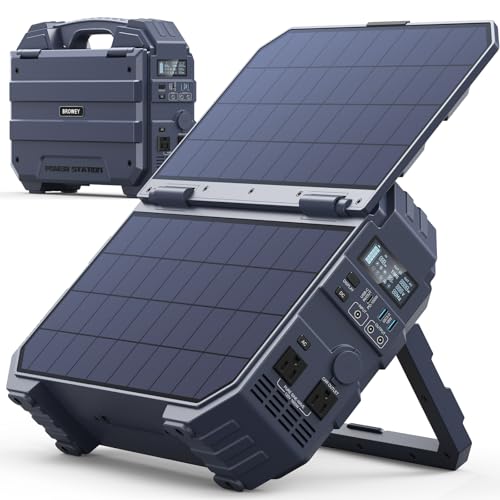
BROWEY 1600W 1024Wh with built in 40W panel
1024Wh LiFePO41600W / 3200W40W built in panel100W USB-C
Check price on Amazon
Best for: Campers who want a self contained unit with a built in panel and a strong inverter.

BROWEY's twist is a 40W solar panel that folds out of the case, so there is nothing separate to carry or lose. For a camper who wants a trickle of solar without managing cables, it is a convenient design, and a 1600W inverter with 3200W peak is stronger than the Jackery's 1500W in the same class.

The cost is that 40W is a tiny panel for a 1024Wh pack: real output of 25 to 30W yields perhaps 150Wh on a good day, so it keeps a phone and light load afloat, not the fridge. Serious solar needs an external array, so the built in panel is a convenience rather than a strategy. The brand has little track record and its service reach is limited.

In ownership terms, the fold out panel adds a hinge and a connector to inspect, so keep it clean and check it for cracks. The LiFePO4 pack is the durable part. It suits users who want an all in one box and a strong inverter more than a solar bundle.

What works

  • 1600W inverter with 3200W peak
  • Built in fold out 40W panel
  • 100W USB-C output
  • 1024Wh LiFePO4 pack

Watch out for

  • 40W panel is a trickle for the pack
  • Little brand history
  • Panel hinge is another wear point

Spec sheet

Capacity
1024Wh LiFePO4
AC output
1600W, 3200W peak
Built in panel
40W fold out
USB-C
100W
Wave
Pure sine
05
Daran 1000W 576Wh LiFePO4, 14.8 lb
576Wh LiFePO41000W / 2000W14.8 lb9 ports
Check price on Amazon
Best for: Trips where weight matters and a few minutes of microwave class power are needed.

Daran squeezes a 1000W inverter and 576Wh of LiFePO4 into 14.8 lb, which makes it the most carriable high output LiFePO4 box in the guide. A 1000W output lets it run a microwave at 700W or a coffee maker, which smaller 300W units cannot, and the 100W PD port charges most laptops quickly.

The weakness is that its inverter outsizes its tank. At 576Wh, a 1000W load empties it in about 30 minutes, so the 1000W rating is for brief tasks rather than long runs. It has no bundled panel in this listing and offers few details on UPS or app control. As a lighter unit it competes with the Bluetti Elite 30 V2 on weight but offers more output at a lower price tier.

Care is simple: keep it dry, charge above freezing and store at partial charge. It suits short trips where weight matters and a few minutes of heavy loads are needed, such as a coffee break or a hair dryer on low.

What works

  • 1000W inverter with 2000W peak
  • LiFePO4 in a 14.8 lb body
  • Nine ports with 100W PD
  • Lower price tier

Watch out for

  • 576Wh empties in about 30 minutes at full load
  • No panel bundled
  • Limited UPS and app detail

Spec sheet

Capacity
576Wh LiFePO4
AC output
1000W, 2000W peak
Weight
14.8 lb
Ports
9 including 100W PD
Wave
Pure sine
06
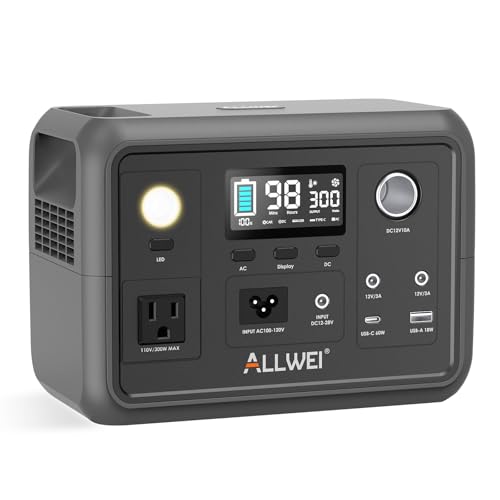
ALLWEI 300W 256Wh LiFePO4 power station
256Wh LiFePO4300W / 600W60W PDPure sine
Check price on Amazon
Best for: Light users who want LiFePO4 durability in the smallest package.

ALLWEI's 300W station is the entry point to LiFePO4: 256Wh of cells that are rated for thousands of cycles in a pocket sized box. For a small kit of phone, laptop and lights, the pack gives about 215Wh usable, enough for two laptop charges and a night of LED lighting.

Its limits are size and ecosystem. 300W cannot run anything that heats, and the 60W USB-C port is tight for a laptop charger. Solar input is modest and no panel is included. The brand has a limited service history and its listing is thin on UPS and app details.

Upkeep is low: no moving parts beyond a fan, and LiFePO4 tolerates being left half charged. If you want the durability of the chemistry in the cheapest possible package, this is it, and the small size keeps weight low for travel.

What works

  • LiFePO4 rated for thousands of cycles
  • Pure sine AC output
  • Compact and light
  • Low cost of entry

Watch out for

  • 300W cannot run heating loads
  • 60W USB-C is tight for some laptops
  • Limited service history

Spec sheet

Capacity
256Wh LiFePO4
AC output
300W, 600W surge
USB-C
60W PD
Wave
Pure sine
Class
Compact

Spec sheet decoder

What the numbers on the box really mean

The specs manufacturers lead with, translated into what they tell you about real-world performance.

LiFePO4

Lithium iron phosphate cells, rated for thousands of cycles and stable at high temperature.

Watch forAll picks here use it, but weight and charging limits differ.

2000 cycles to 80%

How many full charge cycles before capacity falls to 80 percent.

Watch forVendor figures vary and are not independently verified.

3000W peak

The Jackery 1000 v2's brief surge allowance for motor starts.

Watch forIt does not raise the 1500W continuous limit.

Wh per pound

A rough measure of energy density, higher is better for carrying.

Watch forJackery 2000 v2 is about 52, Daran 1000W about 39.

UPS 10ms

How fast the unit switches to battery when wall power fails.

Watch forJackery lists 10ms on the 1000 v2 and 20ms on the 2000 v2.

Methodology

How We Evaluated These LiFePO4 Solar Generators

Chemistry and cycle claims

We checked each listing for LiFePO4 and for stated cycle life, treating vendor numbers as claims. We favored units that gave a figure and a warranty.

Capacity and weight

We compared watt-hours to weight to rank energy density. The 2042Wh Jackery at 39.5 lb and the 576Wh Daran at 14.8 lb sit at different points on the same curve.

Inverter and pack balance

We compared inverter output to pack size to see how long each unit can run at full load, from 30 minutes on the Daran to about an hour on the UDPOWER.

Charging

We compared wall charge speed, solar bundles and USB-C wattage. The Jackery 1000 v2's 50 minute charge and the UDPOWER's two 120W panels lead their groups.

Support

We weighed brand service reach and warranty clarity. Jackery leads, and smaller brands were judged on the basis of listed specs and not on invented history.

Decision guide

How to Choose the Right LiFePO4 Solar Generators

By Use

SituationPickWhy
Weekly camping and home backupJackery Solar Generator 1000 v2Balanced capacity, charge speed and support
Home backup with bigger loadsJackery Explorer 2000 v22042Wh and 2200W
First solar kit with panelsUDPOWER S12001191Wh with 2x120W
Light travel with a microwaveDaran 1000W 576Wh14.8 lb with 1000W
Phones, laptop and lightsALLWEI 300W 256WhSmall and durable

By Budget

TierPickWhy
LowestALLWEI 300W 256WhLiFePO4 at the smallest size
Lower midDaran 1000W 576Wh1000W at a lower tier
MidUDPOWER S1200Capacity and panels
Upper midBROWEY 1600WStrong inverter and built in panel
HighestJackery Explorer 2000 v2Large pack and support

LiFePO4 vs Standard Lithium

LiFePO4

More cycles, better heat tolerance and a lower fire risk, but heavier per watt-hour and unable to charge below freezing. All six picks use it. It suits weekly use and hot storage.

Standard lithium

Lighter and denser at 500 to 800 cycles, sometimes cheaper. It suits occasional trips where weight and price matter and the unit sits mostly unused.

Choose LiFePO4 for frequent cycling, standard lithium for rare use.

Solar Pairing

PreferencePickWhy
Biggest bundled panelsJackery Explorer 2000 v22x200W included
Two small panels at low costUDPOWER S12002x120W included
No cables to carryBROWEY 1600WBuilt in 40W panel
Single foldable panelJackery Solar Generator 1000 v2200W foldable
Choose your ownDaran 1000W 576WhNo panel bundled

For Cold Weather Use Specifically

Look for

A low temperature charge cutoff or heater and a discharge range down to about minus 4 F. Never charge a LiFePO4 pack below freezing, which plates lithium and damages cells.

In this comparison

The Jackery units are best documented for cold use. For the smaller brands, keep the unit warm and charge it indoors.

When to Spend More

Spend more if

You cycle weekly or rely on it for backup. The Jackery 1000 v2 and Explorer 2000 v2 bring UPS, fast charge and service.

Save if

Use is occasional. The ALLWEI and Daran give LiFePO4 durability at low tiers, with less support.

Ownership

Maintenance schedule

The upkeep that decides whether this machine lasts two seasons or ten.

TaskIntervalWhy it matters
Check charge levelEvery 3 monthsLiFePO4 self discharges slowly, but a pack stored empty can fail to restart. The protection circuit itself draws a little power, so a unit left in a garage for a year at low charge can lock itself out, which is why a quarterly check is cheap insurance.
Avoid freezing chargeEvery use in winterCharging below freezing damages LiFePO4 cells even if the unit allows it.
Clean fan ventsEvery 6 monthsDust restricts airflow and raises inverter temperature at high load. A can of compressed air from a few inches away clears the grille without pushing grit deeper, and it should be done with the unit off and unplugged.
Inspect solar connectorsEvery 6 monthsLoose plugs cause heat and reduce charging.
Run a deep cycleOnce per yearReveals capacity loss and recalibrates the gauge.

FAQ

Frequently Asked Questions

Is LiFePO4 worth the extra weight?

For regular use, yes. It offers about 2,000 to 3,000 cycles against 500 to 800 for other lithium types, and it tolerates heat well. For rare trips, lighter lithium-ion saves carrying weight.

How long will a LiFePO4 solar generator last?

At one cycle a week, a 2,000 cycle pack lasts decades on paper, but electronics and fans will age first. Expect a practical life of 8 to 12 years with good care.

Can I charge LiFePO4 in the cold?

Not below freezing. Charging in the cold causes lithium plating and permanent loss. Keep the unit warm during charge, or choose one with a cutoff or heater.

Is LiFePO4 safer?

It is more thermally stable and less prone to runaway than other lithium chemistries, but any battery can fail. Buy from a brand that lists protections and certifications.

Why do some LiFePO4 units charge so fast?

The cells tolerate high charge rates and the units use large AC inputs. The Jackery 1000 v2 refills in 50 minutes, but you need a circuit that can supply it.

Are vendor cycle claims reliable?

They are targets. Cell grade, temperature and depth of discharge change real life. Check the warranty length as a hint to how confident the maker is, and remember that cycles are counted to 80 percent capacity, not to failure, so a pack keeps working past the quoted number with a shorter runtime.

Bottom line

The short version

Browse more lifepo4 solar generatorson Amazon →
James Miller, Lead Machine Editor

About the author

James Miller

Lead Machine Editor, MachineFanatic

James Miller leads MachineFanatic's buying guides, turning spec sheets, manuals and owner feedback into clear verdicts on power tools, outdoor power equipment, shop machines and kitchen machines.

More from James →

Keep reading

Related guides