
Amazon affiliate links - we earn a commission.Affiliate disclosure

Buying guide · 12 min read · Updated 2026-11-13

Best Lithium Solar Generators (2026)

Six lithium solar generators from carry-on sized packs to a 1kWh unit, compared on watt-hours, weight, air travel limits and honest runtime.

James MillerBy James MillerLead Machine Editor6 machines comparedSpec-sheet verified
Best Lithium Solar Generators

At a glance

Our top picks

Side by side

Spec comparison

MachineCapacityAC outputWeightWave
BLUETTI Elite 100 V2 1024Wh 1800W with 100W panelBest OverallBLUETTI Elite 100 V2 1024Wh 1800W with 100W panel1024Wh1800W, 3600W surge25 lb, 17Ln/a
EnginStar 296Wh pure sine station, 300W ACBest Value Outage KitEnginStar 296Wh pure sine station, 300W AC296Wh (80000mAh)300W, 2 outlets6.5 lbPure sine
GRECELL 330W 230.88Wh with 60W USB-C PDBest USB-C PowerGRECELL 330W 230.88Wh with 60W USB-C PD230.88Wh330W, 600W surgen/aPure sine
MARBERO M823 300W 237Wh camping stationBest Camping KitMARBERO M823 300W 237Wh camping station237Wh300W, 375W peakn/aPure sine
HOWEASY 88Wh 120W station, 2.3 lbBest Carry-On SizeHOWEASY 88Wh 120W station, 2.3 lb88Wh120W, 240W peak2.3 lbn/a
ENOFLO 97.68Wh station with 120W peak AC socketBest Budget Pocket PackENOFLO 97.68Wh station with 120W peak AC socket97.68Wh (26,400mAh)1 socket, 120W peakn/an/a

Lithium in a solar generator usually means the lighter, denser pack chemistry that runs phones and laptops, in contrast with the heavier iron phosphate packs aimed at daily cycling. For travel, hiking and occasional outage kits, that lightness is the whole point.

The catch is that small lithium packs behave very differently from large ones. A pack under about a hundred watt-hours can ride in a carry-on, while a bigger one cannot, and the inverter rating on the label tells you little about how long a night will last. This guide sorts picks by how they are really used.

Before you buy

6 Criteria to Look For Before Buying a Lithium Solar Generator

  1. 01

    Know the 100Wh airline limit

    Most airlines allow spare lithium packs up to 100Wh in cabin baggage, and larger ones up to 160Wh need approval. The HOWEASY at 88Wh and ENOFLO at 97.68Wh fit under 100Wh, while the 237Wh, 296Wh and 1024Wh units cannot fly. Check your airline's current rules.

  2. 02

    Cycle life of lithium-ion

    Standard lithium-ion packs in units like the EnginStar and GRECELL are typically rated 500 to 800 cycles, against 2,000 or more for LiFePO4. For occasional use that is plenty, but a weekly camper would see capacity fall within three years. Match the chemistry to frequency.

  3. 03

    Watt-hours decide the night

    A 296Wh pack runs a 30W router for about eight hours, a 230Wh pack about six and an 88Wh pack under three. The inverter wattage only matters if you run heavy loads. Always start from watt-hours.

  4. 04

    USB-C power delivery

    Feeding a laptop through the AC outlet loses 10 to 20 percent as heat. The GRECELL's 60W PD port can power a typical ultrabook directly. Match the PD wattage to your charger, since a 65W charger on a 60W port will charge slowly.

  5. 05

    Panel compatibility

    Small units accept limited solar input, often 12 to 24V barrel connectors at 60 to 100W. The Elite 100 V2 comes with a 100W panel. For the others, check the input voltage window and connector before buying a panel.

  6. 06

    Weight and portability

    The EnginStar is 6.5 lb for 296Wh, the Elite 100 V2 25 lb for 1024Wh, and the HOWEASY 2.3 lb for 88Wh. Energy per pound is similar, so choose by how much energy you actually need to carry.

Detailed reviews

The 6 best lithium solar generators, explained

01
BLUETTI Elite 100 V2 1024Wh 1800W with 100W panel
1024Wh1800W / 3600W45 min to 80%10ms UPS
Check price on Amazon
Best for: Buyers who need real appliance power and a fast charge from a lithium unit.

Bluetti's Elite 100 V2 takes a 1024Wh pack and gives it an 1800W inverter and a 3600W surge, which makes it the only unit here that can start a small window air conditioner or a drill press. The 25 lb body and a hidden handle make it one handed to carry, and a 10ms UPS means a desktop or router stays up through a blink.

The tradeoffs are the 100W bundled panel and the price. With a 100W panel real output is 60 to 80W, which Bluetti says fills the pack in about 7 hours of full sun under ideal conditions, which in practice means a couple of days. The unit sits at an upper tier among lithium picks and costs more than three of the small packs combined.

It is easy to own. The app lets you cap the charge level, update firmware and read live watts, and the fast charge of 0 to 80 percent in 45 minutes recovers well after an outage. Keep it dry, store it at around half charge and keep the vents clear. For anyone whose loads exceed a laptop and a lamp, it is the pick. Against the 296Wh EnginStar it holds more than three times the energy at roughly four times the weight, so the choice comes down to whether you need appliance power or only device charging, and whether the extra 18 lb matters to you.

What works

  • 1800W inverter with 3600W surge
  • 0 to 80% charge in about 45 minutes
  • 10ms UPS switchover
  • App control and charge limits

Watch out for

  • 100W panel refills slowly
  • Upper price tier
  • 25 lb is heavy for a backpack

Spec sheet

Capacity
1024Wh
AC output
1800W, 3600W surge
Charge
0 to 80% in 45 minutes
Weight
25 lb, 17L
Panel
100W, full charge in about 7 hours
02
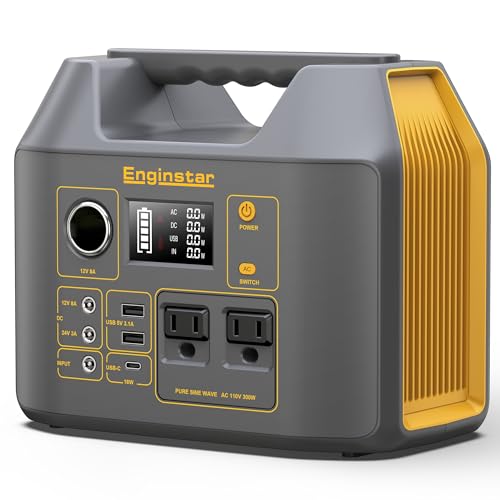
EnginStar 296Wh pure sine station, 300W AC
296Wh300W AC6.5 lbPure sine
Check price on Amazon
Best for: Outage kits and CPAP backup where capacity per cost matters most.

EnginStar's 296Wh pack puts nearly 300Wh in a 6.5 lb box about the size of a lunch cooler. That capacity runs a 30W router for roughly eight hours or a CPAP for a night, and two pure sine outlets keep sensitive chargers happy. It is the pack to buy for an outage kit where the goal is a few devices alive for a night.

What you give up is flexibility. The 300W inverter cannot run a kettle, hair dryer or microwave, and no panel is included, so solar use means buying a panel and matching its voltage and connector. The brand is small and the listing says little about cycle life, so assume a standard lithium-ion pack of 500 to 800 cycles.

Ownership is simple: keep it half charged in storage, avoid hot cars and top it up quarterly. Compared with the GRECELL below it holds about 28 percent more energy for similar weight. It is a strong fit for the buyer who wants the most watt-hours for the lowest price.

What works

  • 296Wh in a 6.5 lb body
  • Two pure sine AC outlets
  • Compact 9 x 5.5 x 7.5 in shell
  • Low cost for its capacity

Watch out for

  • 300W cannot run heating loads
  • No panel bundled
  • Small brand with little service history

Spec sheet

Capacity
296Wh (80000mAh)
AC output
300W, 2 outlets
Weight
6.5 lb
Size
9 x 5.5 x 7.5 in
Wave
Pure sine
03
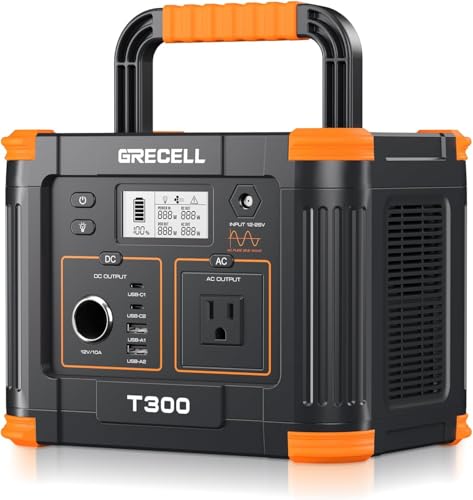
GRECELL 330W 230.88Wh with 60W USB-C PD
230.88Wh330W / 600W surge60W PDPure sine
Check price on Amazon
Best for: Remote workers and CPAP users who want strong USB-C output and 330W AC.

GRECELL's 330W unit prioritizes outputs. It can run a CPAP, a projector or a laptop, and the 60W USB-C PD port feeds most laptops directly, which saves the energy that would be lost through the AC inverter. The 600W surge handles a small fan or a mini fridge start.

Its pack is smaller than the EnginStar's at about 231Wh, so a CPAP night is closer to a one night margin than two. The lithium cell chemistry and the maker's mention of quality cells suggest a careful design, but the listing does not publish cycle life or UPS performance. It also has no panel in the base listing.

For ownership, it is a light, simple box. Keep the vents clear and store at partial charge. It suits travelers and remote workers who value PD output, while the larger EnginStar suits those who value capacity first. A typical use is a day of video calls from a campsite or a park bench: a laptop at 45W plus a phone at 10W stretches 231Wh to around four hours of real work, which is plenty for a half day session before the wall or a panel brings it back.

What works

  • 60W USB-C PD for direct laptop charging
  • 330W AC with 600W surge
  • Pure sine output
  • Light compact body

Watch out for

  • 230.88Wh is a modest tank
  • No panel bundled
  • No published cycle life

Spec sheet

Capacity
230.88Wh
AC output
330W, 600W surge
USB-C
60W PD
Wave
Pure sine
Targets
CPAP, projectors, laptops
04
MARBERO M823 300W 237Wh camping station
237Wh300W / 375W peak2 AC outletsPure sine
Check price on Amazon
Best for: Campers who want a simple camping box with two AC outlets.

MARBERO's M823 is the latest 300W model of its M82 series, built for camping with two AC outlets plus DC and USB ports. The 237Wh pack runs lights, phone charging and a small fan through a night, and the pure sine output suits camera chargers and laptops.

The pack is mid sized and its peak rating of 375W is modest, so surges beyond a small fan are not covered. The listing lists no panel in this variant, and the brand has little documented service history. Compared with the EnginStar it holds 20 percent less energy, but the M82 series has a record of owner use as a camping box.

Ownership is routine: switch the inverter off when idle, avoid heat, and top up every few months. MARBERO also sells a bundled solar kit of the same series. This variant suits campers who want a dependable camping box and will add panels separately.

What works

  • Two AC outlets plus DC and USB
  • Pure sine output
  • 237Wh handles a night of light loads
  • Part of an established M82 series

Watch out for

  • 375W peak is modest
  • No panel in this variant
  • Smaller pack than the EnginStar

Spec sheet

Capacity
237Wh
AC output
300W, 375W peak
Series
M82 series, latest 300W model
Outlets
2 AC, DC, USB
Wave
Pure sine
05
HOWEASY 88Wh 120W station, 2.3 lb
88Wh120W / 240W peak2.3 lb8 ports
Check price on Amazon
Best for: Flyers and commuters who want AC and USB ports in a carry-on size.

HOWEASY's 88Wh pack is under the 100Wh carry-on limit most airlines apply, so it can ride in cabin baggage where bigger stations cannot. At 2.3 lb and 6.6 x 4 x 3 inches it is closer to a power bank with an AC outlet than a generator, and it has eight ports including two 120V sockets.

Its power is limited. 120W continuous and 240W peak run a laptop, a phone and a small fan, nothing more, and 88Wh is about one laptop charge plus some. It is a travel convenience, not a solar generator in the sense of the bigger units, though it can accept a small panel.

Ownership is light: store at half charge, avoid heat and do not leave it in a checked bag, since airlines restrict spare lithium packs. This one is for a traveler who wants AC outlets on a flight day and nothing more.

What works

  • 88Wh is under the 100Wh carry-on limit
  • 2.3 lb body
  • Eight ports including two AC outlets
  • Low cost

Watch out for

  • 120W limit runs only light loads
  • Only one laptop charge of energy
  • Small solar capability

Spec sheet

Capacity
88Wh
AC output
120W, 240W peak
Weight
2.3 lb
Size
6.6 x 4 x 3 in
Ports
8 including 2 AC
06
ENOFLO 97.68Wh station with 120W peak AC socket
97.68Wh120W peak AC26,400mAh6 ports
Check price on Amazon
Best for: Travelers who need a single AC socket in a pocketable pack.

ENOFLO's 97.68Wh pack is as close to the 100Wh airline limit as a station gets, so you can take a bigger battery on a plane than many alternatives. It has a single 110V AC socket with a 120W peak, a USB-C port and four other outputs, and it fits a day pack.

Its role is narrow. One socket and 120W peak mean one laptop or a few small devices, and the pack empties fast under any real load. As a solar generator it is a stretch: a 20W panel would barely keep up with a phone. It is also a pack with a small brand and little documentation.

For ownership, treat it as a power bank: keep it dry, charge it before trips and do not let it sit empty. It is the choice for buyers who only need AC for a laptop or a camera on a trip and want the lowest outlay. Pack it in carry-on baggage rather than checked, keep it switched off in transit and carry the charging cable with it, because airline staff may ask to see the Wh rating on the label.

What works

  • 97.68Wh stays under the 100Wh carry-on limit
  • Six output ports
  • Pocketable size
  • Lowest cost in the guide

Watch out for

  • Single AC socket with 120W peak
  • Tiny energy reserve
  • Small brand with limited detail

Spec sheet

Capacity
97.68Wh (26,400mAh)
AC output
1 socket, 120W peak
Ports
6 including USB-C
Class
Pocket pack
Air travel
Under the 100Wh limit

Spec sheet decoder

What the numbers on the box really mean

The specs manufacturers lead with, translated into what they tell you about real-world performance.

100Wh limit

The cabin baggage threshold for spare lithium batteries on most airlines.

Watch forHOWEASY 88Wh and ENOFLO 97.68Wh fall under it.

mAh vs Wh

Milliamp-hours at 3.7V convert to watt-hours by multiplying by 0.0037.

Watch forENOFLO lists 26,400mAh, which is 97.68Wh.

120W peak

A brief AC surge on the smallest units, not a continuous rating.

Watch forENOFLO lists 120W peak on a single socket.

10ms UPS

Switchover time to battery during a power failure.

Watch forOnly the Elite 100 V2 lists it here.

1800W

The Elite 100 V2's continuous inverter output.

Watch forIt is six times the output of the 300W units.

Methodology

How We Evaluated These Lithium Solar Generators

Energy and runtime

We compared watt-hours and computed runtime at 30W and 60W loads, from 88Wh on the HOWEASY to 1024Wh on the Elite 100 V2.

Air travel eligibility

We checked pack sizes against the 100Wh and 160Wh carry-on thresholds. Only the HOWEASY and ENOFLO qualify for cabin use without approval.

Chemistry and life

We noted that the small packs are standard lithium-ion with a shorter cycle life than LiFePO4, treated the Elite 100 V2 as the heavy duty exception, and weighed occasional use against heavy cycling.

Ports and output

We compared AC wattage, USB-C PD and outlet count. The Elite 100 V2's 1800W and the GRECELL's 60W PD stand out.

Support and value

We weighed brand service reach, solar bundles and cost per watt-hour. Bluetti leads support, while the small brands score on price.

Decision guide

How to Choose the Right Lithium Solar Generators

By Trip Type

SituationPickWhy
Flight with a laptop and phoneHOWEASY 88WhUnder the 100Wh cabin limit
Flight with a camera and phoneENOFLO 97.68WhLargest pack that still flies
Weekend camping, light loadsMARBERO M823Two AC outlets and 237Wh
Outage kit with CPAPEnginStar 296WhLargest small pack
Appliance backupBLUETTI Elite 100 V21800W and 1024Wh

By Budget

TierPickWhy
LowestENOFLO 97.68WhPocket pack for devices
LowerHOWEASY 88WhLight carry-on kit
Lower midEnginStar 296WhMost Wh per cost
MidGRECELL 330WUSB-C PD and surge
HighestBLUETTI Elite 100 V2Appliance power and UPS

Flyable vs Ground Only

Flyable packs

The HOWEASY at 88Wh and ENOFLO at 97.68Wh are under the common 100Wh cabin limit. They suit travelers who need AC for a laptop on arrival, but they hold only a charge or two.

Ground only packs

The EnginStar, GRECELL, MARBERO and Elite 100 V2 exceed 160Wh and cannot fly in the cabin. They suit road trips, camping and home backup, with far more energy.

Pick a flyable pack only if you must fly with it, otherwise buy the energy.

Solar Readiness

PreferencePickWhy
Panel in the boxBLUETTI Elite 100 V2100W panel bundled
Panel you chooseEnginStar 296WhLarge pack, bring your own panel
Small panel top upMARBERO M823Camping series with solar options
Minimal solarENOFLO 97.68WhPocket pack for small panels
USB-C solar inputGRECELL 330WPD charging path

For Medical Device Backup Specifically

Look for

Pure sine output, a pack sized to the device draw and clear instructions from the device maker. A CPAP at 30 to 40W with no humidifier runs about six hours on a 230Wh pack.

In this comparison

The EnginStar 296Wh and GRECELL 330W provide pure sine output at CPAP scale. Only the device maker can approve a power source for medical use.

When to Spend More

Spend more if

You want appliance power, a fast charge and support. The BLUETTI Elite 100 V2 gives 1800W and 10ms UPS at an upper tier.

Save if

You only need device power. The EnginStar and HOWEASY give a night of devices at low cost.

Ownership

Maintenance schedule

The upkeep that decides whether this machine lasts two seasons or ten.

TaskIntervalWhy it matters
Check charge levelEvery 3 monthsLithium-ion packs self discharge. Keep them at 50 to 60 percent for storage.
Keep out of heatAlwaysHeat above 40 C ages lithium cells quickly. Avoid hot cars, sunny window sills and enclosed gear boxes in summer, and let a pack that has been in the cold come up to room temperature before you charge it.
Inspect cables and socketsEvery 6 monthsLoose barrel plugs overheat and limit charging.
Switch the inverter offAfter every useThe AC inverter draws standby power even with nothing plugged in.
Run a full cycleOnce a yearReveals capacity loss and recalibrates the gauge.

FAQ

Frequently Asked Questions

Can I take a solar generator on a plane?

Only if it is under about 100Wh in cabin baggage, or 160Wh with airline approval. Units like the HOWEASY at 88Wh and ENOFLO at 97.68Wh qualify. Larger packs cannot fly in the cabin.

Is lithium-ion worse than LiFePO4?

It is lighter and cheaper but rated for fewer cycles, usually 500 to 800 against 2,000 or more. For occasional use that difference may never matter.

How long will 296Wh run a CPAP?

A CPAP without humidifier draws 30 to 40W, so about six to seven hours after losses. Add a humidifier and the time drops to about three.

Does the 120W rating mean it can run a hair dryer?

No. A hair dryer draws 1,000W or more. A 120W unit runs a laptop, phone and small fan.

Can small lithium units use solar panels?

Yes within the input limit, often 60 to 100W at 12 to 24V. Check the connector type and voltage before buying a panel.

Are all lithium stations the same?

No. Cell grade, battery management and inverter quality vary. Look for pure sine output and listed protections such as over current, over temperature and short circuit cutoffs, and prefer sellers that publish a warranty length and a support contact over those that publish only a capacity number.

Bottom line

The short version

Browse more lithium solar generatorson Amazon →
James Miller, Lead Machine Editor

About the author

James Miller

Lead Machine Editor, MachineFanatic

James Miller leads MachineFanatic's buying guides, turning spec sheets, manuals and owner feedback into clear verdicts on power tools, outdoor power equipment, shop machines and kitchen machines.

More from James →

Keep reading

Related guides