
Amazon affiliate links - we earn a commission.Affiliate disclosure

Buying guide · 12 min read · Updated 2026-11-13

Best Solar Generators for Camping (2026)

Six solar generators for car camping trips, from a 4.7 lb 192Wh pack to a 1,024Wh kit, ranked by how many nights of lights, coolers and gadgets each covers.

James MillerBy James MillerLead Machine Editor6 machines comparedSpec-sheet verified
Best Solar Generators for Camping

At a glance

Our top picks

Side by side

Spec comparison

Camping power needs sort into a few simple bands: a handful of lights and phones, a laptop or camera kit, a powered cooler, and the occasional kettle or CPAP. Matching a battery to the highest band you will really use is the whole decision.

This guide takes six solar generators and runs them through a typical weekend. We count the nights each one covers, how easily it travels in a trunk, how quickly a panel refills it and what happens when the weather turns, so you can pick the one that matches your style of camping.

Before you buy

6 Criteria to Look For Before Buying a Solar Generator for Camping

  1. 01

    How many nights you need

    A phone uses about 15Wh per charge, a lantern 5Wh an hour and a compressor cooler 300 to 500Wh a day. A 292Wh Jackery 300 covers two nights of lights and phones, while the 1,024Wh Jackery 1000 v2 adds a cooler for two days. Add 20 percent for cold nights, since lithium cells deliver less in the cold.

  2. 02

    Carry weight

    A 4.7 pound Powkey goes anywhere, a 7.5 pound Jackery 300 is easy, and a 1,000Wh class unit is a 20-plus pound lift. At a walk-in site weight is the deciding factor, so pick the smallest battery that covers your real needs. A pack that weighs more than a third of what you can comfortably carry will stay in the car.

  3. 03

    Inverter wattage

    300W units like the Jackery 300 and ALLWEI run lights, laptops and fans, 500W units like the GRECELL add a blender, and 1,500W units run a kettle. Heating loads are the ones that push you up a size.

  4. 04

    USB-C PD ports

    A 60W or 100W USB-C PD port charges laptops without the AC inverter, saving 10 to 15 percent of stored energy. The Jackery 300's 100W and the GRECELL's 60W are real advantages at camp. Check that your charger can actually negotiate that wattage.

  5. 05

    Solar refill for multi-night trips

    A 40W panel makes about 100Wh a day, a 200W panel about 600Wh. For a three-night trip with a cooler you want 200W or more, which is why the Jackery 1000 v2 kit leads the group.

  6. 06

    Weather and storage

    Batteries should not be charged below freezing or left in a hot car. Keep the unit in the tent or cabin overnight, and store it away from direct sun during the day. Frozen cells cannot be charged safely, so warm the pack indoors before plugging in.

Detailed reviews

The 6 best solar generators for camping, explained

01
Jackery Solar Generator 1000 v2 with 200W Solar Panel
1,024Wh LiFePO41,500W AC3,000W surge200W panel
Check price on Amazon
Best for: Campers who want a cooler, lights and a kettle for a long weekend.

A kilowatt-hour is the sweet spot for a camping weekend. This kit runs a 12V-style compressor cooler for about two days, a few LED lanterns, phone charging and a laptop in the evening, with the 200W panel putting back roughly 600Wh on a clear day. The 1,500W inverter also handles a kettle or a small induction burner for short stretches, which sets it apart from the smaller packs.

The feature that matters most on a busy road trip is the 50 minute full recharge from a wall outlet, so a motel night or a lunch at a cafe resets it. It also switches to battery in 10 milliseconds, handy if you use it as a UPS at home. Relative to the Jackery 300 it holds about 3.5 times the energy, but it is also about three times the weight.

Store it in the car cabin out of direct sun, keep the inverter off when you only need USB and let it sit around half charged between trips. On a three-night trip, a sensible routine is to run the cooler and lights from the battery overnight, then let the panel handle the day while the unit sits in a shady spot and the panel sits in the sun. If the weather turns, a quick top-up from the car's 12V socket keeps the essentials alive.

What works

  • 1,024Wh powers a cooler for about two days
  • 1,500W inverter handles a kettle
  • Full recharge in about 50 minutes
  • 200W panel included

Watch out for

  • Heavy for a long walk-in site
  • 200W panel is slow on cloudy days
  • Overkill for lights and phones only

Spec sheet

Capacity
1,024Wh
Rated AC output
1,500W
Surge
3,000W
Wall recharge
About 50 minutes
Included panel
200W
02
Jackery Solar Generator 300 with 40W Solar Panel
292Wh LiFePO4300W AC7.5 lb100W USB-C PD
Check price on Amazon
Best for: Tent campers who want a light battery for lights and electronics.

For tent camping, this is close to the right size. At 7.5 pounds and 292Wh, it covers lights, phone and camera charging and a small fan across two nights, and the 100W USB-C PD port refills a laptop without going through the inverter. Six outputs mean the whole campsite crowd can plug in.

Its battery chemistry is the standout: the listing says it is rated for over 4,000 charge cycles, which is a decade of weekend trips. The 40W panel is more of a top-up than a refill, so most campers charge it at home beforehand.

It cannot run a cooler or a kettle for more than a short stretch, and it will refuse anything above 300W. Treat it as the electronics battery, keep it out of the sun in the car and store it half charged. Many campers keep it clipped near the tent door with a lantern plugged in, then move it indoors for charging. Because the outlets are all on one face, cables stay tidy and the unit is easy to find in the dark.

What works

  • 7.5 pounds, easy to carry
  • 100W USB-C PD charges laptops efficiently
  • 4,000-plus cycle LiFePO4
  • Six simultaneous outputs

Watch out for

  • Cannot run a cooler overnight
  • 40W panel only trickles
  • 300W ceiling limits cooking

Spec sheet

Capacity
292Wh
Rated AC output
300W
Weight
7.5 lb
USB-C
100W PD
Cycle life
4,000+
03
GRECELL 500W Power Station, 519Wh
519.48Wh battery500W AC2 pure sine outletsPD 60W USB-C
Check price on Amazon
Best for: Families who want enough energy for a cooler night and plenty of USB ports.

This is the middle rung that many families end up on. 519Wh covers a small camp cooler for a night, plus lights, phones and a tablet, and the 500W inverter handles a fan or a blender at the campsite. The spec sheet claims 10 devices at once, so a family's chargers all fit.

It sits between the Jackery 300 and the 1,000Wh units on both energy and weight, at roughly 14 pounds. The PD 60W USB-C port charges most laptops and phones quickly. There is no solar panel in this listing, so you charge it at home or from the car and add a panel if you need one.

Be realistic about the heater and kettle limits: 500W will not boil water quickly or run a hair dryer. Avoid hot cars and store it at moderate charge. The 140,400mAh figure in the title is a marketing conversion of the same 519Wh, so judge it by the watt-hour number, not the milliamp-hours. A family of four can reasonably expect two nights of phones, lights and a tablet before it needs a refill.

What works

  • 519Wh covers a night of cooler and electronics
  • Ten devices can charge at once
  • 60W USB-C PD fast charging
  • Lighter than the 1,000Wh class

Watch out for

  • No panel in this listing
  • 500W cannot run a kettle or heater
  • Brand has a thin track record

Spec sheet

Capacity
519.48Wh
Rated AC output
500W
AC outlets
2 pure sine
USB-C
60W PD
Weight
About 14 lb
04
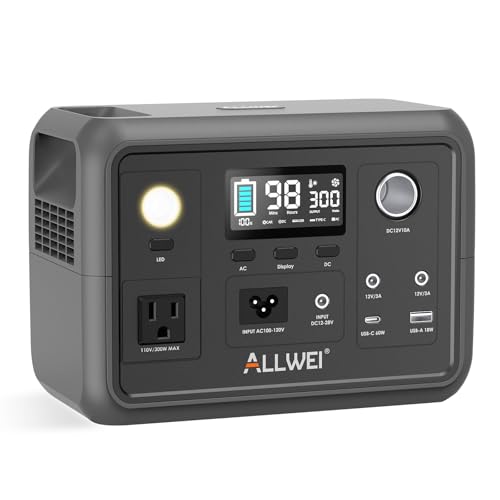
ALLWEI 300W Power Station, 256Wh LiFePO4
256Wh LiFePO4300W AC600W peakPD 60W
Check price on Amazon
Best for: Tent campers on a budget who still want LiFePO4.

ALLWEI keeps things simple: a 256Wh LiFePO4 battery, a single pure sine AC outlet at 300W with a 600W peak, two DC5521 ports, a car socket and fast USB ports. The LFP chemistry matters, since it holds more charge cycles than the cheap lithium-ion packs in this price range.

For a weekend it covers lights, phones, a small camera kit and a fan, a bit less than the Jackery 300 on capacity but at a lower cost. The single AC outlet is the main limit: if you want two appliances you need a power strip.

No solar panel is bundled, so plan on charging before the trip. Store it at half charge, keep it dry and do not leave it in a hot car. Because only one AC outlet is available, many owners run a short power strip rated for the load, never a long thin extension cord that would waste watts and heat up.

What works

  • LiFePO4 chemistry at a low price
  • Pure sine wave AC output
  • 60W PD USB-C port
  • Light and compact

Watch out for

  • Only one AC outlet
  • 256Wh is a small tank
  • No panel in the listing

Spec sheet

Capacity
256Wh
Rated AC output
300W
Peak output
600W
Outlets
1 AC, 2 DC5521, car, USB
USB-C
60W PD
05
BROWEY S1600 1,024Wh with Built-In 40W Solar Panel
1,024Wh LiFePO41,600W AC3,200W peakBuilt-in 40W panel
Check price on Amazon
Best for: Campers who want a kilowatt-hour with a panel that cannot be forgotten.

Browey puts a fold-out 40W panel inside the case, so there is no separate panel to pack or lose. With a 1,024Wh LiFePO4 battery and a 1,600W pure sine inverter, it matches the Jackery 1000 v2 on tank and edges it on output, with a 3,200W peak that starts a larger cooler or a small pump without trouble.

The built-in panel is a trickle charger, not a primary source, since 40W yields only about 100Wh on a sunny day. Most campers will still charge it before leaving and treat the panel as a top-up. A foldable 120W panel is available in a bigger bundle if you need more.

Brand history is thin, so keep the receipt and check that the hinge on the panel is robust. Store it at moderate charge and wipe the panel clean before folding. Lined up against the Jackery 1000 v2 it trades a larger, proven panel for convenience, so it suits campers who prefer fewer things to pack and charge before leaving home.

What works

  • Built-in fold-out 40W panel
  • 1,600W output with 3,200W peak
  • LiFePO4 rated 3,000-plus cycles
  • 1,024Wh matches the best-selling class

Watch out for

  • 40W panel is a trickle charger
  • Smaller brand with less support
  • Similar weight to the Jackery

Spec sheet

Capacity
1,024Wh
Rated AC output
1,600W
Peak output
3,200W
Panel
40W fold-out, built in
Cycle life
3,000+ to 80%
06
Powkey R180 200W Power Station, 192Wh LiFePO4
192Wh LiFePO4200W AC4.7 lbLED flashlight
Check price on Amazon
Best for: Hike-in campers who count every ounce.

Weight is the whole story here. At 4.7 pounds and about the size of a loaf of bread, this 192Wh pack goes in a day pack for a hike-in site, and the dual-white LED flashlight doubles as an emergency light. It charges by wall, car or solar panel, though the panel is sold separately.

The LiFePO4 cells are rated for long life and the 200W AC outlet runs a laptop, a camera charger or a small fan. It will not run a cooler for a night, and heavy loads drain 192Wh in under an hour.

For ultralight campers this is a good second battery. Treat the AC outlet as a convenience, switch it off between uses and keep it out of hot places. It also suits sleeping-bag camping, where a small unit beside the pillow charges a phone and runs a tiny light without disturbing anyone.

What works

  • 4.7 pounds, fits a day pack
  • LiFePO4 chemistry
  • Built-in LED flashlight
  • Charges by wall, car or solar

Watch out for

  • 192Wh is the smallest tank here
  • 200W AC limit
  • No panel included

Spec sheet

Capacity
192Wh
AC output
200W
Weight
4.7 lb
Size
7.1 x 5.3 x 5.5 in
Panel
Not included

Spec sheet decoder

What the numbers on the box really mean

The specs manufacturers lead with, translated into what they tell you about real-world performance.

Wh capacity

The size of the tank. Divide by your load in watts for hours of runtime. Real runtime is about 85 percent of it after losses.

Watch forFrom the Powkey's 192Wh to the Jackery 1000 v2's 1,024Wh.

Rated output

The wattage the inverter sustains. It sets the biggest single appliance you can run.

Watch forThe Powkey lists 200W, the Browey 1,600W.

USB-C PD

A fast-charge port that bypasses the inverter. It is the efficient way to charge laptops.

Watch forThe Jackery 300 offers 100W, the GRECELL and ALLWEI 60W.

Cycle life

How many full charges before the battery drops to roughly 80 percent of capacity.

Watch forThe Jackery 300 lists over 4,000, the Browey over 3,000.

Pure sine wave

A clean AC waveform that suits sensitive electronics.

Watch forThe ALLWEI, GRECELL, Jackery and Browey list it.

Methodology

How We Evaluated These Solar Generators for Camping

Nights of runtime

We estimated how many nights each unit covers for lights, phones and a cooler. The Jackery 1000 v2 covers about two days of cooler plus electronics, the Jackery 300 about two nights without one.

Portability

We ranked units by weight and size. The 4.7 pound Powkey led, the 7.5 pound Jackery 300 followed, and the 1,000Wh units tail.

Output headroom

We compared rated watts to camp appliances. Only the Jackery 1000 v2 and Browey run a kettle, while the GRECELL handles a blender.

Refill options

We looked at wall charge speed and panels. The Jackery 1000 v2's 50-minute charge and 200W panel beat the small built-in panels.

Ownership

We used listing details and owner feedback patterns for support and battery life, not our own camping trips. We gave extra credit for LiFePO4 and for clear cycle-life claims.

Decision guide

How to Choose the Right Solar Generators for Camping

By Camp Style

StylePickWhy
Hike-in, ultralightPowkey R1804.7 pounds
Tent, lights and phonesJackery Solar Generator 3007.5 pounds, 100W USB-C PD
Family with a coolerGRECELL 500W519Wh and 10 devices
Long weekend with kettleJackery Solar Generator 1000 v21,500W and 200W panel
Built-in panel convenienceBROWEY S1600Fold-out 40W panel

By Budget

TierPickWhy
LowestALLWEI 300WLiFePO4 at a low price
Low-midPowkey R180Ultralight
MidGRECELL 500WLarger tank
UpperJackery Solar Generator 300Support and cycle life
TopJackery Solar Generator 1000 v2Capacity and fast recharge

Small and Light vs Big and Capable

Small and light

The Powkey, Jackery 300 and ALLWEI give 192 to 292Wh in under 8 pounds. They suit electronics, lights and fans and travel anywhere.

Big and capable

The Jackery 1000 v2 and Browey give 1,024Wh and kettles and coolers, at 20-plus pounds. They suit car camping and trailers.

Pick small if you walk in, big if you drive in.

Panel Included vs Panel Later

PreferencePickWhy
Panel in the boxJackery Solar Generator 1000 v2200W included
Panel built inBROWEY S1600Fold-out 40W
Small panel includedJackery Solar Generator 30040W
No panel, charge at homeGRECELL 500WWall and car charge

For a Powered Cooler Specifically

Look for

A compressor cooler averages 30 to 40W, or 300 to 500Wh a day. You need at least 500Wh for one night and 1,000Wh for two with margin.

In this comparison

The GRECELL's 519Wh covers one night. The Jackery 1000 v2 and Browey cover two with electronics.

When to Spend More

Spend more if

You camp for three nights or more or want a kettle. The Jackery 1000 v2 is the sensible step up.

Save if

You camp for a night or two with lights and phones. The ALLWEI or Jackery 300 is plenty.

Ownership

Maintenance schedule

The upkeep that decides whether this machine lasts two seasons or ten.

TaskIntervalWhy it matters
Charge fully before each tripBefore every tripA full battery from the wall is the fastest and most reliable start. Do it the night before so the battery is cool and ready.
Turn off the AC inverterAfter useAn idle inverter drains the battery and wastes charge.
Store at half chargeBetween seasonsLithium cells age slowest at moderate charge.
Keep dry and out of hot carsAlwaysHeat and moisture shorten battery life and corrode ports. A silica gel pack in the carry bag helps in humid camps.
Clean and fold panels carefullyAfter each tripCreased or dirty panels lose output.

FAQ

Frequently Asked Questions

How big a solar generator do I need for camping?

For lights and phones, 200 to 300Wh is plenty. For a cooler add 300 to 500Wh a night, and for a kettle choose a 1,000Wh unit. A quick tally on paper before you buy takes a minute and prevents a costly mismatch.

Is LiFePO4 worth it for camping?

Yes. LiFePO4 lasts thousands of cycles and tolerates heat better. The Jackery 300, ALLWEI and Browey use it. Cheaper lithium-ion packs typically last 500 to 800 cycles, so LiFePO4 can outlast them several times over.

Which is the best value?

The ALLWEI for light users and the GRECELL for families. Both give useful capacity for less than the premium brands. Check that your chosen unit has the ports your devices need before you order.

Can I run a space heater?

No. A heater draws 1,000 to 1,500W and drains a 1,024Wh battery in under an hour. Use warmer sleeping gear. A hot water bottle filled from a stove is far cheaper per night of warmth.

Will solar panels recharge it at camp?

Yes, slowly. A 200W panel refills about 600Wh on a good day, and 40W panels only top up. Angle the panel toward the sun and move it every couple of hours for the best yield.

Can I bring one on a plane?

Only batteries under 100Wh fly freely and units above 160Wh are not allowed. All of these exceed the limit, so drive to camp. Check the airline's current rules if you carry a small power bank instead.

Bottom line

The short version

Browse more solar generators for campingon Amazon →
James Miller, Lead Machine Editor

About the author

James Miller

Lead Machine Editor, MachineFanatic

James Miller leads MachineFanatic's buying guides, turning spec sheets, manuals and owner feedback into clear verdicts on power tools, outdoor power equipment, shop machines and kitchen machines.

More from James →

Keep reading

Related guides