
Amazon affiliate links - we earn a commission.Affiliate disclosure

Buying guide · 10 min read · Updated 2026-11-13

Best Solar Generators Under $150 (2026)

Four solar generators under $150, from an 88Wh pocket kit to a 192Wh LiFePO4 pack, with honest advice on what a battery this small can and cannot run.

James MillerBy James MillerLead Machine Editor4 machines comparedSpec-sheet verified
Best Solar Generators Under $150

At a glance

Our top picks

Side by side

Spec comparison

At this price, a solar generator is a rechargeable battery with an AC outlet and a way to refill from the sun. Worth owning, and easy to oversell. The honest question is which small pack gives you the most life for phones, lights and a laptop.

We looked at four units that sit under the cap on Amazon listing prices when this guide was updated. Prices move, so check the live listing, but the capacity ladder from about 90Wh to about 190Wh stays the same, and so do the limits of what such a pack can run.

Before you buy

6 Criteria to Look For Before Buying a Solar Generator Under $150

  1. 01

    What 100Wh really buys

    A smartphone takes about 15Wh per charge, a tablet 30Wh, a laptop 50 to 70Wh and an LED lantern 5Wh an hour. So 192Wh gives roughly 12 phone charges or three laptop charges, and 88Wh about a third of that. Count your devices before you choose a size. Write down a one-day list of devices and the minutes each runs; that list is worth more than any marketing number.

  2. 02

    Battery chemistry

    LiFePO4 cells last thousands of cycles and tolerate heat better, while cheap lithium-ion packs fade after a few hundred. The DaranEner and Powkey use LiFePO4, which matters because a pack you replace in two years is not a bargain. Over three years of weekend use, a pack rated for 3,000 cycles will still be at full strength while a 500-cycle pack may already have lost a fifth of its capacity. Always check what the listing actually states about chemistry, since vague wording often means standard lithium-ion.

  3. 03

    AC wattage ceiling

    These inverters range from 120W to 300W. A laptop charger uses 45 to 100W, a small fan 30W and a CPAP without a heated humidifier about 40W. The 300W DaranEner has the most headroom, the 120W HOWEASY the least. Look at the charger label of your laptop, since a gaming laptop brick can be 150W or more and will not work on these units at all.

  4. 04

    Solar input and panel size

    A 30W panel returns about 90Wh a day, a 60W panel 190Wh. Only the DaranEner lists a 60W DC input, so it is the only one that can refill in a day from a matching panel. The bundled 30W panels are top-ups. Open-circuit voltage matters too: a panel that exceeds the input's voltage limit can trip the protection or damage the port. If you cannot decide, pair a 60W panel with the DaranEner, which is the best-matched combination in this guide.

  5. 05

    USB ports versus AC

    Charging a phone through a USB port skips the inverter and its 10 to 15 percent loss. On a 150Wh pack that saving matters, so use USB wherever possible and keep the AC outlet for laptops. Many packs also offer a USB-C PD port, which can charge a laptop directly at 45 to 60W without converting to AC at all.

  6. 06

    What you should not run

    Never plan on a refrigerator, space heater, hair dryer, kettle or CPAP heated humidifier. Those draw 400 to 1,500W, far above this tier's 120 to 300W, and would drain the pack in minutes. If a rating label is unreadable, a plug-in watt meter costs very little and answers the question in seconds.

Detailed reviews

The 4 best solar generators under $150, explained

01
DaranEner 192Wh LiFePO4 Power Station, 300W Peak 600W
192Wh LiFePO4300W AC600W peak60W solar input
Check price on Amazon
Best for: Buyers who want long battery life and a real solar input at the lowest cost.

This pack stands out for its chemistry and its inverter. A 192Wh LiFePO4 battery is rated by the maker for roughly ten times the life of ordinary lithium-ion cells, and the inverter is a 300W pure sine unit with two outlets and a 600W surge, which handles a laptop, a fan, a camera charger and a small pump without trouble.

Charging has three routes. A wall adapter inputs up to 100W, a car socket works, and a compatible solar panel can feed up to 60W of DC, which refills the pack in roughly four to five hours of good sun with a 60W panel. That makes it the only unit here that can reasonably refill from a panel in a day.

It does not include a panel, so you add one. Compared with the MARBERO 150Wh kit it holds 42Wh more and runs on longer-lived cells, at the cost of the bundled panel. Half charge is the right resting point, and the inverter should stay off when you only need USB. Here is a concrete weekend plan. Charge it from the wall on Friday, run a laptop for two hours each evening at about 40W, charge two phones twice and keep a lantern on for three hours; that totals around 190Wh across two days, so the pack ends the weekend nearly flat. A 60W panel parked in good sun on Saturday returns about 190Wh, which resets it for the drive home.

What works

  • LiFePO4 cells for long life
  • 300W pure sine output with 600W surge
  • Accepts up to 60W of solar
  • Two AC outlets

Watch out for

  • No panel included
  • 192Wh covers only light loads
  • Brand has a thin track record

Spec sheet

Capacity
192Wh
Rated AC output
300W
Peak output
600W
Solar input
Up to 60W DC
Wall input
Up to 100W
02
Powkey R180 200W Power Station, 192Wh LiFePO4
192Wh LiFePO4200W AC4.7 lbLED flashlight
Check price on Amazon
Best for: Hikers and paddlers who count every ounce.

The Powkey is the lightest way to get a 192Wh LiFePO4 pack with an AC outlet: 4.7 pounds and a body about the size of a loaf of bread. It is the one to throw into a daypack or a canoe dry bag, and the dual-white LED flashlight built into it works as an emergency light.

Its 200W AC output is lower than the DaranEner's 300W, so a bigger laptop brick or a small pump can overload it, but phones, tablets, camera batteries and LED lights are well within range. The listing says you can recharge it from a wall outlet, a car socket or a solar panel, but the panel is not included.

In practice, it is the cheaper and lighter cousin of the DaranEner. Spare it the hot car, store it at moderate charge and use the USB ports rather than the AC outlet whenever you can. For a sense of scale, 192Wh is about what a typical large phone battery bank holds, three or four times over. A single overnight stay with two phones, a headlamp and a camera battery uses perhaps 60Wh, which leaves the pack two-thirds full for the next day. The case is a simple rounded box with the outlets on one face, so cables stay tidy and the unit slides into a bag without snagging. If you carry it in a pack, keep the AC outlet capped and the power switch off so nothing can switch it on by accident and drain it between stops.

What works

  • 4.7 pounds, tiny footprint
  • LiFePO4 chemistry
  • Built-in LED flashlight
  • Charges by wall, car or solar

Watch out for

  • 200W AC output is limited
  • Panel not included
  • Less surge headroom than the Daran

Spec sheet

Capacity
192Wh
AC output
200W
Weight
4.7 lb
Size
7.1 x 5.3 x 5.5 in
Charging
Wall, car or solar panel
03
MARBERO 150Wh Solar Generator with Solar Panel
150Wh battery150W peakPanel includedAC and USB ports
Check price on Amazon
Best for: Gift buyers and first-timers who want the panel included.

The MARBERO is the all-in-one answer: a 150Wh battery, a foldable panel and a spread of AC, DC and USB outputs in one box, so you can charge from the sun on the first day. It is built for a weekend of phone charging, lights and perhaps a small fan.

The tank is modest, and the 150W peak output means anything above a laptop charger is out of reach. The bundled panel is small, so expect it to top up rather than fully refill after a day of use.

For a gift, a trunk emergency kit or a first taste of solar, the convenience is real. Charge it from the wall before you go, test the panel in sun and store it at moderate charge. A realistic test of any kit like this is the first sunny afternoon: set the panel in direct sun, plug the battery in and see how the display climbs over an hour. A small panel typically adds a few percentage points an hour, which tells you whether the bundle will keep up with your phone habit. If the number is lower than you hoped, a larger third-party panel with a matching connector is the cheapest upgrade, but confirm the voltage range first, since overvoltage can shut the input down. Gift buyers should note that the panel's folded size is close to a magazine, which makes it easy to tuck into a glove box or a go-bag next to the battery.

What works

  • Panel included in the box
  • Light and simple to use
  • AC, DC and USB outputs
  • Low cost for a complete kit

Watch out for

  • 150Wh tank is small
  • 150W peak limits appliances
  • Panel is a top-up, not a full refill

Spec sheet

Capacity
150Wh
Peak output
150W
Included
Foldable solar panel
Outputs
AC, DC and USB
Use
Camping and backup
04
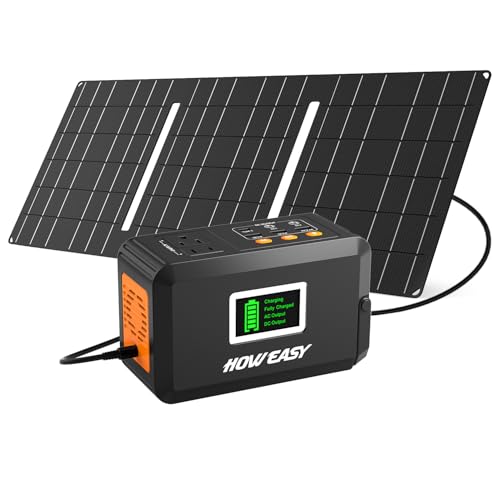
HOWEASY H120 120W Solar Generator with 30W Panel
88Wh battery120W AC30W panel8 output ports
Check price on Amazon
Best for: Emergency kits and light phone and light use.

The HOWEASY H120 is the smallest kit here. An 88Wh battery with a 120W AC output and 8 ports fits a small bag, and a 30W panel completes the package. It will charge a phone five to six times or run a few LED lights for a night.

Its limits are the limits of 88Wh. A laptop can drain it in an hour or two, and the 30W panel returns roughly 90Wh on a good day, so a full refill takes about a sunny day.

This is a gadget for light users and emergency kits. Keep it charged, use the USB ports in preference to the AC outlet and store it away from heat. To put the 88Wh in perspective, it is about the energy in a single car-camping lantern night plus a couple of phone charges. That is genuinely useful when the power goes out and the family needs light and a charged phone, but it is not a battery for hobbies like drone flying or camera shoots. Because the case is small, vent holes are small too, so avoid leaving it in a sunny window where heat builds, and keep the AC outlet off whenever the USB ports cover the need.

What works

  • Smallest kit with a panel included
  • Eight output ports
  • Very low cost
  • Fits in a small bag

Watch out for

  • 88Wh runs out quickly
  • 120W AC limit
  • 30W panel is slow

Spec sheet

Capacity
88Wh
AC output
120W
Included panel
30W
Ports
8 including 2 AC
Use
Camping and backup

Spec sheet decoder

What the numbers on the box really mean

The specs manufacturers lead with, translated into what they tell you about real-world performance.

Wh capacity

The energy stored. It sets how many phone or laptop charges you get.

Watch forFrom the HOWEASY's 88Wh to the Daran and Powkey's 192Wh. A 100Wh difference is about two laptop charges.

AC watts

The most the inverter can supply continuously.

Watch forThe Daran lists 300W, the Powkey 200W, the HOWEASY 120W.

Peak watts

A short surge for startup. Not extra continuous power.

Watch forThe Daran lists 600W peak, the MARBERO 150W.

DC solar input

The maximum panel power the pack accepts.

Watch forThe Daran lists 60W, which a 60W panel can match.

LiFePO4

A battery chemistry with long cycle life and good heat tolerance. It usually costs a little more but lasts much longer.

Watch forThe Daran and Powkey list it.

Methodology

How We Evaluated These Solar Generators Under $150

Useful energy

We compared battery sizes against phones, tablets and laptops. The 192Wh units cover roughly 12 phone charges, the 88Wh HOWEASY about five. We assumed 15Wh per phone, 30Wh per tablet and 60Wh per laptop charge, then applied a 0.85 conversion factor.

Inverter headroom

We ranked AC output. The Daran's 300W led, followed by the Powkey's 200W and the HOWEASY's 120W. We also asked whether the surge figure is high enough to start a small fan.

Solar ability

We looked at input limits and included panels. The Daran's 60W input was the best fit for a real refill. A 60W input paired with a 60W panel refills about 190Wh in good sun.

Chemistry and life

We favored LiFePO4 packs, which last far longer than cheap lithium-ion. We relied on the listings and owner feedback patterns rather than personal ownership.

Price and cap

Every product here sat under the cap at Amazon listing prices when updated. We excluded anything above it or with unknown pricing. Because prices fluctuate, we treated the cap as a rule for inclusion, not as a measure of value.

Decision guide

How to Choose the Right Solar Generators Under $150

By What You Charge

SituationPickWhy
Phones and a few lightsHOWEASY H12088Wh and a panel
Phones, tablet, cameraMARBERO 150Wh kitPanel included
Laptop and a small fanDaranEner 192Wh300W pure sine
Ultralight travelPowkey R1804.7 pounds
Longest battery lifeDaranEner 192WhLiFePO4 cells
Gift for a new camperMARBERO 150Wh kitEverything in one box

By Budget Within the Cap

TierPickWhy
LowestHOWEASY H120Smallest and cheapest
Low-midMARBERO 150Wh kitPanel included
MidPowkey R180LiFePO4 and light
Near the capDaranEner 192WhBest inverter and input
Skip if you need moreNext tier upMove to a 288Wh pack with 600W output

Panel in the Box vs Better Battery

Panel in the box

The MARBERO and HOWEASY include small panels, so you can charge from the sun right away. It is convenient, but the panels only top up.

Better battery

The DaranEner and Powkey use LiFePO4 and need a separate panel. The battery lasts longer and the inverter is stronger, but you buy the panel yourself.

Choose a kit for convenience, a LiFePO4 pack for longevity, and add a separate panel when you can.

Weight and Portability

PreferencePickWhy
LightestPowkey R1804.7 pounds
Smallest kitHOWEASY H120Fits a small bag
BalancedMARBERO 150WhLight with panel
Most capableDaranEner 192Wh300W AC
Best for a desk backupDaranEner 192WhPure sine output for a router and modem

For Emergency Kits Specifically

Look for

A pack that holds its charge in storage, has USB ports for phones and a built-in light. LiFePO4 holds charge better than cheap lithium-ion. Keep it fully charged and check it every quarter.

In this comparison

The Powkey's flashlight and the DaranEner's long-life cells suit a bug-out bag. Top up every three months. Test the pack once a season with a real device so you know it works before you need it, and replace any cable that has cracked.

When to Spend More

Spend more if

You need more than phones and a laptop. A 288Wh to 300W unit in the next tier does a lot more. A 288Wh or 300W pack costs only a little more and doubles the number of devices you can serve, so check the next tier before you click buy.

Save if

You only charge phones. The HOWEASY or MARBERO kit is enough. You can always add a second pack later, since small packs are cheap and easy to share between family members.

Ownership

Maintenance schedule

The upkeep that decides whether this machine lasts two seasons or ten.

TaskIntervalWhy it matters
Top up the batteryEvery three monthsSmall packs self-discharge, and a flat lithium cell can be damaged. Set a calendar reminder so the battery never sits flat for months.
Use USB when possibleEvery useIt avoids inverter losses that matter on a 150Wh pack. A phone on USB uses about a fifth less stored energy than the same phone on an AC adapter.
Store at moderate chargeLong storageModerate charge slows cell aging. A pack left at full charge in a hot room ages faster than one stored at half in a cool one.
Keep out of hot carsAlwaysHeat shortens lithium life. A glove compartment in summer can exceed 130 degrees.
Fold panels gentlyAfter useCreases crack cells and cut output. Wipe the panel with a damp cloth, never an abrasive one, since scratches scatter light and cut output.

FAQ

Frequently Asked Questions

What can a solar generator under $150 run?

Phones, tablets, LED lights, a small fan and a laptop. It cannot run a refrigerator, heater, kettle or hair dryer. Think of it as a larger, outlet-equipped power bank rather than a small generator. A router and modem together draw about 15 to 20W, so a 192Wh pack can keep them alive for around eight hours.

Is a $150 solar generator worth it?

For light users, yes. It is an affordable way to keep phones and lights alive in an outage or at camp. Do not expect it to replace a gas generator. If you want to run anything with a heating element, plan on the 1,000Wh class instead. A pack that lives in the glove box and gets used a few times a year easily earns its cost.

Which is the best value?

The DaranEner 192Wh for long life and solar input, and the MARBERO kit if you want a panel included. Both are fine for phone, light and laptop duty; neither is a refrigerator battery.

Can I charge it with a solar panel?

Yes, but check the panel's voltage and connector. The DaranEner accepts up to 60W DC, and the kits include small panels. A mismatched connector is the most common reason a panel does not charge the pack. Panels that exceed the input voltage limit can trip protection, so read the input range before buying one.

Will the price stay under $150?

Not necessarily. The $150 cap reflects Amazon listing prices when this guide was updated, and discounts move units in and out. If the live price is above the cap, check back a few days later or look at the previous tier.

How long will it last?

LiFePO4 units like the DaranEner and Powkey should last years of regular use. Cheaper lithium-ion packs may fade sooner. Keep them partly charged and out of heat, and they will outlast the phones they charge.

Bottom line

The short version

Browse more solar generators under $150on Amazon →
James Miller, Lead Machine Editor

About the author

James Miller

Lead Machine Editor, MachineFanatic

James Miller leads MachineFanatic's buying guides, turning spec sheets, manuals and owner feedback into clear verdicts on power tools, outdoor power equipment, shop machines and kitchen machines.

More from James →

Keep reading

Related guides