

Amazon affiliate links - we earn a commission.Affiliate disclosure

Buying guide · 12 min read · Updated 2026-11-13

Best Solar Generators Under $1,500 (2026)

Five solar generators under $1,500 that move past the basic kilowatt-hour: 1.5kWh tanks, 2,000W inverters and panel kits that can carry a refrigerator.

James MillerBy James MillerLead Machine Editor5 machines comparedSpec-sheet verified
Best Solar Generators Under $1,500

At a glance

Our top picks

Side by side

Spec comparison

Between the thousand-dollar kilowatt-hour box and the heavyweight home batteries sits a middle class: bigger tanks, stronger inverters and enough output to carry a refrigerator and a few tools. That middle is where most households get their first serious backup battery.

This guide looks at five solar generators that fit under the cap on Amazon listing prices when we updated it. Prices move, so confirm the live listing, but the questions that separate them stay put: how big is the tank, how hard can the inverter push, and how quickly does it refill from sun or the wall.

Before you buy

6 Criteria to Look For Before Buying a Solar Generator Under $1,500

  1. 01

    Tank size for a refrigerator and extras

    A refrigerator averages 50 to 150W and a few lights and electronics add 100W, so 1,000Wh lasts 6 to 10 hours. The DYNESS's 1,536Wh stretches that to 10 to 15 hours. If you want a day or more, plan on at least 1,500Wh or a solar kit. For example, a household with a refrigerator at 100W, a router at 15W, three lights at 30W and a laptop at 50W draws about 200W, which a 1,536Wh tank carries for around six and a half hours before any solar help.

  2. 02

    Inverter strength for motors

    A refrigerator compressor, a sump pump and a table saw all draw a multiple of their running watts at start. The Yeti 1500's 3,600W surge and the Anker's 3,000W peak handle them, while the Jackery's 1,500W rating is borderline for a larger saw. A good rule is to take the largest motor you own, read its label for running amps, multiply by 120 and then by three to find the surge you should demand from the inverter.

  3. 03

    Solar input ceiling

    A bigger input means a smaller array refills faster. The DYNESS accepts up to 1,200W and gets 80 percent in 1.2 hours, while a 400W kit like the Jackery's takes about three hours to fill 1,024Wh. Match your array to the input. Remember that the panel array must also respect the unit's voltage window, since a series string that exceeds it can trip protection or shorten the life of the input stage.

  4. 04

    Battery life claims

    A 4,000-cycle LiFePO4 pack lasts about ten years of daily cycling. The Yeti 1500 and Jackery quote that scale, the DYNESS an upgraded LiFePO4 design. A battery that outlives the appliances it backs up is the right target. Warranty terms differ by brand, and some void coverage if the battery is left deeply discharged, so read the paperwork rather than assuming ten years.

  5. 05

    UPS behavior

    If the battery sits between wall and appliance, switchover speed matters for computers. The DYNESS lists a built-in UPS and the Jackery a 10ms switchover. A refrigerator tolerates much slower, but a desktop does not. If you run an office or a streaming setup from the unit, the switchover time is worth confirming in the manual, not just the marketing line.

  6. 06

    Panels in the kit or not

    The Jackery includes 400W, the Anker a 200W panel in a second box, and the Yeti and DYNESS none. Panels can cost as much as a quarter of the battery, so count them when comparing prices. Panels also need somewhere to live, and rigid 200W units are about the size of a door, so plan a ground rack or a wall mount rather than leaning them on a fence.

Detailed reviews

The 5 best solar generators under $1,500, explained

01
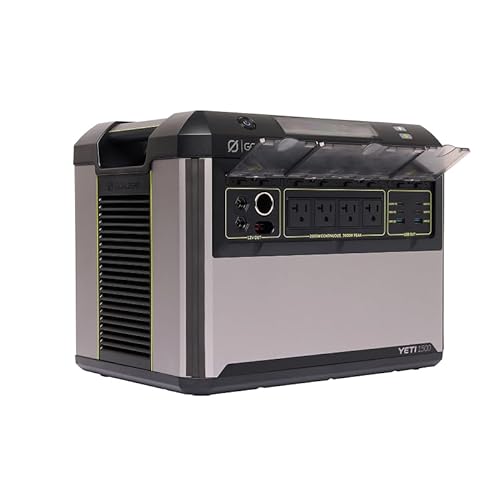
Goal Zero Yeti 1500 Portable Power Station, LiFePO4
LiFePO4 pack2,000W inverter3,600W surge4,000 cycles
Check price on Amazon
Best for: Households that want a polished, long-lived battery for refrigerator and tool backup.

Goal Zero has been building power stations for longer than most of its competitors, and the Yeti 1500 shows the benefit of that history. It pairs a 2,000W inverter with a 3,600W surge, which starts a refrigerator compressor, a window air conditioner or a table saw without hesitation, and a LiFePO4 pack rated for 4,000 cycles, which the maker equates to ten years of daily use.

The listing says it charges from zero to 80 percent much faster than earlier Yetis, and it is marketed as solar generator ready, meaning it takes Goal Zero's own panels and the common third-party ones through a standard input. In the 1.5kWh class it is the most polished kit for a household that wants a battery to live in the garage and appear on the first day of an outage.

The cost is that you pay for the brand and its app, and the listing does not include panels, so budget for them. Keep it in a dry, temperate spot, store it at half charge and run it under a real load a few times a year so you know the inverter still performs as rated. Owners also point to its sturdy handles and a layout where every port is on the front face, which matters when the unit sits on a garage shelf and cables must come out cleanly.

What works

  • 2,000W inverter with 3,600W surge
  • LiFePO4 rated for 4,000 cycles
  • Mature brand and app
  • Solar-ready input

Watch out for

  • Panels sold separately
  • Brand premium over generic units
  • Less expansion than newer rivals

Spec sheet

Inverter
2,000W
Surge
3,600W
Cycle life
4,000 cycles
Chemistry
LiFePO4
Solar
Solar generator ready
02
DYNESS 1,536Wh Portable Power Station, 1,800W AC
1,536Wh LiFePO41,800W AC3,600W surge1,200W solar input
Check price on Amazon
Best for: Buyers who want the biggest tank and a high solar input for the money.

DYNESS is a battery maker first, and this unit is the largest tank in the under-$1,500 bracket at 1,536Wh. That is half again the energy of a standard kilowatt-hour box, which turns a refrigerator's 12 to 14 hours of runtime into closer to 20 and gives a laptop-and-lights evening plenty of margin.

The inverter is rated 1,800W with a 3,600W surge, which handles a compressor, and the listing quotes 80 percent in 50 minutes from the wall and 80 percent in 1.2 hours from up to 1,200W of solar. That solar input ceiling is unusually high, so a 600 to 800W array fills it quickly in good sun. A built-in UPS function keeps routers and computers alive through an outage.

It asks you to bring your own panels, and the brand's support network is thinner than Goal Zero's. Check the connector type before buying panels, keep the unit shaded and store it at moderate charge. Treat the unusually high 1,200W solar ceiling as an opportunity: a 800W ground array of four panels will take a flat pack to 80 percent in roughly an afternoon.

What works

  • 1,536Wh is the largest tank in the bracket
  • 1,200W solar input refills fast
  • 50 minutes to 80 percent from the wall
  • Built-in UPS function

Watch out for

  • No panels included
  • Thinner support network
  • Lower surge than a Yeti in practice

Spec sheet

Capacity
1,536Wh
Rated AC output
1,800W
Surge
3,600W
Solar input
Up to 1,200W
AC recharge
80% in 50 minutes
03
Anker SOLIX C1000 Gen 2 with 200W Solar Panel
1,024Wh LFP2,000W AC3,000W peak9 ports
Check price on Amazon
Best for: Buyers who want a strong inverter in a compact, well-supported kit.

The C1000 Gen 2 is the smallest tank here and the cheapest way into the bracket, but it matches the bigger units on inverter strength: 2,000W continuous and a 3,000W peak. That is enough to run a refrigerator, a microwave or a circular saw from a case that is 14 percent smaller and 11 percent lighter than the first generation.

The bundle includes a 200W panel that ships in a separate box, so the first sunny afternoon gives a real refill of roughly 600Wh. Nine ports let phones, laptops and camp gear all plug in at once, and Anker's app and support network are among the strongest in the category.

With only 1,024Wh the limit is endurance rather than power. A 600W load drains it in under two hours, so it suits short outages, tools and trips. Keep the unit ventilated, update the app and store it half charged. In a workshop it is a quiet substitute for a small gas generator, with no fuel to store and no fumes in the garage.

What works

  • 2,000W inverter in a compact body
  • 200W panel included
  • Nine ports
  • Strong brand support

Watch out for

  • 1,024Wh is the smallest tank here
  • Panel ships separately
  • No expansion option listed

Spec sheet

Capacity
1,024Wh
Rated AC output
2,000W
Peak output
3,000W
Ports
9
Included panel
200W, shipped separately
04
Jackery Solar Generator 1000 v2 with 2x200W Panels
1,024Wh LiFePO41,500W AC3,000W surge400W of panels
Check price on Amazon
Best for: Buyers who want panels, battery and a major brand in one box.

Where the other units here sell you a battery, this one sells you a system. Two 200W panels are in the box, and the listing quotes about three hours to refill the 1,024Wh pack from them, which puts the kit among the few in this bracket that can nearly refill itself in a sunny day.

The inverter is a more modest 1,500W with a 3,000W surge, so a kettle or a window air conditioner is at the edge, but a refrigerator, a coffee maker and tools are fine. The LiFePO4 pack is described as keeping over 70 percent of its capacity after a decade, and the 10ms UPS-style switchover and 50 minute wall charge make it a good everyday backup.

It is the choice for someone who wants everything in one purchase and a brand with deep support. Compared with the Anker C1000 Gen 2 it gives up 500W of output and gains a double-sized panel kit. Because the panels are standard 200W foldables, they can later be reused with a larger Jackery if you upgrade.

What works

  • Two 200W panels included
  • About three hours to refill from solar
  • Long-life LiFePO4 pack
  • Deep accessory ecosystem

Watch out for

  • 1,500W inverter is the weakest here
  • 1,024Wh is a modest tank
  • Panels are bulky to store

Spec sheet

Capacity
1,024Wh
Rated AC output
1,500W
Surge
3,000W
Included panels
2 x 200W
Solar recharge
About 3 hours
05
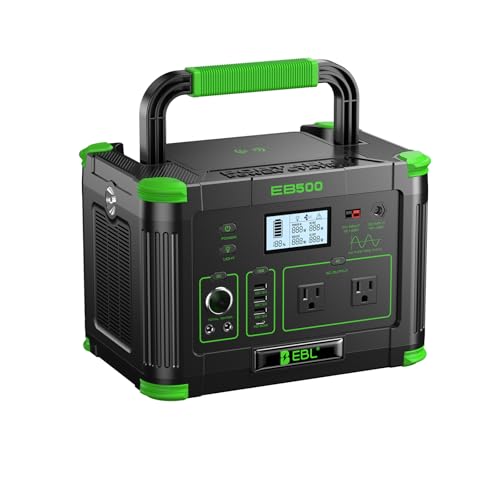
EBL 500W Power Station, 519Wh with Wireless Charging
519.48Wh battery500W pure sine10 portsWireless pad
Check price on Amazon
Best for: Buyers who want a light second battery next to a larger unit.

This is the entry in the group that sits well below the cap, and it is here to show what a smaller budget buys. A 519Wh battery, 500W of pure sine output, ten ports and a wireless charging pad make it a flexible camping and travel companion, and an MPPT solar controller allows panel charging.

It will not run a refrigerator for more than a few hours or a power tool for more than a few minutes, so it is a complement to a bigger unit. The sensible use is as a secondary battery for phones and laptops, so the main station is free for appliances.

Brand history is thinner than Goal Zero's, so keep the receipt and register the product. Store it half charged and keep it out of hot cars. Used this way, it effectively doubles your phone-and-laptop endurance without touching the big battery.

What works

  • Ten ports and a wireless charging pad
  • MPPT solar charging
  • Pure sine wave output
  • Light and easy to carry

Watch out for

  • 519Wh is far below the others
  • 500W cannot start a compressor reliably
  • Thinner brand support

Spec sheet

Capacity
519.48Wh
Rated AC output
500W
Ports
10
Recharge modes
Wall, car and solar with MPPT
Extras
Wireless charging pad

Spec sheet decoder

What the numbers on the box really mean

The specs manufacturers lead with, translated into what they tell you about real-world performance.

Inverter vs surge

The inverter is the continuous output and surge is a brief startup ceiling. That is the figure to compare against the label on your biggest appliance.

Watch forThe Yeti lists 2,000W and 3,600W, the Jackery 1,500W and 3,000W.

Solar input

The most panel power the unit will accept. A bigger number is only useful if you own enough panels to reach it.

Watch forThe DYNESS lists up to 1,200W, the Jackery kit about 400W.

Cycle rating

How many full charges before capacity drops to roughly 80 percent. Treat it as a lifespan estimate, not a guarantee, since heat and deep discharge shorten real life.

Watch forThe Yeti lists 4,000 cycles.

Fast charge

How quickly the wall refills the battery. It matters for rolling outages. Fast charging puts more stress on cells, so use it when you need it rather than by default.

Watch forThe DYNESS lists 80 percent in 50 minutes.

Wh capacity

The tank. Runtime equals Wh times 0.85 divided by load. It is the first number to check and the last one to be fooled by.

Watch forFrom 519Wh on the EBL to 1,536Wh on the DYNESS.

Methodology

How We Evaluated These Solar Generators Under $1,500

Capacity and refrigerator runtime

We estimated runtime at an average of 100W. The DYNESS gives about 13 hours, the 1,024Wh units about 8 and the EBL about 4. A 0.85 inverter efficiency factor was applied to every figure.

Motor-start strength

We compared surge ratings to typical compressor and tool starts. The Yeti 1500's 3,600W and the DYNESS's 3,600W led. We treated tools with large motors as the harder test.

Solar refill

We considered panels in the box and input limits. The Jackery's 400W kit and the DYNESS's 1,200W input led. Panel-in-the-box kits were credited, but we also noted that bundles ship separately in some cases.

Cap fit

We included only machines under the cap at Amazon listing prices when updated. Prices move, so verify before ordering. Machines above the cap or with unknown pricing were left out.

Support

We used listing details and owner feedback patterns for brand strength, not our own use. Warranty length and app quality were noted where the listing stated them.

Decision guide

How to Choose the Right Solar Generators Under $1,500

By Job

JobPickWhy
Refrigerator and freezer backupDYNESS 1,536WhBiggest tank
Motor-heavy toolsGoal Zero Yeti 15003,600W surge
Compact tool and fridge kitAnker SOLIX C1000 Gen 22,000W in a small body
Panels and battery in oneJackery Solar Generator 1000 v2 kit400W of panels
Phones and laptops alongsideEBL 519WhTen ports and wireless

By Budget Within the Cap

TierPickWhy
LowestEBL 519WhLight duty
Low-midDYNESS 1,536WhMost energy per dollar
MidAnker SOLIX C1000 Gen 2 kitStrong inverter and panel
UpperJackery 1000 v2 kitPanels included
Near the capGoal Zero Yeti 1500Brand and cycle life

Bigger Tank vs Stronger Inverter

Bigger tank

The DYNESS gives 1,536Wh, so a refrigerator, lights and a router last through a night with room to spare. It suits outage backup.

Stronger inverter

The Yeti 1500 and Anker Gen 2 give 2,000W, which runs tools and bigger motors. They suit workshops and garages.

Pick the tank for outages and the inverter for tools.

Brand Maturity vs Specs per Dollar

PreferencePickWhy
Established brand and appGoal Zero Yeti 1500Long track record
Mature ecosystem and panelsJackery 1000 v2 kitDeep accessories
Strong app and supportAnker SOLIX C1000 Gen 2Compact and polished
Most specs for the moneyDYNESS 1,536WhLargest tank and solar input

For Home Backup Specifically

Look for

A tank above 1,500Wh, a UPS function and a solar input that can refill in a day. List your critical loads and their watts first.

In this comparison

The DYNESS matches that with 1,536Wh, a UPS function and 1,200W of solar input. The Yeti 1500 is the more polished choice.

When to Spend More

Spend more if

You want more than a day of refrigerator runtime. The next tier brings 2,000Wh-plus units.

Save if

You want a battery for tools and camping. The Anker C1000 Gen 2 does it for less.

Ownership

Maintenance schedule

The upkeep that decides whether this machine lasts two seasons or ten.

TaskIntervalWhy it matters
Run a real loadEvery three monthsA watt-meter test confirms the inverter still delivers its rating. Write the readings in a notebook to spot decline early.
Store at 50 percentLong storageA pack left at 100 percent all season ages measurably faster than one left near the middle. Use a vacuum with a brush attachment, not compressed air that can push dust inward.
Clean fan inletsEach seasonDust limits full-power runtime. Set a phone reminder so the check does not slip.
Check panel connectorsEach seasonLoose connectors lose power. A drop of contact cleaner on connectors helps in humid climates.
Update the appTwice a yearFirmware tunes charging and safety. Note the version number before and after so you can report problems accurately.

FAQ

Frequently Asked Questions

What can a 1.5kWh solar generator run?

A refrigerator for about 12 to 20 hours, a laptop for 20 charges or a circular saw in short bursts. It cannot sustain a heater or air conditioner for long. For a household with medical devices, confirm the exact draw of each device first.

Is Goal Zero worth the premium?

If you value a mature brand and long cycle life, yes. If you want the most energy per dollar, the DYNESS is better value. Both brands are legitimate, and the choice usually comes down to price and how much you value support.

Which is the best value under $1,500?

The DYNESS 1,536Wh gives the most energy and solar input for the money. The Anker C1000 Gen 2 kit is the compact value choice. Remember to confirm the live price, since the ranking can shift when a model goes on sale.

Does it need panels to be useful?

No, but panels extend runtime. A 400W kit like the Jackery's refills in about three hours of sun. A foldable 200W panel is about the size of a small suitcase when packed, which is easy to store in a closet.

Will the price stay under the cap?

Not necessarily. The $1,500 cap reflects Amazon listing prices when this guide was updated, and deals move units in and out. Deals tend to cluster around major shopping events, so patience can save real money.

Can I use these indoors?

Yes. LiFePO4 stations produce no fumes, but keep them ventilated and away from water. A smoke detector and normal clearance from walls are still sensible precautions.

Bottom line

The short version

Browse more solar generators under $1,500on Amazon →
James Miller, Lead Machine Editor

About the author

James Miller

Lead Machine Editor, MachineFanatic

James Miller leads MachineFanatic's buying guides, turning spec sheets, manuals and owner feedback into clear verdicts on power tools, outdoor power equipment, shop machines and kitchen machines.

More from James →

Keep reading

Related guides