

Amazon affiliate links - we earn a commission.Affiliate disclosure

Buying guide · 13 min read · Updated 2026-11-13

Best Solar Generators Under $2,000 (2026)

Six solar generators under $2,000 with tanks from 1,024Wh to 3,840Wh, ranked on home-backup value, expansion and how long each runs essentials.

James MillerBy James MillerLead Machine Editor6 machines comparedSpec-sheet verified
Best Solar Generators Under $2,000

At a glance

Our top picks

Side by side

Spec comparison

At this price a solar generator stops being a camping accessory and starts to look like real household backup. Tanks of two to four kilowatt-hours can ride out a night of outage for a refrigerator, a few lights, a router and a medical device, and the inverters are strong enough to start a sump pump.

We looked at six machines that fit under the cap on Amazon listing prices when this guide was updated. Prices move, so check the live listing, but the choices below span the main strategies: the biggest tank per dollar, the most polished mid-size unit and a few compact one-kilowatt-hour alternatives.

Before you buy

6 Criteria to Look For Before Buying a Solar Generator Under $2,000

  1. 01

    Watt-hours per dollar

    At this price you can choose between a 3,840Wh ABOK Ark3600 and a 1,024Wh DELTA 3 Classic. For outage backup, tank size matters most, since a refrigerator, router and lights at about 200W drain 1,024Wh in four hours but 3,840Wh in about 16. Do not buy on tank size alone: a 3.8kWh unit that cannot start your pump is less useful than a 2kWh unit that can.

  2. 02

    Inverter and surge

    A sump pump or refrigerator compressor draws 3 to 6 times its running watts at start. The ABOK's 4,500W peak, the OUPES's 4,500W surge and the Yeti's 3,600W handle that, while the Ark2000's 2,400W A-Boost is borderline for a larger pump. Check the compressor's locked-rotor amps on the label if it is listed, since that figure sets the true starting demand.

  3. 03

    Expansion path

    The OUPES Mega 1 grows from 1,024Wh to 5,120Wh, the ABOK Ark2000 to 4,608Wh and the Ark3600 to 11,520Wh. The Yeti and DELTA 3 Classic do not. Expansion lets you start smaller, but packs cost real money. A good test of any expansion plan is to ask what a second pack costs today, because it is often the deciding factor.

  4. 04

    Solar input

    A higher input refills faster. The ABOK Ark3600 accepts 2,000W, the Ark2000 1,200W and the OUPES less. Your array has to exist to use it, so count panel cost when comparing. A 400W array fills about 1,200Wh a day, so a 3,840Wh unit needs a few sunny days or a wall top-up to refill fully.

  5. 05

    Standby draw and UPS

    An idle inverter at 10W drains 240Wh a day, a quarter of a 1,024Wh unit. The Elite 200 V2 lists about 10W standby, and the DELTA 3 Classic a sub-10ms UPS. Turn the inverter off when not needed. Always read the idle draw in the manual and turn the inverter off between uses if the unit is only for emergencies.

  6. 06

    Support and warranty

    Goal Zero, Bluetti and EcoFlow have long support histories, while ABOK and OUPES are younger. Keep your receipt, register the unit and check warranty terms, especially for battery degradation. Look for a written statement of how battery capacity is covered after the first few years, not just the headline term.

Detailed reviews

The 6 best solar generators under $2,000, explained

01
ABOK Ark3600 3,840Wh with 400W Solar Panel
3,840Wh LiFePO43,600W AC4,500W peak2,000W solar input
Check price on Amazon
Best for: Households that want the biggest tank for the money.

A 3,840Wh tank under the cap is the headline. That is nearly double a typical two-kilowatt-hour unit, and with a 3,600W inverter and a 4,500W peak it can run a refrigerator, a freezer, a sump pump and lights all at once, with enough left over for a short stretch on a window air conditioner.

The listing includes a 400W solar panel and a 2,000W solar input ceiling, so adding more panels makes recharge quick, and expansion batteries lift capacity to 11,520Wh if the budget allows later. It is a single-leg 120V machine, so it does not run 240V loads, and it is heavy at this capacity.

The brand is younger than Goal Zero or Jackery, which means support is thinner and the accessory shelf is shorter. Keep the receipt, run a real load test in the first week and store it half charged. A sensible install is on a low shelf near the refrigerator with short heavy-gauge cords, since a 3,600W inverter punishes thin extension leads and a long run wastes watts as heat.

What works

  • 3,840Wh is the largest tank in the bracket
  • 3,600W inverter runs several essentials at once
  • 400W panel included
  • Expandable to 11,520Wh

Watch out for

  • Heavy and bulky
  • 120V single-leg output only
  • Younger brand with thinner support

Spec sheet

Capacity
3,840Wh
Rated AC output
3,600W
Peak output
4,500W
Solar input
2,000W
Expansion
Up to 11,520Wh
02
BLUETTI Elite 200 V2 with 200W Solar Panel, 2,080Wh
2,080Wh LFP2,600W AC3,900W surge10W standby
Check price on Amazon
Best for: Buyers who value brand maturity and balanced specs in a mid-size unit.

The Elite 200 V2 is the one to choose if you prefer a mature brand and a thoughtful design. 2,080Wh and a 2,600W inverter with 3,900W surge run a refrigerator, a sump pump and a router comfortably, and the listing cites a standby draw of about 10W, which helps when the unit sits waiting for an outage.

Its cells are described as automotive-grade LiFePO4 that passed 33 tests, and four AC outlets mean a few circuits can connect directly. In this bracket it is the most balanced box: not the biggest tank, but strong output, a mature app and an included 200W panel.

Compared with the Ark3600 it holds 1,760Wh less energy but is lighter, quieter in daily use and backed by a larger support network. Keep it in a dry spot, store it half charged and update the app. The single 200W panel in this bundle returns about 600Wh a day, so owners who expect to lean on solar usually add a second panel within a season.

What works

  • 2,600W with 3,900W surge
  • Low standby draw
  • 200W panel included
  • Four AC outlets and a mature app

Watch out for

  • 2,080Wh is about half the Ark3600's tank
  • One panel refills slowly
  • No 240V output

Spec sheet

Capacity
2,080Wh
Rated AC output
2,600W
Surge
3,900W
Included panel
200W
Outlets
4 AC
03
ABOK Ark2000 1,536Wh with 200W Solar Panel
1,536Wh LiFePO42,000W AC2,400W A-Boost1,200W solar input
Check price on Amazon
Best for: Buyers who want to start mid-size and expand storage later.

The Ark2000 is the modest sibling to the Ark3600, built around a 1,536Wh pack that can grow. The listing says one Ark2000E expansion battery takes it to 3,072Wh and two reach 4,608Wh, so you can start with a refrigerator-night's worth of energy and add storage when budget allows.

The inverter is rated 2,000W with a 2,400W A-Boost mode for resistive loads, and solar input tops out at 1,200W, so a 600 to 800W array refills it quickly. Eight ports cover the usual household and camping loads, and the 200W panel in the bundle gives you a first solar refill.

It costs less than the Ark3600 and weighs far less, but it holds 2,304Wh less. A listing note says panels are currently out of stock in some shipments, so check delivery before counting on them. Keep it ventilated and store it at moderate charge. If you plan to expand, buy the matching Ark2000E module rather than mixing platforms, since expansion batteries are proprietary to each series.

What works

  • Expands to 3,072Wh or 4,608Wh
  • 2,000W with 2,400W A-Boost
  • 1,200W solar input
  • 200W panel in the bundle

Watch out for

  • Panel stock may ship separately
  • 1,536Wh needs expansion for long outages
  • Younger brand with thin support

Spec sheet

Capacity
1,536Wh
Rated AC output
2,000W
A-Boost output
2,400W
Solar input
1,200W
Expansion
To 3,072Wh or 4,608Wh
04
OUPES Mega 1 with 100W Panel, 2,000W 1,024Wh
1,024Wh LiFePO42,000W AC4,500W surge36 min to 80%
Check price on Amazon
Best for: Workshops and homes where charging speed and surge matter more than the first tank.

The Mega 1 goes for charging speed and surge. A 36 minute 0 to 80 percent recharge is the fastest in this bracket, and a 4,500W surge handles heavy compressor starts, with 2,000W of continuous pure sine output behind it. The 1,024Wh base pack expands to 5,120Wh, so the platform can grow far beyond its starting size.

The included 100W panel is a modest starter, so most owners add more. On its own the 1,024Wh tank is the smallest in the bracket, and the cost-effectiveness depends on expansion packs being priced sensibly when you need them.

It is a good fit for a workshop or a home office where fast turnaround matters. Check the app, keep the vents clear and store it at half charge. For a workshop the fast recharge pairs well with a generator or a utility window, where an hour of wall power can restore four-fifths of the tank.

What works

  • 36 minutes from 0 to 80 percent
  • 4,500W surge for heavy starts
  • Expandable from 1,024Wh to 5,120Wh
  • 2,000W pure sine output

Watch out for

  • 1,024Wh base is the smallest tank here
  • 100W panel is a starter
  • Expansion packs add cost quickly

Spec sheet

Capacity
1,024Wh, expands to 5,120Wh
Rated AC output
2,000W
Surge
4,500W
Fast charge
0 to 80% in 36 minutes
Included panel
100W
05
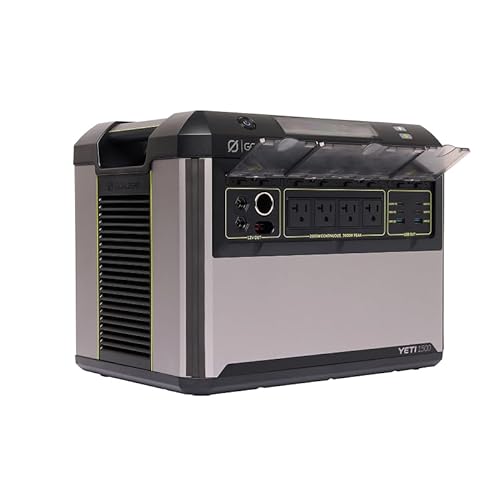
Goal Zero Yeti 1500 Portable Power Station, LiFePO4
LiFePO4 pack2,000W inverter3,600W surge4,000 cycles
Check price on Amazon
Best for: Buyers who want a long track record and polished support.

Goal Zero sits at the polished end of the bracket. The Yeti 1500's 2,000W inverter and 3,600W surge are well matched to a refrigerator and tools, and the LiFePO4 pack is rated for 4,000 cycles, which the maker equates to a decade of daily use.

The listing says it charges from empty to 80 percent much faster than older Yetis, and it is solar-ready for Goal Zero panels and common third-party ones. You pay for the brand, the app and the long track record, which makes it a safe pick for a buyer who does not want to troubleshoot.

Compared with the Ark3600 it has a smaller tank and a higher price per watt-hour, but it is quieter in daily use and far better supported. Store it half charged and test it under load. Its sturdier chassis and carry handles also make it the easiest of the group to move between a garage and a car.

What works

  • 2,000W inverter with 3,600W surge
  • LiFePO4 rated for 4,000 cycles
  • Mature brand and app
  • Solar-ready input

Watch out for

  • Panels sold separately
  • Highest cost per watt-hour here
  • Smaller tank than the ABOK units

Spec sheet

Inverter
2,000W
Surge
3,600W
Cycle life
4,000 cycles
Chemistry
LiFePO4
Solar
Solar generator ready
06
EcoFlow DELTA 3 Classic 1,024Wh 1,800W AC
1,024Wh1,800W AC3,600W surge10ms UPS
Check price on Amazon
Best for: Home offices and apartments that want a compact, polished UPS-style backup.

Where the others chase capacity, the DELTA 3 Classic chases polish. It delivers 1,800W with X-Boost to 3,600W surge in a compact one-kilowatt-hour body, charges to 80 percent in 45 minutes and switches to battery in under 10 milliseconds, which makes it the best desk-side or home-office UPS in the group.

It has a 100W USB-C output for laptops, and the app and ecosystem are among the best in the category. It is the lightest and most portable choice here, which suits people who might also take it camping.

The limitation is energy: 1,024Wh runs a refrigerator for about a night and a half of its draw but a bigger load drains it fast. Use it for essentials, store it half charged and keep the app updated. Because the app reports real-time input and output, it is easy to see which appliance is eating the battery.

What works

  • Under 10ms switchover keeps computers on
  • 45 minutes from 0 to 80 percent
  • 100W USB-C output
  • Compact and light

Watch out for

  • 1,024Wh is the smallest tank here
  • X-Boost lowers voltage under load
  • Costs more per watt-hour than the ABOK units

Spec sheet

Capacity
1,024Wh
Rated AC output
1,800W
Surge
3,600W with X-Boost
Fast charge
0 to 80% in 45 minutes
UPS
Under 10ms

Spec sheet decoder

What the numbers on the box really mean

The specs manufacturers lead with, translated into what they tell you about real-world performance.

Wh capacity

The tank. It decides how long loads run. Always compare watt-hours, not milliamp-hours, across brands.

Watch forFrom 1,024Wh to 3,840Wh in this lineup.

Surge or peak watts

A brief ceiling for motor startup. The label on your appliance is the number to compare it with.

Watch forThe ABOK lists 4,500W peak and the OUPES 4,500W surge.

A-Boost or X-Boost

A mode that lifts output for resistive loads by lowering voltage. The mode lowers voltage, so avoid using it with sensitive electronics.

Watch forThe Ark2000 lists 2,400W A-Boost, the DELTA 3 Classic X-Boost.

Fast-charge time

How long the wall takes to refill 80 percent. A shorter time is helpful only if your wall circuit can supply the input.

Watch forThe OUPES lists 36 minutes, the EcoFlow 45.

Expansion capacity

Extra packs that add watt-hours. Check the manual for how many packs are supported and in what combinations.

Watch forThe Ark3600 expands to 11,520Wh.

Methodology

How We Evaluated These Solar Generators Under $2,000

Backup runtime

We estimated runtime at a 200W essential load with a 0.85 factor. The Ark3600 gives about 16 hours, the Elite 200 V2 about 8 and the one-kilowatt-hour units about 4. Heavier loads were treated as optional extras rather than the baseline.

Motor start

We compared surge ratings to compressor and pump starts. The ABOK and OUPES led with 4,500W figures. Pump and compressor starts were treated as the hardest test.

Growth

We noted expansion options. The OUPES, ABOK Ark2000 and Ark3600 expand. Packs that need matching modules were noted.

Cap fit

We included only machines under the cap at Amazon listing prices when updated. Prices move. Machines above the cap or with unknown pricing were excluded.

Support

We used listing details and owner feedback patterns for brand maturity, not our own use. We weighed ease of getting replacement parts.

Decision guide

How to Choose the Right Solar Generators Under $2,000

By Backup Goal

GoalPickWhy
Overnight plus a dayABOK Ark3600 with 400W panel3,840Wh
Overnight with polishBLUETTI Elite 200 V22,080Wh and low standby
Start small and growABOK Ark2000Expands to 4,608Wh
Fast turnaround, workshopOUPES Mega 136-minute charge, 4,500W surge
Desk UPSEcoFlow DELTA 3 ClassicUnder 10ms switchover

By Budget Within the Cap

TierPickWhy
LowestEcoFlow DELTA 3 ClassicCompact and polished
Low-midOUPES Mega 1Expandable
MidABOK Ark2000Mid-size with expansion
UpperBLUETTI Elite 200 V2Mature brand
Near the capABOK Ark3600 or Yeti 1500Biggest tank or best support

Biggest Tank vs Best Support

Biggest tank

The ABOK Ark3600 gives 3,840Wh for the money. It is the choice for multi-hour outages with several loads.

Best support

The Goal Zero Yeti 1500 and Bluetti Elite 200 V2 offer mature apps and long warranty histories. They suit buyers who want less risk.

Choose a tank for outages and support for peace of mind, and do not pay for expansion you will never use.

Fixed vs Expandable

PreferencePickWhy
Fixed, doneGoal Zero Yeti 1500No expansion needed
Expandable mid-sizeABOK Ark2000To 4,608Wh
Expandable fast-chargingOUPES Mega 1To 5,120Wh
Expandable largeABOK Ark3600To 11,520Wh

For a Sump Pump Specifically

Look for

A surge of at least 3,000W and a tank that runs the pump for the length of a storm. A half-horsepower pump draws about 1,000W running and 3,000W at start. A float switch that restarts the pump after a power cut is also worth fitting.

In this comparison

The ABOK Ark3600, OUPES Mega 1 and Yeti 1500 handle the start. The Ark3600 gives the longest run.

When to Spend More

Spend more if

You want multi-day outage cover. Move to a 5kWh-class unit above this cap.

Save if

You only need a night of essentials. The Elite 200 V2 or DELTA 3 Classic does it. Both leave room for a second battery later.

Ownership

Maintenance schedule

The upkeep that decides whether this machine lasts two seasons or ten.

TaskIntervalWhy it matters
Load test the unitEvery three monthsA real load confirms the inverter and battery perform as rated. Log the result so you can see degradation over years.
Store at half chargeLong storageCells sitting at full charge for months lose usable capacity faster than cells rested mid-range. Top up the charge every two to three months.
Clean fans and ventsEach seasonDust shortens full-power runtime. Use a soft brush rather than compressed air.
Check panel connectorsEach seasonLoose connectors lose power. Replace any cracked cable at once.
Update app firmwareTwice a yearUpdates tune charging and safety. Keep a note of the version you installed.

FAQ

Frequently Asked Questions

What can a 3.8kWh solar generator run?

A refrigerator, freezer, sump pump and router for about 12 to 16 hours, or a window air conditioner for two hours. It does not replace a whole-house system. A transfer switch installed by an electrician is the safe way to feed hardwired circuits.

Is a younger brand risky?

A little. ABOK and OUPES have shorter support histories, so keep your receipt and register the unit. Goal Zero and Bluetti carry less risk. If in doubt, ask the seller about the battery warranty in writing.

Which is the best value under $2,000?

The ABOK Ark3600 delivers the most energy per dollar, while the Elite 200 V2 is the polished mid-size alternative. The cheaper route is often to buy the base unit and add panels later.

Do I need to expand?

Not necessarily. A 2kWh unit covers essentials overnight. Expansion helps for longer outages but adds cost and weight. Check that spare modules are sold in the same series before relying on a path. Most owners are happy with one unit and a modest array.

Will the price stay under the cap?

Not necessarily. The $2,000 cap reflects Amazon listing prices when this guide was updated, and sales move units in and out. Waiting for a sale event can move the price by a meaningful amount.

Can they power a whole house?

No. They can feed selected circuits through a transfer switch, but central air or an electric range would drain them quickly. For a whole home, a hardwired battery system is the better route.

Bottom line

The short version

Browse more solar generators under $2,000on Amazon →
James Miller, Lead Machine Editor

About the author

James Miller

Lead Machine Editor, MachineFanatic

James Miller leads MachineFanatic's buying guides, turning spec sheets, manuals and owner feedback into clear verdicts on power tools, outdoor power equipment, shop machines and kitchen machines.

More from James →

Keep reading

Related guides