
Amazon affiliate links - we earn a commission.Affiliate disclosure

Buying guide · 12 min read · Updated 2026-11-13

Best Solar Generators Under $750 (2026)

Five solar generators under $750, mostly 1kWh-class machines with 1,200W to 1,800W inverters, ranked on charge speed, panel kits and surge strength.

James MillerBy James MillerLead Machine Editor5 machines comparedSpec-sheet verified
Best Solar Generators Under $750

At a glance

Our top picks

Side by side

Spec comparison

This is the price band where the kilowatt-hour power station becomes affordable, and the competition is fierce. The machines look similar on a spec sheet, but they differ in how fast they charge, how hard the inverter can push and whether the panels come in the box. That is a big shift from the earlier tiers.

We compared five units that sit under the cap on Amazon listing prices when this guide was updated. Prices move, so check the live listing, but the ranking below is built on features that do not change with a sale, mainly output strength, charging speed and what you get in the kit.

Before you buy

6 Criteria to Look For Before Buying a Solar Generator Under $750

  1. 01

    Output for kitchen and tools

    A kettle draws 1,200 to 1,800W and a microwave 1,000W or more. The Bluetti's 1,800W and the EcoFlow's 1,800W run them, the Jackery's 1,500W handles a microwave but not every kettle, and the UDPOWER's 1,200W is marginal. Check the appliance label, since resistive loads draw their rated wattage continuously while motors have a start-up spike on top.

  2. 02

    Solar input and panels

    The Bluetti accepts up to 1,000W of solar and ships with 200W, the UDPOWER ships with 240W and the Jackery with 100W. A 200W panel returns about 600Wh a day. More input only helps if you own more panels. A 600W array fills a 1,024Wh battery in under two sunny hours at the Bluetti's input limit, but only if you own the panels.

  3. 03

    Charge speed

    The EcoFlow reaches 80 percent in 45 minutes, the Jackery fills in about 50, and the Bluetti's TurboBoost AC reaches about 1,200W. A fast charger turns a lunch stop into a full tank. Fast charging also helps if you use a generator or a short grid window to recover.

  4. 04

    Energy per dollar

    The UDPOWER's 1,191Wh with panels offers the most watt-hours and solar capacity per dollar, while the Bluetti and EcoFlow charge a premium for output and polish. Decide which you value. The cheapest kit is not always the best value if the inverter cannot start your appliance. Compare watt-hours with the panels included, not the station alone.

  5. 05

    Boost modes

    Power Lifting and X-Boost let resistive loads run above the rated output by lowering the voltage. They are useful for kettles and heaters, but sensitive electronics should stay on normal output. Never use a boost mode with computers or medical devices, and keep resistive loads on it only for short periods.

  6. 06

    Support and longevity

    Jackery, Bluetti and EcoFlow have long support histories and apps. UDPOWER and Takki are newer, so keep receipts. LiFePO4 cells in the first four last thousands of cycles. If a brand is unfamiliar, order from a seller with an easy return policy and test the unit in the first week.

Detailed reviews

The 5 best solar generators under $750, explained

01
BLUETTI Elite 100 V2 Solar Generator with 200W Panel, 1,024Wh
1,024Wh LFP1,800W AC3,600W surge1,000W solar input
Check price on Amazon
Best for: Buyers who want the strongest, fastest-charging kilowatt-hour kit.

The Elite 100 V2 gets the balance right. An 1,800W inverter with a 2,700W Power Lifting mode and a 3,600W surge runs a refrigerator, a microwave or a table saw from a one-kilowatt-hour tank, and a 200W panel is in the kit so the first sunny afternoon returns about 600Wh.

Charging is its standout. The listing quotes 1,200W TurboBoost AC charging and up to 1,000W of solar input, which Bluetti calls the fastest solar charge for a one-kilowatt-hour station. In practice a 600W array would fill it in under two hours of sun, and the wall fills it in under an hour.

The price premium over the cheaper kits is real, but you get a mature app and good support. Judged against the Jackery 1000 v2 it has 300W more rated output and a much higher solar input. Keep the vents clear, store it half charged and update the app. For a typical outage plan, load the refrigerator, router and a few lights at about 200W, leave the Power Lifting mode for the occasional kettle, and let the 200W panel and a second array carry the day, so the battery spends the evening full instead of empty. Because the unit charges so fast from the wall, an hour of grid power between rolling outages also restores most of the tank.

What works

  • 1,800W with 2,700W Power Lifting mode
  • 1,000W solar input
  • 1,200W TurboBoost wall charging
  • 200W panel included

Watch out for

  • Power Lifting lowers voltage on heavy loads
  • 1,024Wh covers only a night of essentials
  • Costs more than the UDPOWER kit

Spec sheet

Capacity
1,024Wh
Rated AC output
1,800W
Power Lifting
2,700W
Surge
3,600W
Solar input
Up to 1,000W
02
UDPOWER S1200 with 2x120W Solar Panels, 1,191Wh
1,191Wh LiFePO41,200W AC240W of panels3,000 cycles
Check price on Amazon
Best for: Budget buyers who want a kit with real panel capacity.

UDPOWER's S1200 kit leans on volume: 1,191Wh of LiFePO4 and two 120W panels for a combined 240W of solar, all for less than most one-kilowatt-hour stations cost without panels. The listing says the battery retains at least 80 percent after 3,000 cycles, and the 1,200W pure sine inverter handles refrigerators and small appliances.

The two panels together return about 700Wh on a sunny day, roughly 60 percent of the pack, so a long weekend of modest use can be sustained from the sun. It has 167Wh more energy than the Bluetti, but it is slower to charge and its inverter is 600W weaker.

The brand is less established, so keep the receipt and register the unit. Panels and station are shipped separately according to a related listing, so check delivery. Store it half charged and fold the panels carefully. A real advantage of the two-panel layout is flexibility: one panel can sit on a tent roof while the other follows the sun on the ground, and either works alone if the other is shaded. Owners who plan to use it for a week off-grid should treat 700Wh a day as the ceiling and budget their appliances accordingly.

What works

  • 1,191Wh with two 120W panels
  • LiFePO4 rated for 3,000 cycles
  • Pure sine wave 1,200W output
  • Lowest cost per watt-hour here

Watch out for

  • 1,200W inverter is the weakest here
  • Slower charging than rivals
  • Newer brand with thin support

Spec sheet

Capacity
1,191Wh
Rated AC output
1,200W
Included panels
2 x 120W
Cycle life
80% after 3,000 cycles
Waveform
Pure sine wave
03
Jackery Solar Generator 1000 v2 with 100W Solar Panel
1,024Wh LiFePO41,500W AC3,000W surge50-min charge
Check price on Amazon
Best for: Buyers who value brand support and ecosystem over raw specs.

Jackery's 1000 v2 is the safe choice. A 1,500W inverter with a 3,000W surge, a 10ms UPS function and a full recharge in about 50 minutes from the wall make a well-rounded kilowatt-hour box, and the listing quotes a 10-year lifespan for the LiFePO4 pack.

The 100W panel is a modest starter, returning roughly 300Wh a day, so this is a wall-first battery that can use the sun as a supplement. Compared with the Bluetti it has less output and a much lower solar input, but its accessory range and support network are deeper.

It suits buyers who value warranty handling and ecosystem over raw specs. Keep it out of hot cars, store it half charged and keep the app updated. Many buyers pair it with a second 100W panel after the first month, which doubles the daily harvest to about 600Wh and turns the kit into a self-sufficient camp battery for electronics and a light cooler load.

What works

  • Established brand and accessories
  • Full recharge in about 50 minutes
  • 10ms UPS function
  • 10-year lifespan claim

Watch out for

  • 100W panel is a modest starter
  • 1,500W is less than the Bluetti's 1,800W
  • Higher cost per watt-hour

Spec sheet

Capacity
1,024Wh
Rated AC output
1,500W
Surge
3,000W
Wall recharge
About 50 minutes
Lifespan
10 years
04
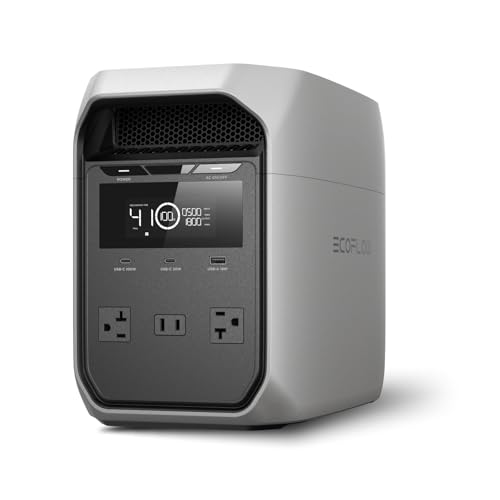
EcoFlow DELTA 3 Classic 1,024Wh 1,800W AC
1,024Wh1,800W AC3,600W surge45 min to 80%
Check price on Amazon
Best for: Home offices and apartments that want a compact UPS-style battery.

The DELTA 3 Classic is the polished small-footprint choice. It delivers 1,800W with an X-Boost mode up to 3,600W surge in a compact body, recharges to 80 percent in 45 minutes and switches to battery in under 10 milliseconds, which makes it a strong desk or home-office backup.

It includes a 100W USB-C output for laptops and has one of the best apps in the category. There is no solar panel in this listing, so you add one, and the unit's solar input is lower than the Bluetti's.

Compared with the Bluetti it has similar output and capacity, a slightly smaller solar ceiling and a more refined user experience. Keep it ventilated, store it half charged and let the app handle firmware. The X-Boost mode is handy for a toaster or a hair dryer but should be used sparingly, since the voltage sags under load and electronics may not like it. Pair it with a surge-protected power strip and it makes a tidy desk-side backup.

What works

  • Under 10ms UPS switchover
  • 45 minutes to 80 percent from the wall
  • 100W USB-C output
  • Strong app and ecosystem

Watch out for

  • No panel in this listing
  • X-Boost lowers voltage under load
  • Lower solar input than the Bluetti

Spec sheet

Capacity
1,024Wh
Rated AC output
1,800W
Surge
3,600W with X-Boost
Fast charge
0 to 80% in 45 minutes
UPS
Under 10ms
05
Takki 277Wh Solar Generator with 60W Panel
277.5Wh battery450W peak60W panel8 ports
Check price on Amazon
Best for: Buyers who want a cheap complete kit for camping and light backup.

This is the odd one out, a 277.5Wh pack with a 60W panel for a fraction of the price of the kilowatt-hour units. It carries eight output ports, a pure sine wave AC outlet and a 450W peak, which is enough for phones, laptops, lights and a fan.

The 60W panel returns about 150 to 200Wh a day, so a modest day of use can be refilled from the sun. It will not run a cooler or a refrigerator, and it is a camping and emergency-kit unit, not a home backup.

Compared with the Bluetti it holds about a quarter of the energy, but it costs a small fraction as much. Keep it away from heat, store it half charged and treat the panel carefully. Because it is so cheap, it makes a good second battery for the car or the kids' camping gear, and the 60W panel is enough to keep it topped up through a week of light use. The 75,000mAh figure in the listing is simply the same 277.5Wh expressed in milliamp-hours at the cell voltage.

What works

  • 60W panel included
  • Pure sine wave output
  • Eight ports
  • Very low cost

Watch out for

  • 277Wh is a small tank
  • 450W peak limits appliances
  • Thin brand support

Spec sheet

Capacity
277.5Wh (75,000mAh)
Peak output
450W
Included panel
60W
Waveform
Pure sine wave
Ports
8

Spec sheet decoder

What the numbers on the box really mean

The specs manufacturers lead with, translated into what they tell you about real-world performance.

Rated vs lifting output

Rated is the sustained wattage and Power Lifting or X-Boost lifts it for resistive loads. That distinction matters when you shop for a kettle or heater.

Watch forThe Bluetti lists 1,800W rated and 2,700W Power Lifting.

Surge watts

A brief startup ceiling for motors. A good rule is to demand at least double the running watts of any motor.

Watch forThe Bluetti and EcoFlow list 3,600W, the Jackery 3,000W.

Solar input

The most panel power the station accepts. A higher number only helps if you own the panels to reach it.

Watch forThe Bluetti accepts up to 1,000W. The UDPOWER kit's 240W is well inside its limit.

TurboBoost AC charging

A high-power wall charging mode. It is a convenience for wall charging, not for solar.

Watch forThe Bluetti lists 1,200W.

Cycle life

Charges before capacity drops to about 80 percent. A cycle count is an estimate, not a guarantee.

Watch forThe UDPOWER lists 3,000. The Jackery quotes a ten-year lifespan.

Methodology

How We Evaluated These Solar Generators Under $750

Output strength

We compared rated and lifting output. The Bluetti and EcoFlow's 1,800W led, the UDPOWER's 1,200W trailed. We assigned extra credit for a Power Lifting or X-Boost mode only when the listing explained how it behaves.

Solar capability

We looked at panels in the box and input limits. The Bluetti's 1,000W input and the UDPOWER's 240W of panels led. Panels were scored by watts and by whether they ship in the same box. A larger array shortens recharge only up to the limit.

Charge speed

We ranked wall charging. The EcoFlow's 45 minutes and the Jackery's 50 led. We assumed a standard wall outlet limit when judging charge time.

Cap fit

We included only machines under the cap at Amazon listing prices when updated. Prices move. Items above the cap or with unknown pricing were left out.

Support

We used listing details and owner feedback patterns for brand strength, not our own use. We also looked at the warranty terms where the listing stated them. We kept the conclusion cautious where listings were thin.

Decision guide

How to Choose the Right Solar Generators Under $750

By Priority

PriorityPickWhy
Strongest output and solarBLUETTI Elite 100 V2 kit1,800W and 1,000W input
Most energy and panels per dollarUDPOWER S1200 kit1,191Wh and 240W of panels
Brand supportJackery Solar Generator 1000 v2Established ecosystem
Desk UPSEcoFlow DELTA 3 ClassicUnder 10ms switchover
Cheapest complete kitTakki 277Wh kit60W panel included
Weekend camping with a coolerUDPOWER S1200 kit1,191Wh and 240W of panels

By Budget Within the Cap

TierPickWhy
LowestTakki 277Wh kitEntry kit
Low-midUDPOWER S1200 kitBest value in the class
MidJackery Solar Generator 1000 v2Brand and ecosystem
UpperEcoFlow DELTA 3 ClassicPolish and UPS
Near the capBLUETTI Elite 100 V2 kitStrongest specs
Skip if you need moreNext tier upMove to a 2kWh unit for overnight cooling

Value Kit vs Premium Specs

Value kit

The UDPOWER S1200 gives 1,191Wh and 240W of panels for the least money. It suits campers and backup users who want solar included.

Premium specs

The Bluetti Elite 100 V2 and EcoFlow DELTA 3 Classic give 1,800W and fast charging. They suit people who run kettles and want quick turnaround.

Choose value for capacity and panels, premium for output and speed, and do not pay for boost modes you will never use.

Panels

PreferencePickWhy
Most panels in the boxUDPOWER S1200 kit2 x 120W
Highest input limitBLUETTI Elite 100 V21,000W
Modest starterJackery 1000 v2 kit100W
Panel laterEcoFlow DELTA 3 ClassicChoose your own
Fast turnaround at a hookupEcoFlow DELTA 3 Classic45 minutes to 80 percent

For Home Backup Specifically

Look for

A UPS-style switchover, 1,500W or more of output and fast recharging. A refrigerator and router at about 150W last about six hours on 1,024Wh. Measure the real draw first so you do not oversize.

In this comparison

The EcoFlow and Jackery switch in 10ms, and the Bluetti and EcoFlow recharge fastest.

When to Spend More

Spend more if

You want a night or more for a refrigerator. Move up to the 2kWh class. The 2kWh class costs more but doubles the runtime.

Save if

You camp and want solar included. The UDPOWER kit does it.

Ownership

Maintenance schedule

The upkeep that decides whether this machine lasts two seasons or ten.

TaskIntervalWhy it matters
Store at half chargeLong storageModerate charge slows lithium aging. Top it up every two to three months. A moderate charge also reduces swelling risk in a warm room.
Run a real loadEvery three monthsA load test confirms the inverter still performs. Write the result in a notebook to track decline. Make the test part of your seasonal routine.
Clean ventsEach seasonDust limits full-load runtime. A soft brush works better than compressed air.
Check panel cablesEach tripLoose connectors lose power. Replace any pinched cable. Carry a spare cable on trips.
Update app firmwareTwice a yearUpdates tune charging. Update in a calm moment, not during an outage.

FAQ

Frequently Asked Questions

What can a 1kWh solar generator run?

A refrigerator for about eight hours, a laptop for 15 charges or a kettle for around 20 boils. Heavy loads drain it in under an hour. A refrigerator typically needs 1,000 to 1,500Wh a day, so a single unit is a few-hour solution without solar. That is roughly a night of essentials, not a week.

Is the Bluetti worth more than the UDPOWER?

If you want stronger output and faster charging, yes. If you want panels and capacity at the lowest price, the UDPOWER is better value. Both are good machines, so the decision is price against speed and output. Both use LFP cells with similar cycle claims.

Which is the best value under $750?

The UDPOWER S1200 kit for capacity and panels, and the Bluetti Elite 100 V2 for performance. If you want one recommendation for most readers, it is the Bluetti kit.

Does Power Lifting work with every appliance?

It suits resistive loads like kettles. Avoid it for sensitive electronics, since voltage drops under load. A watt meter on the appliance gives a far better answer than a label. If in doubt, leave it off.

Will the price stay under the cap?

Not necessarily. The $750 cap reflects Amazon listing prices when this guide was updated, and sales move units in and out. Waiting for a seasonal sale often moves a unit well under its usual price. Check the live price before ordering.

Can they run a CPAP overnight?

Yes. A CPAP uses 30 to 150Wh a night, so these units cover many nights. A CPAP with a heated humidifier uses closer to 100 to 150Wh a night. Keep the unit near the bed so the cable is short.

Bottom line

The short version

Browse more solar generators under $750on Amazon →
James Miller, Lead Machine Editor

About the author

James Miller

Lead Machine Editor, MachineFanatic

James Miller leads MachineFanatic's buying guides, turning spec sheets, manuals and owner feedback into clear verdicts on power tools, outdoor power equipment, shop machines and kitchen machines.

More from James →

Keep reading

Related guides