
Amazon affiliate links - we earn a commission.Affiliate disclosure

Buying guide · 13 min read · Updated 2026-11-07

Best Soldering Stations (2026)

Six temperature controlled soldering stations compared by wattage, tip recovery and ESD safety: Hakko, Weller, Yihua, WEP and FNIRSI for electronics and repair.

James MillerBy James MillerLead Machine Editor6 machines comparedSpec-sheet verified
Best Soldering Stations

At a glance

Our top picks

Side by side

Spec comparison

MachineTemperature rangeTypePowerExtras
Hakko FX888DX digital soldering stationBest OverallHakko FX888DX digital soldering station120 to 899 FTemperature controlled stationn/an/a
Weller WE1010NA 70 watt digital soldering stationBest ESD-Safe PickWeller WE1010NA 70 watt digital soldering stationn/an/a70 Wn/a
WEP 927-IV 110 watt soldering station kitBest High-Power KitWEP 927-IV 110 watt soldering station kitn/aKit110 WLED magnifier, 5 extra tips
Yihua 939D+ 75 watt equivalent digital soldering stationBest Mid-Range DigitalYihua 939D+ 75 watt equivalent digital soldering station392 to 896 FDigital station75 W equivalentn/a
Yihua 926 III 60 watt digital station kitBest Beginner KitYihua 926 III 60 watt digital station kitn/aKit60 W6 extra tips, 2 helping hands
FNIRSI DWS-200 200 watt soldering station kitBest High-Power SpecialistFNIRSI DWS-200 200 watt soldering station kit212 to 842 Fn/a200 W2 helping hands

A soldering station separates the heater and temperature control from the pen you hold, which is what lets it hold a set temperature while you work. That steadiness is the main difference between a station and the cheap iron that overheats until the tip is black.

Wattage affects how fast a tip recovers heat after touching a cold joint, not how hot it can get. Match the power to the joints you solder, then check tip availability, ESD safety and whether a hot air gun or presets would actually help your work.

Before you buy

6 Criteria to Look For Before Buying a Soldering Station

  1. 01

    Wattage means recovery, not temperature

    Wattage mainly sets how quickly the tip regains heat after touching a cold joint, not how hot it can get. A 60 watt Yihua 926 III suits general PCB work, 70 to 75 watts as on the Weller and Yihua 939D+ is comfortable for mixed work, and 110 to 200 watts as on the WEP 927-IV and FNIRSI DWS-200 suits big joints. Buy for your largest regular joint. A useful test is to tin a thick wire and watch how quickly the solder flows again after touching it; a station that droops and stalls needs more wattage.

  2. 02

    Temperature control quality

    A station holds a set temperature through a sensor feedback loop, which is the main advantage over a basic iron. Digital PID control, as on the Hakko FX888DX, is steadier than a thermostat. Typical set points are 320 to 360 C for leaded solder and 340 to 380 C for lead-free. Check that the display reads the tip temperature rather than the heater temperature, since some budget units report the latter and drift under load.

  3. 03

    Lead-free capability

    Lead-free alloy melts at a higher temperature, so a station needs more power and better recovery. A weak iron may reach the temperature but then burn out tips quickly. If you use lead-free solder, favor 70 watts or more. Do not simply raise the temperature to compensate for a weak iron, because higher heat shortens tip life and burns flux.

  4. 04

    Tip availability and type

    Fine conical tips suit PCB and SMD work and chisel tips suit connectors and thicker wire. The Hakko and Weller ecosystems offer replacement tips nearly everywhere, while smaller brands may be limited. Check that spare tips exist before you buy. Keep one fine tip and one chisel tip on hand, since swapping tips is cheaper than forcing the wrong shape to work.

  5. 05

    ESD safety

    Static can damage sensitive components, so an ESD safe station grounds the tip and body. The Weller WE1010NA lists ESD safe construction. If you repair modern electronics, it is a worthwhile feature.

  6. 06

    Extras that matter

    Presets, sleep mode, helping hands and magnifiers are convenient, but they are not the core. The WEP 927-IV adds three presets, sleep mode and an LED magnifier, and the Yihua 926 III adds helping hands. Treat extras as bonuses and spend the money on the iron and tips. A decent fume extractor or a small fan pulling air away from your face is worth more than a magnifier lamp.

Detailed reviews

The 6 best soldering stations, explained

01
Hakko FX888DX digital soldering station
120 to 899 FDigital displayRotary encoderF or C
Check price on Amazon
Best for: Regular electronics hobbyists who want a dependable station.

The FX888DX is a digital temperature controlled station with a range of 120 to 899 degrees Fahrenheit, a rotary encoder for setting temperature and a display that shows Fahrenheit or Celsius. Its value comes from the heater and sensor in the pen, which recover quickly after touching a cold pad, and from a tip family that is stocked everywhere, so replacement tips are never a problem.

The tradeoff is that you pay for the brand and a sound design rather than a pile of extras. It has no hot air function and the kit includes few accessories, so a beginner may still buy helping hands and extra tips. Compared with the Weller WE1010NA, it is similar in class but has a digital readout and a rotary encoder, and against the Yihua 939D+ it is the better supported product.

In ownership terms, keep the tip tinned and clean it on brass wool rather than a wet sponge, which shocks the tip. Turn the temperature down when idle, since a hot idle iron oxidizes the tip quickly. Replace the tip when it will not wet, not when it looks worn.

What works

  • Fast heat recovery in a pen-mounted heater
  • Digital display in F or C with a rotary encoder
  • Tips and parts are available everywhere
  • Temperature range of 120 to 899 F covers leaded and lead-free

Watch out for

  • No hot air function and few accessories
  • Costs more than kit-style budget stations

Spec sheet

Temperature range
120 to 899 F
Display
Digital, F or C
Control
Rotary encoder
Type
Temperature controlled station
Tips
Widely available
02
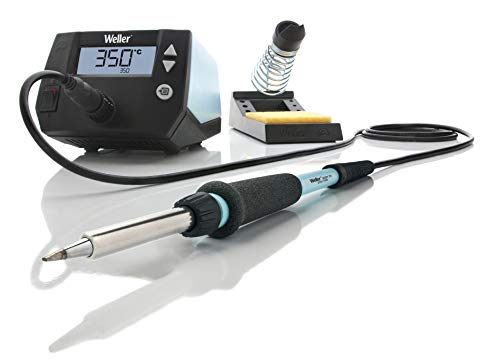
Weller WE1010NA 70 watt digital soldering station
70 WESD safeDigitalSafety rest
Check price on Amazon
Best for: Electronics work where static protection matters.

The WE1010NA is a one-channel digital station with a 70 watt iron and ESD safe construction, which protects static-sensitive parts. A PH70 safety rest with a sponge holds the iron, and an ETA tip is included, so the station is ready to work out of the box. The 70 watt rating gives good tip recovery on typical PCB joints and moderate wire.

Its compromise is that it offers a single channel and a modest feature list for its tier. Compared with the Hakko FX888DX, it is comparable in class, and compared with the 110 watt WEP 927-IV, it has less power but a more established tip and support ecosystem. It is the sort of station that suits a bench where static control matters.

Upkeep follows the usual rules: keep the tip tinned, clean it often and replace it when it will not wet. Store the iron in its rest, and avoid dropping the pen because the heater element is delicate. Pair it with a decent stand and a good fume extractor and the setup lasts for years.

What works

  • ESD safe design protects sensitive components
  • 70 W iron recovers heat well on PCB joints
  • Includes a safety rest and an ETA tip
  • Well supported tip ecosystem

Watch out for

  • Single channel with a short feature list
  • Less power than 110 W stations

Spec sheet

Power
70 W
Safety
ESD safe
Iron
WEP70 with tip retainer
Holder
PH70 safety rest with sponge
Tip
ETA 0.062 inch included
03
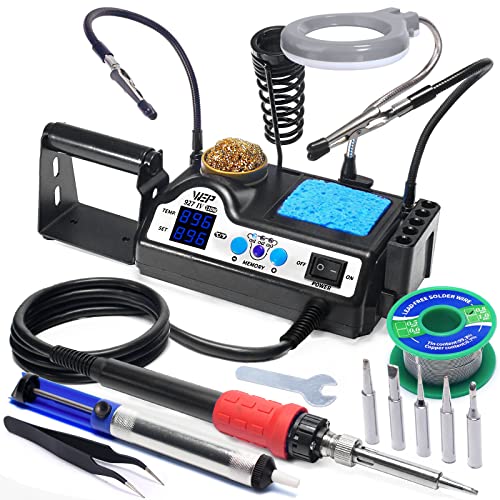
WEP 927-IV 110 watt soldering station kit
110 W3 preset channelsSleep modeLED magnifier
Check price on Amazon
Best for: Heavier joints and wire where tip recovery matters.

The 927-IV is a high-power kit with a 110 watt heating element, three preset channels, a sleep mode that cools the tip when the pen sits idle, and a lamp with an LED magnifier. The extra power means the tip recovers quickly on large joints, heatsink tabs and thick wire, which is where lower-watt stations drag. Five spare tips are included.

The tradeoff is brand maturity and finish. Kit stations rely on bundled accessories, and the support behind them is less established than for Hakko or Weller. Compared with the Yihua 926 III, it offers far more power and presets, and against the FNIRSI DWS-200, it is a more conventional design with a simpler interface.

Use the presets for your two or three common temperatures, let sleep mode protect the tip and clean it on brass wool. Replace tips when plating wears through.

What works

  • 110 W element recovers quickly on large joints
  • Three preset temperature channels
  • Sleep mode protects the tip when idle
  • Includes an LED magnifier and five extra tips

Watch out for

  • Less established brand support
  • Accessory quality varies in kit stations

Spec sheet

Power
110 W
Presets
3 preset channels
Safety
Sleep mode
Extras
LED magnifier, 5 extra tips
Type
Kit
04
Yihua 939D+ 75 watt equivalent digital soldering station
75 W equivalent392 to 896 FBuilt-in transformerDigital
Check price on Amazon
Best for: Someone who solders weekly and wants more power than a basic kit.

The 939D+ is a digital station rated at about 75 watts with a temperature range of 392 to 896 degrees Fahrenheit. It is built for people who solder regularly, with precision heat control and a safety transformer design. The control logic holds temperature more steadily than a plain thermostat iron, and the range covers leaded and lead-free solder.

The limitation is that tip choice and long-term support are narrower than for Hakko. Compared with the 926 III, it offers more power and a higher-tier build, and against the Hakko FX888DX it costs less but has fewer replacement options.

Keep the tip tinned, avoid keeping it hot while idle and replace tips with ones that match the pen. A stable bench and a decent fume extractor complete the setup. Because the unit has presets, mark your common temperatures on a card beside the bench.

What works

  • 75 W equivalent heat for general electronics
  • 392 to 896 F range covers leaded and lead-free
  • Precision heat control
  • Lower cost than the Hakko and Weller

Watch out for

  • Narrower tip and support ecosystem
  • No ESD detail on the listing

Spec sheet

Power
75 W equivalent
Temperature range
392 to 896 F
Control
Precision heat control
Type
Digital station
Use
Regular soldering
05
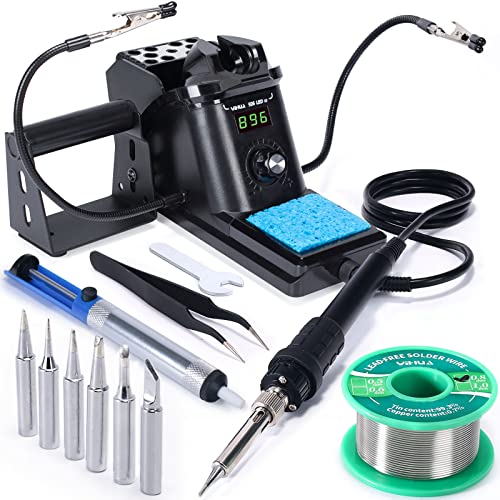
Yihua 926 III 60 watt digital station kit
60 WDigital display6 extra tips2 helping hands
Check price on Amazon
Best for: Beginners who want everything needed to start soldering.

The 926 III is a compact 60 watt digital station sold as a kit with two helping hands, six spare tips and lead-free solder. Fast heating and an adjustable temperature range make it comfortable for general electronics, and the compact body saves bench space. Everything needed to start is in the box.

The compromise is power and construction. A 60 watt station handles ordinary PCB joints, but it is slower on large pads and heavy ground planes, and the build is lighter than the Hakko or Weller. Against the 939D+, it costs less and offers fewer watts, and against the WEP 927-IV, it is the simpler, lower tier option.

Keep the tip tinned, use the helping hands to steady boards and clean the tip regularly. If you outgrow it, the spare tips and helping hands remain useful.

What works

  • Complete kit with helping hands and extra tips
  • 60 W is enough for most PCB work
  • Compact digital station
  • Lowest cost in this guide

Watch out for

  • Slower on large pads and heavy wire
  • Lighter build than premium brands

Spec sheet

Power
60 W
Display
Digital
Extras
6 extra tips, 2 helping hands
Solder
Lead-free roll included
Type
Kit
06
FNIRSI DWS-200 200 watt soldering station kit
200 W3S melting212 to 842 FC245 and C210 tips
Check price on Amazon
Best for: Heavy connectors, ground planes and thick wire.

The DWS-200 pushes power to 200 watts and advertises about 3 second melting over a range of 212 to 842 degrees Fahrenheit. It ships with six F245 and three F210 tips plus helping hands, and a built-in copper heating core helps it hold temperature when a big joint draws heat. For heavy work such as XT60 connectors, ground planes and thick wire, the extra power is a real advantage.

Its tradeoff is that power does not equal precision, and a 200 watt station on delicate SMD work needs lower temperature settings and careful handling. Compared with the Hakko FX888DX, it is far stronger but less proven, and against the WEP 927-IV it offers nearly twice the power.

Set a lower temperature for small parts, keep tips clean and watch for tip wear since high power stresses plating. Make sure your bench has adequate ventilation.

What works

  • 200 W heats big joints very quickly
  • About 3 second melting time
  • Includes six F245 and three F210 tips
  • Helping hands in the kit

Watch out for

  • Less proven than Hakko or Weller
  • Needs care on delicate SMD work

Spec sheet

Power
200 W
Temperature range
212 to 842 F
Melt time
About 3 seconds
Tips
6 F245 and 3 F210
Extras
2 helping hands

Spec sheet decoder

What the numbers on the box really mean

The specs manufacturers lead with, translated into what they tell you about real-world performance.

Wattage

The heater's power rating, which governs how quickly the tip recovers heat. It does not set maximum temperature. A higher number helps most when soldering thick copper or large ground planes.

Watch forThe Yihua 926 III is 60 W, the Weller is 70 W, the WEP 927-IV is 110 W and the FNIRSI is 200 W.

Temperature range

The span of set points the station allows. A wider range covers more solder types. A range that starts near 200 C is useful for low-temperature solder and heat-sensitive parts.

Watch forThe Hakko covers 120 to 899 F while the Yihua 939D+ covers 392 to 896 F.

PID control

A control method that adjusts heater power smoothly to hold temperature. It reduces overshoot. Without it, a cheap iron can overshoot by tens of degrees before settling.

Watch forDigital stations like the Hakko FX888DX use this style of control.

ESD safe

The iron and station are grounded to prevent static discharge to components. A grounded wrist strap adds protection on sensitive boards.

Watch forThe Weller WE1010NA lists it explicitly.

Sleep mode

The station lowers the tip temperature when the pen sits idle. It protects the tip from oxidizing. Check the idle timeout so it does not cool while you reposition a board.

Watch forThe WEP 927-IV includes it.

Methodology

How We Evaluated These Soldering Stations

Heat delivery

We compared rated wattage and temperature range. The FNIRSI is 200 W and the Yihua 926 III is 60 W. Better recovery for the stated job scored higher. We also noted how quickly each unit reaches its set point.

Control quality

We looked at digital display, PID control and presets. The Hakko FX888DX has a rotary encoder and the WEP 927-IV has three presets. Steady temperature scored higher. We looked at how clearly each model shows its set point.

Tips and support

We considered tip families and availability. Hakko and Weller tips are common, while smaller brands are narrower. Easy replacement scored higher. We counted the tips included in each kit.

Safety features

We checked ESD design, sleep mode and holders. The Weller is ESD safe and the WEP 927-IV has sleep mode. Safer designs scored higher. We also noted whether a stand with tip cleaner is provided.

Ownership

We weighed build quality and owner feedback patterns on tip life and heater reliability. Stations with robust pens scored higher. We looked at how comfortable the pen is for long sessions.

Decision guide

How to Choose the Right Soldering Stations

By Type of Work

SituationPickWhy
General electronics repairHakko FX888DXFast recovery and common tips
Static-sensitive repairWeller WE1010NAESD safe construction
Heavy joints and connectorsFNIRSI DWS-200200 W and quick melting
Large pads and thick wireWEP 927-IV110 W with presets
First stationYihua 926 IIIKit with helping hands

By Budget

SituationPickWhy
Lowest tierYihua 926 IIIComplete beginner kit
Entry digitalYihua 939D+75 W equivalent
Mid tier powerWEP 927-IV110 W with extras
Upper tier powerFNIRSI DWS-200200 W
Premium brandHakko FX888DXProven pen and tips

Standard Station vs High-Power Station

Standard 60 to 75 W

The Yihua 926 III, 939D+ and Weller handle PCB work and wire. They are easier on delicate parts and cheaper.

High power 110 to 200 W

The WEP 927-IV and FNIRSI DWS-200 heat large joints fast. They need lower settings on fine work and a careful hand.

Fine electronics should pick standard power, and heavy repairs should pick high power.

Solder Type

SituationPickWhy
Leaded solder, low heatYihua 926 IIILower power is adequate
Lead-free on PCBWeller WE1010NA70 W recovery and ESD safety
Lead-free on large jointsWEP 927-IV110 W element
Wide set rangeHakko FX888DX120 to 899 F

For PCB Repair Specifically

Look for

Look for 60 to 75 watts, steady temperature control and fine tips. Too much power burns pads, and too little drags on ground planes. Use a fume extractor.

In this comparison

The Hakko FX888DX and Weller WE1010NA are best here, with the Yihua 939D+ as a value alternative.

When to Spend More

Spend more if

Spend more if you solder daily or repair valuable devices. The Hakko and Weller reward you with tip support and steady temperature.

Save if

Save if you solder occasionally. The Yihua 926 III and 939D+ cover general work.

Ownership

Maintenance schedule

The upkeep that decides whether this machine lasts two seasons or ten.

TaskIntervalWhy it matters
Tin the tip after useEvery sessionA tinned tip resists oxidation. A bare hot tip turns black and stops wetting. Use a small amount of fresh solder rather than old blobs, which contain burnt flux.
Clean on brass woolDuring useBrass wool removes oxide without the thermal shock of a wet sponge. Keep brass wool in a dish so it never drags across the bench.
Lower temperature when idleEvery breakA hot idle iron oxidizes the tip fast. Sleep mode or a lower set point helps.
Replace worn tipsWhen they will not wetA worn tip transfers heat poorly and slows every joint. Keep a spare tip in the same family as your main one.
Check the cord and pen connectorTwice a yearHeat and flexing wear the cable. A frayed lead is a safety hazard.

FAQ

Frequently Asked Questions

How many watts do I need?

Sixty to 75 watts suits general electronics, and 110 to 200 watts suits heavy joints. Wattage sets recovery, not maximum temperature. If you are unsure, a 70 watt station is the safest middle path for mixed work.

Is lead-free solder harder?

Yes. It melts hotter and needs more power and better recovery. Choose a station with at least 70 watts for regular lead-free work.

Do I need a hot air station?

Only for surface-mount rework and desoldering. A soldering iron alone covers through-hole and basic SMD work. If your work involves large heatsinks or battery packs, plan on 110 watts or more.

Why does my tip turn black?

Oxidation from heat and a lack of tinning. Keep the tip coated with solder and lower the temperature when idle. Cleaning with brass wool and tinning right after is the simplest habit that doubles tip life.

What is ESD safe and do I need it?

It grounds the iron to protect components from static. It matters when repairing modern boards.

How long does a station last?

The station can last many years. Tips and heaters are the wear items, and Hakko and Weller parts are easy to find. Use a quality flux and fresh solder, because the best station cannot fix old oxidized solder.

Bottom line

The short version

Browse more soldering stationson Amazon →
James Miller, Lead Machine Editor

About the author

James Miller

Lead Machine Editor, MachineFanatic

James Miller leads MachineFanatic's buying guides, turning spec sheets, manuals and owner feedback into clear verdicts on power tools, outdoor power equipment, shop machines and kitchen machines.

More from James →

Keep reading

Related guides