
Amazon affiliate links - we earn a commission.Affiliate disclosure

Buying guide · 12 min read · Updated 2026-11-07

Best RV Solar Panels for Battery Charging (2026)

Six solar panels and kits for charging RV batteries, from trickle maintainers to a 200W panel, compared on controller type, battery chemistry and output.

James MillerBy James MillerLead Machine Editor6 machines comparedSpec-sheet verified
Best RV Solar Panels for Battery Charging

At a glance

Our top picks

Side by side

Spec comparison

Charging an RV battery from the sun is a different job from running a refrigerator. A battery has a state of charge, a chemistry and a voltage limit, and the panel only helps if the controller feeds those limits correctly. Most failed solar setups fail at the controller, not the panel.

The biggest split is between maintainers that only offset self-discharge and true charging kits that refill a house bank each day. Our assessment rests on published specs and owner feedback patterns, looking at panel watts, controller type, supported battery chemistries and how realistic the claimed charging speed is for an RV.

Before you buy

6 Criteria to Look For Before Buying a RV Solar Panel for Battery Charging

  1. 01

    Panel watts versus battery size

    A 100Ah 12V battery holds about 1,200Wh, so refilling half of it takes roughly 600Wh. The ECO-WORTHY 200W kit makes about 800Wh in four strong sun hours, while the SOLPERK 30W makes a fraction of that. Match panel watts to how much you take out of the battery each day.

  2. 02

    Controller type

    PWM controllers like the one in the ECO-WORTHY kit are cheap and rugged but waste voltage headroom, while MPPT controllers recover more in cold or hazy light. Small MPPT kits like the SOLPERK 30W and Voltset 20W gain a little, but the effect is larger on 200W arrays. Pay for MPPT when you have more than 150W.

  3. 03

    Battery chemistry profile

    Lead-acid batteries want a charge-and-float cycle, while LiFePO4 batteries want a fixed voltage and no float. The Voltset 20W lists LiFePO4, AGM, Gel and flooded support, while the ECO-WORTHY listing requires you to check the settings. A wrong profile slowly damages the battery.

  4. 04

    Maintainer versus charger

    A 12W or 20W panel offsets self-discharge and small parasitic draws but cannot recharge a bank after a night of use. Panels at 100W and above are chargers. Mixing up the two is the most common reason RV owners think their solar is broken.

  5. 05

    Wire gauge and run length

    A long, thin cable between panel and controller loses power as heat. The Hoysicy 100W includes 16.4 ft of cable, enough for a short roof run, but a 200W panel at 12V needs thicker wire for long runs. Put the controller close to the battery, not the panel.

  6. 06

    Protection features

    Reverse polarity, short circuit, over-discharge and overcharge protection save a battery from wiring mistakes. The SOLPERK 30W and Voltset 20W list all four, while a bare panel like the DOKIO 200W includes none. If you are new to solar wiring, protection is worth more than an extra few watts.

Detailed reviews

The 6 best rv solar panels for battery charging, explained

01
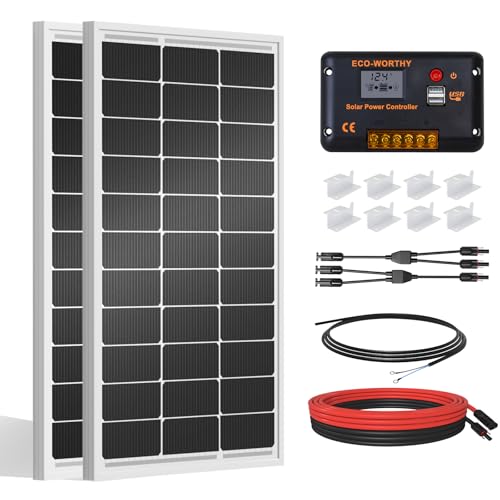
ECO-WORTHY 200W Panel Kit With 30A PWM Controller
200W mono panels30A PWM controller12V or 24V systemsAluminum frame
Check price on Amazon
Best for: RV owners who want to refill a house battery each day with a complete kit.

A complete 200W kit is the sweet spot for refilling an RV house battery, because it produces about 800Wh in four hours of strong sun, according to the listing. That covers a day of lights, a fan, a phone charger and a good part of a small fridge's draw. The 30A PWM controller handles the current from the panel with plenty of margin.

The weakness is PWM. A PWM controller pulls the panel down to battery voltage and leaves energy behind, so on a cold or hazy day the kit will make less than an MPPT setup using the same panels. Another point is that PWM controllers often target lead-acid profiles, so confirm there is a lithium setting before connecting a LiFePO4 bank.

The corrosion-resistant aluminum frame is built for outdoor mounting, and the kit suits either 12V or 24V banks. Seal the brackets with lap sealant and check the controller screw terminals each season for looseness. Compared with the Hoysicy 100W kit it doubles the panel area for a modest step up in cost.

What works

  • 200W yields about 800Wh in four hours of strong sun
  • 30A controller has headroom above the panel's current
  • Works with 12V or 24V battery banks
  • Corrosion-resistant aluminum frame for outdoor mounting

Watch out for

  • PWM controller leaves energy on the table in cold or hazy light
  • Lithium charge profile must be confirmed before use

Spec sheet

Rated power
200W
Controller
30A PWM
Daily energy
About 800Wh in 4 sun hours
Cell gain
Up to 21.5% claim
Frame
Corrosion-resistant aluminum
02
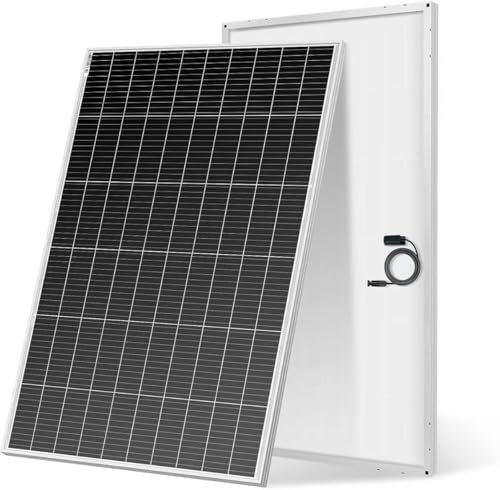
DOKIO 200W 18V Monocrystalline Panel, MC4 Leads
200W mono panel18V classMC4 leadsPre-drilled frame
Check price on Amazon
Best for: Owners who already have a quality MPPT controller and want a clean panel to feed it.

DOKIO sells this as a bare panel, so you choose the controller yourself, and that is a feature if you already own a good one. The 18V class output suits a 12V battery system, and the pre-drilled aluminum frame matches common bracket patterns. The listing mentions a cell design that reduces shading losses and holds performance in heat.

Because there is no controller in the box, a beginner can end up with a panel and no way to charge safely. You must add a controller with the right amp rating, which for 200W at 12V means at least 20A and preferably 30A. Compared with the ECO-WORTHY kit, you save the cost of a controller you may not want but lose the convenience of a matched set.

The MC4 leads let you extend the wiring with standard connectors, but crimp them properly and weatherproof the joint. Inspect the frame corners for corrosion every season. It is a sound building block for someone who knows their electrical setup and wants flexibility.

What works

  • Leaves the choice of controller to you
  • Pre-drilled aluminum frame matches common brackets
  • MC4 leads allow standard wiring extensions
  • 18V class output suits 12V battery banks

Watch out for

  • No controller included, so a beginner needs extra parts
  • Shade-loss and heat claims are not backed by published numbers

Spec sheet

Rated power
200W
Voltage class
18V, for 12V systems
Connectors
MC4 leads
Frame
Aluminum, pre-drilled
Controller
Not included
03
Hoysicy 100W Panel Kit With 20A Controller
100W mono panel20A controller16.4 ft cableWaterproof box
Check price on Amazon
Best for: Small rigs and first-time buyers who want a complete starter kit they can expand.

With a 20A controller sized well above a 100W panel's current, this kit leaves room to add a second panel later. The listing mentions overcharge protection, a waterproof junction box, edge sealing and a corrosion-resistant frame. A 16.4 ft cable gives you freedom to put the controller inside the rig and the panel on the roof.

One hundred watts is a topping-up size for an RV, not a full recharge. It will offset a fridge's idle draw or keep a spare battery alive but struggles with daily cycling of a larger bank. If you plan on running anything beyond lights and a fan, the 200W ECO-WORTHY kit is a better fit.

The included cable saves buying extension wire, and the sealed junction box tolerates rain. Check the controller's battery profile before connecting lithium, and tighten terminals after the first week of vibration. For owners who want a first step into solar without redoing the whole system, it is a clean starting point.

What works

  • 20A controller leaves room to add a second panel
  • 16.4 ft cable included for easy routing
  • Waterproof junction box and edge sealing
  • Monocrystalline cells at a small-kit size

Watch out for

  • 100W only offsets idle loads on a house bank
  • Controller type is a basic design, not a tracking unit

Spec sheet

Rated power
100W
Controller
20A with protection
Cable
16.4 ft
Box
Waterproof junction box
Cells
Monocrystalline silicon
04
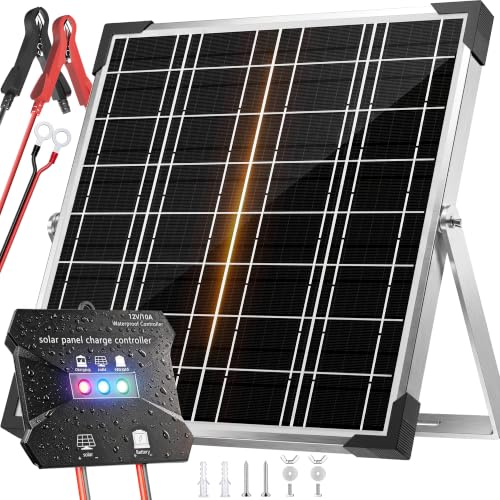
SOLPERK 30W Maintainer Kit With MPPT Controller
30W A+ mono panelMPPT controller360 degree bracketWaterproof
Check price on Amazon
Best for: Storage and stand-by use, such as keeping a spare or starter battery full.

SOLPERK pairs a 30W panel with an MPPT controller, which is rare at this size, and the controller guards against overcharge, over-discharge, short circuit and reverse polarity. A 360 degree adjustable bracket lets you aim the panel at the sun even when the vehicle is parked at an awkward angle. The panel uses A+ monocrystalline cells.

The 30W output is a maintainer rate: roughly 100 to 150Wh on a good day, not enough to refill a house bank. It prevents a spare or a starter battery from going flat during storage and offsets small parasitic loads. It is not a replacement for a roof array, and it should not be used as one.

Because the panel is small, mounting is easy on a dash, a roof edge or a stand. Check the bracket pivot for slack and keep leads away from sharp edges. It outperforms the Hoysicy 20W maintainer in controller quality, and it is the best option when you only need to hold a battery full.

What works

  • MPPT controller at a small maintainer size
  • Four protections guard the battery
  • 360 degree bracket aims the panel at the sun
  • Easy to mount on a dash, roof edge or stand

Watch out for

  • 30W is far too small to refill a house battery
  • Not suited to daily cycling of an RV bank

Spec sheet

Rated power
30W
Controller
MPPT with protections
Bracket
360 degree adjustable
Protections
Overcharge, over-discharge, short, reverse
Cells
A+ monocrystalline
05
Voltset 20W MPPT Trickle Charger Kit
20W panelMPPT controllerLiFePO4, AGM, GelWaterproof
Check price on Amazon
Best for: Owners with a mix of lithium and lead-acid batteries who need a flexible maintainer.

What stands out here is the breadth of battery support: the listing names LiFePO4, AGM, Gel, flooded and lithium-ion batteries. That matters for an RV owner who runs a lithium house bank and a lead-acid starter battery, because one kit can serve either. The MPPT controller claims 20 to 30% faster charging than simpler designs.

At 20W the panel is a maintainer, so expect it to hold a battery rather than recharge one. Compared with the SOLPERK 30W it has less panel and gives slower top-ups, but the chemistry flexibility is its edge. Treat the faster-charging claim with caution, because the gain is relative to the maker's own comparison.

Care is minimal: wipe the surface, check the clamps or ring terminals and keep the controller cabling dry. Make sure the battery chemistry selector matches your pack before leaving it connected for weeks. It is a safe, low-maintenance option for a parked rig.

What works

  • Supports LiFePO4, AGM, Gel, flooded and lithium-ion
  • MPPT controller improves charging over basic designs
  • Four layers of battery protection
  • Waterproof build suits outdoor parking

Watch out for

  • 20W cannot refill a house battery
  • Faster-charging claim is a maker comparison, not an independent figure

Spec sheet

Rated power
20W
Controller
MPPT, 20 to 30% faster claim
Chemistries
LiFePO4, AGM, Gel, Flooded, Li-ion
Protections
Overcharge, over-discharge, short, reverse
Use
RV and boat maintainer
06
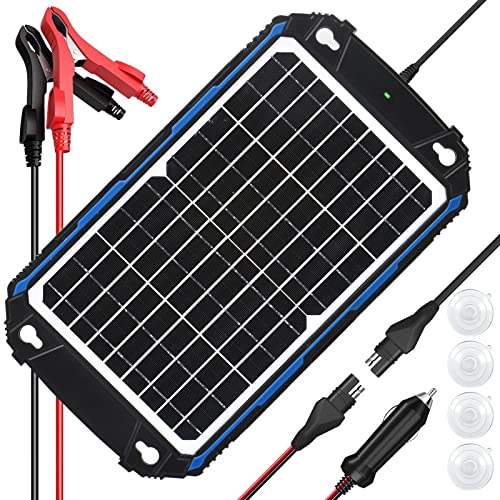
SUNER POWER 12W Maintainer With Ultra-Smart MPPT
12W panelMPPT controller3-stage chargeAuto resume
Check price on Amazon
Best for: Winter storage and long-parked rigs with a lead-acid starter battery.

Charging in three stages (bulk, absorption and float) is how a lead-acid battery is meant to be filled, and SUNER POWER builds that algorithm into a 12W unit. The charger stops when the battery is full and restarts when it drops, so you can leave it connected for months. An integrated MPPT chip squeezes extra output from a very small panel.

Twelve watts is the smallest panel in this guide, and it does not so much charge a battery as hold it. If your battery sits idle in winter storage, that is exactly the right tool. If you cycle an RV bank daily, this will not even keep up.

Because the controller is built in, there is less to connect, and fewer places for water to get in. Clean the panel, keep the cable off hot surfaces and check the battery clamps for corrosion. Compared with the Voltset 20W it has fewer chemistries and less power, but its charging logic is textbook.

What works

  • Three-stage bulk, absorption and float charging
  • Stops when full and resumes when needed
  • Built-in MPPT in a very small unit
  • Simple to connect with few external parts

Watch out for

  • 12W is the lowest power in the lineup
  • Not suitable for a daily-cycled house bank

Spec sheet

Rated power
12W
Controller
Built-in MPPT
Charge stages
Bulk, absorption, float
Auto features
Stops at full, resumes later
Battery
12V

Spec sheet decoder

What the numbers on the box really mean

The specs manufacturers lead with, translated into what they tell you about real-world performance.

PWM versus MPPT

PWM connects the panel straight to the battery at battery voltage, while MPPT converts excess voltage into extra current. MPPT gains 10 to 30 percent in poor light.

Watch forThe ECO-WORTHY 200W is PWM, while the SOLPERK 30W and Voltset 20W are MPPT.

Controller amps

The maximum current into the battery. Divide panel watts by battery voltage to find the current you need.

Watch forThe Hoysicy 100W has 20A, and the ECO-WORTHY 200W has 30A.

Charge stages

Bulk pushes current in fast, absorption holds voltage as the battery fills, and float maintains a low trickle. Lithium batteries do not use float.

Watch forThe SUNER POWER 12W lists three stages, so confirm it is suitable for a lithium pack.

Sun hours

The number of hours per day at peak sun intensity, usually 4 to 5. Daily energy equals panel watts times sun hours times about 0.7.

Watch forThe ECO-WORTHY listing quotes 800Wh from 200W in four hours, which assumes no loss.

Battery protections

Features that stop reverse connection, shorts, overcharge and deep discharge. They protect your battery if you wire it wrongly.

Watch forThe DOKIO 200W bare panel has none of these because it has no controller.

Methodology

How We Evaluated These RV Solar Panels for Battery Charging

Charging capacity

We compared each pick's rated watts against typical RV battery sizes. The 200W kits ranked above the 12W and 20W maintainers for daily charging. The ECO-WORTHY 200W's stated 800Wh was the top figure in the lineup.

Controller quality

We reviewed the controller type, amp rating and protections. The MPPT units on the SOLPERK and Voltset scored well for their size, while PWM on the 200W kit scored lower on efficiency but higher on headroom. A bare panel scored zero here.

Battery compatibility

We checked which chemistries each controller supports, treating lithium compatibility as essential for modern RVs. The Voltset 20W lists the widest range, and the ECO-WORTHY listing was less explicit. Confirmation of the lithium profile mattered.

Installation ease

We considered cable length, bracket quality and whether the kit is ready to connect. The Hoysicy 100W includes 16.4 ft of cable and a waterproof box. Kits without controllers lost points for beginners.

Owner feedback patterns

Owner feedback patterns shaped our view of controller reliability and over-claimed output. We adjusted for listings that made performance claims without numbers.

Decision guide

How to Choose the Right RV Solar Panels for Battery Charging

By Battery Use

SituationPickWhy
Daily cycling of a house bankECO-WORTHY 200W kitAbout 800Wh in four sun hours
Keeping a starter battery fullSUNER POWER 12WFloat charging in a tiny unit
Mixed lithium and lead-acid batteriesVoltset 20WWidest chemistry support
Small house battery, add laterHoysicy 100W kit20A controller with room to expand

By Budget

TierPickWhy
CheapestSUNER POWER 12WBasic maintainer
LowVoltset 20WMPPT with broad chemistry support
MidHoysicy 100W kitReal charging power and cable
PremiumECO-WORTHY 200W kitEnough panel for a house bank

Maintainer vs Charger

Maintainer

The SUNER POWER 12W, Voltset 20W and SOLPERK 30W hold a battery near full. They suit storage, spare batteries and small parasitic loads, and they cost little.

Charger

The ECO-WORTHY 200W and Hoysicy 100W deliver enough energy to recharge after daily use. They need a controller with enough amps and a lithium-compatible profile.

Choose a maintainer for parked rigs, a charger for rigs you use every day.

Kit vs Bare Panel

PreferencePickWhy
Ready to connectECO-WORTHY 200W kitPanel and 30A controller together
Own a good controllerDOKIO 200W panelPanel only, MC4 leads
Beginner, small systemHoysicy 100W kitController and cable included
Dash-top maintainerSOLPERK 30WAdjustable bracket included

For Lithium Batteries Specifically

Look for

A controller with a lithium profile and no float stage, plus low-temperature charge protection if you camp in the cold. Lithium cells should not be charged below freezing.

In this comparison

The Voltset 20W lists LiFePO4 support explicitly, and the DOKIO 200W with a separate MPPT controller gives full flexibility. Confirm the ECO-WORTHY profile before connecting a lithium bank.

When to Spend More

Spend more if

You cycle the battery daily or run a refrigerator. The ECO-WORTHY 200W kit or a DOKIO 200W with a separate MPPT controller does the job.

Save if

The rig sits most of the year. The SUNER POWER 12W or SOLPERK 30W prevents the battery from going flat at low cost.

Ownership

Maintenance schedule

The upkeep that decides whether this machine lasts two seasons or ten.

TaskIntervalWhy it matters
Check battery voltageMonthlyA voltmeter on the battery shows whether the panel is actually charging. A drifting resting voltage is the first sign of a wiring or controller fault.
Clean the panelMonthly in seasonDust and pollen cut output on a small panel more than on a large one. Plain water and a soft cloth do the job.
Tighten controller terminalsAfter the first week, then yearlyVibration loosens screw terminals, which causes heat and voltage drop. Retorque to the manual's value.
Inspect clamps and ring terminalsEvery seasonCorrosion on battery clamps adds resistance and stops charging. Clean with a wire brush and apply a thin grease layer.
Confirm battery profileEvery few monthsA changed setting can overcharge or undercharge. Check it against the battery maker's voltage chart.

FAQ

Frequently Asked Questions

How much panel do I need to charge an RV battery?

Divide your daily watt-hours by 4 to 5 sun hours and multiply by about 1.4 for losses. A 100Ah lithium battery used to half capacity needs roughly 150W to refill in a day.

Can a 20W panel charge an RV battery?

It can hold a battery full or offset small drains, but it cannot recharge a bank after heavy use. Treat it as a maintainer.

Is MPPT worth it on a small panel?

The gain is modest below 100W, but MPPT does help in cold or hazy light. The Voltset 20W and SOLPERK 30W include it, while the ECO-WORTHY 200W uses PWM.

Do I need a different controller for lithium?

You need a controller with a lithium or adjustable profile. Lead-acid profiles often use a float stage that is wrong for lithium.

Can I leave a maintainer connected all winter?

Yes, a controller that stops at full charge and resumes later, like the SUNER POWER 12W, is made for that. Check the battery monthly anyway.

Why is my battery not charging in the shade?

A solar panel needs direct light to reach the charge voltage. Shade or heavy cloud can drop the output below what the battery needs, so move the panel into full sun.

Bottom line

The short version

Browse more rv solar panels for battery chargingon Amazon →
James Miller, Lead Machine Editor

About the author

James Miller

Lead Machine Editor, MachineFanatic

James Miller leads MachineFanatic's buying guides, turning spec sheets, manuals and owner feedback into clear verdicts on power tools, outdoor power equipment, shop machines and kitchen machines.

More from James →

Keep reading

Related guides