
Amazon affiliate links - we earn a commission.Affiliate disclosure

Buying guide · 12 min read · Updated 2026-11-07

Best Solar Panels for Boondocking RVs (2026)

Six solar panels and kits for boondocking RVs, covering roof arrays, a battery kit and portable ground panels you can move out of the shade.

James MillerBy James MillerLead Machine Editor6 machines comparedSpec-sheet verified
Best Solar Panels for Boondocking RVs

At a glance

Our top picks

Side by side

Spec comparison

Boondocking means no hookups, so every watt-hour you use must come from the sun, a generator or the battery bank. That changes how you judge a panel: peak watts matter less than how many hours of useful charging you collect when the rig is parked under a few trees on a gray morning.

Roof panels are always on duty but stay in one spot, while ground panels can chase the sun out of the shade. We evaluated each pick on its spec sheet and owner feedback patterns, comparing array size, shade handling, portability, voltage and battery fit, because a boondocking system lives or dies on its daily energy balance.

Before you buy

6 Criteria to Look For Before Buying a Solar Panel for Boondocking RVs

  1. 01

    Daily energy budget

    Boondocking starts with a number: your daily watt-hours. A refrigerator, lights, a pump and laptops commonly add up to 1000 to 2000Wh. Divide by 4 to 5 sun hours and 0.7 for losses to size the array, so 1500Wh needs about 500W of panels.

  2. 02

    Battery storage versus array size

    The Renogy ShadowFlux kit stores 3840Wh but only makes 560 to 640Wh a day from one 200W panel, a ratio that leaves the battery nearly always partly empty. A good rule is that the array should be able to refill about a third to a half of the bank in one sunny day. Add panels before adding batteries.

  3. 03

    Shade tolerance

    Boondocking spots often include trees, hills or the shadow of your own roof gear. Panels with anti-shade layouts, like the ShadowFlux, or split-panel designs, like the Callsun, keep producing when part of the surface is shaded. Standard panels can lose most of their output from one shaded cell row.

  4. 04

    Roof panels versus portable panels

    Roof panels are always charging but cannot leave the shade, while portable panels can be placed in the sun but need daily handling. The Renogy portable at 13.89 lb is manageable, and the ZOUPW 350W is heavier and larger. Many boondockers use a roof array plus one portable panel for the bad days.

  5. 05

    Voltage and controller match

    Series wiring of two Callsun panels reaches 54.62V open-circuit, and the ZOUPW 350W reaches 50.2V, so your controller or station input must accept those values with cold-weather margin. Wiring to the wrong voltage damages equipment or wastes the panel. Read the controller's maximum input before buying any high-voltage panel.

  6. 06

    Winter sun hours

    In winter, sun hours can drop from 5 to 2 or less depending on latitude, which cuts output by more than half. A boondocker who camps in cold climates should oversize the array and keep a backup generator. N-type panels and MPPT controllers help in low light and cold.

Detailed reviews

The 6 best solar panels for boondocking rvs, explained

01
Renogy 200W ShadowFlux Kit With 3840Wh LiFePO4 Battery
200W ShadowFlux panel3840Wh LiFePO412V 300Ah50A controller
Check price on Amazon
Best for: Boondockers who want matched storage and charging, and will expand the array over time.

A 3840Wh lithium bank is the headline here, since it is large enough to carry a typical RV through two or three overcast days of boondocking. Renogy pairs it with a ShadowFlux N-type panel, whose cell layout keeps producing when a vent hood or tree branch shades part of the surface. The kit is built for house power rather than device charging.

One 200W panel is a small array for a battery this big. In four strong sun hours it returns around 560 to 640Wh, so refilling the 3840Wh bank from empty would take a week, and boondockers will need to add panels or run a generator on dull spells. That is the honest tradeoff: storage is generous, charging is lean.

The real value is a matched, documented system that avoids the guessing that ruins DIY banks. Plan on adding a second and third panel, check the controller input voltage before you do, and keep the battery inside the living space in winter. Compared with the Renogy 200W rigid panel it costs far more, but it includes the storage you would otherwise price separately.

What works

  • 3840Wh bank carries a rig through several cloudy days
  • ShadowFlux layout limits losses from partial shade
  • Matched system avoids controller and battery mismatches
  • N-type cells hold output better on hot roofs

Watch out for

  • 200W refills a bank this size very slowly without added panels
  • Highest cost in the group because the battery is included

Spec sheet

Panel
200W N-type, anti-shading
Battery
12V 300Ah LiFePO4, 3840Wh
Controller
50A class
Cells
ShadowFlux anti-shading layout
Use
RV house power
02
Callsun 400W Bifacial Pair, Two 200W N-Type Panels
2 x 200W N-type25.6% efficientBifacial47.48V Vmp in series
Check price on Amazon
Best for: Boondockers who want the most roof watts and are comfortable choosing a controller.

Callsun sells two 200W N-type bifacial panels as a pair, and the listing spells out what happens when you wire them in series: 47.48V at maximum power, 54.62V open-circuit and 8.43A. Those figures tell an installer exactly which MPPT controller will accept the array, and they show why series wiring works well for long boondocking cable runs, because low current means thin wire and small losses. Each panel splits into two independent halves, which helps in partial shade.

Series wiring needs an MPPT controller with an input rating well above 54.62V, plus allowance for cold mornings when open-circuit voltage rises. If your controller tops out near 50V or 60V, parallel wiring is the safer choice, but then you carry 17A and need thicker cable. That is a real design decision, and the listing at least gives you the numbers to make it.

For boondocking, 400W is a respectable roof array, returning around 1.1 to 1.3kWh a day in good sun. It costs less per watt than the portable panels in this guide and needs no daily setup. Seal the mounts, check the connectors each season, and keep both faces clean.

What works

  • Pair provides 400W with published series and parallel electrical figures
  • Dual-module layout keeps one half running if the other is shaded
  • 25.6% efficiency on N-type 16BB cells
  • Series wiring allows thin wire on long cable runs

Watch out for

  • Series wiring needs an MPPT controller with a high voltage input
  • Bifacial gain is small when roof mounted

Spec sheet

Total power
400W, two 200W panels
Series output
47.48V Vmp, 54.62V Voc, 8.43A
Efficiency
25.6%
Layout
Dual-module anti-shading
Systems
12V or 24V batteries
03
Renogy 200W N-Type 16BB Rigid Panel
200W N-type 16BB25% efficient24V-class outputLighter frame
Check price on Amazon
Best for: Boondockers who build their array one panel at a time on a clear roof.

As a building block, this is hard to beat: a single 200W N-type panel with a higher operating voltage that cuts current and wire loss on long runs. Renogy says it is 7.5% smaller and 11.7% lighter than the model it replaces, which makes it easier to carry up a ladder and fit between vents. The listing says it still produces well on cloudy days thanks to the higher voltage.

It has no shade strategy beyond that, so a shadow across one cell row will drag it down, and a tree-camping boondocker should favor the ShadowFlux or the Callsun's split-panel design. The panel suits an open roof in the desert or on a plain. It needs an MPPT controller to make use of its voltage, and that cost belongs in your budget.

Two or three of these on a roof make a sound 400W to 600W boondocking array. Seal every foot with lap sealant and check the sealant each spring. Compared with the Callsun pair it is smaller and easier to add one at a time, which suits boondockers who build their system in stages.

What works

  • N-type cells with 16 busbars at 25% efficiency
  • Lighter and smaller than the previous model
  • Higher voltage cuts current and wire loss
  • Easy to add one panel at a time

Watch out for

  • No shade-tolerant layout
  • Needs an MPPT controller to use its voltage headroom

Spec sheet

Rated power
200W
Cells
N-type, 16 busbar, 25%
Weight
11.7% lighter than prior model
Size
7.5% smaller than prior model
Voltage
24V-class, for 12V or 24V banks
04
Renogy 200W Portable Panel With 45W USB-C
200W N-type 16BB13.89 lb45W USB-C PDFolds to 24 x 23 in
Check price on Amazon
Best for: Boondockers who park in shade and want a panel they can move into the sun.

A portable panel earns its place in boondocking because you can drag it into the sun while the rig sits in shade. Renogy's 200W folding panel weighs 13.89 lb and folds to about 24 by 23 inches, with a magnetic latch, and it carries a 45W USB-C PD port plus two USB-A ports for devices. N-type 16-busbar cells give it good heat behavior.

The cost is attention. A portable panel needs setting out in the morning, turning toward the sun a couple of times a day, and packing before weather or a drive. It also needs a cable long enough to reach the rig, and cable loss at 12V is real over long runs. At 200W, it is a supplement to a roof array rather than a replacement.

It pairs well with a roof panel for the rainy-day case when the roof is shaded but the clearing nearby is not. Store it flat and dry, wipe grit from the magnetic seam, and keep the cable coiled loosely. Next to the ZOUPW 350W it is smaller and easier to handle but offers less output.

What works

  • Moves out of the shade when the rig is parked under trees
  • N-type cells with 25% efficiency in a 13.89 lb panel
  • 45W USB-C port charges laptops directly
  • Magnetic fold keeps it closed in a bag

Watch out for

  • Needs daily setup, aiming and packing
  • 200W portable output is a supplement, not a main array

Spec sheet

Rated power
200W
Cells
N-type, 16 busbar, 25%
Weight
13.89 lb
Folded size
23.72 x 22.99 x 1.97 in
Ports
USB-C PD 45W, dual USB-A, DC
05
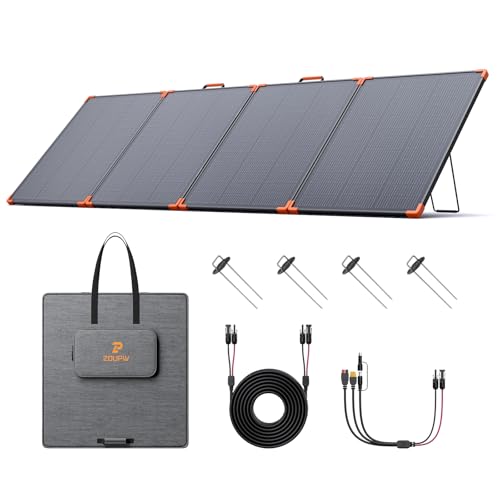
ZOUPW 350W N-Type Portable Panel, 50.2V Open Circuit
350W N-type 16BB50.2V VocETFE surfaceIP68 rated
Check price on Amazon
Best for: Boondockers with a large solar generator or high-voltage MPPT input.

At 350W, this is the largest portable panel here, and its 50.2V open-circuit voltage is aimed at large solar generators of one kilowatt-hour and up. The ETFE coating and IP68 rating are meant for harsh weather, and the N-type 16-busbar cells claim 25% efficiency. If you own a big power station or a battery system with a high input window, the voltage is a plus.

That 50.2V is also a warning. A basic 12V PWM controller cannot accept it, and many station inputs top out at around 50V or less, so the cold-morning rise in voltage can push it past the limit. Check your controller or station specification carefully, and use an MPPT controller or station with a suitable input window.

A 350W portable panel is also awkward to carry and to aim, and it needs a stable setup in wind. It delivers the most ground-level power in this lineup and compares well with two 200W foldables for fewer cables. Keep the connectors dry, wipe the ETFE surface with a soft cloth, and store flat.

What works

  • 350W is the largest portable output in the lineup
  • 50.2V open-circuit voltage suits high-capacity generators
  • ETFE coating and IP68 rating for rough weather
  • N-type 16BB cells at 25% efficiency

Watch out for

  • High voltage can exceed the limits of some controllers and stations
  • Bulky to carry and aim compared with a 200W panel

Spec sheet

Rated power
350W
Cells
N-type, 16 busbar, 25%
Open-circuit voltage
50.2V
Surface
ETFE coating
Rating
IP68
06
SUNIVORA 200W Portable Panel, 22.5% Efficiency
200W portable22.5% efficient15.9 lbIP65 rated
Check price on Amazon
Best for: Boondockers who want a modest, lower-cost ground panel for a power station.

Think of this as the plain portable panel: A+ monocrystalline cells at 22.5% efficiency, an ETFE surface, an IP65 rating and a 4-in-1 MC4 connector cable aimed at power stations. At 15.9 lb and about 24 by 21 inches folded, it is similar in size to the Renogy portable but a bit heavier and a little less efficient. It has a carry handle.

The efficiency gap is small in daily use, roughly two to three percentage points, and it translates to a few watts on a bright day. What you give up is the heat behavior of N-type cells and the USB ports, since this panel is focused on feeding a power station. The 4-in-1 cable helps with connector variety but check your exact station before assuming it fits.

For a boondocker who wants an inexpensive ground panel to supplement a roof array, it works. Plan to carry it, aim it and pack it every day. Keep the seam clean, avoid dragging it on rough ground, and check the cable at the strain relief.

What works

  • 22.5% efficiency in a 200W folding panel
  • 4-in-1 MC4 cable covers several station connectors
  • ETFE surface with an IP65 rating
  • Carry handle makes it easy to move

Watch out for

  • Heavier than the Renogy portable at 15.9 lb
  • No USB ports, so it is focused on power stations

Spec sheet

Rated power
200W
Efficiency
22.5%
Weight
15.9 lb
Folded size
24 x 21 in
Connectors
4-in-1 MC4 cable

Spec sheet decoder

What the numbers on the box really mean

The specs manufacturers lead with, translated into what they tell you about real-world performance.

Vmp and Voc

Vmp is the voltage at maximum power, and Voc is the higher voltage with no load. Controllers must accept Voc with margin for cold mornings.

Watch forThe Callsun pair reaches 47.48V Vmp and 54.62V Voc in series.

Battery watt-hours

Energy stored, found from amp-hours times voltage. A 12V 300Ah battery stores about 3840Wh.

Watch forThe Renogy ShadowFlux kit lists 3840Wh.

ETFE surface

A tough fluoropolymer film used on portable panels instead of glass. It resists scratches and sheds dirt but can wear over years.

Watch forThe ZOUPW 350W and SUNIVORA 200W both use ETFE.

Bifacial gain

The extra output from light hitting the back of a transparent-backed panel. It depends on how much light reflects up from below.

Watch forThe Callsun pair is bifacial, but on a roof the gain is small.

IP65 versus IP68

The second digit rates water protection. IP65 handles jets, while IP68 handles immersion.

Watch forThe ZOUPW 350W lists IP68 and the SUNIVORA 200W lists IP65.

Methodology

How We Evaluated These Solar Panels for Boondocking RVs

Daily energy delivery

We compared each pick's rated watts against typical boondocking energy budgets. The Callsun 400W pair and the ZOUPW 350W lead on raw output, while the single 200W panels depend on being combined. We also weighed storage in the ShadowFlux kit.

Shade and weather handling

We looked for anti-shade designs, split-panel layouts and weather ratings. The ShadowFlux and the Callsun scored highest for shade, and the ZOUPW's IP68 rating scored highest for weather. Standard panels scored lowest on shade.

Portability and daily effort

We compared weight, folded size and setup effort for the portable panels. The Renogy portable at 13.89 lb scored well, and the SUNIVORA at 15.9 lb a bit lower. Roof panels got credit for needing no daily work.

Electrical compatibility

We checked published voltages against common controller and station input limits. The listing detail on the Callsun pair earned credit, and the 50.2V ZOUPW was flagged for input limits. Missing specs lose points.

Owner feedback patterns

Owner feedback patterns shaped our view of portable panel durability and kit support. We discounted marketing claims about efficiency that were not tied to a published figure.

Decision guide

How to Choose the Right Solar Panels for Boondocking RVs

By Daily Energy Use

SituationPickWhy
Lights, phones and a fan onlySUNIVORA 200WModest portable panel
Fridge, lights and laptopRenogy 200W rigid x2400W array from two panels
Full-time boondocking with a big loadCallsun 400W pairLargest roof array in the group
Large lithium bank to refillRenogy ShadowFlux kit3840Wh bank plus expandable array

By Budget

TierPickWhy
CheapestSUNIVORA 200WPortable panel for a station
Low to midRenogy 200W rigidSingle roof panel
MidCallsun 400W pairTwo panels for the price per watt
PremiumRenogy ShadowFlux kitIncludes a large battery

Roof vs Ground Panels

Roof

The Callsun pair and the Renogy rigid panel charge all day with no effort. They cannot escape shade, so they suit open camps and long stays.

Ground

The Renogy portable, ZOUPW 350W and SUNIVORA 200W move into the sun. They need daily setup but save a bad-shade site.

Choose roof for open land, add a ground panel if you often camp under trees.

Series vs Parallel Wiring

SituationPickWhy
Long wire runsCallsun 400W pairSeries gives 8.43A at 47.48V
Shade on one panelCallsun 400W pairParallel keeps the other panel running
PWM controller onlyRenogy 200W rigidKeep voltage low with a single panel
High-voltage station inputZOUPW 350W50.2V open-circuit voltage

For Cloudy Weeks Specifically

Look for

A big battery bank, a shade-tolerant panel layout and the ability to add a generator input. Cloudy output is a quarter or less of sunny output.

In this comparison

The Renogy ShadowFlux kit with 3840Wh fits this case best, since the bank carries several days. Add the Callsun pair or a second Renogy rigid panel to cut recovery time.

When to Spend More

Spend more if

You boondock for weeks at a time or in cold, low-sun regions. The ShadowFlux kit or the Callsun 400W pair give you capacity and shade resilience.

Save if

You boondock for a few nights between hookups. The Renogy 200W rigid or the SUNIVORA 200W cover light use.

Ownership

Maintenance schedule

The upkeep that decides whether this machine lasts two seasons or ten.

TaskIntervalWhy it matters
Clean roof and portable panelsEvery week while boondockingDust, pollen and bird droppings accumulate quickly in the field and cut output. Plain water with a soft cloth works, and a dry brush does not.
Check battery state each morningDailyA monitor shows whether you are gaining or losing energy day to day. Knowing the trend lets you cut loads before the battery is empty.
Inspect roof sealant and bracketsEvery seasonRoad vibration and UV crack sealant and loosen brackets. A leak under a panel foot can do real damage.
Check MC4 connectors and cable strain reliefEvery seasonPortable cables flex every day and fail at the connectors. Replace any cable with cracked insulation.
Verify controller input limits in cold weatherBefore winterOpen-circuit voltage rises as temperature falls, and a margin that works in summer can exceed a controller limit in winter.

FAQ

Frequently Asked Questions

How much solar do I need to boondock?

Most boondockers aim for 400 to 800W on the roof, depending on whether they run a fridge, a laptop and a water pump. Divide daily watt-hours by 4 to 5 sun hours and 0.7 for losses.

Is a portable panel better than a roof panel for boondocking?

A roof panel charges with no effort but cannot leave the shade. A portable panel can chase the sun but needs daily setup. Many people use both.

Can I add a generator as a backup?

Yes, a generator through a converter or an inverter charger fills in on dull days. Many boondockers run it for an hour a day to top up the bank.

Do I need MPPT for boondocking?

For arrays above about 200W, yes. MPPT recovers more in cold or low light, which matters most when you depend on solar.

How do I handle partial shade?

Choose panels with shade-resistant layouts like the ShadowFlux or a split design like the Callsun, and park so the roof stays clear of trees when you can. Series wiring suffers most from shade.

Will solar run my air conditioner?

Not realistically. An RV air conditioner needs far more panel, battery and inverter capacity than a typical boondocking array.

Bottom line

The short version

Browse more solar panels for boondocking rvson Amazon →
James Miller, Lead Machine Editor

About the author

James Miller

Lead Machine Editor, MachineFanatic

James Miller leads MachineFanatic's buying guides, turning spec sheets, manuals and owner feedback into clear verdicts on power tools, outdoor power equipment, shop machines and kitchen machines.

More from James →

Keep reading

Related guides