
Amazon affiliate links - we earn a commission.Affiliate disclosure

Buying guide · 12 min read · Updated 2026-11-07

Best Solar Panels for Pop-Up Campers (2026)

Six solar panels and kits for pop-up campers, built around portable and ground-set panels because a lifting roof cannot carry rigid glass.

James MillerBy James MillerLead Machine Editor6 machines comparedSpec-sheet verified
Best Solar Panels for Pop-Up Campers

At a glance

Our top picks

Side by side

Spec comparison

MachineRated powerCellsWeightFolded sizeController
Renogy 200W N-Type Solar Blanket, 8.82 lbBest OverallRenogy 200W N-Type Solar Blanket, 8.82 lb200WN-type, 16 busbar, 25%8.82 lb16.14 x 15.35 x 3.07 inn/a
DOKIO 300W N-Type Suitcase Kit With 20A ControllerBest Ready-to-Charge KitDOKIO 300W N-Type Suitcase Kit With 20A Controller300WN-type, 16 busbarn/an/a20A, waterproof, USB
SUNIVORA 200W Portable Panel, 15.9 lbBest Mid PortableSUNIVORA 200W Portable Panel, 15.9 lb200Wn/a15.9 lb24 x 21 inn/a
400W Portable Panel, 36V ETFE, 31.3 lbBest High Output400W Portable Panel, 36V ETFE, 31.3 lb400Wn/a31.3 lb22.99 x 35.43 x 1.77 inn/a
Newpowa 35W 12V Panel With Waterproof ControllerBest Fixed TrickleNewpowa 35W 12V Panel With Waterproof Controller35W182mm mono, 21 to 23%n/an/aWaterproof, in kit
SOLPERK 20W Panel Kit With 10A MPPT ControllerBest MaintainerSOLPERK 20W Panel Kit With 10A MPPT Controller20WA+ monocrystallinen/an/a10A MPPT

A pop-up camper changes the solar question completely, because the roof is the part that moves. A lifting roof, a fabric tent section and a tight tow weight mean that a rigid glass panel on top is usually the wrong answer, and the places you can bolt something are few.

The practical solution is a portable panel you set on the ground, plus perhaps a small fixed panel on a rigid surface. We evaluated each pick on its spec sheet and owner feedback patterns, comparing weight, folded size, output, connector type and how realistic each one is for a small battery and light loads.

Before you buy

6 Criteria to Look For Before Buying a Solar Panel for Pop-Up Campers

  1. 01

    Roof limits on a pop-up

    A lifting roof, a canvas section and tight tow weight mean rigid glass panels on top are usually a poor fit. Check your owner's manual for roof load limits before drilling anything. A portable panel avoids the problem entirely.

  2. 02

    Weight and stowage

    The Renogy blanket weighs 8.82 lb and folds to about 16 by 15 inches, while the 400W portable weighs 31.3 lb and folds to 23 by 35 inches. A pop-up has little spare weight or storage, so pick the lightest panel that meets your needs. Weight you tow burns fuel on every trip.

  3. 03

    Battery size to match

    A typical pop-up battery stores only 600 to 1200Wh, so even a 200W panel refills it in a day. A 400W panel is mostly useful for a large power station. Match the panel to your storage, not to the biggest number.

  4. 04

    Controller and connectors

    A blanket or foldable panel designed for stations often has MC4 or DC outputs and no controller. If you charge a bare camper battery, add an MPPT controller or choose a kit with one, like the DOKIO 300W with its 20A controller. A wrong pairing can overvolt a controller, and a pop-up battery is usually small enough that a mistake empties or cooks it in a single weekend.

  5. 05

    Setup effort and wind

    A portable panel needs setting out, aiming and weighing down in wind, and it has to be brought in before a storm. A frameless blanket is easiest to move but easiest to damage. Think about whether you will really handle it every day.

  6. 06

    Fixed versus portable use

    A small fixed panel like the Newpowa 35W or SOLPERK 20W keeps the battery topped up with no effort, while a portable panel does the real charging. Many pop-up owners use both. Decide whether the camper sits stored for long periods, because a camper that sleeps in a driveway all winter needs the maintainer far more than the big panel.

Detailed reviews

The 6 best solar panels for pop-up campers, explained

01
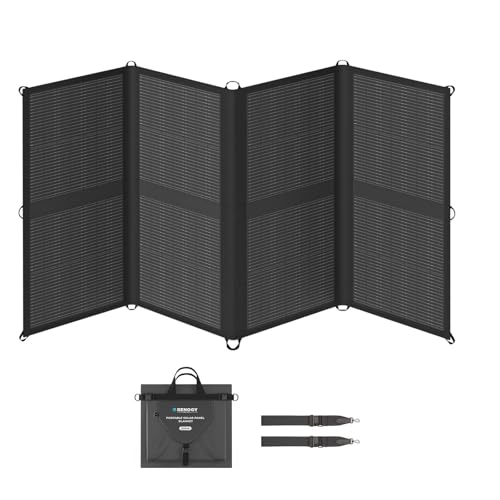
Renogy 200W N-Type Solar Blanket, 8.82 lb
200W N-type 16BB8.82 lbFolds 16 x 15 in25% efficient
Check price on Amazon
Best for: Pop-up owners who want a light, compact panel that stores in a cabinet.

Weight and bulk are the two numbers that matter in a pop-up, and this blanket wins both: 8.82 lb is 54% lighter than a conventional 200W panel, and it folds to about 16 by 15 by 3 inches, small enough for a cabinet or a bin. The listing suggests laying it on the ground, across a vehicle windshield or on a sunny patch, which suits a camper with no roof mount. N-type 16-busbar cells deliver up to 25% efficiency.

A blanket has no frame, so it can be damaged by sharp rocks and it must be weighed down in wind. It is designed for power stations, so check the connector type against your battery or controller and add an MPPT controller if you feed a bare battery. Compared with the SUNIVORA 200W it weighs about seven pounds less and folds far smaller.

Because you handle it daily, treat the folds gently and shake grit from the cells before packing. Keep it dry in storage, and coil the cable loosely. For a pop-up with a small battery and light loads, this is the cleanest solar option.

What works

  • Only 8.82 lb, about 54% lighter than a conventional 200W panel
  • Folds to roughly 16 by 15 by 3 inches
  • N-type 16BB cells reach up to 25% efficiency
  • Can lie on the ground or across a windshield

Watch out for

  • No rigid frame, so it needs weighing down in wind
  • Designed for power stations, so controller pairing needs checking

Spec sheet

Rated power
200W
Cells
N-type, 16 busbar, 25%
Weight
8.82 lb
Folded size
16.14 x 15.35 x 3.07 in
Form
Flexible blanket
02
DOKIO 300W N-Type Suitcase Kit With 20A Controller
300W N-type 16BB20A sealed controllerUSB ports30 degree bracket
Check price on Amazon
Best for: Pop-up owners who want a complete plug-and-charge kit and have storage space.

Alligator clips on the leads let you connect this suitcase kit straight to a camper battery, and the included 20A waterproof controller makes it a complete charging system in one case. A 9.8 ft extension cable keeps the controller in shade while the panel sits in the sun, and a 30 degree bracket props it up. The N-type 16-busbar cells sit in an aluminum frame with reinforced corners.

Three hundred watts into a 20A controller at 12V is more than the controller can pass in full sun, since 20A at about 14V is roughly 280W, so you will clip a little on bright days. That is not a problem for a pop-up's small battery, which will be full long before the panel's capacity matters. Unfolded it stretches 78.4 inches, so you need a clear patch of ground.

The case is bulky to store in a pop-up, and it needs a flat spot out of the way of foot traffic. Check the alligator clip teeth for corrosion and consider a ring-terminal lead. It outclasses the Newpowa 35W in charging power but takes much more space.

What works

  • 20A waterproof controller included in the case
  • 300W is the most panel in the lineup with a controller
  • 9.8 ft cable keeps the controller out of the sun
  • Aluminum frame with reinforced corners

Watch out for

  • Controller current limit clips the top of 300W at 12V
  • Large unfolded size and bulky case

Spec sheet

Rated power
300W
Cells
N-type, 16 busbar
Controller
20A, waterproof, USB
Unfolded size
78.4 x 31.1 x 0.8 in
Cable
9.8 ft extension
03
SUNIVORA 200W Portable Panel, 15.9 lb
200W portable22.5% efficient15.9 lbIP65 rated
Check price on Amazon
Best for: Pop-up owners with a power station who want a sturdier folding panel.

A folding panel with a handle, ETFE surface and IP65 rating, this SUNIVORA is the middle road between the blanket and the suitcase. Its A+ monocrystalline cells convert 22.5% of sunlight, and the 4-in-1 MC4 cable is meant to match several power-station inputs. At 15.9 lb and 24 by 21 inches folded it is easy to carry.

It lacks a controller, so you either feed a power station that has its own MPPT or add a controller for a bare battery. That is simple for a station owner and an extra purchase for a camper-battery owner. Next to the Renogy blanket it is heavier and bulkier but sturdier because of its rigid panels.

The handle makes it easy to move around the site and into the sun. Store it flat, keep the connectors capped, and wipe the surface with a soft cloth. For a pop-up that sees a few weekends a month, it is an accessible choice.

What works

  • 22.5% efficiency on A+ monocrystalline cells
  • Carry handle and 24 by 21 inch folded size
  • ETFE surface with IP65 rating
  • 4-in-1 MC4 cable fits several stations

Watch out for

  • No controller, so a bare battery needs a separate one
  • Heavier and bulkier than the Renogy blanket

Spec sheet

Rated power
200W
Efficiency
22.5%
Weight
15.9 lb
Folded size
24 x 21 in
Connectors
4-in-1 MC4 cable
04
400W Portable Panel, 36V ETFE, 31.3 lb
400W portable36V output25% efficientIP67 rated
Check price on Amazon
Best for: Pop-up owners with a large power station who want quick refills.

Four hundred watts on the ground is a lot of power for a pop-up, and this folding panel carries it in a 22.99 by 35.43 by 1.77 inch folded package that weighs 31.3 lb. The ETFE surface, IP67 rating and A+ monocrystalline cells claiming 25% efficiency suit hard outdoor use. A 4-in-1 connector set covers common power-station plugs.

It is also the heaviest and largest panel here, and a pop-up has little spare weight or storage. The 36V class voltage requires a controller or station that accepts it, and it is far more panel than a typical pop-up battery needs. This one fits owners who carry a large power station for a fridge and want to refill it in a day.

Expect to carry it with two hands and to anchor it in wind. Wipe the surface, check the connectors and store it flat. Next to the Renogy blanket it gives double the watts at over three times the weight.

What works

  • 400W ground output refills a large station quickly
  • ETFE surface and IP67 rating for rough use
  • 25% efficiency claim on A+ monocrystalline cells
  • 4-in-1 connector set for several stations

Watch out for

  • 31.3 lb and a large folded size strain a pop-up's weight budget
  • 36V class voltage must match the controller or station input

Spec sheet

Rated power
400W
Voltage
36V class
Weight
31.3 lb
Folded size
22.99 x 35.43 x 1.77 in
Rating
IP67
05
Newpowa 35W 12V Panel With Waterproof Controller
35W mono panel12V systemWaterproof controllerPre-drilled frame
Check price on Amazon
Best for: Pop-up owners who want a small fixed panel to keep the battery topped up in storage.

Small and fixed is the idea: a 35W monocrystalline panel with pre-drilled frame holes, a waterproof controller and 3 ft of pre-attached leads. Its current at maximum power is only 2.04A, so it is a trickle charger that holds a camper battery topped up between trips, not a panel that runs a fridge. The cells are rated at 21 to 23% efficiency.

A pop-up has few places to mount even a small panel, but a fixed, non-lifting surface such as the front storage box or a tongue box may work. At 35W the panel makes roughly 100 to 120Wh on a good day. That is enough to offset self-discharge and a few lights, not to recover from a weekend of use.

It has the lowest cost and the smallest footprint here. Seal the screw holes if you drill into a surface, and check the lead connections. It makes a useful companion to a portable panel, which does the heavy lifting.

What works

  • Small fixed panel fits a non-lifting surface
  • Waterproof controller included in the kit
  • Pre-drilled frame and pre-attached leads
  • Keeps the battery topped up between trips

Watch out for

  • 35W is a maintainer, not a charger for heavy use
  • Few suitable fixed mounting spots on a pop-up

Spec sheet

Rated power
35W
Cells
182mm mono, 21 to 23%
Current
Imp 2.04A
Controller
Waterproof, in kit
Wiring
Pre-attached 3 ft leads
06
SOLPERK 20W Panel Kit With 10A MPPT Controller
20W mono panel10A MPPT controllerIP67 ratedTempered glass
Check price on Amazon
Best for: Pop-ups that spend months in storage and need a battery maintainer.

A glass-faced 20W panel with a 10A MPPT controller and IP67 rating is the lightest answer to keeping a camper battery alive. The A+ monocrystalline cells sit behind low-iron tempered glass in a corrosion-resistant aluminum frame. The controller claims better efficiency than basic units and protects against overcharge.

It is a maintainer, plain and simple. Twenty watts returns around 60 to 80Wh on a good day, which will not recover a battery after a weekend of lights and a pump. For a pop-up that sits in a yard for months between trips, though, it prevents the slow discharge that kills batteries.

It can sit on a dashboard, a tongue box or a stand, and a bracket lets you aim it. Clean the glass, check the clamps and keep the cable tidy. Compared with the Newpowa 35W it offers a better controller but less power.

What works

  • Glass-faced panel with an IP67 rating
  • 10A MPPT controller with overcharge protection
  • Light enough to move or stow easily
  • Prevents slow battery discharge in storage

Watch out for

  • 20W cannot recover a battery after heavy use
  • Only useful as a maintainer

Spec sheet

Rated power
20W
Controller
10A MPPT
Surface
Low-iron tempered glass
Rating
IP67
Cells
A+ monocrystalline

Spec sheet decoder

What the numbers on the box really mean

The specs manufacturers lead with, translated into what they tell you about real-world performance.

Imp and Vmp

Current and voltage at maximum power. Multiply them for watts, and use them to match a controller.

Watch forThe Newpowa 35W lists Imp 2.04A, a small current.

Folded size

How big the panel is when stored. It decides whether it fits in a cabinet or a storage bin.

Watch forThe Renogy blanket is 16.14 by 15.35 by 3.07 inches, the SUNIVORA is 24 by 21 inches.

ETFE versus glass

ETFE is a lightweight polymer film used on portable panels, while glass is heavier and more scratch resistant. ETFE can wear over years.

Watch forThe SUNIVORA and 400W panels use ETFE, and the SOLPERK uses glass.

36V class panels

Higher-voltage panels send less current through the cable, but the controller or station must accept the voltage.

Watch forThe 400W portable is a 36V class panel.

Solar blanket

A frameless flexible panel that rolls or folds into a small package. It is light but less protected than a framed panel.

Watch forThe Renogy blanket weighs 8.82 lb.

Methodology

How We Evaluated These Solar Panels for Pop-Up Campers

Weight and stowage

We compared weight and folded size, since a pop-up has little of either to spare. The Renogy blanket at 8.82 lb and 16 by 15 inches scored highest. The 400W portable at 31.3 lb scored lowest here.

Charging usefulness

We compared rated watts against a typical pop-up battery. A 200W panel refills a small battery in a day, while 20W and 35W panels maintain. The DOKIO 300W kit's controller made it a complete charger.

Controller and connector fit

We checked whether each pick includes a controller and which connectors it ships with. The DOKIO and Newpowa kits include controllers, and the portable panels feed stations. Panels without controllers lost points for bare-battery use.

Durability

We looked at surface material, IP rating and frame. The glass-faced SOLPERK and the IP67 400W panel scored well, and the frameless blanket scored lower. Hinge and cable strain were noted.

Owner feedback patterns

Owner feedback patterns shaped our view of daily handling, wind problems and connector fit. We adjusted for claims that were not tied to a stated figure.

Decision guide

How to Choose the Right Solar Panels for Pop-Up Campers

By Battery Setup

SituationPickWhy
Small camper battery, light loadsSOLPERK 20WMaintainer with MPPT
Camper battery used every weekendDOKIO 300W kitController and 300W in one case
Power station for fridgeRenogy 200W blanketLight and compact 200W
Large station, fast refill400W portable panel400W ground output

By Budget

TierPickWhy
CheapestSOLPERK 20WSmall maintainer
Low to midNewpowa 35W kitFixed panel with controller
MidSUNIVORA 200WPortable folding 200W
PremiumRenogy 200W blanketN-type cells in a light blanket

Blanket vs Suitcase

Blanket

The Renogy blanket is 8.82 lb and folds small. It has no frame, so it needs weighing down and careful handling on rough ground.

Suitcase

The DOKIO 300W kit is rigid and ships with a controller, but it is bulky to store and long when open.

Choose the blanket for weight and storage, the suitcase for a ready-to-use charging kit.

Fixed vs Portable

PreferencePickWhy
No daily handlingNewpowa 35WFixed trickle panel
Real charging powerRenogy 200W blanketPortable 200W
Storage keepingSOLPERK 20WMaintainer in a small package
Big refills400W portable panelHigh output

For Weekend Camping Specifically

Look for

A panel that stores easily, sets up in minutes and refills a small battery by Sunday. Weekend use rarely needs more than 200W.

In this comparison

The Renogy 200W blanket fits the weekend case best, with the SUNIVORA 200W as a sturdier alternative.

When to Spend More

Spend more if

You camp off-grid for several days. The Renogy 200W blanket or the DOKIO 300W kit give you real recovery.

Save if

You camp mostly in campgrounds with hookups. The SOLPERK 20W or Newpowa 35W keep the battery healthy for little.

Ownership

Maintenance schedule

The upkeep that decides whether this machine lasts two seasons or ten.

TaskIntervalWhy it matters
Shake out and inspect before foldingEvery useGrit between folds scratches cells and cracks seams. Check the surface before you pack it.
Check cables and connectorsEvery seasonPortable cables flex daily and fail at the connector. Replace any cable with cracked insulation.
Dry before storageEvery useA damp panel grows mildew in a storage box. Let it air dry completely.
Check battery voltageMonthly in storageA maintainer only works if the battery is connected and the panel sees light. Verify the voltage is holding.
Inspect clamps and terminalsEvery seasonCorrosion adds resistance and stops charging. Clean with a wire brush.

FAQ

Frequently Asked Questions

Can I mount a rigid panel on a pop-up roof?

Usually not, because the roof lifts and carries little weight. A portable panel on the ground avoids the problem.

How much solar does a pop-up need?

For lights, a fan and a pump, 100 to 200W is enough. A fridge or power station may need more.

Do I need a controller?

If you charge a bare battery, yes. Power stations have their own, but a bare battery needs a controller to avoid overcharging.

Is a solar blanket durable?

It is lighter than a framed panel but easier to damage on rough ground. Weigh it down in wind and keep it off sharp rocks.

Can I leave a maintainer panel connected?

Yes, a good controller stops charging at full and resumes later. Check the battery monthly anyway.

Will 200W run a pop-up fridge?

A small 12V fridge can run from a 200W panel and a decent battery. Large three-way fridges need more.

Bottom line

The short version

Browse more solar panels for pop-up camperson Amazon →
James Miller, Lead Machine Editor

About the author

James Miller

Lead Machine Editor, MachineFanatic

James Miller leads MachineFanatic's buying guides, turning spec sheets, manuals and owner feedback into clear verdicts on power tools, outdoor power equipment, shop machines and kitchen machines.

More from James →

Keep reading

Related guides