

Amazon affiliate links - we earn a commission.Affiliate disclosure

Buying guide · 12 min read · Updated 2026-11-07

Best Solar Panels for Travel Trailers (2026)

Six solar panels and kits for travel trailers, from a 100W starter to two-panel 400W sets, compared on roof fit, heat loss and the long cable run to the tongue.

James MillerBy James MillerLead Machine Editor6 machines comparedSpec-sheet verified
Best Solar Panels for Travel Trailers

At a glance

Our top picks

Side by side

Spec comparison

A travel trailer sits between a van and a big motorhome in roof size, and it has one quirk that shapes every solar decision: the batteries usually live up on the tongue, many feet from the roof. That long run between panel and battery makes wire gauge, voltage and controller placement matter more than they do in a van.

Trailers also tend to be parked for long stays in the sun, which stresses panels thermally. We evaluated each pick on its spec sheet and owner feedback patterns, comparing roof footprint, temperature behavior, kit contents, portable alternatives and how well each handles expansion toward a larger array.

Before you buy

6 Criteria to Look For Before Buying a Solar Panel for Travel Trailers

  1. 01

    Tongue battery cable run

    Most trailers carry batteries on the tongue, often 25 feet or more from the roof, so a long run of cable loses power as heat. Series wiring with an MPPT controller halves current and cuts those losses, which favors the HQST 400W pair. A thin cable on a PWM kit like the ECO-WORTHY can lose a noticeable share of its output.

  2. 02

    Temperature coefficient

    A trailer parked in a sunny lot can see roof temperatures far above ambient, and panels lose power with heat. The 400W set rated at minus 0.3% per degree beats older panels that lose 0.4% or more. On a very hot day that difference adds up to double-digit percentages.

  3. 03

    Roof layout and shadows

    A trailer roof has an air conditioner, vents, a skylight and a satellite dish. Measure around them and keep panels out of the shadow of the air conditioner. A series string loses output sharply when one panel is shaded, so parallel wiring or a shade-tolerant panel helps.

  4. 04

    Panel count and mounting points

    Each panel needs feet, sealant and connectors, and each hole is a leak risk. Two 200W HQST panels give 400W with four mounting points, while four 100W panels need eight. Fewer, larger panels simplify the install if the roof has room.

  5. 05

    Controller type and amps

    MPPT controllers handle higher-voltage series strings and recover more energy than PWM, especially on a long cable run. The kits here use 30A PWM units, which suit 200W or less at 12V. For 400W, plan on a 30 to 40A MPPT controller.

  6. 06

    Roof versus portable

    A roof array charges all day with no effort, while a portable kit like the Go Power can move into the sun when the trailer sits in shade. A portable kit also avoids roof holes. Many owners combine a modest roof array with a portable panel.

Detailed reviews

The 6 best solar panels for travel trailers, explained

01
HQST 400W Set, Two 200W N-Type Panels
2 x 200W N-type 16BB46.3 x 30.1 in each25.4% efficientIP65 rated
Check price on Amazon
Best for: Trailer owners who want 400W from only two panels and are ready for an MPPT controller.

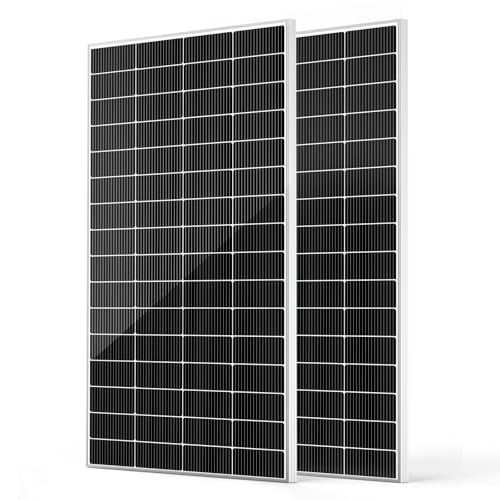
A pair of 200W panels, each only 46.3 by 30.1 inches, gives a trailer 400W without eating the roof. HQST uses N-type 16-busbar cells with up to 25.4% efficiency and Grade A+ quality, and the 1.2 inch frame keeps clearance for the roof edge. The listing cites a 30-year output warranty, which you should read for the actual degradation allowance.

Because the trailer's battery is usually at the tongue, wiring decides how much of that 400W you keep. Series wiring doubles the voltage and halves the current, so a thin run loses little, but it needs an MPPT controller with a suitable input window. The panels have no shade layout, so a roof air conditioner shadow across one panel hurts a series string.

Plan the layout so both panels sit forward of the air conditioner or well clear of it. Seal each foot, add a roof entry gland rather than a new hole, and check sealant yearly. Compared with the Callsun 100W pair, it has half the mounting points for the same total watts.

What works

  • 400W from just two compact panels
  • N-type cells with up to 25.4% efficiency
  • 46.3 by 30.1 inch size fits beside vents and the air conditioner
  • Fewer mounting points than a four-panel array

Watch out for

  • No shade-tolerant layout, so an AC shadow hurts a series string
  • IP65 is a notch below IP68 panels

Spec sheet

Total power
400W, two 200W panels
Cells
N-type, 16 busbar, up to 25.4%
Size each
46.3 x 30.1 x 1.2 in
Rating
IP65
Warranty claim
30-year output
02
400W Set, Two 200W N-Type Panels, -0.3%/C
2 x 200W N-type25.6% efficient-0.3%/C coefficientReverse blocking diodes
Check price on Amazon
Best for: Trailers parked in hot, sunny climates where roof heat cuts output.

Heat is the quiet enemy of a roof panel on a trailer parked in a summer lot, and this set advertises a temperature coefficient of minus 0.3% per degree Celsius, better than older panels. That means for every degree above 25 C the panel loses about 0.3% of its power, so a 65 C roof costs roughly 12%. The cells are A+ grade N-type with up to 25.6% efficiency.

The listing also mentions built-in reverse blocking diodes that limit the damage from a passing shadow, though it does not publish the percentage of output retained. Treat it as a margin, not a guarantee. The set is configured for 12V or 24V banks, which gives flexibility if you later convert the trailer to a higher voltage.

The brand is unnamed in the listing, so verify warranty and support before buying. Mount with an air gap so heat can leave, and check the connectors each season. Compared with the HQST pair it leads on temperature behavior and is similar in watts.

What works

  • Minus 0.3% per degree coefficient trims hot-roof losses
  • A+ N-type cells with up to 25.6% efficiency
  • Reverse blocking diodes help with shadows
  • Configurable for 12V or 24V banks

Watch out for

  • Brand is unnamed, so warranty and support need checking
  • Shade benefit is not quantified in the listing

Spec sheet

Total power
400W, two 200W panels
Cells
A+ N-type, up to 25.6%
Temperature coefficient
-0.3% per degree C
Shade features
Reverse blocking diodes
System
12V or 24V batteries
03
Callsun 200W Set, Two 100W N-Type Panels
2 x 100W N-type 16BB31.1 x 22.7 in each11.4 lb each25% efficient
Check price on Amazon
Best for: Trailers with a roof broken into small gaps by vents and a skylight.

Two small 100W panels give a trailer 200W while leaving room around a crowded roof, and each module measures only 31.1 by 22.7 inches and weighs 11.4 lb. The N-type 16-busbar cells claim 25% efficiency with better light absorption and fewer hot spots than 9BB or 10BB designs. Wiring the pair in series or parallel is a free choice.

The small size is both strength and weakness. Each module needs its own feet and sealant, so four mounting points get you 200W where the HQST would take two for 400W. That is worth it if your roof is split by fixtures into narrow rectangles, and wasteful if you have open space.

The pair is a sensible entry level that can grow by adding another set. Keep the wiring short, fuse each string, and check sealant yearly. Next to the ECO-WORTHY 200W kit it gives better cells and a smaller footprint, but you supply the controller.

What works

  • 31.1 by 22.7 inch modules fit small roof gaps
  • N-type 16BB cells at up to 25% efficiency
  • Fewer hot spots than 9BB or 10BB designs
  • Easy to expand by adding another pair

Watch out for

  • Four mounting points for only 200W
  • No controller included

Spec sheet

Total power
200W, two 100W panels
Cells
N-type, 16 busbar, 25%
Size each
31.1 x 22.7 x 1.1 in
Weight each
11.4 lb
Size gain
15% smaller than traditional
04
ECO-WORTHY 200W Kit With 30A PWM Controller
200W mono panels30A PWM controller12V or 24V800Wh daily claim
Check price on Amazon
Best for: First-time trailer owners who want a complete and inexpensive 200W starter.

Everything for a basic trailer system arrives in one box: 200W of monocrystalline panels and a 30A PWM controller, with a claimed 800Wh a day in four hours of sun. The aluminum frame is corrosion resistant and rated for strong wind. It works with 12V or 24V banks.

The PWM controller is where the trailer's long cable run bites. A PWM controller wants the panel voltage near the battery voltage, so parallel wiring and thick cable are needed to the tongue, which adds cost the kit's cables rarely cover. An MPPT upgrade makes the long run much more efficient.

For a weekend trailer with a modest battery, the kit gets you working at a low price. Seal the feet, fuse near the battery and measure the run to the tongue before trusting the supplied wire. It is the cost-first choice, below the Callsun pair on cell quality.

What works

  • Complete 200W kit with a 30A controller
  • Works with 12V or 24V battery banks
  • Corrosion-resistant aluminum frame
  • 800Wh daily claim suits weekend use

Watch out for

  • PWM controller loses efficiency on a long tongue cable run
  • Older monocrystalline cells give fewer watts per square foot

Spec sheet

Array
200W
Controller
30A PWM
Daily energy
About 800Wh in 4 sun hours
Cell gain
Up to 21.5% claim
Frame
Corrosion-resistant aluminum
05
Renogy 100W Starter Kit With 30A PWM Controller
100W mono panel30A PWM controller500Wh daily claimUL 61730 certified
Check price on Amazon
Best for: Occasional weekend trailer owners adding solar for the first time.

One 100W panel and a 30A controller give a trailer the lightest possible entry into solar, with a claimed 500Wh a day. The listing cites UL 61730, CSA and IEC certification, and ratings of 2400Pa wind and 5400Pa snow. A ten-year coverage claim on panel materials adds some comfort.

At 100W it only keeps a modest battery topped up and runs lights and a fan, which is far less than the HQST pair can do. What the kit offers is a controller with plenty of headroom, so you can add panels later without a swap, though it remains PWM. For a trailer used for occasional weekends, it fits.

Mount it near the front of the roof to shorten the cable run to the tongue battery. Seal the feet and check the sealant each spring. It is the most affordable roof kit here and a good test of whether you want solar at all.

What works

  • 30A controller leaves room to add panels later
  • UL 61730 and IEC 61215 certifications listed
  • Rated for 2400Pa wind and 5400Pa snow
  • Lowest-cost roof kit in the lineup

Watch out for

  • 100W only keeps a small battery topped up
  • PWM controller wastes energy as the array grows

Spec sheet

Array
100W, one panel
Controller
30A PWM
Daily energy
About 500Wh
Certification
UL 61730, IEC 61215
Loads
2400Pa wind, 5400Pa snow
06
Go Power GP-PSK-130 Folding Kit With 10A Controller
130W folding panels10A controllerAdjustable legsAnderson, SAE, XLR plugs
Check price on Amazon
Best for: Trailer owners who park in shade or want solar with no roof work.

For a trailer parked in the shade, a folding kit that sets up in the sun makes sense, and Go Power supplies a 130W folding panel with a 10A controller and adjustable legs. It includes Anderson-style connectors, SAE and XLR plugs and ring terminals, so it can reach a battery or a trailer inlet.

The 130W output is modest, and a 10A controller caps the kit at about 140W at 12V, which is a good match for the panel but no room for growth. It will keep a trailer battery topped up on a long stay but will not run a fridge all day. The legs let you aim the panel without a prop.

Coil the cable loosely, and store the kit in its case. A portable kit has no roof penetrations, which suits renters and people who tow rarely. It complements a roof array on shady stays.

What works

  • Folding panel moves out of the shade
  • Adjustable legs aim the panel without a prop
  • Many plug types for different inlets
  • No roof penetrations or sealant needed

Watch out for

  • 130W gives limited charging power
  • 10A controller leaves no room to expand

Spec sheet

Rated power
130W
Form
Folding portable kit
Controller
10A
Legs
Adjustable angle
Plugs
Anderson-style, SAE, XLR, ring terminals

Spec sheet decoder

What the numbers on the box really mean

The specs manufacturers lead with, translated into what they tell you about real-world performance.

Temperature coefficient

The percent of power lost per degree Celsius above 25 C. A smaller number means better output on a hot roof.

Watch forThe 400W set lists minus 0.3% per degree, better than many older designs.

Voltage drop

The loss of voltage along a cable due to resistance. Longer, thinner cable and higher current make it worse.

Watch forA tongue-mounted battery makes this critical on a trailer.

Reverse blocking diode

A diode that stops current flowing backward into a panel, protecting it from damage when shaded.

Watch forThe 400W set lists them, but they do not quantify shade output.

Pa wind and snow loads

The pressure the frame can carry, with 2400Pa for wind and 5400Pa for snow being typical ratings.

Watch forThe Renogy 100W kit lists both.

Portable versus fixed

Portable kits sit on the ground and move into sun, while fixed panels bolt to the roof and charge all day.

Watch forThe Go Power kit is portable at 130W.

Methodology

How We Evaluated These Solar Panels for Travel Trailers

Roof footprint and count

We compared module size and the mounting points needed for each watt. The HQST pair at 46.3 by 30.1 inches scored best for open roofs, and the Callsun 31.1 by 22.7 inch modules for tight ones. Fewer holes scored higher.

Heat and shade behavior

We looked for temperature coefficients and shade features. The 400W set's minus 0.3% per degree stood out, and the diodes gave a small credit. Single-string panels without features scored lowest.

Long-run electrical fit

We assessed how each pick suits a long cable to a tongue battery. N-type panels with MPPT and series wiring scored high, and PWM kits scored lower. Missing voltage specs lost points.

Kit completeness

We checked controllers, plugs and brackets. The ECO-WORTHY and Renogy kits include controllers, the HQST and Callsun sets do not, and the Go Power kit includes plugs. We counted expansion headroom.

Owner feedback patterns

Owner feedback patterns shaped our view of roof leaks, controller reliability and cable-run losses. We discounted warranty claims without terms.

Decision guide

How to Choose the Right Solar Panels for Travel Trailers

By Roof Space

SituationPickWhy
Open roof, room for two panelsHQST 400W pair400W from two modules
Roof broken into small gapsCallsun 2 x 100W31.1 by 22.7 inch modules
Hot-climate parking400W N-type setMinus 0.3% per degree
No roof work wantedGo Power folding kitPortable 130W

By Budget

TierPickWhy
CheapestRenogy 100W starterOne panel and a controller
Low to midECO-WORTHY 200W kit200W complete
MidCallsun 2 x 100WN-type cells, small modules
PremiumHQST 400W pairLarger array and better cells

PWM vs MPPT for a Trailer

PWM

The ECO-WORTHY and Renogy kits use PWM. It is simple and fine for 100 to 200W, but a long tongue cable run on 12V loses more.

MPPT

Series strings of the HQST or 400W set need MPPT. It cuts current, tolerates thin wire and recovers more energy in cold or hazy light.

Choose PWM for one or two small panels, MPPT as soon as you reach 400W.

Wiring Strategy

ConditionPickWhy
Long cable to the tongueHQST 400W pairSeries wiring halves current
Shade from the air conditioner400W N-type setParallel with reverse diodes
One panel onlyRenogy 100W kitSimple parallel-style wiring
Portable setupGo Power kitShort cable to a trailer inlet

For Extended Camping Specifically

Look for

400W or more of panel, an MPPT controller, a lithium battery and a wiring plan for the tongue run. A fridge and electronics can use 1000Wh a day.

In this comparison

The HQST 400W pair with an MPPT controller fits the case, and the 400W N-type set adds hot-roof benefit.

When to Spend More

Spend more if

You camp off-grid for days or park in hot sun. The HQST pair and the 400W set give you the output and heat behavior.

Save if

You camp in short trips with hookups. The Renogy 100W starter or the ECO-WORTHY 200W kit keep the battery topped up.

Ownership

Maintenance schedule

The upkeep that decides whether this machine lasts two seasons or ten.

TaskIntervalWhy it matters
Inspect roof sealantEvery yearTrailer roofs flex and bake, and sealant cracks. A leak at a panel foot can damage the roof deck.
Check cable run and glandEvery seasonA long cable to the tongue chafes at body seams. Look for worn insulation and warm connectors.
Clean panelsMonthly in seasonA trailer parked under trees collects debris. Use water and a soft cloth.
Check battery state and controller settingsEvery few monthsWrong settings or a loose terminal show up first as a battery that never fills.
Inspect brackets after towingBefore each seasonHighway vibration loosens hardware. A loose panel can lift in the wind.

FAQ

Frequently Asked Questions

How many panels does a travel trailer need?

Two 200W panels cover most trailers for a fridge, lights and electronics. Add more if you boondock for days.

Why is wiring to the tongue so important?

A long run of thin cable loses power as heat. Series wiring with MPPT reduces current and loss.

Can I run the trailer air conditioner on solar?

Not with a typical roof array. It needs far more panel, battery and inverter capacity than 400W provides.

Is a portable kit enough?

For light use, yes. A 130W portable kit keeps a battery topped up but will not run a fridge all day.

Should I drill the roof?

You can if you seal every hole. Prefer existing holes or a cable entry gland to limit leak points.

What size controller do I need?

Divide array watts by battery voltage and add headroom. A 400W array at 12V needs a controller above 30A, so choose 40A to be safe.

Bottom line

The short version

Browse more solar panels for travel trailerson Amazon →
James Miller, Lead Machine Editor

About the author

James Miller

Lead Machine Editor, MachineFanatic

James Miller leads MachineFanatic's buying guides, turning spec sheets, manuals and owner feedback into clear verdicts on power tools, outdoor power equipment, shop machines and kitchen machines.

More from James →

Keep reading

Related guides