
Amazon affiliate links - we earn a commission.Affiliate disclosure

Buying guide · 12 min read · Updated 2026-11-13

Best Solar Panels for Truck Campers (2026)

Six solar panels and kits for truck campers compared on roof footprint, weight, controller type and how much battery charging each one really delivers.

James MillerBy James MillerLead Machine Editor6 machines comparedSpec-sheet verified
Best Solar Panels for Truck Campers

At a glance

Our top picks

Side by side

Spec comparison

A truck camper roof is a small, crowded, often curved or tent-topped surface that also has to survive low branches, rough roads and a lot of vibration. Solar for it is less about maximum watts and more about what actually fits and stays put.

Weight above the cab changes handling, so every pound on the roof counts. The best choice balances panel size, battery bank, controller quality and mounting method rather than chasing the biggest rating.

Before you buy

6 Criteria to Look For Before Buying a Solar Panel for Truck Campers

  1. 01

    Roof footprint and weight

    Truck camper roofs are small, and weight above the cab affects handling. The Renogy 100W is the lightest and smallest, while the ECO-WORTHY 2 x 195W weighs 20.15 lb each at about 59 by 26 inches. Measure free roof space, then add the panel dimensions before ordering, and leave a clear walkway to the roof hatch or the ladder so nobody ever has to step on a panel.

  2. 02

    Panel size versus battery bank

    A 100W panel yields roughly 300 to 400Wh a day, while a 400W HQST set yields four times that. Match output to your battery capacity, since a single 100Ah battery stores about 1280Wh. Oversizing the panel without a bigger bank wastes the harvest.

  3. 03

    Controller type

    PWM controllers, like the one in the ECO-WORTHY 200W kit, waste around 20 to 30 percent compared with MPPT. The SOLPERK kit includes MPPT. For a single small panel PWM is tolerable, but for 200W or more, MPPT pays back quickly.

  4. 04

    Shade handling

    Camper roofs collect shadows from vents, ladders and trees. The ECO-WORTHY 195W panels use a six-zone layout that limits losses. A conventional two-zone panel can drop sharply when one corner is shaded.

  5. 05

    Mounting and sealing

    Roof screws are leak paths, and truck camper roofs flex on rough roads. Use sealant on every penetration and re-check each spring. Pre-drilled frames such as the DOKIO speed up the job, but the sealing is still your responsibility.

  6. 06

    Battery chemistry compatibility

    Lithium batteries need a controller with a lithium profile, or they will be undercharged or overcharged. Some bundled controllers default to lead acid. Confirm the setting before first use, since the default on many bundled controllers is sealed lead acid and a lithium bank will sit partly charged.

Detailed reviews

The 6 best solar panels for truck campers, explained

01
Renogy 100W N-Type 16BB Solar Panel
100WN-Type 16BBGrade A+ cellsLow temp coeff.
Check price on Amazon
Best for: Single-battery truck campers with a small roof and modest loads.

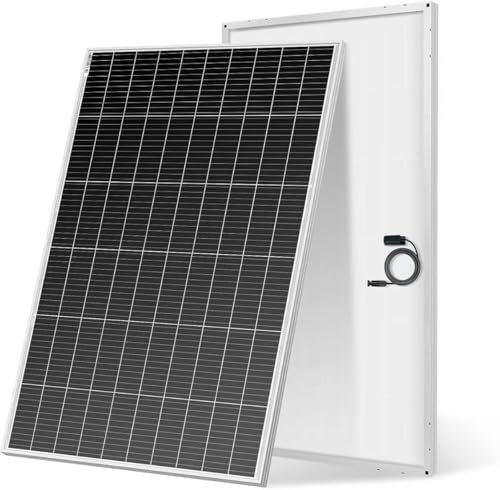
Renogy builds this panel around N-type 16-busbar cells at a claimed 25 percent, in a package the maker says is smaller and lighter than the previous 100W model. A low temperature coefficient means output drops less as the roof heats up, which matters on a dark camper shell sitting in summer sun. Its small footprint leaves room for a roof vent, an antenna and a ladder.

A single 100W panel yields roughly 300 to 400Wh a day in decent sun, enough for lights, a fan, phone charging and a small compressor fridge with careful use. That is more modest than the 400W HQST set, but it weighs a fraction as much. For a typical truck camper with a single battery, it is a sensible match and leaves the option to add a second panel later.

Mount it on a flat section of the roof with sealant and a drip edge. Pair it with an MPPT controller if you add panels, but a good PWM unit is adequate for one panel. Because roof access on a truck camper is awkward, put the connectors where you can reach them from a ladder without kneeling on the panel.

What works

  • N-type cells tolerate roof heat well
  • Small footprint leaves room for roof gear
  • Lightweight for a cab-over roof
  • Room to add a second panel later

Watch out for

  • 100W is slow for a power-hungry fridge
  • Needs a separate controller and cable

Spec sheet

Rated power
100W
Cell type
N-Type 16BB Grade A+
Efficiency claim
25%
Design
Smaller and lighter than predecessor
Heat behaviour
Low temperature coefficient
02
ECO-WORTHY 2 x 195W N-Type Bifacial Panels
2 x 195W6-zone anti-shade25% eff.20.15 lb each
Check price on Amazon
Best for: Campers who park under trees and want strong output with less shade loss.

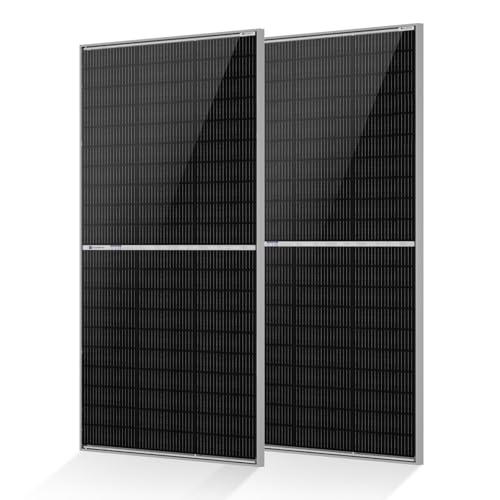
ECO-WORTHY splits each panel into six electrical zones, instead of the usual two, so a shadow across one corner takes out less of the panel. That matters on a truck camper where roof vents, a ladder or a branch regularly shades one end. The cells are N-type bifacial with 18 busbars, claiming 25 percent efficiency.

Each panel weighs 20.15 lb and measures about 59 by 26 inches, which is long and narrow, so two of them fit on a larger camper roof but not a compact one. Compared with the HQST 2x200W set, it offers better shade handling but similar output, while compared with the single Renogy 100W it quadruples the rating at roughly four times the roof area. The total of 390W suits a fridge and a larger battery bank.

Because there is no controller in the listing, budget for an MPPT unit sized for your wiring. Check the roof load rating for 40 lb of panels plus brackets, since weight above the cab affects handling.

What works

  • Six-zone design limits shade loss
  • N-type bifacial cells claim 25 percent
  • 390W total supports a fridge and larger bank
  • Long narrow shape fits some roof layouts

Watch out for

  • Two panels weigh about 40 lb together
  • Panels only, no controller included

Spec sheet

Total power
390W (2 x 195W)
Cell type
N-Type bifacial, 18BB
Shade design
6-zone anti-shade
Size
58.86 x 26.18 x 1.18 in
Weight
20.15 lb each
03
HQST 400W Solar Panels, 2 x 200W N-Type
2 x 200WN-Type 16BB25.4% eff.46.3 x 30.1 in
Check price on Amazon
Best for: Larger truck camper roofs that can take two compact panels.

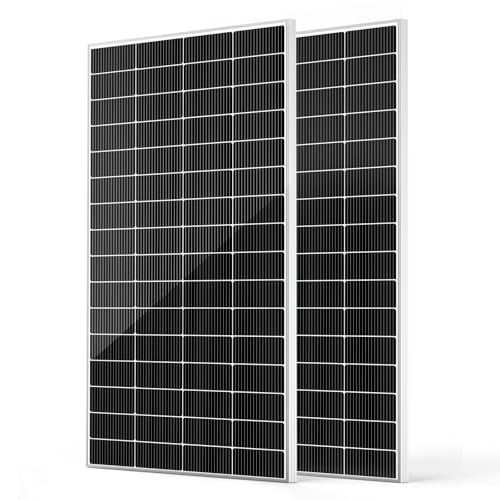
HQST pairs two 200W panels measuring 46.3 by 30.1 inches, a compact shape the maker aims at Class B campervans. Grade A+ N-type 16BB cells claim up to 25.4 percent efficiency, and IP65 sealing protects the junctions. Its squarer footprint is friendlier to a truck camper roof than the 59 inch length of the ECO-WORTHY panels.

Four hundred watts roughly doubles the harvest of the ECO-WORTHY set in the sun, so it supports a fridge, a heater fan and device charging comfortably. The cost is weight and roof area, which a small cab-over roof may not allow. Compared with the DOKIO single panel, two panels give you wiring flexibility and a fallback if one is damaged.

Plan the layout before drilling, and keep at least a hand-width of space around each panel for sealant and airflow. Fit a drip edge below the cable gland, and route the cable through a sealed entry rather than a gap beside the roof vent. Truck camper roofs are often thin fibreglass over foam, so use backing plates or large washers where screws pass through.

What works

  • Compact 46.3 by 30.1 inch panels
  • N-type 16BB cells claim up to 25.4 percent
  • IP65 sealed junction and connectors
  • Two panels give a fallback if one fails

Watch out for

  • About 40 lb of panels on a cab-over roof
  • Panels only, controller sold separately

Spec sheet

Total power
400W (2 x 200W)
Cell type
N-Type 16BB Grade A+
Efficiency claim
up to 25.4%
Panel size
46.3 x 30.1 x 1.2 in
Water rating
IP65
04
DOKIO 200W 18V Monocrystalline Solar Panel
200W18VMC4 leadsPre-drilled frame
Check price on Amazon
Best for: Owners with one long stretch of free roof who want simple wiring.

DOKIO offers a single 200W panel with an aluminium frame, pre-drilled mounting holes and MC4 leads, aimed at 12V systems. The listing mentions an upgraded cell design meant to reduce shading losses and stay steady in heat. It is a plain, honest panel with few extras.

A single 200W panel gives about twice the output of the Renogy 100W in roughly twice the area, so it fits where one long free stretch of roof exists. It wires with one pair of leads, which keeps installation simple. In shade the whole panel suffers together, so it is less forgiving than the ECO-WORTHY six-zone design.

Choose the controller on purpose: a single 200W panel works with a good PWM unit but does better with MPPT. Mount it with all four corner points and sealant around each screw.

What works

  • One panel and one pair of leads
  • Pre-drilled aluminium frame
  • MC4 leads fit standard controllers
  • Twice the output of a 100W panel

Watch out for

  • No bundled controller or brackets
  • Whole panel suffers under shade

Spec sheet

Rated power
200W
Voltage class
18V for 12V systems
Frame
Aluminium, pre-drilled
Leads
MC4
Cells
Monocrystalline with shade-loss design
05
SOLPERK 100W 12V Solar Panel Kit with MPPT Controller
100W kitMPPT controllerIP67Plug and play
Check price on Amazon
Best for: First-time buyers who want a panel and an MPPT controller in one box.

SOLPERK ships a 100W panel with an MPPT controller and plug-and-play cable, which is the simplest way to get started. The listing claims cell efficiency near 30 percent, a figure well above what silicon panels normally reach, so treat the marketing number with caution and judge it by its 100W rating. The controller claim is a more useful detail, since MPPT harvests more than a basic PWM unit.

Compared with the Renogy 100W panel, this kit gives you the controller in the box but less transparency on the cell technology. It suits an owner who wants to add a panel to a camper in an afternoon, with minimal wiring knowledge. Battery maintenance mode is covered too.

Check the controller battery profile before connecting, since a lead-acid default can undercharge lithium. Keep the leads short and seal every screw hole. A neat trick is to coil any spare cable flat under the panel rather than leaving a loop that flaps in highway wind.

What works

  • MPPT controller included in the kit
  • Plug-and-play cables
  • Pre-drilled mounting holes
  • IP67 rating listed for the panel

Watch out for

  • Efficiency claim is not credible for silicon
  • Thin detail on cell technology

Spec sheet

Rated power
100W
Controller
MPPT included
Cell claim
A+ monocrystalline
Water rating
IP67 listed
Mounting
Pre-drilled holes
06
ECO-WORTHY 200W 12V/24V Panel Kit with 30A PWM
200W kit30A PWM21.5% eff.800Wh/day est.
Check price on Amazon
Best for: Budget-minded owners who want 200W of solar in a single kit.

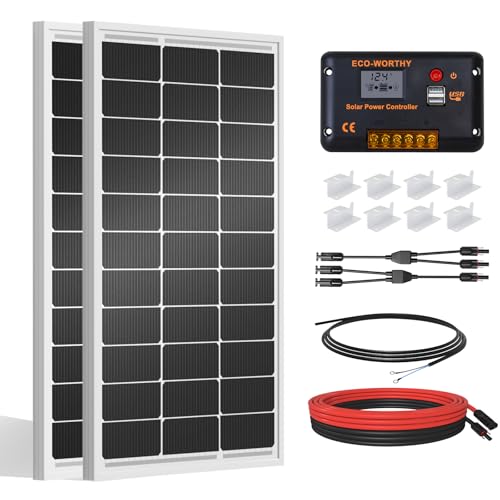
ECO-WORTHY sells a 200W panel kit with a 30A PWM controller and a corrosion-resistant aluminium frame. Its maker estimates about 800 watt-hours a day under four hours of full sun, a realistic planning figure. The kit works with 12V and 24V systems.

PWM controllers are cheaper but pull the panel voltage down to battery voltage, wasting roughly 20 to 30 percent of potential harvest compared with MPPT. For a single 200W panel that loss is acceptable if budget matters, and the controller can be swapped later for an MPPT unit. Compared with the SOLPERK kit it offers twice the panel rating but a simpler controller.

Treat it as a starter system: fine for lights, fan and phone charging, with room to upgrade the controller. Check the battery type setting before use, and note that a PWM controller needs a 12V panel matched to a 12V battery, so do not wire panels in series on this kit.

What works

  • 200W with a 30A controller in one kit
  • Aluminium frame resists corrosion
  • Works with 12V and 24V banks
  • Maker publishes a daily energy estimate

Watch out for

  • PWM controller wastes some harvest
  • Upgrade to MPPT needs a separate purchase

Spec sheet

Total power
200W
Controller
30A PWM
Cell efficiency
Up to 21.5%
Daily estimate
About 800Wh in 4 sun hours
System
12V or 24V

Spec sheet decoder

What the numbers on the box really mean

The specs manufacturers lead with, translated into what they tell you about real-world performance.

Temperature coefficient

How much panel output falls for each degree of heat above test conditions. A lower value means less loss on a hot roof.

Watch forRenogy lists a low coefficient on its 100W panel.

Zone count

The number of independent electrical sections in a panel. More zones isolate shade better.

Watch forThe ECO-WORTHY 195W panel has six zones, against two on typical panels.

PWM versus MPPT

PWM matches panel voltage to the battery and wastes the excess. MPPT converts excess voltage to current and harvests more.

Watch forThe ECO-WORTHY kit uses PWM and the SOLPERK uses MPPT.

Voltage class

A panel labelled for 12V systems has around 18V operating output. Higher voltage panels need a controller that accepts them.

Watch forThe DOKIO is an 18V panel intended for 12V banks.

Cell efficiency claim

The fraction of sunlight converted at the cell. Commercial silicon panels sit roughly between 20 and 25 percent.

Watch forThe SOLPERK listing's near-30 percent claim sits above that normal range.

Methodology

How We Evaluated These Solar Panels for Truck Campers

Roof fit

We compared dimensions and weights from the 100W Renogy to the 2 x 195W ECO-WORTHY set. Compact and light panels scored best for cab-over roofs. Long panels lost points for fit.

Controller quality

We separated PWM from MPPT and noted which kits include a controller. The SOLPERK kit scored for MPPT, while panels-only listings lost points.

Shade design

We checked for zone counts and bypass diode layouts. The six-zone ECO-WORTHY panel scored highest here.

Cell technology

We compared N-type against older monocrystalline cells and noted heat behaviour. The Renogy and HQST panels earned credit for N-type cells.

Owner feedback patterns

Owner feedback was scanned for repeat comments on mounting leaks, connector fit and overstated output. Repeated problems reduced ranking.

Decision guide

How to Choose the Right Solar Panels for Truck Campers

By Roof Space

SituationPickWhy
Tiny cab-over roofRenogy 100WSmallest footprint
One long free stretchDOKIO 200WOne panel, one mount
Larger roof, compact panelsHQST 2 x 200W46.3 by 30.1 inch panels
Long narrow roofECO-WORTHY 2 x 195W59 by 26 inch panels
Add-on kit in an afternoonSOLPERK 100WController included

By Budget

TierPickWhy
Lowest outlaySOLPERK 100WPanel and controller together
Low to midECO-WORTHY 200W kit200W with PWM controller
Mid-rangeRenogy 100WN-type cells
Upper midDOKIO 200WSingle large panel
PremiumHQST 400W or ECO-WORTHY 2 x 195WHigher output

Small vs Large Arrays

Small arrays

The Renogy 100W and SOLPERK 100W add little weight and fit anywhere. They suit lights, fans and small fridges.

Large arrays

The HQST 400W and ECO-WORTHY 390W sets charge a bigger bank but add about 40 lb above the cab.

Weekend campers should pick a small array, while full-timers with a fridge and heater fan need the larger sets.

Controller Choice

PreferencePickWhy
MPPT in the boxSOLPERK 100WIncludes MPPT
PWM to start cheaplyECO-WORTHY 200W kit30A PWM
Own controller laterDOKIO 200WMC4 leads
MPPT upgrade plannedRenogy 100WPanel only

For Off-Grid Fridge Use Specifically

Look for

Choose at least 200W of panels and an MPPT controller, with a battery bank that can carry the fridge overnight. Add a battery monitor so you can see state of charge.

In this comparison

The HQST 2 x 200W and ECO-WORTHY 2 x 195W sets provide enough harvest for a fridge, while the Renogy 100W suits only light loads.

When to Spend More

Spend more if

Spend more on the HQST or ECO-WORTHY sets when you boondock for days at a time or park in shade. Output and shade handling repay the cost, since a second cloudy day in the woods is exactly when a small system runs the battery flat.

Save if

Save with the SOLPERK or ECO-WORTHY kit when use is occasional. A small system is fine for weekend trips, as long as you accept that a long cloudy stretch will call for a drive or a generator top-up.

Ownership

Maintenance schedule

The upkeep that decides whether this machine lasts two seasons or ten.

TaskIntervalWhy it matters
Inspect roof sealantEvery 6 monthsTruck camper roofs flex on rough roads. Cracked sealant leaks into the roof core, where water rots wood and delaminates the fibreglass skin before you see a stain inside.
Clean the panelsMonthly in seasonDust and pollen reduce harvest. A soft cloth and water are enough.
Check connectors and cable routingEvery seasonVibration loosens plugs and chafes cables, and a chafed positive lead against a metal roof edge can short and start a fire. Re-secure with clips, and replace any cable that shows cracked insulation near the roof entry.
Retighten mounting hardwareYearlyHighway vibration loosens brackets. A loose panel can lift in wind.
Verify the controller profileAfter any battery changeA wrong profile undercharges lithium or overcharges lead acid. Check it in the menu, and write the setting on a label next to the controller.

FAQ

Frequently Asked Questions

How much solar does a truck camper need?

For lights, a fan and device charging, 100W is enough. A compressor fridge and heater fan push the need toward 200 to 400W, depending on battery size.

Should I use a rigid or flexible panel?

Rigid panels cost less per watt and last longer, so use them on a flat roof. Flexible panels suit curved or weight-limited roofs but age faster.

Is a trickle charger the same as a solar panel kit?

No, trickle chargers maintain a battery and cannot run a fridge. A 100W or larger panel actually charges a bank.

Does weight on the roof matter?

Yes, because weight above the cab raises the centre of gravity. Two 20 lb panels is acceptable on most campers, but check the camper manual for a roof load rating, and add the weight of brackets, sealant and cable to your total.

Do I need MPPT?

For 200W or more, MPPT is worth it, especially in cold weather. For a single small panel, PWM is workable.

Can I add panels later?

Yes, if the controller has headroom. Choose a controller larger than your first panel to leave room, and keep the new panel matched in voltage class to the old one so the two can share a controller cleanly.

Bottom line

The short version

Browse more solar panels for truck camperson Amazon →
James Miller, Lead Machine Editor

About the author

James Miller

Lead Machine Editor, MachineFanatic

James Miller leads MachineFanatic's buying guides, turning spec sheets, manuals and owner feedback into clear verdicts on power tools, outdoor power equipment, shop machines and kitchen machines.

More from James →

Keep reading

Related guides