
Amazon affiliate links - we earn a commission.Affiliate disclosure

Buying guide · 16 min read · Updated 2026-11-25

Best Tankless Water Heaters Under $300 (2026)

Six point-of-use electric tankless water heaters at or under $300, including Rheem 3.5kW, ThermoMate 3500W and APUS 4500W, with honest flow and wiring notes.

James MillerBy James MillerLead Machine Editor6 machines comparedSpec-sheet verified
Best Tankless Water Heaters Under $300

At a glance

Our top picks

Side by side

Spec comparison

A point-of-use electric tankless heater is a small box with a heating element that warms water only while it flows. It replaces the wait for hot water at one fixture, such as a bathroom sink or a workshop basin, and it is not a replacement for a whole-house water heater.

Prices move, and the $300 cap used here reflects live listing prices when this guide was updated. At this cap every unit is sized for a single sink, so the real decisions are wiring, flow rate, safety shutoffs and how honestly each listing describes what the machine can and cannot do.

Before you buy

6 Criteria to Look For Before Buying a Tankless Water Heater Under $300

  1. 01

    Single fixture only

    A 3 to 5 kW point-of-use electric heater gives roughly 0.5 to 1.5 gallons per minute of useful temperature rise, which suits one sink and nothing more. A shower needs about 2 gallons per minute of hot water, and a whole house needs a unit drawing 24 kW or more on 240 volts. Every unit here is sized for one fixture. If you want a shower, look at a different category. People often buy a small heater hoping it will handle a kitchen sink and a dishwasher together, and they find the water lukewarm the moment both run, because the element can only heat so much water per minute. Think of the unit as a tap-side convenience that saves waiting for the main heater's hot water to travel down a long pipe.

  2. 02

    Voltage, amps and wiring

    Amperage is roughly power divided by voltage, so 3500 watts at 120 volts draws about 29 amps and 3000 watts at 110 volts draws about 27. Those loads exceed a standard 15 or 20 amp outlet and call for a dedicated circuit. A 240 volt unit such as the APUS draws less current for the same power, but needs a 240 volt line. The wiring can cost more than the heater. A quick way to check feasibility is to open your breaker panel and look for spare slots and the panel's total rating, since a small home with a full panel may not be able to take another 30 amp circuit without an upgrade. Ask an electrician for a quote before you order the unit, because that number often decides whether the project makes sense.

  3. 03

    Flow and temperature rise

    A tankless heater adds a fixed amount of heat to the water that passes through it, so lower flow gives a higher rise. A colder inlet reduces the deliverable temperature, since one unit that delivers 6.5 gallons per minute at a 45 degree rise gives only about 4.5 at a 77 degree rise. Size by the coldest incoming water you will see in winter. The ThermoMate lists 0.4 to 0.66 GPM, which is realistic. A useful rule is that a 3.5 kW element can raise 0.5 gallons per minute by roughly 55 degrees Fahrenheit, so in a basement with 50 degree water you will get lukewarm to warm water at that flow, and a warmer climate will feel hotter. Turning the tap down a little raises the output temperature, which is the dial you actually have.

  4. 04

    Safety protections

    Look for dry-fire cutoff, over-temperature shutoff, ground fault protection and an IPX rating if the unit sits under a sink. The lianfengymx lists dry-fire and system shutoff, and the ECOAPTUNIT lists IPX4. A recognized safety listing from a testing lab matters more than the number of icons on a box. Unlisted units in a wet location are a risk. Check the listing for a certification mark from a recognized lab and ask the seller for the file number, because anyone can print a symbol on a box. Ground fault protection on the circuit is a sensible addition regardless of what the heater itself claims.

  5. 05

    Hard water and descaling

    Scale reduces heat transfer and flow, and it builds faster in hard water. The ThermoMate separates its element from the water line to reduce buildup. Descale by circulating vinegar or a descaling solution through the unit, and clean the inlet screen yearly. In very hard water, add a filter or softener. A white crust around the faucet aerator and a falling flow rate are the usual signs, and a quick descale restores most of the lost performance. Skipping this step is the single most common reason a small heater fails within a few years.

  6. 06

    Mounting and plumbing

    Point-of-use units mount on the wall near the fixture and connect with short hoses or 1/2 inch fittings. The lianfengymx requires vertical mounting only. A long run of pipe wastes the benefit, since water in the line is still cold. Place the heater as close to the tap as possible. Insulate the short pipe between the heater and the faucet so heat is not lost on the way, and leave room around the unit for service access. Under a sink, make sure nothing stored below can knock a fitting loose, since a leak next to an electrical device is a serious hazard.

Detailed reviews

The 6 best tankless water heaters under $300, explained

01
Rheem 3.5 kW Point-of-Use Thermostatic Tankless Electric Water Heater, 120V
3.5 kW120V0.5 GPMThermostatic
Check price on Amazon
Best for: A single basement or workshop sink where an established brand and honest flow matter.

The Rheem 3.5 kW heater is a 120 volt, thermostatic point-of-use unit that the maker says provides up to 0.5 gallons per minute. It is aimed at one-fixture jobs such as a basement sink or a garage workshop, and the listing tells the buyer to verify the electrical requirements before purchase. That honesty about what the unit does is the main reason it tops the list.

Half a gallon per minute is a low flow, enough for hand washing but not a kitchen sink running at full pressure, and it is typical of 120 volt point-of-use heaters. Set beside the ThermoMate 3500W, the Rheem states a similar flow but comes from a manufacturer with a long record in water heating. Measured against the APUS 4500W, it uses a standard 120 volt supply, though the current draw is still high.

A 3.5 kW load on 120 volts draws nearly 29 amps, so it needs a dedicated 30 amp circuit and professional wiring. Descale the heating chamber if the water is hard, and clean the inlet screen yearly. Do not connect it to a fixture that you expect to deliver shower flow.

What works

  • States up to 0.5 GPM honestly
  • Thermostatic control
  • Established water heater brand
  • Clear single-fixture guidance

Watch out for

  • Low flow at 0.5 GPM
  • Needs a dedicated high-amp circuit
  • Single fixture only

Spec sheet

Power
3.5 kW
Voltage
120V
Flow
Up to 0.5 GPM
Control
Thermostatic
Use
Basement sink, garage workshop, one fixture
02
ThermoMate 3500W 120V Tankless Electric Water Heater, 29.2 Amp, Hardwired
3500W29.2 amp0.4-0.66 GPMHardwired
Check price on Amazon
Best for: Buyers who want clearly stated amperage and flow and will hire an electrician.

The ThermoMate lists 3500 watts at 120 volts, a draw of 29.2 amps, a flow of 0.4 to 0.66 gallons per minute and an instruction that it must be hard wired, with no plug. It adjusts power automatically as inlet flow and temperature change. A cast aluminum heating element separate from the water line is meant to reduce scale and corrosion.

The listing gives the numbers a buyer needs: the amp draw, the flow range and the wiring requirement. Against the Rheem, it offers a wider flow range and clear amperage, though with less brand history. Next to the 3000W units, it delivers more heat but draws more current, so it demands the better circuit.

Have a licensed electrician hardwire it on a dedicated 30 amp breaker with the correct gauge wire. Keep the unit upright and close to the sink. Clean the inlet screen yearly and descale if flow drops.

What works

  • Amp draw and flow range are stated
  • Cast aluminum element reduces scale
  • Auto power adjustment
  • Clear hardwire instruction

Watch out for

  • Must be hardwired, no plug
  • 29.2 amp draw needs a dedicated circuit
  • Low flow

Spec sheet

Power
3500W at 120V
Current
29.2 amps
Flow
0.4 to 0.66 GPM
Install
Must be hardwired, no plug
Element
Cast aluminum, separated from the water line
03
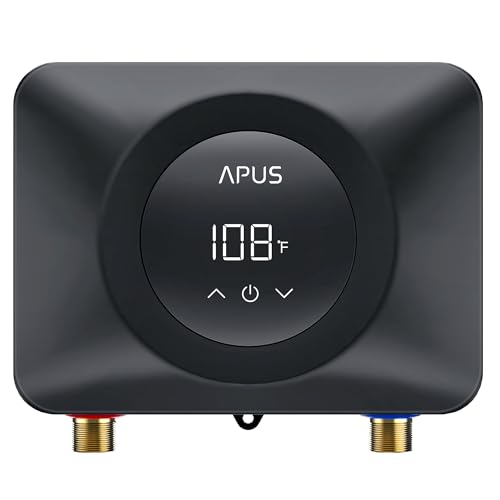
APUS 4500W 240V Point-of-Use Electric Tankless Water Heater with LED Display
4500W240V3 second hot waterLED touch
Check price on Amazon
Best for: Sinks where a 240 volt line is available and more heat is wanted.

The APUS runs on 240 volts at 4500 watts and advertises hot water in about three seconds, with an LED touch control and an under-sink compact design. A 240 volt supply draws less current for the same power, so a 4500 watt unit pulls roughly 19 amps, well below the draw of a 120 volt unit with similar output. It is designed for a single sink or similar low-flow fixture.

Higher voltage is the practical advantage, since it delivers more heat from a smaller circuit and gives a stronger temperature rise at a given flow. Set beside the Rheem, it has more power but needs a 240 volt line that many bathrooms and workshops lack. Measured against the 3000W 110V units, it heats more and draws far less current.

A 240 volt circuit is a job for an electrician, and the cost of running it can exceed the price of the heater. Descale the chamber on schedule and clean the inlet screen. If you do not already have 240 volt wiring nearby, a 120 volt unit may be cheaper overall.

What works

  • 4500W gives stronger temperature rise
  • Lower current at 240V
  • Hot water in about 3 seconds
  • LED touch display

Watch out for

  • Needs a 240V circuit
  • Efficiency claim is a maker figure
  • Single sink only

Spec sheet

Power
4500W
Voltage
240V
Response
About 3 seconds to hot water
Control
LED touch control with display
Use
Single sink or low-flow fixture
04
ECOAPTUNIT 3000W 110V Under-Sink Tankless Heater, IPX4, F or C Display
3000W110VIPX4F or C display
Check price on Amazon
Best for: Buyers who want clear waterproofing and safety listings on a 3000W unit.

The ECOAPTUNIT is a 3000 watt, 110 volt under-sink heater with a stainless steel and ABS housing, IPX4 waterproofing and a display that switches between Fahrenheit and Celsius. Multiple safety safeguards are listed. The compact design fits tight cabinets.

IPX4 means the housing is splash resistant, which is a useful listing for a unit that sits under a sink, though it is not a safety certification by itself. Against the 3000W unbranded units, it states more about its protections. Next to the ThermoMate, it offers lower power and lower current but also less heat.

Note that 3000 watts at 110 volts draws about 27 amps, which is far above a standard 15 or 20 amp outlet, so confirm the wiring requirement before buying. A licensed electrician should handle the install. Check the manual for the required circuit and the grounding method.

What works

  • IPX4 waterproofing
  • Stainless and ABS housing
  • Fahrenheit or Celsius display
  • Compact for tight cabinets

Watch out for

  • About 27 amp draw at 110V
  • Single fixture only
  • Low flow

Spec sheet

Power
3000W at 110V
Housing
Stainless steel and ABS
Water protection
IPX4 waterproofing
Display
Switch between Fahrenheit and Celsius
Fit
Compact for tight spaces
05
lianfengymx 3000W 110V Electric Tankless Water Heater with LED Display
3000W110VDry-fire cutoffWall mount
Check price on Amazon
Best for: Single sinks where a dry-fire cutoff is a priority.

The lianfengymx unit is a 3000 watt, 110 volt heater with an LED display, an automatic system shutoff and a dry-fire cutoff. It is designed exclusively for sink applications and mounts vertically on a wall only. Ports are 1/2 inch NPT steel for standard connections.

The listing explains that operation is flow-dependent, so reducing water flow increases the output temperature, which is the physics of every tankless heater. The dry-fire cutoff prevents the element from heating without water. Set beside the ECOAPTUNIT, it lists a protection cutoff but less about waterproofing.

Mount it vertically as instructed and use the correct fittings. Have the circuit checked, since the draw exceeds a standard outlet. Clean the inlet screen yearly.

What works

  • Dry-fire cutoff
  • Automatic system shutoff
  • LED display
  • Steel NPT ports

Watch out for

  • Vertical mounting only
  • High current draw
  • Lesser-known brand

Spec sheet

Power
3000W at 110V
Display
LED display
Protection
Automatic shutoff and dry-fire cutoff
Mounting
Vertical wall mount only
Ports
1/2 inch NPT steel
06
3000W 110V Under-Sink Instant Electric Water Heater with Digital Display
3000W110VDigital displayABS body
Check price on Amazon
Best for: Budget buyers who will verify the safety listing and use an electrician.

This generic 3000 watt, 110 volt heater has an ABS body, an LED display and a thin, compact design. Multiple protection functions are listed. It is the budget-tier entry for a single sink.

Less is known about the maker than about Rheem or ThermoMate, and the listing is vague about certifications. Measured against the ECOAPTUNIT, it has fewer stated protections. If you consider this model, confirm that it carries a recognized safety listing before wiring it into a wet location.

The same wiring warning applies: 3000 watts at 110 volts needs a dedicated high-amp circuit. Treat the unit as a low-flow convenience for hand washing. Clean the inlet screen yearly.

What works

  • Low price tier
  • Compact and thin
  • LED display
  • Basic protections

Watch out for

  • Little certification detail
  • High current draw
  • Unknown maker

Spec sheet

Power
3000W at 110V
Body
ABS with LED display
Design
Ultra-thin and compact
Safety
Water and electric protections
Use
Under-sink instant hot water

Spec sheet decoder

What the numbers on the box really mean

The specs manufacturers lead with, translated into what they tell you about real-world performance.

3.5 kW at 120V

The heating power and supply voltage. Dividing watts by volts gives about 29 amps of current.

Watch forThe Rheem and ThermoMate both use it, so plan for a dedicated circuit.

0.5 GPM

Gallons per minute of useful hot water. It is a low flow suited to hand washing.

Watch forThe Rheem lists it, and the ThermoMate lists 0.4 to 0.66.

4500W at 240V

Higher power with lower current, since amps equal watts divided by volts.

Watch forThe APUS needs a 240 volt line.

IPX4

An ingress protection rating for splashing water. It is not a safety certification.

Watch forThe ECOAPTUNIT lists it.

Dry-fire cutoff

A protection that shuts off the element when no water flows. It prevents burnout.

Watch forThe lianfengymx lists it.

Methodology

How We Evaluated These Tankless Water Heaters Under $300

Honest flow and use

We favored listings that state flow, such as the Rheem's 0.5 GPM and the ThermoMate's 0.4 to 0.66, and that say the unit is for one fixture.

Electrical requirements

Stated voltage and amperage were compared, from the APUS's 240V draw to the 29.2 amps on the ThermoMate. Units that hide the requirement scored lower.

Safety features

Dry-fire cutoffs, IPX4 and thermostatic control were weighed. Recognized brands such as Rheem scored for support.

Build and scale management

The ThermoMate's separated element and stainless housings were compared against basic ABS cases.

Fit at the cap

Every item is at or under the cap on its live listing. We favored clear electrical information over larger wattage claims.

Decision guide

How to Choose the Right Tankless Water Heaters Under $300

By Installation

SituationPickWhy
Standard 120V circuit upgrade, trusted brandRheem 3.5 kW Point-of-UseHonest 0.5 GPM and brand support
Want amperage and flow statedThermoMate 3500W 120V29.2 amps and 0.4 to 0.66 GPM
240V availableAPUS 4500W 240VMore power, less current
Want waterproofing listedECOAPTUNIT 3000WIPX4 housing
Dry-fire cutofflianfengymx 3000WProtection listed

By Budget

TierPickWhy
Lowest in the lineup3000W Digital Display HeaterCheapest generic
Lower middleECOAPTUNIT 3000WSafety listing
Middlelianfengymx 3000WDry-fire cutoff
Upper middleAPUS 4500W 240VMore power
Top of the capRheem 3.5 kW Point-of-UseBrand and honest flow

120V vs 240V

120V or 110V

Uses existing voltage but the high current needs a dedicated circuit. Heat is limited.

240V (APUS)

Delivers more heat at lower current, but needs a 240 volt line that may not be nearby.

Choose 240V if the wiring exists, and 120V if you want a simpler run.

Brand vs Generic

PreferencePickWhy
Established makerRheem 3.5 kW Point-of-UseLong water heater record
Detailed spec listingThermoMate 3500W 120VAmps and flow stated
Lowest cost3000W Digital Display HeaterGeneric

For a Workshop or Basement Sink Specifically

Look for

A single-fixture rating, a dedicated circuit and a unit that tolerates a damp location. Low flow is acceptable for hand washing.

In this comparison

The Rheem is the safest bet, and the ThermoMate is the best documented.

When to Spend More

Spend more if

You want hot water for more than one sink or a shower. Whole-house electric units draw 24 kW or more, and gas models give far more flow.

Save if

You need hot water at one sink occasionally, in which case a small unit is enough.

Ownership

Maintenance schedule

The upkeep that decides whether this machine lasts two seasons or ten.

TaskIntervalWhy it matters
Clean the inlet screenYearlyDebris restricts flow. Remove the screen and rinse it.
Descale the heating chamberEvery 6 to 12 months in hard waterScale reduces heat transfer. Circulate vinegar or descaler.
Check electrical connectionsYearlyHigh-current connections can loosen. Have an electrician check.
Test the safety shutoffYearlyTurn the water off and confirm the unit cuts power.
Drain before freezingBefore cold snapsFrozen water cracks the housing. Drain unheated spaces.

FAQ

Frequently Asked Questions

Can I run a shower with a point-of-use heater?

No. These units give roughly 0.5 to 1.5 gallons per minute, far below shower flow. They serve one sink.

What does the $300 cap buy?

It buys 3 to 4.5 kW point-of-use heaters for a single fixture. The cap reflects listing prices when this guide was updated.

Can I plug one into a normal outlet?

Usually not. A 3000 to 3500 watt unit draws about 27 to 29 amps, so it needs a dedicated circuit and hardwiring.

Do I need an electrician?

Yes, in nearly every case. The wiring and breaker are the main cost and safety concern, and local code often requires a permit and an inspection for a new dedicated circuit. A licensed electrician also confirms that your panel can carry the added load.

How long do these heaters last?

Five to ten years with descaling. Scale and elements are the wear points, and a unit in soft water or with a filter can last the long end of that range. Cheap generic units tend to fail earlier, so keep the invoice and the model number for warranty claims.

Are generic units safe?

Check for a recognized lab listing. Without one, wet-location use is a risk.

Bottom line

The short version

Browse more tankless water heaters under $300on Amazon →
James Miller, Lead Machine Editor

About the author

James Miller

Lead Machine Editor, MachineFanatic

James Miller leads MachineFanatic's buying guides, turning spec sheets, manuals and owner feedback into clear verdicts on power tools, outdoor power equipment, shop machines and kitchen machines.

More from James →

Keep reading

Related guides